
The following is a text for Kin Ting Li’s exhibition ‘This World’ at Galerie Falk Losniza in Basel. The Exhibition runs from 27.3.26–30.5.26.
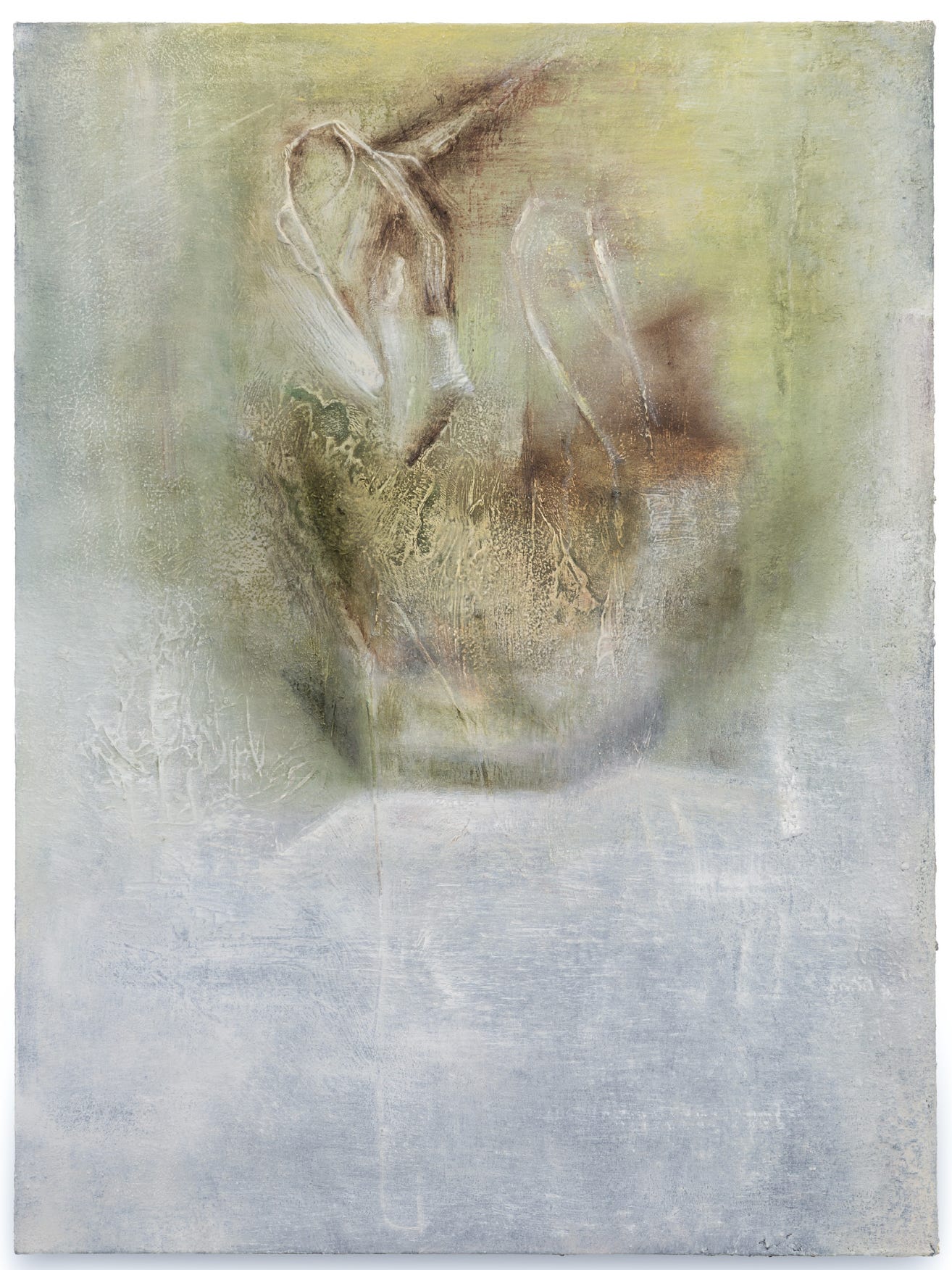
The Word for World is Forest, Oil and marble dust on canvas, 102 x 76.5 cm, 2026
Painting grows out of geology. Not just the caves that our ancestors spelunked through, but the macroscopic plates and bluffs of continents. The specificity of the terrain produces distinct pictorial norms. Murals from Teotihuacan mimic the shallow depth of pine, oak and alder forest. The lowlands of the Netherlands have their famous painted light, thanks to the silver mirror of the North Sea; and England’s bard Wordsworth wouldn’t be who he became were it not for the complex hedgerows and forests that were declining in industrial Britain.
Kin Ting grew up in Hong Kong. There, asbestiform skyscrapers bundle into packed columns, compressed by thirty mountains. Each one is dressed in a cloak of green vines dusted with Mormon and Courtesan butterflies, which flop about in elliptical trajectories. From the high peaks, human commerce settles like pools of heavy cream in the valley troughs before trickling into Kowloon Bay towards the grey ocean. Kin Ting’s paintings borrow from this library of rocky crags; their waxy grounds are a semi-opaque mordant which traps a stormy atmosphere. The layered sediment forms palisades, snowy tundra and bioluminescent tunnel walls. The artist’s attention microscopes to the ground’s subtle plaques and seams, which prop up fibrous crenelations or recede into hollowed indentations. From the outermost promontories, petroglyphs jut from the pearlescent runes. Skulls, chrysanthemums and saints are moulded from the ground’s tracer lines.
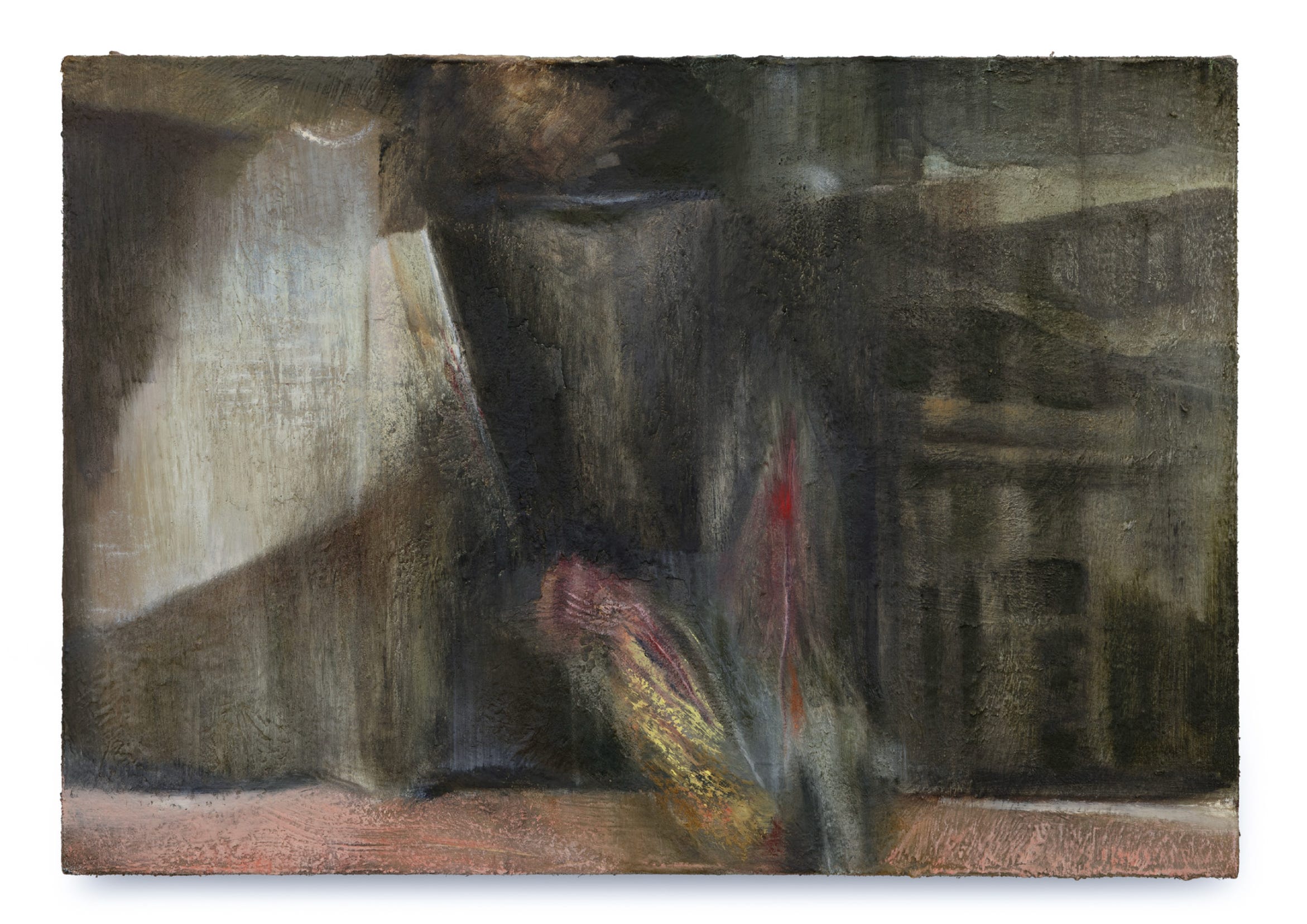
‘Bloom’, Oil and marble dust on linen, 46 x 66 cm, 2026
Living and working in the UK since 2014, Kin Ting has absorbed painting lineages from two continents. The signatures of German Romantic and Taoist art are both vivid, as are the subterranean fantasies of the Symbolists. The two former traditions in particular inherit the mountain as their primary totem; its immovable and sublime scale produced a Lilliputian transformation for the sages Immanuel Kant and Tao Hongjing alike. In Kin Ting’s paintings, we sense the echo of Caspar David Friedrich’s awestruck “Rückenfiguren” or Wu Boli’s “Dragon Pine”: an ink tree rendered as an ecstatic bolt of lightning. All across the islands of Hong Kong are Neolithic rock carvings, many on the islands’ beaches; their concentric grooved figures are not dissimilar to Kin Ting’s hieroglyphs. Archaeologists speculate that they are designed to ward off bad weather. Such bewitched meteorology calls to mind Baudelaire’s personified mountain, his ‘Giantess’, with whom he wished to “sleep in the shadow of her breast, quietly as a village nestling under a hill”. This perfumed fantasy chimes with Kin Ting’s paintings: they are at times camp and occultist, and hint at the ray-traced open worlds of game engines as much as those of Arthurian legend. There is an unabashed commitment to a fantasy refuge the viewer can get lost in. The imagery is slow to discern, whilst swimming in a hyper-sensate and tactile atmosphere. In this sense, he is a kindred spirit with the geologist-poet Novalis, who regarded fairy tales as the highest form of poetry and sought transcendence in the black tunnels of Saxony.
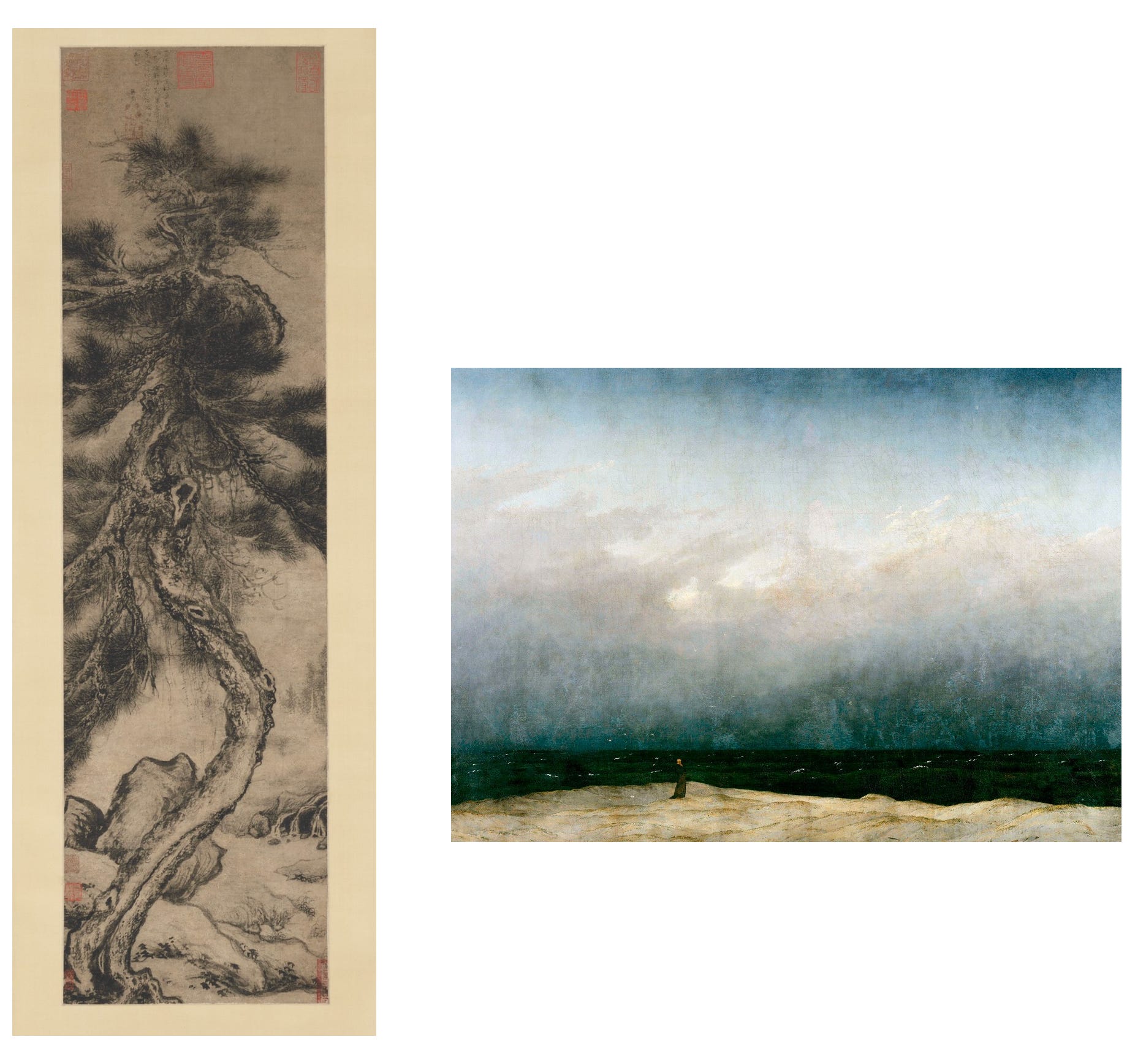
Wu Boli, ‘Dragon Pine’, late 14th–early 15th century, Hanging scroll; ink on paper
Caspar David Friedrich, ‘The Monk by the Sea’, 1810
These artistic and philosophical traditions had such a strong preoccupation with the planet’s surface that they emphasised an “Urgrund” or “Taiji” from which to scaffold reality: an imperceptible and unpicturable bedrock. One which can only be inferred through the broken mirror of names and objects. The mountain is appealing because its giant scale belies a symmetrical absence of vast and unmanifest spirit. The painter is familiar with this parity of the visible and invisible. They accept that making a picture of the absolute is a ludicrous task, yet against the odds, the mind and body somehow interact and inform one another. Our perception and actions provide evidence that spirit and matter are pregnant with one another. Exempting inner yoga’s or contemplation, what choice does an artist have other than to make concatenations of objects or images? To show what cannot be pictured. This is a perennial realisation, as true for Ludwig Wittgenstein as the Buddha. In the Mahaparinirvana Sutra, he encourages a disciple to disidentify with the body, saying:
“Think that this body is like a plantain, a mirage, watery foam, a phantom, a transformed body, a castle, an unfired brick, lightning, a picture drawn on water”
This list of symbols would not be amiss emerging from Kin Ting’s paintings: snow drifts in a flow of outer imagination, one indistinguishable from the kaleidoscope of inner daydreams. Intelligibility is only possible embedded within a non-picturable and formless totality. If a person is hyper-fixated on details and loses context, then reality becomes immensely brittle; this is a feature of schizophrenia and delirium. Therefore, what is real is some dynamic oscillation between figure and ground. This union has been given many names: David Bohm called it the “Implicate Order,” Carl Jung the “Unus Mundus” and Merleau-Ponty the “Flesh of the World.” Perhaps its most succinct expression is the Taoist “Taijitu,” or yin-yang symbol.
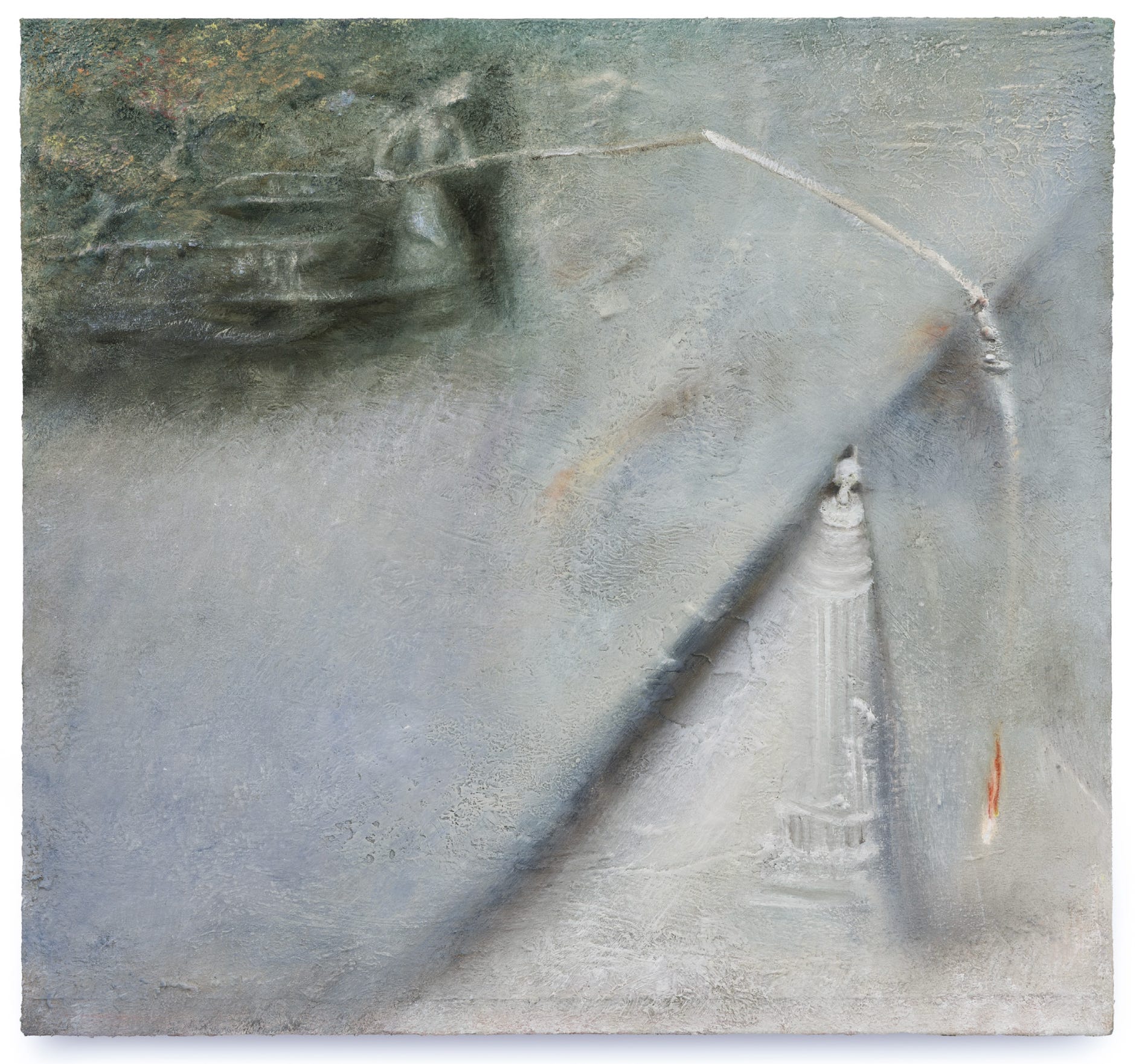
‘Motivation’, Oil, foam coat and marble dust on canvas, 71 x 76 cm, 2026
The price the mind pays for a healthy synchrony with the world is that it becomes common-sensical, even banal. It is then incumbent on the artist to wound the “Flesh of the World,” to scarify or tattoo it, to make a fresh opening. For the ground which people seek is not what its name suggests; the need for anchorage, rootedness and stability is oxymoronic. The ground is in its essence dynamic and changing; Gautama’s image “drawn on water.” The painter can never hope to capture this with materials alone. But as Kin Ting’s paintings emphasise, if the viewer enters the picture with enough imagination and superstition, then the marriage of inner and outer worlds is easier than it first appears.
No posts
Comments
Nothing yet. Say the first thing.
Sign in to join the conversation.