
The following is a text to accompany Rebecca Ackroyd’s exhibition ‘The Privy Window’ at Ginny on Frederick in London. The exhibition continues until 25th October.
Worms
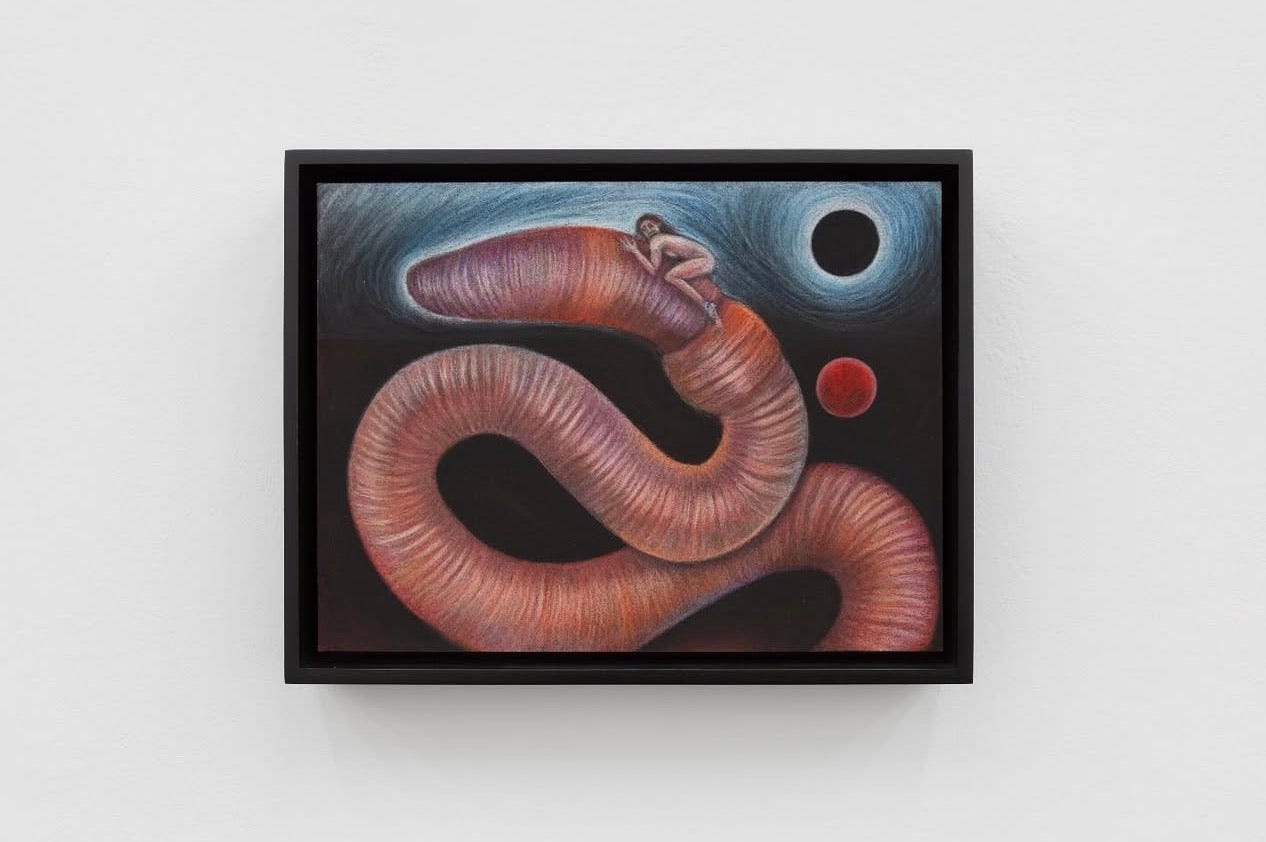
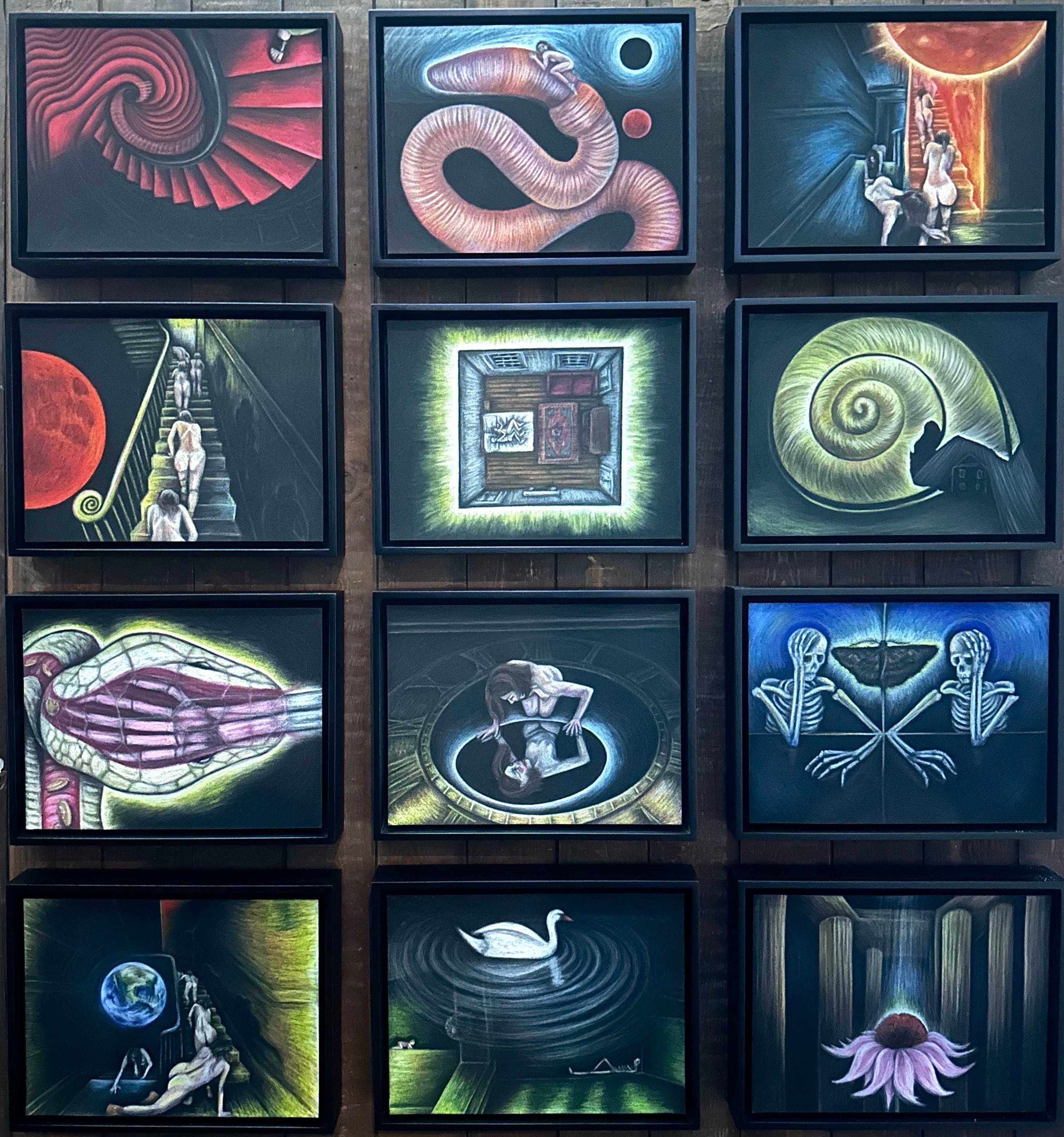
The artist clings to a monstrous earthworm the size of a train carriage; her breasts and chin are glued to its gelatinous rippling skin. Below, a blood sun has fallen from the magnetosphere, leaving a black socket.
Dear reader, I regret to inform you that you don't exist. You are a primordial stomach, albeit with added features: a tube of ingestion and excretion that grew vestigial limbs and a brain so it could get more calories. Your soul is a hallucination built by your digestion: 'Digero ergo sum'. This fact we have collectively repressed; it's in the category of the unbearable or unidentifiable, like sewerage, factory farms or climate change. Consider the anandamide magnetism of a beautiful person, the flowering of a little baby's countenance, a supermodel or sports personality; yes even they are a homunculus worm, ensconced in a bio-robotic suit. Whatever feat of human excellence is achieved, it's all an epiphenomenon of gastric yearning.
If only we could have been plants, a much more dignified conversion of energy. A sunflower must drink in light as if it were manna. Such chlorophyllic entities would surely be less perverse, less riddled with mammalian vulgarity amplified to human sinfulness and shame. They are in a dimension of mineral algebra, cleansed of the semiotic hierarchy necessary to disentangle pleasure from pain. Humans' instinctual fears have shifted from sensory inputs to exogenous representations: symbols. We must enact the nouns of 'sex', 'rage' and 'death'. All of life is possessed by Schopenhauer's 'will to live', but for other species it must feel like hunger or satiation itself, blind and unlingering volition. There is no character of the self which perishes within an oak tree, no story is killed through its demise, no history!
Bargaining
A celestial red giant and blue earth hover over the stairwell. The body of the naked artist is captured in strobed frames. Crawling upwards she is bombarded with coronal mass ejections and magnetic waves. A nude ascending the staircase.
Rebecca's art is a form of self-portraiture that confronts and inspects the ego. The ego is primarily fearful. Fear produces the ego's urgent volition; its instinct is to mediate, to seduce, to camouflage. A healthy society or individual is one that has synchronised its fears with its in-group. Thus the ego is cautious to reveal its fears, whilst wanting to sanction the fears of others. Death is often caricatured as the big fear, underneath all the little ones, but that's not quite true. A fear exceeding death is abandonment, excommunication, total repudiation. In our ancestral environment, exile from the tribe meant a twofold demise: the death of both body and legacy.
Nothing hurts a child more than to be ignored. So we adorn the family house with pictures and act out dance routines; our ego makes offerings to our parents, to monitor their attention on us. A common theory of art is that of sexual selection; that the waste of time and resources to produce beauty indicates abundant wealth and virulent reproductive capacity. But perhaps art is, instead, a natal bargaining tool? A plea to be noticed, and divert the collective fears of the culture away from oneself in the form of a tribute. As the artist externalises symbols that were previously private and interior, the subsequently public pictures produce both a soothing kinship and a proto-legality. In an unequal power dynamic symbolic verification protects the weaker party, yet the trade-off is more efficient surveilling. Was not the law instituted by carving it into a stele, for all eyes to see?
Camouflage
The skeletal hand of a child reaches into the mouth of a copperhead snake; it's flinging coins down the animal's throat as if it were a wishing well. Perhaps it is summoning them, to float upwards from the stomach?
There's something striking about how the input-output machine of the internet is hungry for that modern obsession: the self-portrait. We feed it faces and it spits out numbing neural patterns. For modernity the self-image was a painful wound: a birth guided by the midwifery of the guillotine and the factory whistle. No longer could psychic turmoil sublimate into the heroin of religion or monarchy. The self was now the responsibility of itself! How burdensome it is to drag around an identity. Early consumerism softened this problem by selling the population new and aspirational caricatures of themselves; more recently we have streamlined this continual replacement and opted for anaesthetics. Your 'self' can be numbed for free; you just have to feed the machine your face and attention. To go unnoticed is now a desiderous fantasy.
The psychologist Donald Winnicott understood this longing to disappear; he said that "Artists are people driven by the tension between the desire to communicate and the desire to hide." This sanctuary has been externalised and automated by information technology. Communication has become a raw material more valuable than gold. The voracity of the signal vaporises any meaningful subjectivity. Values have been replaced with quantity: it's no wonder that authorship has been usurped by the word 'content', a volumetric measure of a raw material. The once vulnerable act of making visible the privacy of the mind is now a way to hide in plain sight; to be camouflaged from the mass externalisation and aggregation of personality. There is in Rebecca's work a longing to re-infantilise, to return, to gain some kinship with the auditorium of personae that arise endogenously. If art has any responsibility, then it is this: to vomit up the symbols and let them proliferate. Allow them to bargain, seduce and enliven us. To wallow in their multivalence and reimagining.
No posts
Comments
Nothing yet. Say the first thing.
Sign in to join the conversation.