
If you missed it, this Substack just turned one year old and I spent last week celebrating it with a three part series that counted down the top 10 AI signals from the past year. Part 1 revealed 10 through 6 from the last year. Part 2 covered 5 through 1. And Part 3 was the playbook, a hands-on guide to what to actually do with all of it, including a lot of PeopleMetrics own journey. If you only have time for one, make it the playbook.
You may have also noticed that over the past 10 issues or so, I’ve quietly been including 3 signals instead of 4 or 5. It’s worked well enough that I’m making it official now … 3 signals, every week, no more, no less.
Let’s get year 2 started!
Last Friday, a coalition of 25 companies including Nvidia, Microsoft, Meta, Dell, IBM, Palantir and Y Combinator published a letter arguing that open-weight (open source) AI models are essential to American competitiveness. Jensen Huang (CEO of Nvidia) introduced it in his first-ever post on X, which now has over 59 million views.

Jensen Huang@JensenHuang
For my first post, I’m sharing a letter @nvidia signed on why open models matter. AI will transform every industry, power every company, and be built by every country. Open models strengthen safety and cybersecurity, accelerate innovation and diffusion, and enable sovereignty.
1:18 PM · Jul 24, 2026 · 54.7M Views
15.2K Replies · 27.3K Reposts · 159K Likes
Notably absent are both OpenAI and Anthropic, the two leading closed frontier models (along with Google and xAI). Google didn't sign the letter, but the head of its AI lab doesn't sound far off from it. A few days later, Demis Hassabis, who runs Google DeepMind, the lab responsible for the Transformer architecture underlying every LLM, posted this:

Demis Hassabis@demishassabis
A strong and secure open ecosystem is important for the world to benefit from AI. We’ve always supported and contributed heavily to open source and science from Jax to Transformers to AlphaFold to Gemma open models which have now been downloaded 300M+ times. And the standards

Jensen Huang @JensenHuang
For my first post, I’m sharing a letter @NVIDIA signed on why open models matter. AI will transform every industry, power every company, and be built by every country. Open models strengthen safety and cybersecurity, accelerate innovation and diffusion, and enable sovereignty.
3:31 PM · Jul 25, 2026 · 755K Views
202 Replies · 638 Reposts · 5.89K Likes
The argument from the letter is straightforward. Open weights let any organization match the right model to the right job at the right cost, instead of paying frontier prices for every task. This is basically the application layer of the industry saying the AI model itself should get cheaper, more interchangeable and act more like commodity infrastructure.
Here's why the timing of that letter isn't a coincidence. Arena, which benchmarks frontier models on real coding tasks, has been tracking US versus Chinese model performance since 2024:
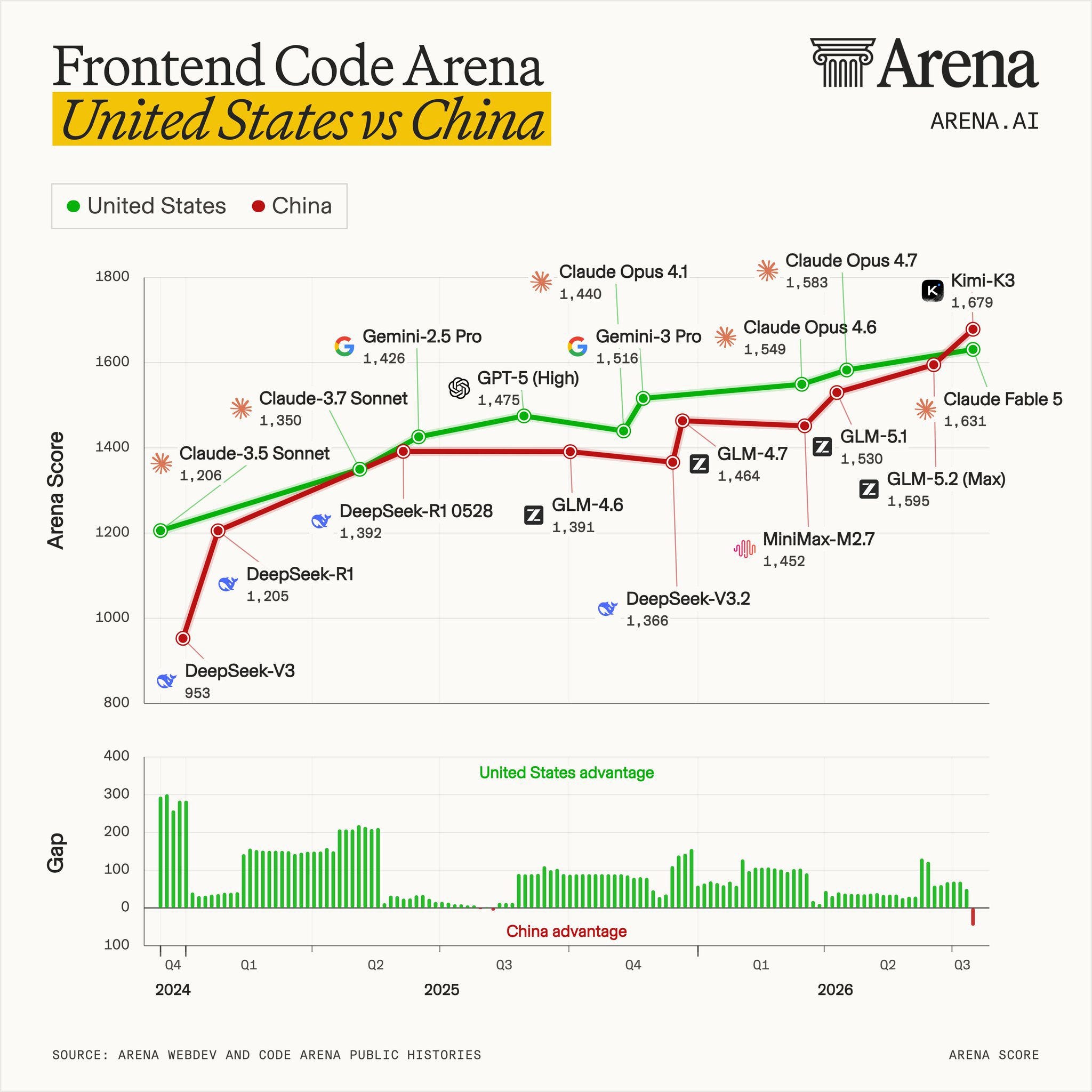
Nearly every model on the Chinese side of that chart, DeepSeek, GLM, Kimi, is open weight (source). And in the most recent data point, Kimi-K3 edged past the best US model for the first time. China has been building its AI strategy around open models and the gap is now closing. That's the real subtext of the Nvidia-led letter: if the US treats open weights as a liability to restrict rather than an ecosystem to lead, China's approach wins by default.
And the data backs them up. Here’s a chart a16z published this month comparing how fast AI has gotten cheap compared to how fast personal computers got cheap:
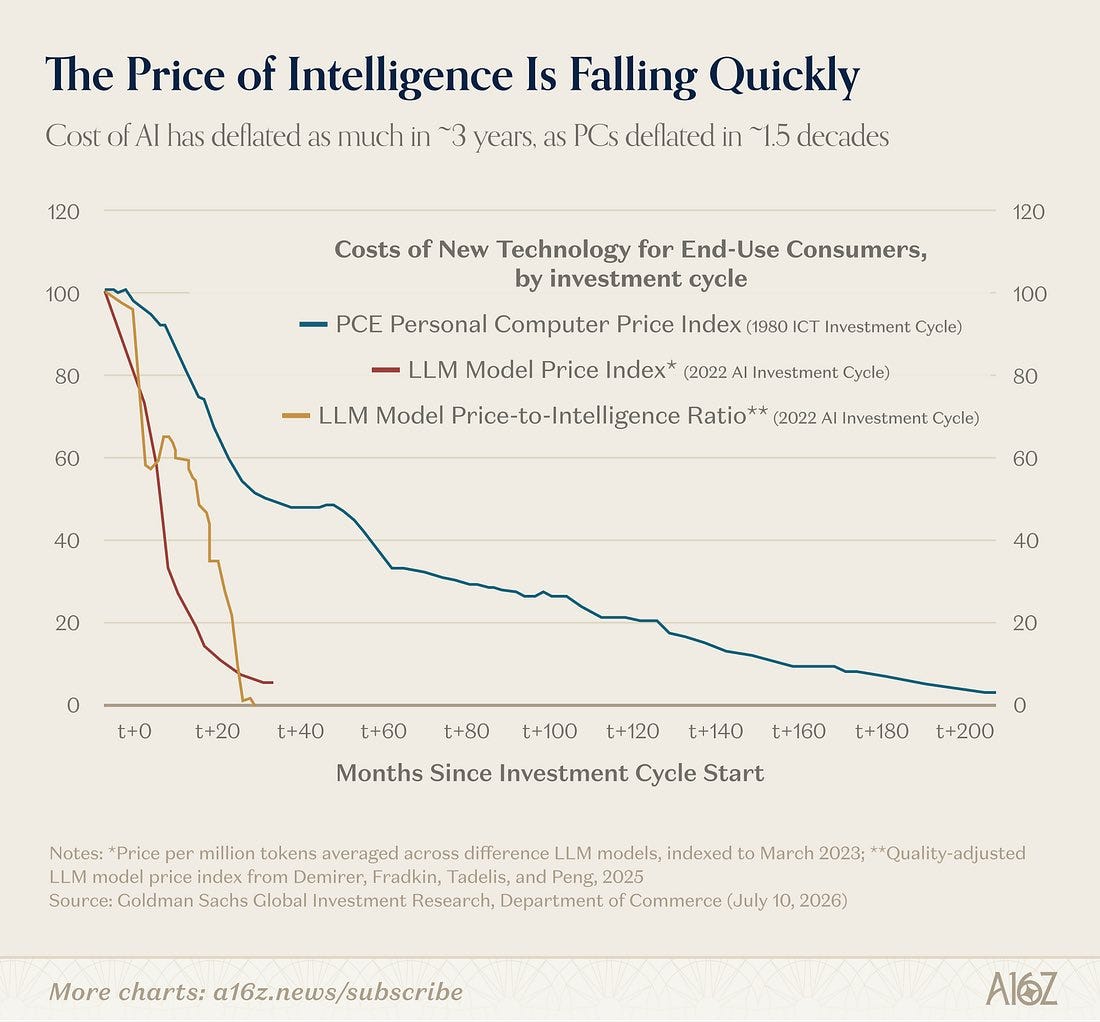
Goldman Sachs and Commerce Department numbers show the cost of AI intelligence falling in about 3 years what took PCs a decade and a half to fall. That collapse is exactly why the China race isn't slowing down. When intelligence gets this cheap this fast, it doesn't just make incumbents more efficient, it lowers the bar for anyone trying to catch up.
Chinese labs have been building under real compute restrictions for years, and it apparently hasn’t mattered in terms of model quality, because the cost of reaching frontier-level performance keeps falling faster than any single country can hoard an advantage. Kimi-K3 didn’t need Google’s or Microsoft’s balance sheet to edge past the best US model. It needed the price of intelligence to keep collapsing, and it did.
Scaling these Chinese models is a different story, though. Moonshot, the company behind Kimi K3, suspended new subscriptions last week after demand overwhelmed its compute capacity within 48 hours of launch. Existing subscribers weren’t affected, but new signups were paused. The US still holds a real advantage in raw compute capacity. However, that advantage will be short-lived if we constrain our own data center buildout, a topic worth its own signal down the road.
Why it matters: This isn't just an industry pricing story, it's closer to a sovereignty question and I don’t think it’s one for Washington to sort out. Every enterprise, including ours, is currently deciding which AI model or family of models becomes the default layer underneath everything it builds. Whichever country's models end up embedded in the world's software by default gains real leverage over the standards, the data practices and the security assumptions baked into that infrastructure.
Right now the US still has the edge, but not because our models are dramatically better anymore, Kimi-K3 just proved they're not. It's because we can actually run models at scale while Moonshot is turning away new subscribers. That gap is being bought with massive investments and innovation in data centers, memory and chips, but it isn't permanent. Slow that down and the compute advantage disappears … and model quality alone won't save us because China has already shown it can match us there. Restrict our own open AI model ecosystem on top of that and American companies eventually face a real choice: a AI model that's more expensive and more closed, or one that's cheaper, open and comes from a country with a different perspective on data privacy and intellectual property. That's why Jensen Huang used his first tweet ever to push a policy letter instead of a product launch and why it reads like a message aimed directly at Washington. But the actual decision gets made company by company (starting now) not in a policy debate that plays out over years.
Back in Issue #50, I pointed to a Ramp/Revelio study showing that companies committed to AI adoption were hiring 10 to 12% more than companies still on the sidelines, evidence against the narrative that AI is quietly gutting the workforce. This week, an Anthropic economist, Peter McCrory, added a much deeper layer of evidence to that same case.

Peter McCrory@PeterMcCrory
https://t.co/udfcEF04vx
5:18 PM · Jul 22, 2026 · 642K Views
56 Replies · 158 Reposts · 738 Likes
The question the essay asks: if AI adoption is this high, why hasn’t unemployment moved at all? The US unemployment rate sat at 4.2% in June, a level the Fed considers full employment. Layoffs, quitting and hiring rates have all been stable. Even workers in roles most exposed to AI automation aren’t showing unusual job losses.
The explanation from this essay is that AI so far behaves like a “skill-biased,” labor-augmenting technology rather than a replacing one. It isn’t eliminating jobs. It’s splitting the workforce into people who know how to actually use it and people who don’t … and making the first group dramatically more valuable. The essay found that people who use AI in more self-directed, agentic ways are already more optimistic about their own pay, job security and ability to find work, because they can already feel the gap opening up between what they can do now and what everyone else can do.
Here’s the part that connects to something I see constantly inside our own walls at PeopleMetrics: the people getting the most out of AI aren’t waiting around for anyone’s permission. They get what I’d call the AI bug, they find a tool that makes them dramatically better at their job … and once that happens, they are not going to be limited by whatever the company happens to provide them. They’ll go find something better themselves. Zara Zhang perfectly captured this on a post this week on X:

Zara Zhang@zarazhangrui
A pattern I keep seeing: the most AI-driven employees pay for the best tools out of pocket. Which means if the company doesn't provide them, your best people are piping company data into external tools on personal cards
2:52 PM · Jul 20, 2026 · 115K Views
118 Replies · 69 Reposts · 1.65K Likes
Her point is your most AI-driven employees will pay for the best tools out of their own pocket if the company doesn’t provide them. In other words, this means your best people may already be putting company/client data into personal accounts on unvetted tools!
Why it matters: We lived this exact progression ourselves. When we first started experimenting with AI, everyone at PeopleMetrics had their own individual ChatGPT license and we ran into the wall almost immediately … we take client data seriously, so people couldn’t just run client work through a personal account. That’s why we stood up a secure ChatGPT Teams instance, so our people could actually use client data safely inside the tool they were already reaching for. When we moved to Claude, we did the same thing again, building the same level of security so the whole team could work with client data with confidence. And we encourage experimentation also. For example, I have given my college Rich Fryzel a license to experiment. He constantly finds and tests new AI tools on his own … and once he vets something, we roll it out to everyone else. That’s the model I’d point to: don’t fight your most AI-hungry people, get ahead of them. Give them room to explore and build the governance around what they find before they build it around you!
Sequoia Capital’s partners spent their AI Ascent 2026 keynote laying out a thesis they’re calling “Services: The New Software,” the idea that the next generation of trillion-dollar companies won’t sell software tools, they’ll sell the actual work itself, done by AI agents instead of people. They estimate the addressable market at something like $10 trillion in services revenue that traditional software never touched. Here’s how they sort which services are exposed first:
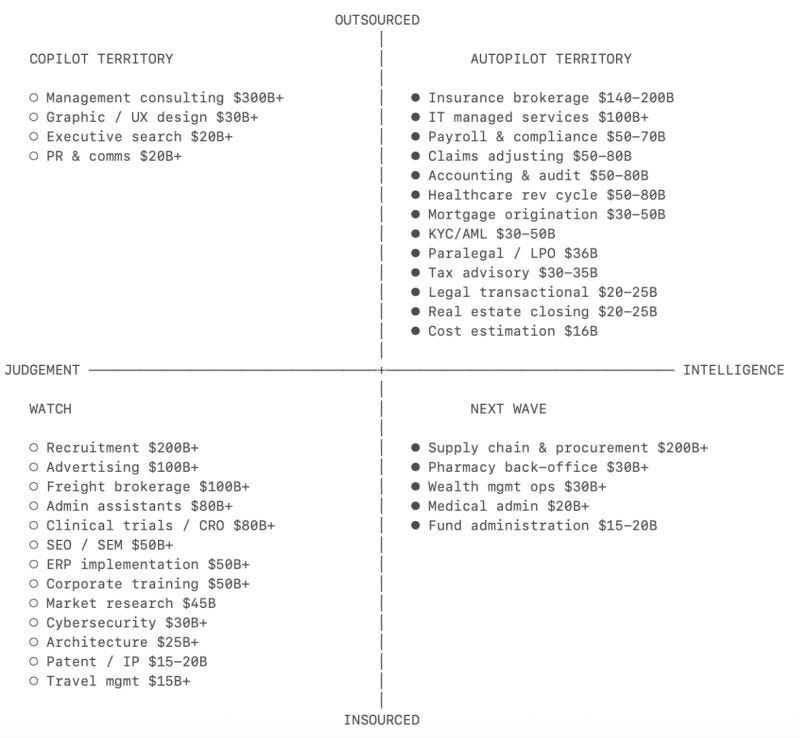
The framework splits work along two lines: how much of it depends on judgment versus raw intelligence and how much of it is already outsourced versus kept in-house. The highest-value early targets, legal transactional work, insurance brokerage, healthcare billing, tax compliance, IT managed services, all share the same two traits: they’re intelligence-heavy and already outsourced. This makes them the path of least resistance for an AI agent to take over.
Market research sits at $45 billion on this map, in the quadrant Sequoia labels “Watch”: judgment-heavy, still kept in-house, not yet automated but flagged as a category worth keeping an eye on. That’s not a hypothetical industry. That’s mine! We are on the judgment side of the line but on notice.
Why it matters: Where you sit on this map determines what it means for you. For me, market research sits in “Watch,” judgment-heavy, but still insourced and still done one client engagement at a time. I don’t think the goal is to defend that spot. I think the real opportunity is moving toward what Sequoia calls “Copilot Territory,” work that stays just as judgment-driven but gets packaged and delivered at scale instead of built bespoke for one client at a time. That’s the actual bet behind bringing insights to life at PeopleMetrics. A 40 page report is judgment locked inside a document one client will read once and hopefully act on it. A customer reel, an interactive avatar, a short film, an infographic and especially one of our new products we’ll be announcing soon (stay tuned) … all of that is the same judgment, delivered in a form that can reach far more people and get reused (and acted upon on behalf of the customer) far more times. The map doesn’t reward staying on the judgment side, it rewards figuring out how to scale it.
This week wasn’t really three separate stories. It was one story showing up at three different scales.
At the largest scale, the price of intelligence collapsing is now a geopolitical fault line, not a tech industry footnote. Nvidia’s CEO used his first tweet ever to push a policy letter, Google’s DeepMind chief backed the same idea days later even though Google didn’t sign and a Chinese model just beat our best one while its own maker was turning away new customers from demand it couldn’t serve. That's real, not theoretical. Every company is choosing which model to build on right now and that choice just got a lot more consequential.
At the scale of a company, the same collapse is quietly sorting people rather than eliminating them. The employees getting the most out of AI aren’t waiting for permission, they’re finding the tools that make them dramatically better and using them, with or without your blessing. Whether that strengthens your company or quietly exposes it comes down to whether you got ahead of it or got left explaining it after the fact.
And at the scale of an industry, and I don’t say this lightly, mine just got mapped. Market research sitting in Sequoia’s “Watch” quadrant isn’t a hypothetical, it’s a $45 billion category with my name on it, being watched by the same investors funding what comes for it next.
Three scales, one force. Intelligence keeps getting cheaper, judgment doesn’t. That’s the whole game, whether you’re a country, a company or an industry trying to figure out where you actually stand.
See you next week.
No posts
Comments
Nothing yet. Say the first thing.
Sign in to join the conversation.