
I grew up on military bases and saw the full lifecycle of war: the absence of my father, the death of my friends’ fathers, the silent wounds that linger on in veterans. Anyone who says war isn’t terrible has never been near it.
For hundreds of years, it was believed that humans were the only species engaging in warfare — at least in the way that we do — with all its organized brutality and deliberate use of strategy.
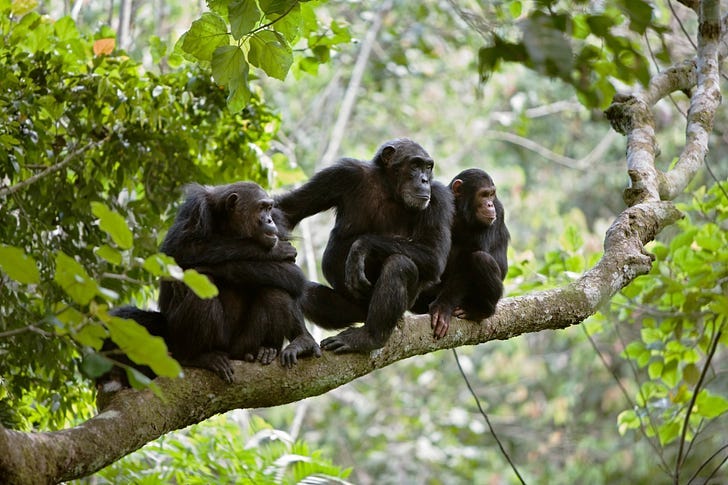
Perhaps it shouldn’t be surprising that this notion was challenged by our closest relatives, chimpanzees. In fact, many scientists argue that chimps are on a similar evolutionary track, living as we did in the Stone Age. They already demonstrate a preference for and understanding of cooked food. They just lack the ability to create fire.
There are even reports of chimps using spears to hunt in Senegal. But it was an initial report of an actual chimp war that rocked the environomental world. Jane Goodall was there as a witness and her perception of kind primates was totally upended.
The origins of the Gombe Chimp War
In the 1970s, Jane Goodall spent years embedded with a chimp community in Gombe Stream National Park, Tanzania.
Initially, she evangelized their beautiful qualities, highlighting their affection for each other, their kindness, and maternal nature, while also acknowledging their capacity for violence.
Goodall herself is considered the matriarch of primate conservation. Her entire goal was to document the friendly chimps in hopes of educating the public and reducing human encroachment.
The chimp community lived as normal with no striking events until 1971. That year, the Northern Kahama alpha male, Leakey, passed away. A new alpha, the second in the hierarchy, stepped forward to take over the group. However, he was not accepted by two brothers, who began fighting with him. Threat displays and small skirmishes broke out in the coming days. And as is typical, just after these violent displays, the same chimps who were attacking each other would then be grooming one another like friends.
Eventually, the turmoil grew too big and caused the chimp community to split. One group migrated north while the other went south. The chimps chose allegiances based on who they had the strongest social ties with. It seemed like a peaceful resolution to the conflict.
There’s an old, and well-known theory in the social sciences, called Contact Hypothesis. It suggests that tensions rise in humans when there is isolation between groups, and decreases when there is intermingling. The same phenomenon is often seen among chimp communities. After initially splitting, everything was fine. The two groups even interacted occasionally. But as they spent more time apart, tensions rose.
The conflict escalated in January of 1974, when the northern tribe formed a war party. All the males came together and migrated towards the other group.
Chaos breaks out in the jungle
A war party descended upon the more peaceful, southern group in the middle of the day, as they were lounging in the brush. They first killed a male chimp named Godi. The event was witnessed by Jane Goodall and other scientists, who watched in horror. It was the first time they’d seen chimps systematically attacking other chimps.
Notably, the chimps went into a fevered celebration after the kill. They jumped up and down, tearing down branches. They flew up and down trees. Their screams soared across the jungle, in an undeniable celebration of bloodlust. Things only got worse.
Over the next four years, the marauding males came back over and over again. They systematically killed each male of the southern troop. It was gang-style violence, teaming up on individual chimps one by one. By the end of 1978, all the males in the southern troop had been killed, along with several females.
The males then forced the remaining females to join them. Tragically, they raped several and killed some of their young. After the group was consolidated back into one, everything slowed down and the war was over. The event was named the Great Gombe Chimpanzee War.
The takeaway and backlash
Initially, Jane Goodall’s claims were met with great skepticism. Jane was already known for having broken a major rule of research: falling in love with your subject matter.
She was also accused of over-anthropomorphizing the chimps. It was an easy conclusion to draw as she’d been known to name the chimps, talk to them, feed them, and sing lullabies as though they were her children.
Many experts also said the conflict was an unnatural occurrence, caused by human influence: direct interference and encroachment on their land. But this was later disproven after a group of scientists conducted their own set of studies on 18 chimp communities throughout Africa.
What they saw confirmed Goodall’s observations. They found that chimps actively engage in warfare. It usually starts with a breakdown in their social structure, followed by a power struggle. Their wars are almost entirely carried out by males, typically over resources. The conflicts are prolonged, with pressure applied over months and years.
The fights can be over the expansion of territory, access to water, food, and fertile females. The shorter in supply any these resources are, the higher the odds of warfare and violence.
No, nobody ever suggested nature was kind. Even in its cruelest moments, everything serves a purpose. There is no malice, nor any remorse.
Yet it is eye-opening to think there is another species carrying out conflicts that are strikingly similar to human warfare. Perhaps it shouldn’t be so surprising given we share 98.8% of our DNA with these powerful creatures. The Gombe Chimpanzee War doesn’t necessarily confirm that war is of human nature. But it certainly highlights brutality, and that empathy and cruelty can both exist in a being.
If anything, it reminds me of how dangerous our base instincts can be, and that harmony is a fragile thing. It needs to be nurtured and cared for with all kindness we can muster.
Be good to each other, folks.
Comments
Nothing yet. Say the first thing.
Sign in to join the conversation.