
Hi, I’m Ylli Bajraktari, President of the Special Competitive Studies Project. Today, we are releasing the second of three episodes of Strait Forward where SCSP’s Channing Lee and guests debunk the myth that Taiwan stole America’s semiconductor industry. The U.S.-Taiwan chip partnership is one of the most consequential collaborations in history to shape America’s innovation power. I hope you enjoy.
Global supply chains can hinge on remarkably modest beginnings. In 1974, inside a local Taipei diner over a $10 breakfast, seven government and technology leaders met to determine how Taiwan could escape a global oil crisis and upgrade its economy. Their decision was to bet on semiconductor manufacturing — through a method that was perceived to be a dying technology.
In Part Two of a three-part Strait Forward miniseries on why Taiwan did not steal America’s chip industry, host Channing Lee visits the Industrial Technology Research Institute (ITRI), established by Taiwan’s government in 1973 to bridge public research with commercial application. She speaks with Stephen Su, ITRI’s Senior Vice President, who shares how that breakfast meeting laid the groundwork for the future of Taiwan’s semiconductor industry.
ITRI signed a $10 million technology transfer agreement with RCA — a seventh-ranked American firm looking to exit the space — in 1976. RCA agreed to teach Taiwanese engineers both integrated circuit design and manufacturing.
Subsequently, a group of Taiwanese researchers were dispatched to the United States for a year of intensive training. Upon their return, they fine-tuned integrated circuit (IC) production yield from virtually 0% to 70%. ITRI continued to grow over the next several years and spun off its first independent company, the United Microelectronics Corporation (UMC), in 1980. Five years later, Morris Chang arrived at ITRI, leveraging its advanced research to launch the Taiwan Semiconductor Manufacturing Company (TSMC) in 1987.

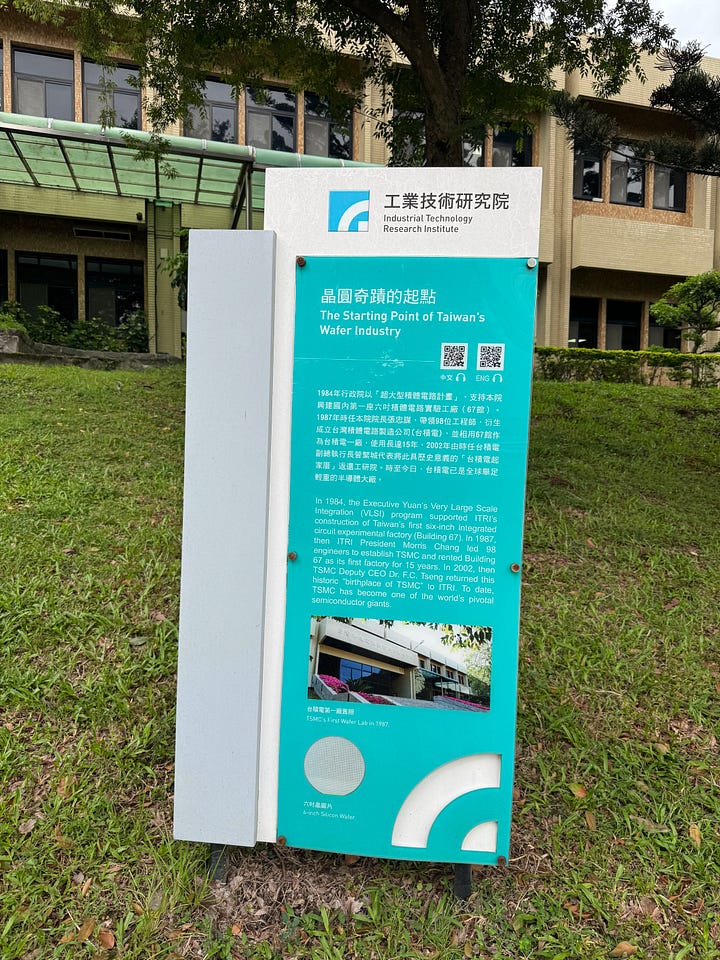
While the 1976 deal provided the initial spark, Taiwan’s modern-day chip empire was built through decades of intense labor, yield improvement, institutional dedication, and global partnerships. Today, TSMC and its famous foundry model relies on over 1,200 suppliers, sourcing precision optics from the Netherlands, specialized chemicals from Japan, and design architectures from American leaders like Nvidia and Qualcomm.
This global interdependence highlights why modern industrial policy cannot succeed through isolation. In fact, over the last half-century, the semiconductor trajectory has evolved through three distinct paradigms:
Made in Taiwan: The early era of domestic manufacturing assembly.
Made by Taiwan: The current phase of Taiwanese foundries expanding fabs into Arizona, Japan, and Germany.
Made with Taiwan: The future model of joint technological innovation, international research partnerships, and shared security standards.
Semiconductors are not a zero-sum game. True technological leadership requires cultivating global supply chains where international partners make each other stronger. And in this era of geopolitical and techno-economic competition, leaning into partners’ comparative advantages to fortify all of our economic security is of paramount importance.
No posts
Comments
Nothing yet. Say the first thing.
Sign in to join the conversation.