
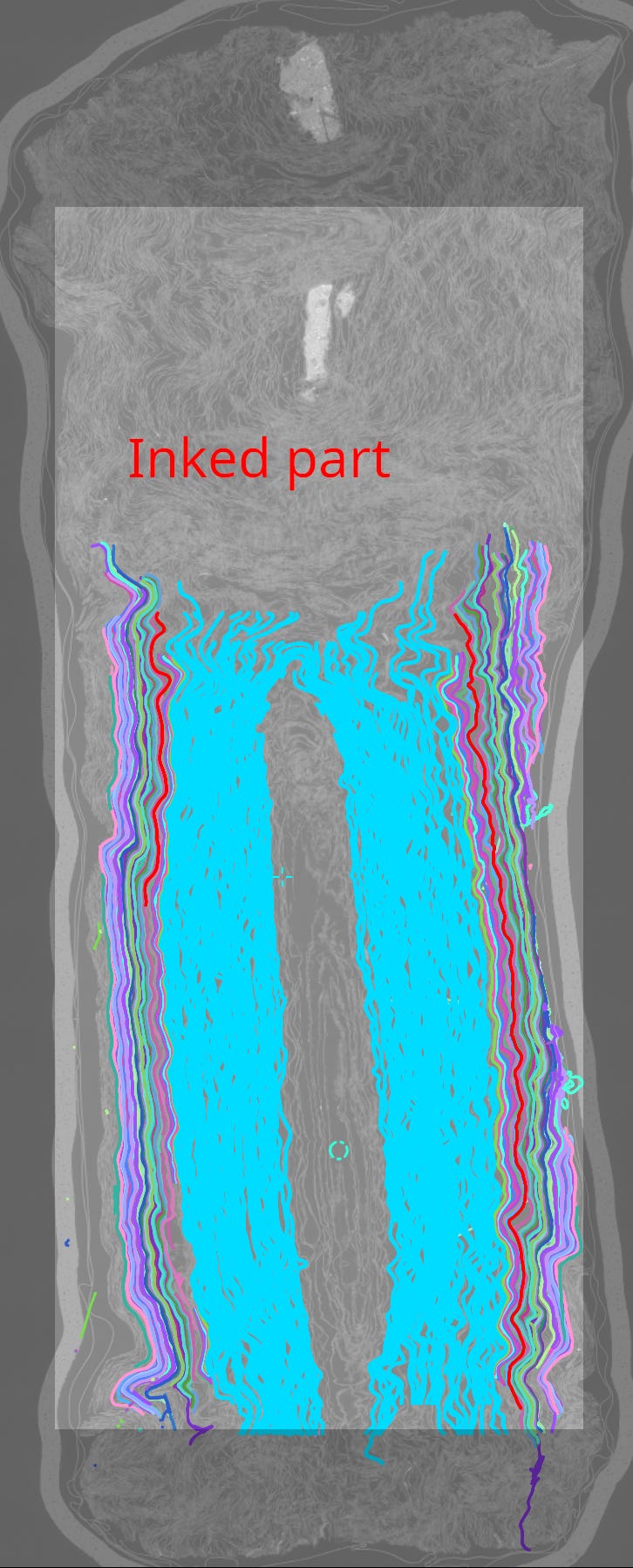
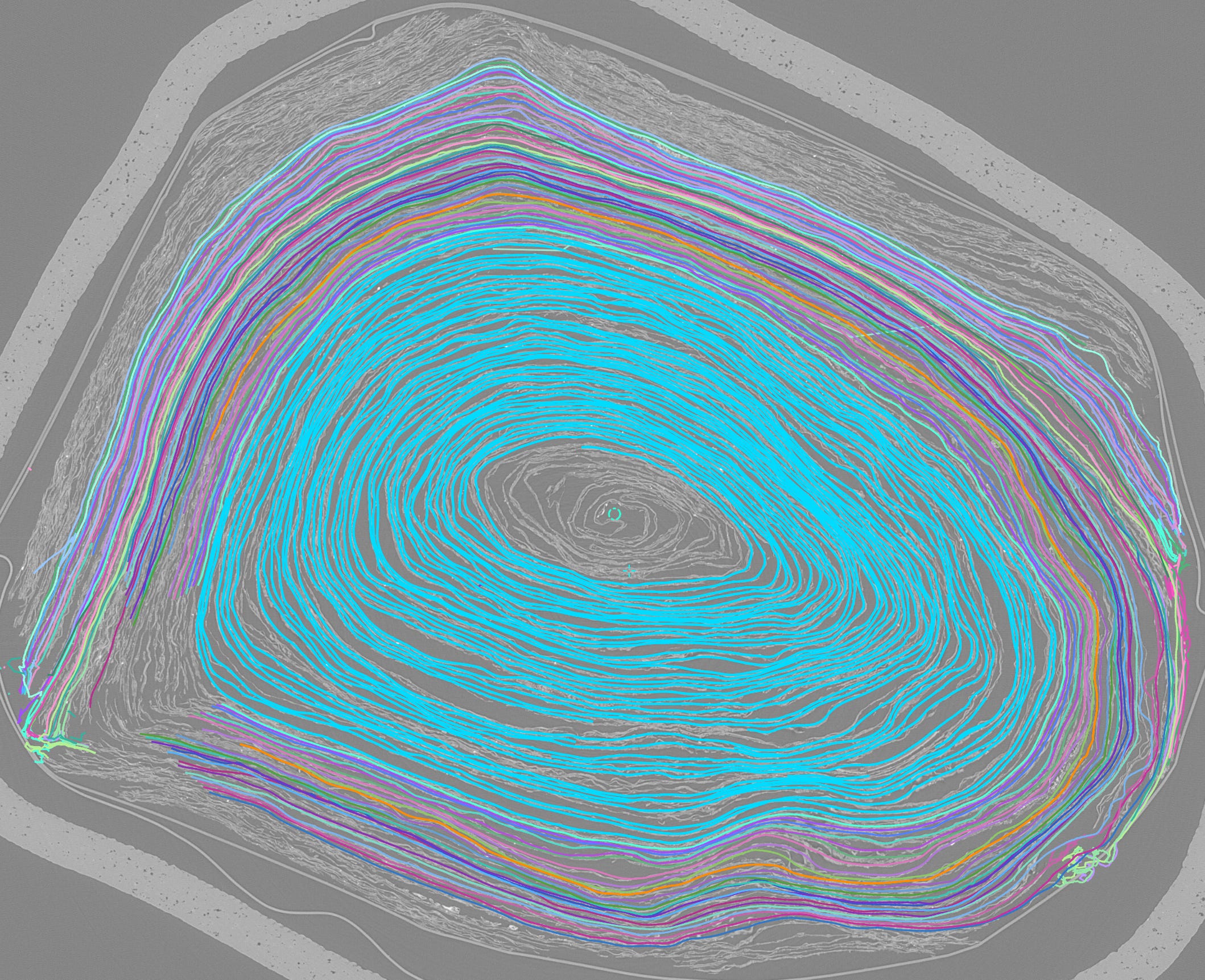
Over the past weeks, the Vesuvius Challenge team has digitally unwrapped the lower ~70% of PHerc. 172—also known online as Scroll 5—focusing on the ink-bearing region (excluding the blank margins).
Compared with earlier work, this is a major shift toward automation. The workflow is no longer “hand-trace everything”: our current VC3D pipeline can now extract surfaces more than 10× faster than a fully manual workflow in the original Volume Cartographer—the tool that was used during the 2023 Grand Prize run to produce the famous PHerc. Paris 4 banner.
That said, the process isn’t push‑button yet. The main remaining manual work is fixing sheet switches / “sheet jumps”—cases where the segmentation accidentally hops from one papyrus layer to a neighboring one instead of staying on the same sheet.

The upper ~30% of PHerc. 172 is currently too mangled for our present methods: the papyrus is distorted and compressed enough that we can’t reliably trace a coherent surface on it.
But the portion we can extract is substantial: the unwrapped surface from the lower region spans roughly 7 meters in length (yes, meters!) and about 14 centimeters in height.
This surface is semi‑continuous rather than perfectly continuous, especially toward the outside of the scroll, where the papyrus is physically broken and some areas are missing.
From a virtual‑unwrapping perspective, this is an exciting milestone: we’re reaching a level of automation that simply wasn’t available before, while still preserving enough control to correct failures like sheet switches.
On the reading side, the picture is more mixed.
In the outer wraps (and partial wraps), ink detection often highlights fragments of columns where multiple letters can be read together.
Deeper inside, we more frequently see column margins, faint row structure, and occasional letters—right at the edge of legibility.
So: we’re extracting far more surface, far faster—but legible text is still unevenly distributed across the scroll.
Fortunately, we have identified an important constraint here: the underlying scan resolution. PHerc. 172 was scanned at 7.9 µm pixel size. With today’s models and rendering pipeline, we may be approaching the practical ceiling of what that dataset can yield.
And although colleagues and scholars who’ve reviewed the outputs have described the result as genuinely exciting and promising and Oxford papyrologists are actively working toward an article discussing the newly legible material, the best virtual unwrapping results are coming from higher resolution scans.
Our recent 2.4 µm scanning protocol, for example, resulted in a clear jump in legibility when we rescanned PHerc. 1667 (Scroll 4). The letters became visible in regions that previously showed no convincing signal.
If you’re excited by this kind of progress, there’s real leverage right now in:
improving surface extraction so we get fewer sheet switches ( we have an ongoing challenge of Kaggle for this ! ),
strengthening ink detection ( for instance in the “hard” inner regions of Scroll 5 ),
and generally making the unwrapping pipeline more scalable and user-friendly.
No posts
Comments
Nothing yet. Say the first thing.
Sign in to join the conversation.