
I guess/
I guess—
I want my work to know what it’s about before I know what the work is about—
which is to say I want to follow the trail of my own breadcrumbs,
or to start picking up the shiny objects the crows left behind, to make them into a necklace, to trust that
if I assemble the shiny objects as I find them,
if I listen to my inner sense of what goes where,
the shiny objects will become something more precious to me than
gemstones.
I guess I’m saying I want to collaborate with crows.
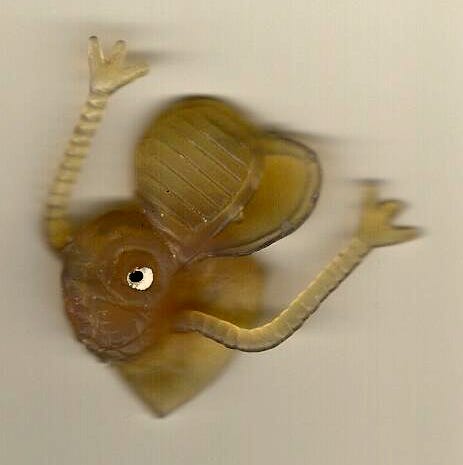
I’ve never seen an orca in real life, but I have dreamed about them, drawn them, written about them.
I spend plenty of time in orca habitats. I swim and paddle year-round in Budd Inlet, a place where they’re regularly sighted, but always on a day I’m not there.
It might be that I’m not ready for them.
I long to see orcas, but I’m not interested in going on a whale watch. I’m not interested in watching for updates and then chasing them down. (No shade on either activity.) I want to continue my slow courtship of the Salish Sea, to learn over years their routes and their culture. I want to trust that eventually I’ll see them. Or not. My life is meaningfully enriched by the process.
The process includes, if I’m open to it (or even if I’m not), other sustaining encounters.
In another era, I had a cabin in the middle of nowhere. A few hundred yards from the cabin was an aspen grove. My partner put a bench there, and I joked that it was my office. I’ve always loved to watch a stand of quaking aspens, the way their leaves flip sides and shimmer, the way they sound like whshwshswshswhshwhshsh…
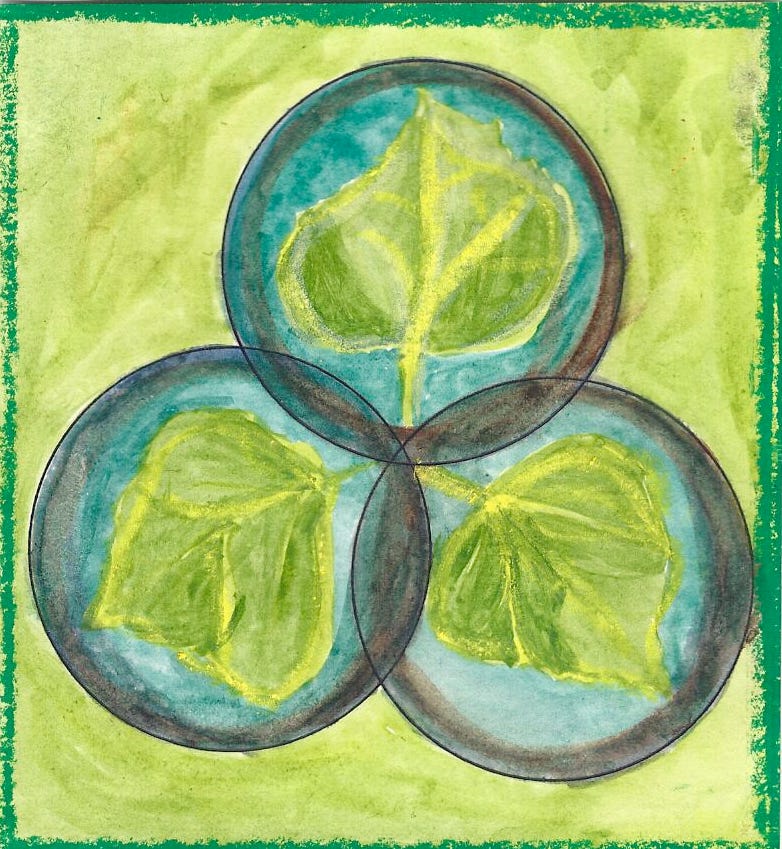
If you let yourself sit in an aspen grove for a while, you might start to believe that everything is all right—for the moment, at least. In the aspen grove at least.
In that aspen grove, there were standing dead trees among the living, snags stripped down to their silvery bark and pointing to the sky.
I learned from that aspen grove that if you sit quietly for long enough, something happens.
By long enough, I mean just long enough for your breath to calm and your body to settle.
By something happens, I mean that a bluebird pops out of a hole in the snag, or a woodpecker arrives, or a wind travels up the hill and wshswhshWHSHWHSHwhsh…
I didn’t write in the aspen grove because I only wrote on my computer, a clunky Dell laptop. Writing was a practice separate from my body.
Yes, the brain is in the body.
But where is the mind?
Microsoft Word is an interface.
In that interface, there are rulers and toolbars.
Your words come out in a row.
Many decisions about how you navigate the page have already been made. An entity made them.
You can clean your mistakes as you go. You don’t have to reckon with them by scribbling over a phrase you didn’t quite mean or typing Xs over a word.
Now AI1 offers—aggressively!—to remove elements of struggle from your writing.
As if frustration is mere inconvenience.
As if frustration isn’t the work making itself.
As if frustration isn’t God.
(As if AI2 were anything but the completion plan for settler-colonialism.)
An aspen grove is an ecosystem.
In that ecosystem there are living things and dead things supporting living things. There are leaves and roots, and bluebirds, and insects and woodpeckers, and grasses and wildflowers and rocks and a bench and possibly you.
To show up daily to an ecosystem feels different than showing up daily to an interface.
(Writing this now [hi!] on the Substack interface, because I do show up to the internet daily. I try to bring the ecosystem to the interface; or maybe I try to make the interface part of my ecosystem.)
I still don’t write in an aspen grove, but my workspace is right next to one. As I type, I can hear them, whshwhshwhsh.
More importantly, my workspace feels like an ecosystem. I’ve got a baby cactus going nuts, and jars filled with tiny bouquets. I’ve got candles and feathers and objects from childhood.
More importantly still, the work itself is part of the ecosystem. I’ve got shelves spilling over with sketches and materials and typewritten notes. I spend half of my creative time attempting to curate and organize them. I’ve come to understand that spending time with the materials is part of the work. It’s part of learning to listen. It’s part of learning to be.
Some writers can get all the way there with the computer as their primary tool.
I cannot.
For me, there’s no greater feeling than walking towards my workspace and leaving my laptop behind. I get to put words and images on paper (not the digital illusion of a ‘page’). I get to make messes. I get to mess up. I get to make things I never intended to make.
I find this to be the best of all joys, when the work doesn’t start with an idea, but an idea starts to form within the work.
Like this afternoon, when I made these circles with our Joyful Practice principles because I knew I would need them for this post. And then on the floor there was this mermaid I had drawn without thinking a month or two ago. I had half-ripped-half-cut her off of another page of doodles, and I thought I might want to use her for something, but I had no idea what.
I’d also been setting up a little altar with a small glass plate awaiting a candle.
And then suddenly these things wanted to be together, so I let them.
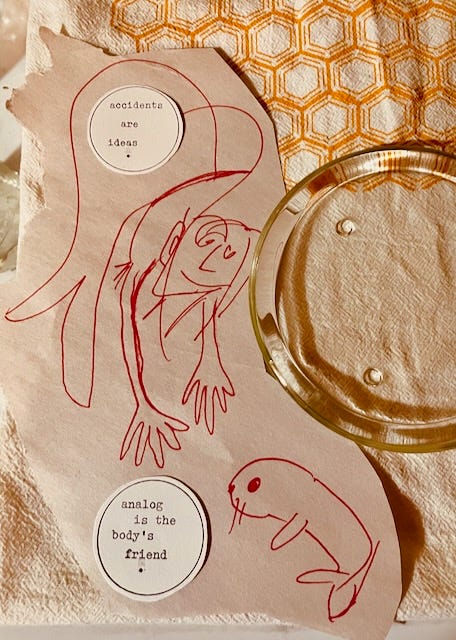
I can’t tell you what it means, but I know it means something (if only to me) because I felt a little click when I put it together, and then a sense of expansion, like in the aspen grove when the birds show up and for a minute everything thing feels aligned.
Note to reader: Every week, we’re writing about a Joyful Practice principle. These principles offer guidelines for approaching creative work. This week’s principles are: Analog is the body’s friend and Accidents are ideas.
On Fridays, we release a podcast (The Joyful Practice Podcast) available here (on Substack), on Apple Podcasts, and on Spotify.
Also on Fridays, we offer an immersive prompt for creative exploration. This feature is called Prompt Portal, and you can find it here on Substack.
No posts
Comments
Nothing yet. Say the first thing.
Sign in to join the conversation.