
The Madonna of Gorlovka
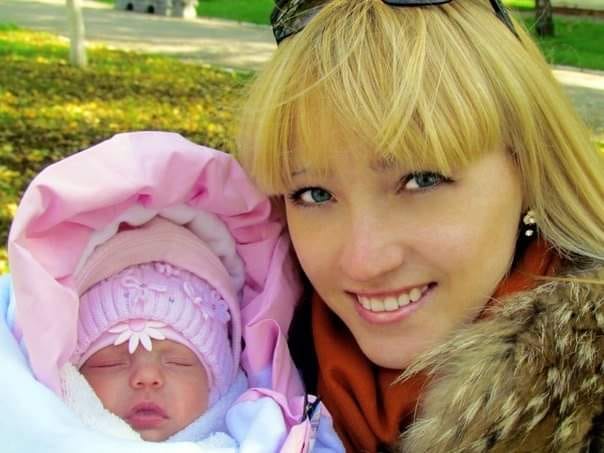
“Kristina was a smart girl. She graduated from Gorlovka Institute of Foreign Languages, and wanted to achieve a lot in life. She loved her little girl Kirochka very much; she wanted a child so much, and eagerly awaited her birth. Even when she was pregnant, all the time, she said: ‘When will Kirochka come?’ She knew exactly what the baby would be called, who she would be.”
These are the words of Natalya Zhuk, the mother of Kristina Zhuk. The timeframe of which she spoke was in July, 2014.
“When Kirochka was born, Kristina did not let her go. Kira sang songs endlessly—she woke up in the morning and screamed from the bedroom: ‘Bah! Bah!’ and began to sing songs. Our neighbors all laughed, because from the first day we constantly sang songs to her. Neighbors asked, they say, who sings there? I sang, Kristina sang. She put on French songs and Kirochka was already humming something.”
Kristina was a citizen of Ukraine, a resident of Kiev. When she became pregnant with Kira, Kristina travelled back to her childhood home of Gorlovka, to be with Natalya and her younger sister, Daria, when the baby was born.
Gorlovka is located 50 kilometers north of Donetsk. The city is named after Pyotr Nikolayevich Gorlov, a Russian geologist and engineer who explored coal deposits in the Donets Basin. In 1867 a village was constructed to house railroad workers involved in the construction of the Kursk-Kharkov-Azov railroad. It was named in honor of Gorlov.
In 1871 the coal mine “Korsun Kop #1” was established, and it quickly became the largest coal mine in Donbass region. By 2014, the coal mining industry in and around Gorlovka was largely concentrated in the Kalinin Mine, which produced around 300,000 tons of bituminous coal per year. Joining the Kalinin mine as a major regional employer was the Styrol chemical concern, a key ammonia and urea producer and the only polystyrene manufacturer in Ukraine. By July 2014 some 240,000 people called Gorlovka home.
“There is still a feeling that they just went out for a walk,” Natalya reminisced later, “and will soon come back, and I will grumble at them—say, ‘you returned so late, it’s time for Kirochka’s bath!’ Every time they were delayed, they came back and shouted: ‘Hurray! Grandma, Kira learned to crawl!’ or ‘Hurray! Grandma, Kira has learned to walk!’, ‘Hurray! We made her first word!’”
Kristina and Kira lived in the home of their mother, Natalya, in an apartment located on the eight floor of a building located on Rudadovka Street, across from a park. “Kirochka just learned to walk,” Natalya reclaeed. “In this park, they strolled 2-3 times a day; they almost never left. There, in this grass, Kira learned how to crawl and walk. They lived in this park,” Natalya said
“And died there.”
War came suddenly to Gorlovka. The events of the Maidan in Kiev that transpired in January and February 2014 seemed distant from the Donbas, where life centered around the factory and work. Even the annexation of Crimea by Russia in March appeared to be an event that was taking place in another world. Protests against the Ukrainian government of interim president Olexandr Turchynov grew in scope and size as the population of the Donetsk region, which had seen some 90.4% of its vote go to the former president Viktor Yanukovych in the 2010 Presidential election, expressed its opposition to the new Ukrainian government.
On April 12, 2014, a heavily armed detachment of some 50 Russian “volunteers” entered Donetsk and moved on the cities of Slovyansk and Kramatorsk. A detachment from this unit made its way to Gorlovka, where it rallied support from the local residents and attempted to seize the local police station. This effort was rebuffed.
On April 13, 2014, Turchynov announced the beginning of an Anti-Terrorist Operation in Donbas, clearing the way for the involvement of the Ukrainian army in putting down the demonstrations. Undeterred, the Gorlovka protesters regrouped, and on April 14 succeeded in taking control of the City Council and the Department of Internal Affairs. At this time the bulk of the police serving in Gorlovka went over to the side of the protesters, who were calling for the independence on the Donbas from Ukraine.
Gorlovka was effectively under the control of the rebellion.
On April 17, a local city councilman, Volodymyr Rybak, was arrested by the rebels when he tried to raise the Ukrainian flag in Gorlovka. His body was later dumped in a local river, along with the bodies of two local activists who had been active at the Maidan demonstrations in Kiev that brought down Yanukovych.
Gorlovka escaped the violence that raged elsewhere in the Donbas in late April and the month of May. On May 11, the citizens of Gorlovka overwhelmingly participated in a referendum calling for independence from Ukraine—more than 75% turned out for the vote, which saw 90% vote in favor. On May 12 the rebels in Donetsk formally declared the independence of the Donetsk Peoples Republic from Ukraine.
Gorlovka was considered to be part of this new republic.
The Ukrainian Armed Forces launched assaults aimed recapturing Gorlovka in early May, prior to the referendum, but were repelled. Fierce resistance from local rebel fighters resulted in heavy Ukrainian casualties, compelling the Ukrainian armed forces to withdraw from their positions around the city in late May.
June found Gorlovka relatively quiet. Daria Zhuk, who was studying in Kiev, joined her mother and older sister in Gorlovka, where they all basked in the joy of baby Kira. The situation, however, deteriorated rapidly starting in early July. On July 5, the Ukrainian military drove Donetsk rebel forces out of Slovyansk. Many of the defenders withdrew toward Gorlovka, determined to make a stand there.
On July 21, the Ukrainian army made a push to capture Gorlovka, sending an armored detachment into the northern suburb of Mayorsk. Sporadic firefights broke over the course of the next two days, before the Ukrainians broke off their attack after a SU-25 ground attack aircraft was shot down while flying over Gorlovka on July 23.
For the Zhuk family, the situation in Gorlovka was becoming intolerable. Daria was sent back to Kiev on July 23, and Natalya was trying her best to arrange safe passage out of Gorlovka for her, Kristina and baby Kira. By the morning of July 27—a Sunday—Natalya was at her wits end.
“Our suitcases stood packed on the doorstep for several days, but for several days we could not leave Gorlovka,” she later recalled. “Wherever we call, in boarding houses or other places, everywhere with a small child they were not accepted. And the last two days and trains did not go. I was ready to run out of the house onto the road, catch some car and arrange for us to be taken away from the city at least somewhere. But suddenly I got a call from a man who was taking people out of Gorlovka and said that he would pick us up the next morning.”
It was two in the afternoon.
“I went to the open window, from which, as if on the palm of your hand, you can see the square, and immediately called my daughter, Kristina, to share the news. At that time she was walking on the street with my granddaughter Kirochka. ‘Kristyusha!’—I shout to her on the phone—‘that’s it, tomorrow at 9 am we leave!’ She is in the phone with joy: ‘Hurrah!’—shouts—‘Kirill, we’re leaving tomorrow! Hurray, grandmother, we’re leaving!’”
Natalya looked out the window. “Kristina, where are you?” she cried. “In the square,” Kristina answered. “Stay where you are,” Natalia said.
It was at that moment that a salvo of 122mm artillery rockets exploded in the square.
To the north, the Ukrainian army was beginning to make another push on Gorlovka, this time from the direction of Zaitseve. At 2 pm, the Ukrainians opened fire on Gorlovka with several batteries of Grad 122mm rockets.
It was these rockets that exploded in the park below Natalya’s apartment.
The park where Kristina was walking with baby Kira.
The first explosions did not kill Kristina and baby Kira. The young mother, wearing denim shorts and a sleeveless black t-shirt emblazoned with the name “Paris”, had time to pick up baby Kira, who was wearing a bright yellow print dress and, holding the baby in her arms, start running across the grass toward her mother’s apartment.
It was a subsequent shell that killed her and the baby, severing one of Kristina’s legs and knocking her to the ground, still holding baby Kira in her arms.
A Ukrainian blogger who had travelled to Gorlovka to report on the escalating conflict took pictures of Kristina and Kira’s lifeless bodies, and immediately posted them on his social media page for the whole world to see.
Shortly thereafter, one of Natalya’s neighbors passed by the bodies, and took them to the morgue.
“Explosion after explosion, fire, smoke and all,” Natalya later recalled. “My world swam before my eyes. I ran out of the apartment to the street shouting ‘Kira! Kristina! Kira! Kristina!’ By the time I got there, the park was already quiet. I didn’t find my children. Falling through the shell craters, I sorted the grass with my hands, looking for toys, but, not finding them, I thought that everything was in order. My only thought was that they were in a bomb shelter.”
Natalya went to the bomb shelter. She didn’t find her daughter and granddaughter, but was precluded from her search by the continued bombardment of Gorlovka by the Ukrainian army. When the shelling stopped, a few hours later, Natalya went to the children’s clinic to see if Kira and her daughter had been brought there. It was in the clinic that she received a phone call from her friends. They had seen the photographs of Kristina and Kira’s bodies on the internet, and told Natalya she must go to the morgue.
Natalya did, and that’s where she found her two missing loved ones.
Natalya tried to bring her girls home the next day, so she could prepare their bodies for burial. The morgue refused to release the bodies due to continued Ukrainian shelling. On the 29th the shelling let up just enough for a quick funeral.
“My girls were buried very quickly,” Natalya remembered. “They hurried me all the time: ‘Faster, faster’—they were afraid that they would bomb again.”
“The politicians decided that I could not be a mother or a grandmother,” Natalya said, ‘that we could no longer rejoice or laugh. We have been deprived of all this. I howled, howled. All night after the funeral, I slept on their grave. After all, what difference does it make, they bomb everywhere anyway.”
July 27 became known as “Bloody Sunday.”
The Ukrainian artillery attacks that day killed 30 citizens of Gorlovka, including five children. More than 100 others were wounded.
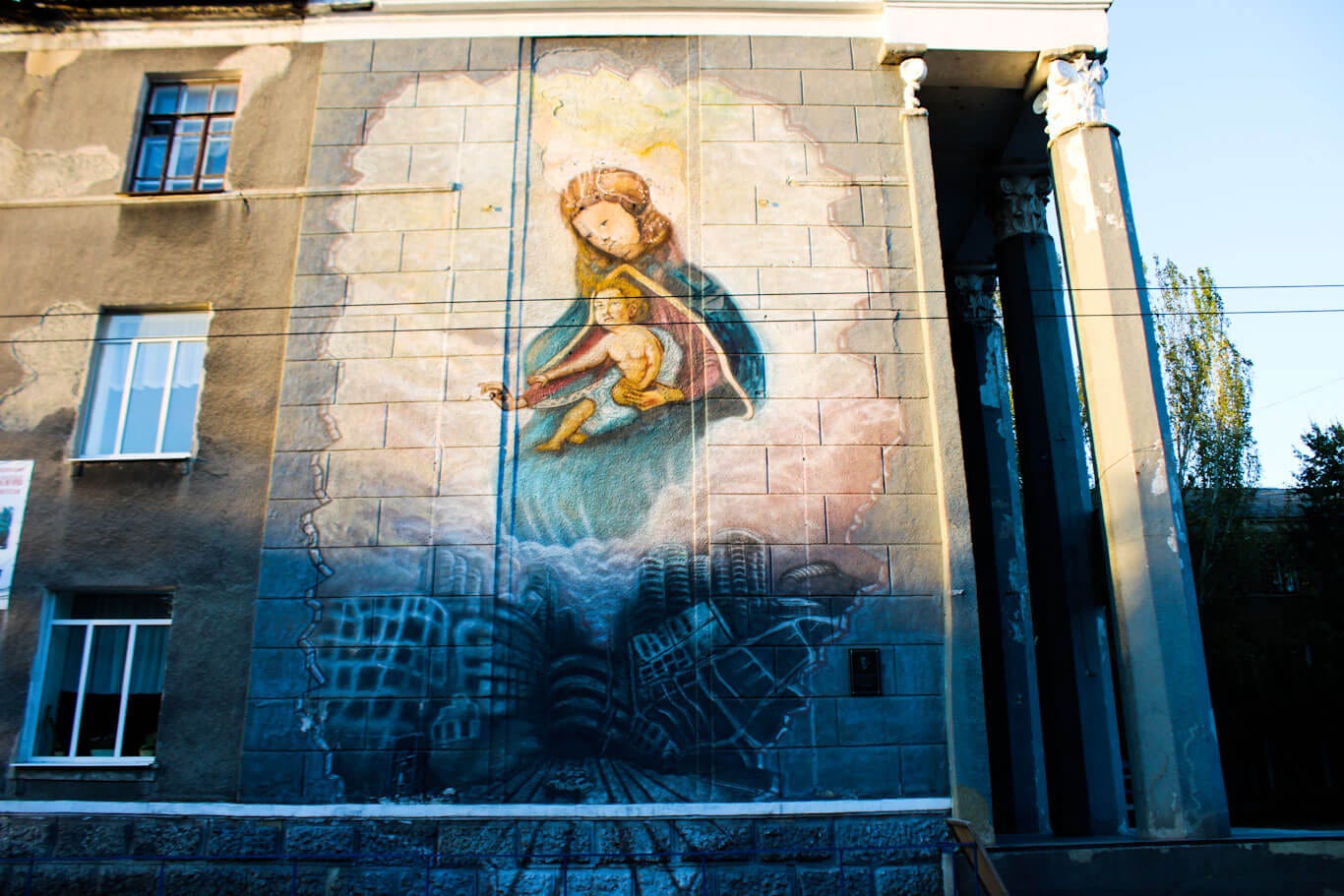
Thanks to the photographs of Kristina and Kira’s torn, lifeless bodies laying on the ground, the world’s attention was captured for at least a moment, and soon Kristina was introduced to the world as “The Madonna of Gorlovka.”
The citizens of Gorlovka painted a mural of Kristina and Kira on the side of a building overlooking the park where they were killed.
The Donetsk People’s Republic has declared July 27 as the “Day of Remembrance for Children Victims of the Donbass War.”
More than 250 children have been killed in the territory encompassing the Donetsk People’s Republic since 2014.
Twelve long years of war.
The first child killed was Kira Zhuk.
Today hardly anyone remembers her name.
The Mayor of Gorlovka
When I first approached “Iskander” with my proposal regarding a visit to the Special Military Operation, back in March 2026, I had envisioned visiting some former battlefields where I would walk the grounds with soldiers who had fought there, getting a first-hand look at the true nature of the conflict. I brought up Bakhmut, Sievierodonetsk, and Adviika as possibilities—all three had been the scene of major battles. As soon as I mentioned Bakhmut, “Iskander” smiled and shook his head. “It’s still too dangerous”, he said. “Too many drones.” But he said he would look into the other two places, and come up with other possibilities.
As the calendar drew nearer to my date of departure, “Iskander” started giving me warnings. “It is becoming more difficult here,” he wrote, referring to the zone of the Special Military Operation. “The Ukrainian drones are becoming very active.” I was advised that the plan would have to be adjusted based upon security realities. “We will do our best to have a good program for you,” “Iskander” said. “But your security is our top priority. And right now it is very dangerous.”
When I arrived in the Donbas, the Ukrainian drone offensive was in full swing. The goal of the Ukrainians was to bring the war home to the citizens of Russia, and their drone operators attacked civilian targets with a vengeance.
The attack on Starobelsk College stands out as an example of this terrorism.
My visit to Sievierodonetsk was cancelled—too dangerous.
And then my visit to Adviika was cancelled as well—too dangerous.
The roads leading to both towns had become virtually impassible due to Ukrainian drone attacks.
I was scheduled to visit the city of Gorlovka on June 10. To get to Gorlovka from Donetsk, one has to take the R-150 Donetsk-Yasinovataya-Gorlovka federal highway. On May 20—ten days before I was scheduled to depart for Russia—the authorities of the Donetsk People’s Republic closed the R-150 Donetsk-Yasinovataya-Gorlovka federal highway due to incessant Ukrainian drone attacks—more than 19 along the highway in one 24-hour period, including one which destroyed a truck outside Yasinovataya, killing the driver.
The highway was still closed when I arrived in Donetsk on June 10.
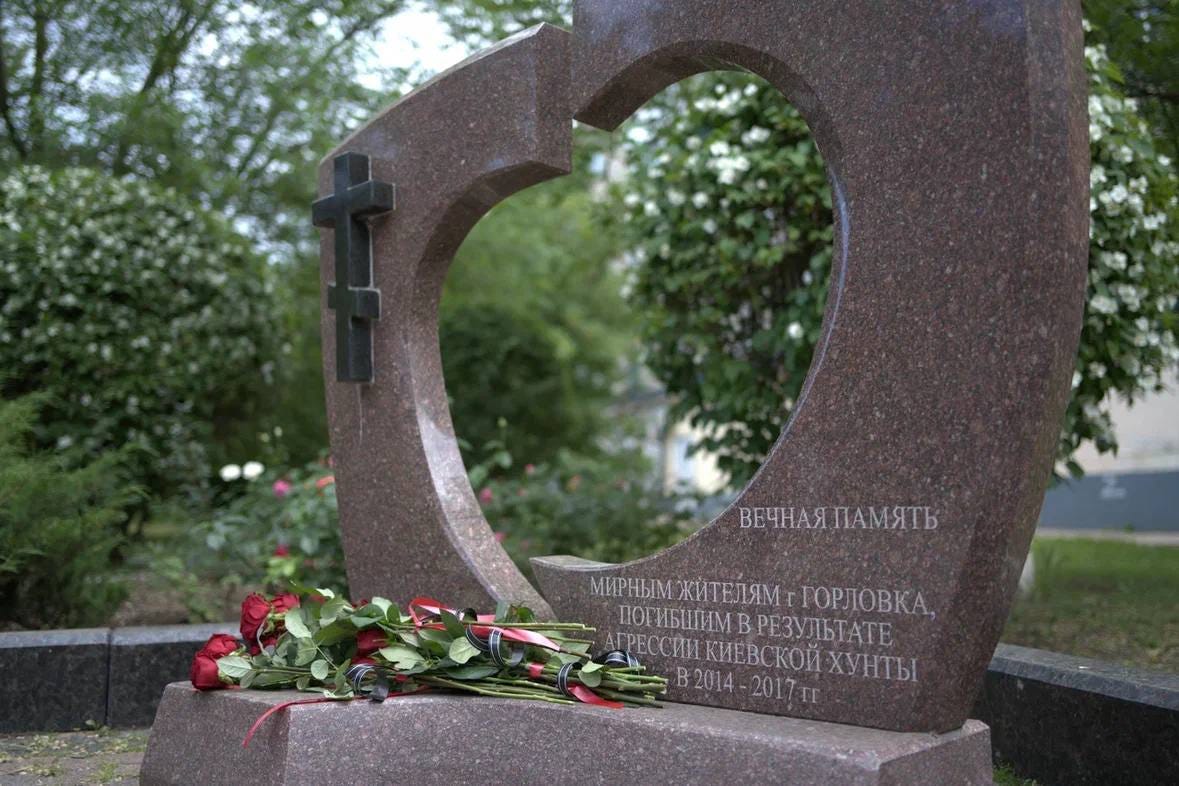
On the morning of June 11 my visit to Gorlovka was still up in the air. I was taken to the Alley of the Angels in the morning, where I laid flowers at the memorial to the children that had been killed in the fighting since 2014.
10-month old Kira Zhuk has been widely recognized as the first child victim of the conflict in the Donbas, but there have been hundreds of children who have died since.
While I visited the Alley of the Angels, the word came down from “above”—I had been cleared to make the drive to Gorlovka.
We would be going in a single vehicle—“Angor” would drive, I would be in the front passenger seat, and Alexandra, Luba, and Artyom would sit in the back.
The protocol was the same as the drive to Starobelsk—scan the horizon for drones, and call them out once seen. “Angor” would make a decision as to try to outrun the drone, or to pull over and have the passengers abandon the vehicle before the drone struck.
As we reached the outskirts of Donetsk, we found the highway covered by anti-drone netting, designed to prevent attacks from FPV drones operated by the Ukrainians. There were road repair crews at work, trying to fix the damage done to the highway by years of Ukrainian artillery fire. The vehicles of the repair crews were sitting ducks for the Ukrainian drone operators, hence the need for the nets.
The burnt out husk of Russian trucks were visible on the side of the road, as well as the blackened patches of asphalt where other vehicles had burned after being struck by Ukrainian drones.
The R-150 was practically empty as we made our way toward Gorlovka. One of the main bridges had been destroyed, and was in the process of being repaired, requiring “Angor” to take a detour that had us meandering on a windy paved road.
“Keep an eye out for drones”, “Angor” warned. “We have to slow down here, and we are very exposed.”
The sight of a car gutted by fire that had crashed into the trees on the right hand side of the road underscored “Angor’s” words. This was not a relic from times past—the car had just been attacked a few days ago.
The fate of its passengers was unknown.
We got back on the main road, and “Angor” pressed down on the accelerator. “Stay alert””, he said. “This is the most dangerous stretch.”
The R150 highway, like the city of Donetsk and its surrounding environs, including Gorlovka, was protected by what was known as the Kupol Donbassa (“Donbas Dome”) air defense system, operated by servicemen of the regional Directorate of the FSB of Russia.
The Donbas Dome is comprised of several overlapping electronic warfare systems designed to either detect, track, and destroy incoming drones, or disrupt their signals to the extent that the drones are no longer able to operate. The Dome is supplemented by mobile fire support teams—basically trucks with machine guns that roam the area of operations picking off drones that somehow evade the wall of electrons generated by the Dome.
The Russians don’t talk too much about the exact composition of the electronic warfare systems that comprise the Donbas Dome, for obvious reasons. At the time of my visit, the greatest threat seemed to be in the form of the US-made “Hornet”/”Martian-2” drone, which used Starlink satellite connectivity to get around the defenses of the Donbas Dome. According to press reports at the time, Russia had begun deploying specialized electronic warfare capability that could block Starlink signals in specific areas. But the coverage provided by these systems was too narrow for any blanket protection, meaning that windows of vulnerability existed within the Dome that were exploited by the Ukrainians on a daily basis.
The stretch of R-150 between Yasinovataya and Gorlovka was particularly dangerous, since it seems to coincide with a gap in the Donbas Dome’s otherwise impressive defensive capabilities. The drive seemed scenic enough—I always enjoy taking in the Russian countryside wherever I travel. But I missed out on whatever that 20-kilometer stretch of road had to offer, instead finding myself focused on the horizon, looking for any evidence of an incoming enemy drone.
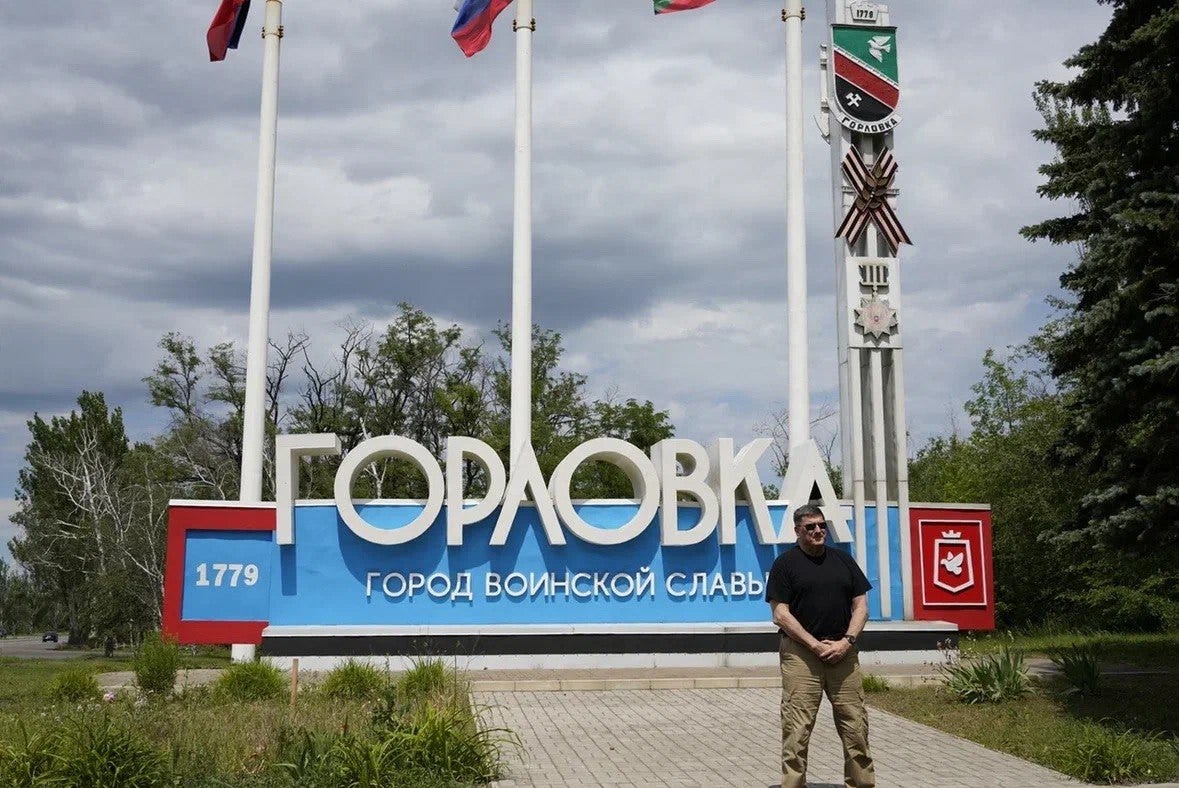
We reached the outskirts of Gorlovka without incident, and “Angor” visibly relaxed as we passed the white, eponymous blue and red painted sign announcing entry into the town.
Our destination was the Gorlovka administration offices, located at 67 Pobedy (Victory) street, in downtown Gorlovka. But because this was wartime, we did not take the most direct route. And when we finally ended up in the vicinity of the building we were to enter, we remained parked in the parking lot, waiting for someone else to decide if the meeting was going to take place or not.
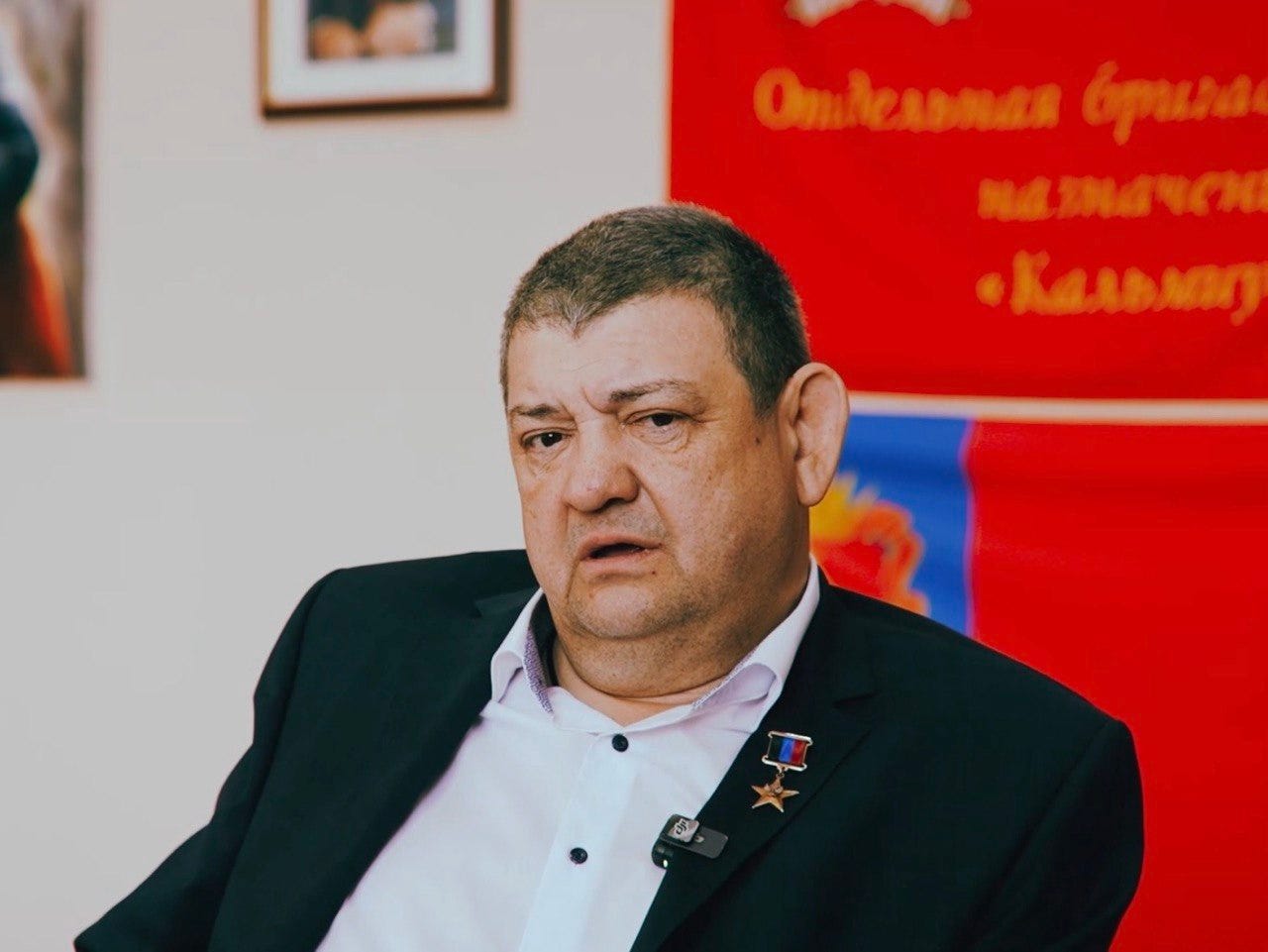
“The meeting” was an interview I was hoping to have with Ivan Prikhodko, the Mayor of Gorlovka.
Ivan wasn’t just any mayor. He was a man with a target on his head, put there by a vengeful Ukrainian government that could not forgive him for joining with the rebels early on in the Donbas’ struggle for independence. Ivan joined the Ukrainian civil service in 2006, and in 2012, he received a Master’s degree in Organizational Management from the Donetsk State University of Management.
In February 2013 Ivan Prikhodko worked as deputy head of the council for the activities of executive bodies of the council in the Voroshilovsky district of Donetsk. This was the position he held when the Maidan coup transpired in February 2014.
On April 12 Ivan Prikhodko found himself embedded with a group of Donbas citizens who were outraged over the behavior of the new Ukrainian government and, as such, decided to take matters into their own hands by storming the Gorlovka city hall. And when Ukrainian troops began their active repressions against the people of the Donbas, Ivan volunteered for military service and was assigned a leadership position in an artillery unit.
After the formation of the Donetsk People’s Republic, and once the situation on the frontline stabilized after the initiation of the Minsk agreement, Ivan served as a district administrator for the city of Donetsk until July 14, 2016, when he was appointed the the acting Mayor of Gorlovka. Nearly two years later, on June 4, 2018, Ivan was appointed the Mayor of Gorlovka.
He was serving in this capacity when the Special Military Operation began on February 24, 2022.
Early the next day, February 25, Ukrainian forces bombarded Gorlovka with artillery, killing one civilian and wounding five others. The bombardment continued over the course of the next three days, killing four more civilians and wounding 10 others.
Over the course of the next year, Gorlovka was struck by more than 9,000 artillery shells, killing 95 people and injuring another 351.
Gorlovka was but one of many locations throughout the Donetsk People’s Republic that were attacked relentlessly by the Ukrainian military. By early 2026, these attacks had resulted in some 5520 civilians being killed in the DPR since the start of the Special Military Operation, including 159 children. More hat 8630 others had been wounded, including 579 children.
Ivan Prikhodko was not immune to these attacks. On December 22, 2022, Ivan was attending a lunch meeting together with Dmitry Rogozin, the former Russian deputy prime minister and former head of ROSCOSMOS who at the time was heading up a volunteer group fighting on behalf of the DP known as the “Tsar’s Wolves.” Also present was Vitaly Khotsenko, the head of the DPR.
The meeting took place in the restaurant of the Shesh-Besh, in the city of Donetsk. Khotsenko’s bodyguard was killed, and four people injured, including Prikhoko, Rogozin, and Khotsenko.
Rogozhin had been staying at the hotel for more than a week, and was regularly conducting meetings in the restaurant, a stylish place popular among the Donetsk elite. The weapon that was used for the attack was a US-made “Excalibur” 155mm GPS-guided artillery shell fired from a French-made Caesar self-propelled artillery system.
The “Excalibur” shell is used when there is a high value target which needs to be struck with great precision. Using a combination of GPS and intertidal guidance, the “Excalibur” has an accuracy measured in terms of centimeters. All that is required is that someone load the precise coordinates of the target into the nose of the artillery shell using what is known as the Enhanced Portable Inductive Artillery Fuse Setter.
The “Exclaibur” round that struck the Shesh-Besh hotel on December 22, 2022, landed exactly where it was intended to land.
There is no doubt in the minds of those who were attacked that day that they were the intended targets of the artillery strike.
Somebody told the Ukrainians where the three men would be at the precise time the shell struck the target.
Meeting the Mayor of Gorlovka was no simple task. He was—literally—a hunted man.
Although a career civil servant, Ivan Prikhodko carries himself with the confidence of a combat-hardened soldier. This could be attributed to a number of factors, first and foremost being that he was, indeed, at one time a combat-hardened soldier (he displays as a trophy a Ukrainian flag he captured from a Ukrainian brigade he helped defeat during the critical battles around Debaltsevo in 2014-2015.)
But the main reason he carries himself like someone who has been staring death in the face for the past dozen years is because he has, in fact, been staring death in the face for the past dozen years.
Ivan not only fought in battle to help free the people of the DPR from the tyranny of Ukrainian nationalism, but he has served as the chief civil officer of a city which literally served as the front line between the Ukrainian army and the DPR militia.
This makes him one of the highest priority targets of the regime in Kiev that illegally seized power back in February 2014.
Ivan Prikhodko was a witness to their crimes from the very beginning. He is in possession of a memory the Ukrainian war criminals who have stalked him and the citizens of Gorlovka for these past twelve years would like to erase.
A Point of Interest
Two months after the Russian military began its Special Military Operation to liberate the Donbas from Ukrainian occupation, a Ukrainian military delegation arrived at the US Army Garrison, Wiesbaden, Germany, where they were taken to the Tony Bass Auditorium. Recently upgraded in 2020, the auditorium normally played host to a wide variety of military and civilian functions. At the time of the Ukrainian visit, however, it had been converted into a temporary headquarters for a newly formed US military organization known as Task Force Dragon. Named after the mascot of the US Army 18th Airborne Corps (a dragon), and commanded by the Commander of the 18th Airborne Corps, Lieutenant General Christopher Donahue, Task Force Dragon was tasked with overseeing logistical support being provided by the United States to the Ukrainian military. With the arrival of the Ukrainian generals, however, Task Force Dragon saw its mission transform from simple logistical facilitation to a warfighting headquarters that would process intelligence information about Russian troop locations into targets that could be precisely and rapidly struck using precision-guided munitions provided by the United States.
The “Excalibur” artillery shell that struck the Shesh-Besh restaurant on December 22, 2022 was directed to its target by Task Force Dragon.
Coordination between Task Force Dragon and the Ukrainian military about the operational tasking of the “Excalibur”-equipped 155mm artillery systems (M777 towed howitzers) began in May 2022. Task Force Dragon’s intelligence fusion cell, located in the basement of the Tony Bass Auditorium, would review the flow of data being collected by the various US intelligence collection platforms directed at the Russian forces operating against Ukraine, and select targets that fell into the priority categories that had been worked out between Task Force Dragon operators and their Ukrainian counterparts.
Command and control was considered a priority one target.
Once an appropriate target had been selected, then Task Force Dragon would find a Ukrainian “Excalibur”-equipped M777 howitzer capable of reaching the target, and forward the coordinates, via a Ukrainian liaison officer, to the unit involved (in the first few months of the operation this mean that that General Donahue and a few aides would be relaying the target data over a secure phone link to General Sirsky, the Commander of Ukrainian ground forces, and his staff.)
Some officers in the US European Command became nervous about the US providing targets to the Ukrainians, given the reality that in doing so the US was becoming a critical part of the “kill chain” when it came to killing Russian soldiers and their commanders.
In the end, Major General Timothy D. Brown, European Command’s chief of intelligence, determined that the location of Russian forces would be a “point of interest.”
In order to reduce the risk of Russian retaliation NATO, all “points of interest” transmitted to Ukraine had to comply with certain intelligence-sharing rules. First and foremost was the underlying principle that when it came to the use of US weapons and US intelligence, the targets that could be struck could not be on what was considered to be uncontested Russian territory.
If Ukraine wanted to strike “Mother Russia”, it would have to do so using its own weapons and intelligence.
Likewise, Task Force Dragon was not permitted to divulge the location of “senior” Russian military targets, such as armed forces chief General Valery Gerasimov
The success of Task Force Dragon was measured in Russian blood. In one particular battle, involving a Russian attempt to build a pontoon bridge across a river near the northern Donetsk city of Sieverodonetsk, an estimated 400 Russian soldiers were killed by precision “Excalibur” fires directed by Task Force Dragon.
Both the Ukrainian army and their American facilitators wanted more. By May Task Force Dragon was openly advocating for the provision of the M142 High Mobility Artillery Rocket System (HIMARS), a light multiple rocket launcher developed in the late 1990s which has seen service with both the US Army and US Marines.
Possessing a greater range than the “Excalibur” artillery shell, and able to deliver more destructive power in greater volumes, many US officers, together with a number of US politicians, including the President of the United States at the time, Joe Biden, viewed HIMARS as representing too big of an escalation, one that might prompt the Russian leadership to significantly escalate the conflict in Ukraine to include attacks against NATO and potential use of nuclear weapons.
But the idea of killing Russians in large numbers was too much temptation, and by June 2022 the decision was made to supply HIMARS to Ukraine.
There were, however, strings attached: the United States, through Task Force Dragon, would control every HIMARS strike. The US would review the targets proposed by Ukraine for attack, and then select both the launcher to be used and the timing of the attack. The US would provide the coordinates, which would be programmed into the launch control system of the HIMARS by Ukrainian soldiers using a special electronic key card which could be deactivated at any time by the Americans through the simple flip of a switch.
Every HIMARS strike was controlled by the United States.
Every single one.
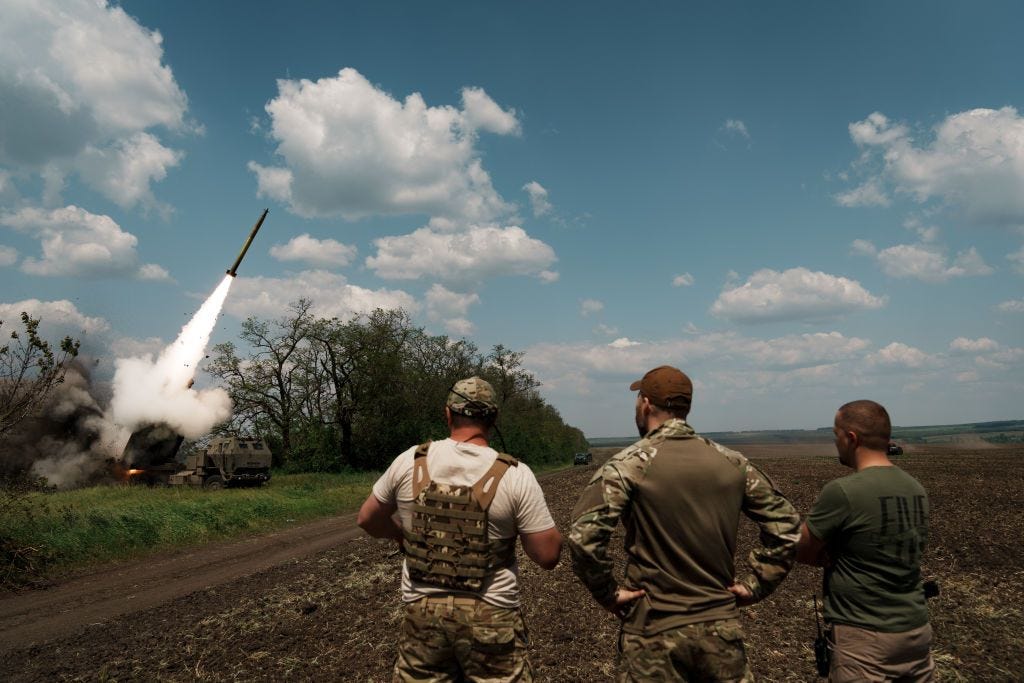
On September 29, 2023, Ukrainian soldiers belonging to the 14th Artillery Brigade fired two HIMARS rockets into central Gorlovka.
The rockets impacted in close proximity to where the Mayor of Gorlovka, Ivan Prikhodko, was working. While the rockets caused significant damage to nearby vehicles and structures, Ivan and those in his party escaped injury.
But there was no doubt in Ivan’s mind that he was the intended target of the strike.
Given the nature of his travels at the time, it is clear that the United States had dedicated specific intelligence resources on identifying, tracking and fixing Ivan’s location, which was then transmitted to a HIMARS launcher dedicated to the task of firing rockets intended to kill the Gorlovka Mayor.
Keep in mind that every HIMARS strike was controlled by the United States.
And in this case, the United States authorized an attempt on the life of a civilian administrator charged with overseeing the day-to-day activities of the city of Gorlovka.
But the United States did not view Ivan as a target per se.
Just a “point of interest.”
How to Become a Russian in one Tragic Lesson
The problem with considering oneself to be Russian back in the summer of 2014 was the reality that one could not turn to Russia for recourse to the law in the case of a horrific crime having been committed by the state against its own citizens.
When Kristina and Kira Zhuk died on the bloodied and torn grass of the park near their home that they so loved to play in, Natalya Zhuk only had one place to turn to: Kiev, and the government of newly-elected President Petro Poroshenko.
“I arrived in Kyiv on August 1 to find those responsible for the murder of my girls,” Natalya recalled. “First of all, I went to the presidential administration, under which stood the mothers of the soldiers. I wanted to talk to them. I brought photos of my girls, I wanted to talk to the mothers, I wanted to say that we have the same mothers in the Donbass, like them, whose sons are going to fight.”
Natalya was denied access, on the grounds that the President was being protected from terrorist attack.
“But why is the President guarded from me, but the President did not save my children?” she asked. “The fact that the President gives orders to kill my children—is this considered normal in our country? Why can’t we just live, raise children, just breathe? People are shot, people are killed, people fill their grief with tears. Some have lost heart after the death of their relatives, they do not know how to act and how to live with it.”
“Many have reconciled,” Natalya observed, before declaring, “I can’t accept.”
Why?
Natalya answers: “Because my children lived in a legal state. Without a declaration of war, some kind of hostilities are going on, and we are being shot. Why are all our rights being violated? Declare war, evacuate the inhabitants and fight. But that doesn’t happen. People are abandoned. Many people think that since we are from the Donbass, since we stayed there, it means that we have some point of view. And no one knows that people just want peace.”
Natalya was looking for answers. “I want to know who was shelling Gorlovka then. I assume that the ATO troops fired, but if this is not the case, let them provide evidence…I want the ATO army to provide evidence that their ‘Grad’ installations did not work on Sunday, July 27 at 14:00 and did not shell our city!”
Natalya took her case to the Ministry of Internal Affairs. She submitted a statement to the Security Services of Ukraine (the SBU), classifying the death of Kristina and Kira “on the fact of a terrorist act.”
“I want them to think about who they are bombing in these cities,” she said. “And what kind of state is this that did not protect my rights and the rights of my children to life? Why such a power, if it does not need people? A state without people? They are killing us! It’s just a shooting.”
Neither the SBU nor the police knew how to handle Natalya’s application. “Even the SBU, when accepting our applications, did not know how to draw them up and how to register them. It was the same in the police—even the higher authorities consulted on how to draw up, because we had no war before and the state had not shot people before. But since the state has taken such liberties as mass murder, let them give an explanation.”
There was no explanation to give.
The violence continued and expanded.
And new weapons were brought to bear against the civilians of Gorlovka.
The Shakhtar Palace of Culture was built in 1951. It was a well known movie theater, frequented by the population of Gorlovka to take in the latest releases. Its spacious halls and rooms were also used by the Gorlovka residents to host concerts and recitals and other cultural events. It played host to the Donetsk philharmonic and, on Saturday nights, would provide space for the children of Gorlovka to take dancing and singing lessons.
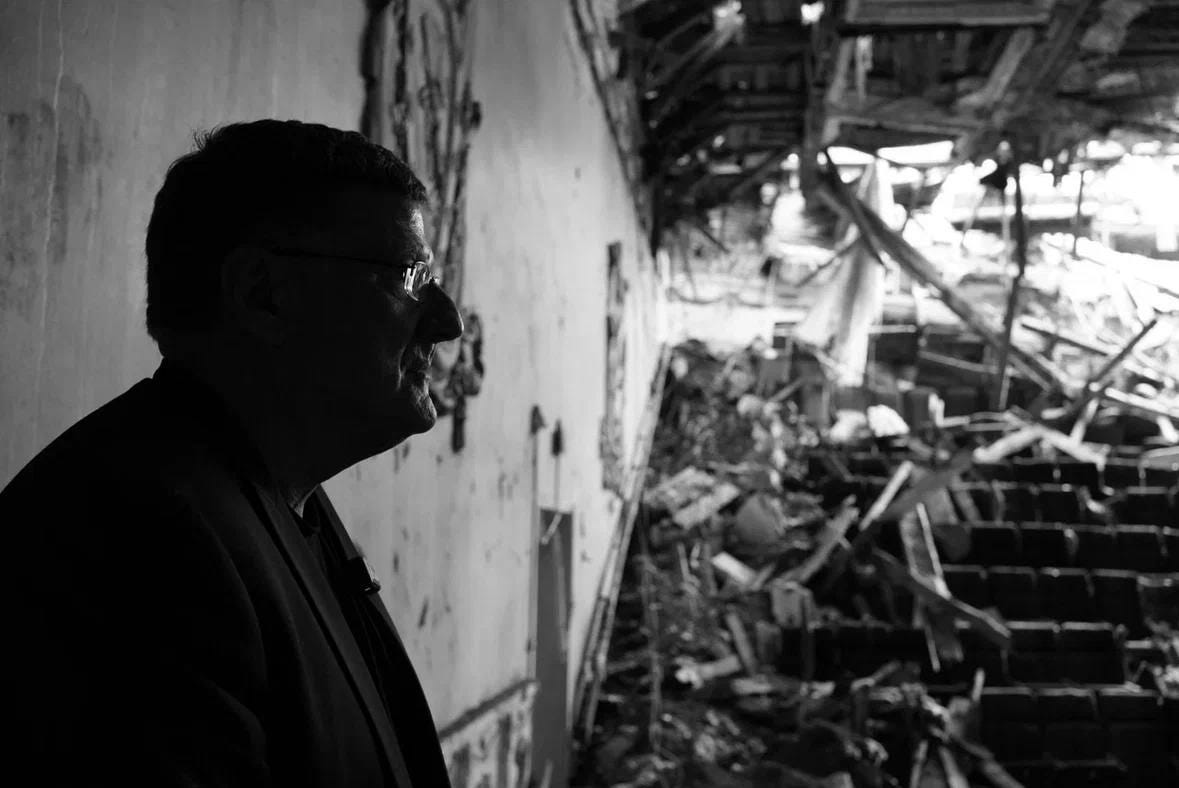
On the night of November 12, just before the scheduled time for a ballet class to begin, two HIMARS missiles tore through the roof of the the Shakhtar Palace of Culture. The room where students would have been practicing their ballet moves was destroyed, as was the movie theater.
The Shakhtar Palace of Culture was a purely civilian object, with absolutely zero connectivity to anything affiliated with the military.
On November 12, 2022, it was the policy of the United States to approve every HIMARS target.
This target was nominated by the Ukrainian military.
And it was selected by the US intelligence fusion cell, working in the basement of the Tony Bass Auditorium in Wiesbaden, as a high priority target.
General Christopher Donahue, the commander of Task Force Dragon, signed off on the attack.
Eight years before the HIMARS attack on the Shakhtar Palace of Culture, Natalya Zhuk wrote a letter to President Poroshenko’s wife, Marina.
Dear Mrs Marina!
They killed my kids! They killed my birds, my doves. Ask your husband WHY?
Why, when your children have the opportunity to laugh, learn…my children are deprived of the right to rejoice, to love, the right to breathe, the right to life?
Why? My dear, WHY?
Why are my little birds, my doves, brutally killed, torn to pieces of their bodies, their hearts?
Who gives such orders?!
What animal has no heart, no common sense?! Why is he not afraid of mother’s tears or curses?! Why decides the fate of many people?!
Ask my dear!
Who gives such orders?
General Christopher Donahue, for one.
An American.
What animal has no heart?
Everyone in the Ukrainian chain of command.
In twelve years, nothing has changed. One need only reflect on the words of Petro Poroshenko himself, addressing the citizens of Odessa on November 14, 2014, to drive this point home.
“And we win together by means of peace! Because we have jobs, and they have not. We have pensions, and they have not. We have support of children and pensioners, they have not. Our children would go to kindergartens and schools, theirs would be sitting in cellars. Because they do not know anything how to do! That’s how we are going to win this war. Because wars are won in minds, and not on the combat fields! They do not know this, but I know. And I have your support, I need it very much in order we win this war without perished Ukrainians, without perished inhabitants of Odesa.”
At the Alley of Angels, in Donetsk, I asked the Ombudsman for Children’s Rights of the Donetsk People’s Republic, who had joined me in laying flowers at the monument about what it was like to be attacked by Ukrainian soldiers back in the summer of 2014.
“It was a shock”, she said. “At that time most of the people who lived in Donetsk still considered themselves to be citizens of Ukraine.”
She paused, choking up.
“Once the first rockets hit,” she continued, “and the children lay dead, everyone of us considered ourselves to be Russian.”
The Angels of Gorlovka
All the hopes. And the aspirations collapsed.
At the hour when it is noon for us, suddenly the “hailstones” (Grad missiles)
sank on the roads and peaceful houses.
The heat is suffocating, with the smell of gunpowder.
The moaning of the trees mingled with
the sound of people, sirens wailing, people screaming.
Rustling in the sky, and the breaks
are one after the other.
A poem written by the children of Gorlovka
“I’m saying a prayer,” the child says.
“Do you do this all the time?” a mother asks.
“Yes, every day,” the child responds.
“I want there to be peace.”
Dima Krivosheev was killed in Heroes’ Square on July 27, 2014, just yards away from where Kristina and Kira Zhuk died.
He was scheduled to catch a bus to Odessa within an hour.
Dima was a great sportsman, but on that day he could not outrun death.
He was 16 years old.
Elsewhere in Gorlovka on that same day, Vika Miroshnichenko was killed by a Ukrainian mortar shell.
She was seven years old.
Nadezhda Korczak was making her way home from school. She was at a bus stop when the Grad missiles fell, killing her.
She was 17 years old.
The slaughter continued into the next month.
On August 7, Victoria Beregovaya took shelter in her family’s cottage.
A Ukrainian shell took her life.
She was 14 years old.
Also at the cottage was Nastenka Podlipskaya, and her mother, Lara.
They both perished.
Nastenka was not yet one year old.
The roll call of the dead goes on and on and on and on.
One child, one mother, one father, sister, brother.
Civilians all, killed for the crime of living in Gorlovka.
The world may have forgotten these names, but the children of Gorlovka will never allow themselves to blunder down the path of collective amnesia regarding the crimes that have been inflicted on them by the Ukrainian government.
“The Sunny Circle” is a museum room created by the staff of the Gorlovka Tourism Center. It was inspired by the work and vision of the Children’s Search Team, students from Gorlovka who made it their mission never to forget the memory of those who have fallen.
The museum is dedicated to all who have fallen in the Donbas.
I visited the “Sunny Circle” as my last stop in Gorlovka.
It is not an easy visit to make.
Too often we who have not been directly involved in the tragedies of others are inclined to pay lip service to their loss.
A token bow of the head, some minor gesticulation of the hands, and then off we go, disappearing into the cocoon of our own existence.
But I had made a promise to the victims of Starobelsk, and to the students of Lugansk, and now to the curators of “The Sunny Circle”, that I would not forget their experiences.
But my commitment went beyond a simple memory exercise.
By listening to their stories, I had committed myself to educating others about this horrible reality, this inconvenient truth that lay before us, naked to the world, if we just had the courage to see.
I watched the movie “The Angels of Gorlovka.”
It is not an easy movie to watch.
But it is mandatory viewing if one is serious about comprehending the root cause of the conflict raging between Ukraine and Russia today.
There is a right and wrong.
It is not up to me to set the moral compass of my fellow humans.
But I can make sure that they are oriented to True North when they finally muster the courage and conviction to undertake this most necessary journey of discovery.
This Trail of Tears, of which Gorlovka is a necessary stop.
“I’ll face death and sternly wave my finger,” the girl’s voice sings. “‘Go away! Go away! I want to live!’”
We drove out Gorlovka the same way we drove in—on Highway R150, the Highway of Death.
As we approached Donetsk, there was a sign welcoming us to the northern limits of the city.
The sign had been battered and heavily damaged by Ukrainian shell fire, and was still considered too exposed for any repairs to be made.
I asked if it would be possible to take a photograph of the sign.
“Angor” looked around nervously. We were still in Indian country as far as drones went—we had just passed a burnt out truck, and the destroyed car we passed on the way in was just a few hundred meters down the bypass road that took us around the destroyed bridge.
“Ok,” he sighed. “But be quick!”
We all disembarked from the vehicle, and took the requisite photos.
Even “Angor” posed for a picture.
As we made our way back to our vehicle, a car pulled up on the shoulder of the road, the window rolled down.
“Are you ok?” the driver asked. “Can I give you a ride?”
“No,” “Angor” said. “We just stopped for a picture.”
“You fools!” the man shouted, before driving away.
“To die for a photograph! There are drones around. Leave now!”
He sped off, gravel tumbling out from behind his tires.
We climbed into our car, and “Angor” drove away, sheepishly reminding me to scan for drones.
On the road to Gorlovka, there is never a moment of peace.
This was a harsh lesson, but one we fortunately were able to learn while driving away in safety.
(This article is the fourth in a series I am doing about my recent travels to the Donbas and Zaporozhia. This trip was made possible through the generous donations of readers and supporters. Future visits to Russia intended to capture the reality of that land and its people and bring it back to an American audience are being planned. Please consider donating so this important work can continue.)
Comments
Nothing yet. Say the first thing.
Sign in to join the conversation.