
New York gave birth to the first strains of punk rock in the late 1970s and England had been ground zero for progressive rock during that same time. But the true avant-garde rock was happening in the rust belt cities like Akron and Cleveland, where bands like Tin Huey, Devo and Pere Ubu came together.
Harvey Gold, who played keyboards and guitar in Tin Huey, recalls the mind frame he shared with his peers. “I used to joke that if I called [Devo vocalist] Mark Mothersbaugh and told him I was about to attach guitar pick-up to a 2X4 and run it through a VCS3 synthesizer and then throw a watermelon at the board, he would say, ‘That sounds cool,’” Gold says, adopting a flat affectation to imitate his friend. “It was a really fun and creative period of time.”
Tin Huey might not have achieved the notoriety of their other peers, though Contents Dislodged During Shipment, released by Warner Brothers in 1979, is considered something of a classic, with a blend of arty song structures, wit and a sense of adventure. “We were very much [people that thought] ‘you are what you eat,’ and we’d eaten a lot of stuff,” he says. “Some of us worked in record stores. We were turning on to all sorts of things.”
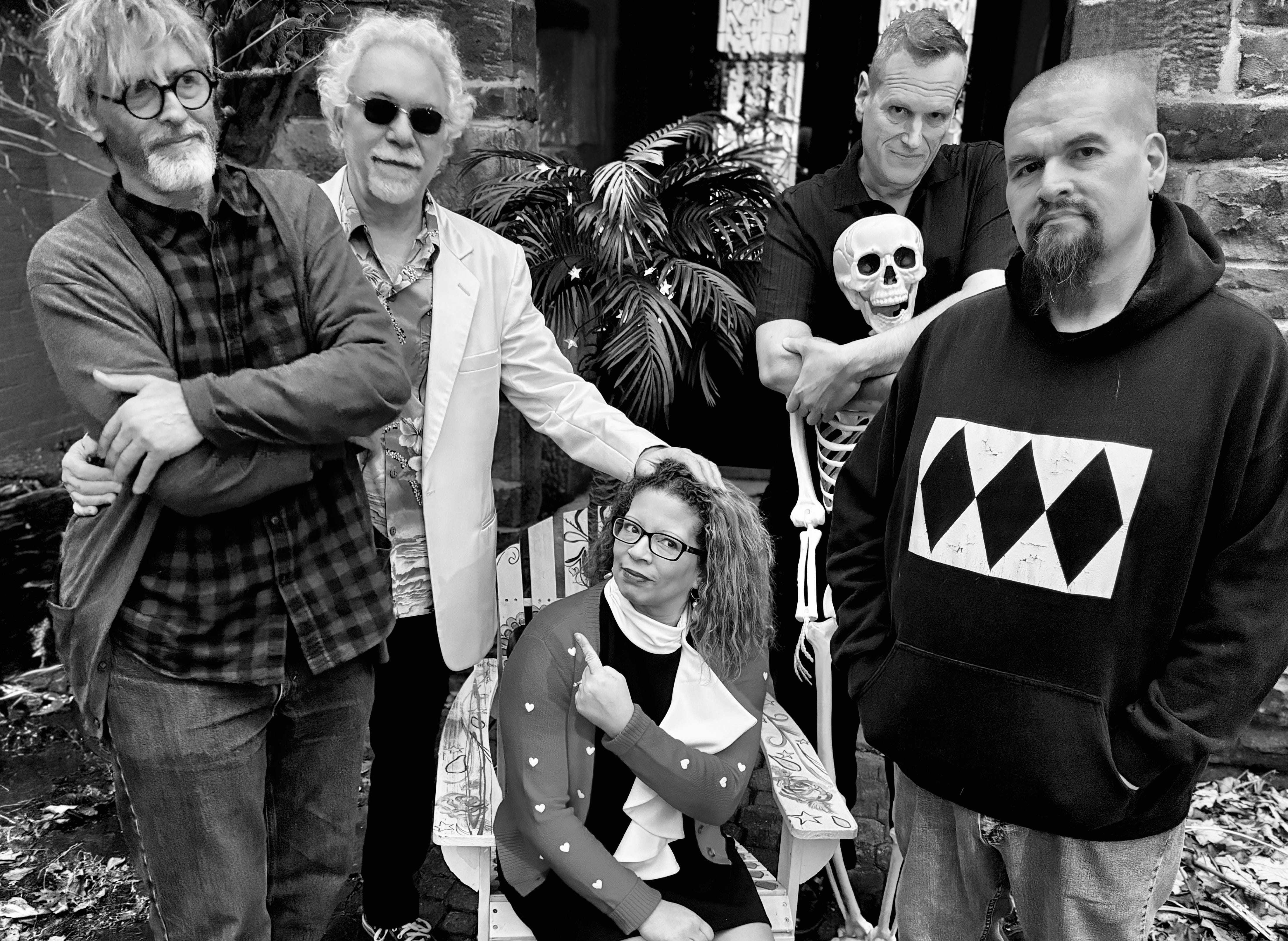
For Gold, time has done nothing to diminish his musical imagination, as evidenced by his latest project, Golems of the Red Planet. They take John Zorn’s Masada compositions – short melodies built on modes used in Ashkenazi Jewish music — and adapt them to surf music.
Masada originally served as the name of a quartet Zorn led in the ‘90s that blended the instrumentation of Ornette Coleman’s quartet (alto saxophone, trumpet, bass and drums) with skeletal compositions written on half a sheet of paper, which they turned into some exciting free bop. The structure leaves each piece open to wide ranges of interpretation, and the music has found its way into string quartets, hardcore punk, women’s acapella groups, salsa and Afrobeat.
Golems of the Red Planet came about when Gold met bassist Mark Allender, who manages the Masada World website and knew Zorn personally. The latter musician was interested in combining the Jewish modes with surf music, which is often based on Middle Eastern scales. “When Mark asked if I wanted to do this, I said sure. But the first perverse move that I made, as the geek that I am, was to say, ‘I’ve got a drummer, I’ll play guitar, you’re going to play bass. And I’m going to mess up your whole plan by making the fourth person a cellist!’ And he said okay,” Gold says, laughing. “At least he had somebody willing to do it.”
Originally a studio-only project, the band came together in 2020, filled out by drummer Bob Etherington (another Tin Huey alum) and cellist Matt Reese. (Violinist Jen Richeson joined after the group recorded their debut album, Surf Masada – A Tribute to John Zorn.) Live performances are relatively new things. In fact, their Pittsburgh visit will only be the fourth show.
Without the initial pressure to perform live, they had time to fully realize where they wanted to take the music. “For us, the actual creative process is [figuring out] what the sound quality of something should be, what the pacing of it should be and literally writing supplemental compositions to get us up to three-minute- or four-minute pieces,” he says. “Some of the things that John wrote are just like scribbles on a piece of paper. Mark will decipher them and come in with sheet music with a sort of idea of how the parts play out. And we take it from there.”
When asked how a cello and violin fit into the twangy sound of surf music, Gold turns serious for a moment. “Well, you could say they don’t,” he intones, before breaking into a laugh. “I mean, that’s part of the deal here. We dip our toe in surf. I have a trademark guitar sound. It’s a very surfy sound. And there are times that our songs have that surf beat: Boom-cha-cha/ Cha/ Boom-cha-cha/ cha. But beyond that, the point is that we are respectful to the concept of surf music, but surf music does not determine where it’s going to end up.” Sometimes the guitar takes the original melody, while other times it’s handled by the cello or violin, adding a unique spin to the textures.
At 73, Gold still continues to play in various projects, having moved back to Akron after two decades in New York. Earlier this year, he played at Cleveland’s Beachland Ballroom in a salute to the garage rock compilation Nuggets, with a supergroup that included guitarist Lenny Kaye (who curated the original two-record set) along with Gold’s Tin Huey “brother in arms” Chris Butler (who later started the Waitresses), James Mastro (the Bongos) and Don Dixon. “I had a wonderful time, and Lenny laughed at my jokes! What more can I ask for,” he says.
But he considers Golems of the Red Planet one of the more interesting projects since Tin Huey. “It’s important to me to be able to create other tableaus and other colors around what we’re doing,” he says. “As long as we feel responsible to what Zorn wrote and, to some degree the surf modality, beyond that we can take it wherever we want to take it.”
Friday, July 31. With We Take Requests. Bellefield Hall 205, University of Pittsburgh, Oakland. 7:30 p.m. $12-$15. https://events.humanitix.com/golems-of-red-planet-play-zorn-s-masada-we-take-requests-at-bellefield-hall-205/tickets
No posts
Comments
Nothing yet. Say the first thing.
Sign in to join the conversation.