
The statistical picture of quantum mechanics is an idea I had in my mind more or less as the correct picture, while occasionally simultaneously holding the gaseous nonsense that the Schroedinger equation somehow describes things the individual particles are doing. Stated simply, the modulus of the solutions to the Schroedinger equation describe a statistical ensemble of many similarly prepared quantum systems. That's what the Born rule says, and that's what the experimenter always measures. The quantum weirdness nonsense mostly comes from the idea that the wave function has some independent reality of its own, and that it is describing the motion of an individual electron or hydrogen atom or whatever. Copenhagen (sort of) and all the other weird interpretations of quantum mechanics say this. They also say the wave function collapses somehow (or we split off in the multiverse, which is even more absurd), which is actually not something in quantum mechanics. That's something pasted on afterwords.
Imagine you’re doing some classical quantum experiment, say, electron diffraction. You can detect a single electron on the multi-channel plate, but you’re only going to see the weird interference pattern when there are a whole bunch of electrons. Similarly when I do electric discharge on some hydrogen, I get the Balmer series in my spectroscope, the image of the Balmer series shows up on my photographic plate or CCD camera in a statistical way. There are no wavefunctions of individual electrons collapsing when it hits the detector as in Copenhagen or whatever Multiverse deranged acid trip view of things. The individual electrons or photons or whatever go about their business, and you only see weirdness when you look at a whole bunch of them. Some people say the individual particles have no particular individual states as they fly through the void, many others say they do. I’m inclined towards “they do” based on observation, but maybe that makes me a weirdo.
I’m on well trodden ground here: the literal and exact interpretation of the Born rule was the view of Einstein which he took great pains to state clearly, and which many of his colleagues (including Born and Bohr) actually agreed with, but they also disagreed with for weird reasons unknown to me. Perhaps he stiffed them on a dinner check or pinched their wives bottoms, or perhaps they just misunderstood each other. We know one of the Born-Einstein debates on this, Born was straw-manning something that was never said, adjudicated so by Pauli. It doesn’t really matter; most people’s views of the actual history of what uncle Albert believed is as false as their views of the Great Depression or World War-1, which were roughly contemporary events. Here’s what he clearly said:
It seems to be clear, therefore, that Born’s statistical interpretation of quantum theory is the only possible one. The Ѱ function does not in any way describe a state which could be that of a single system; it relates rather to many systems, to “an ensemble of systems” in the sense of statistical mechanics. If, except for certain special cases, the Ѱ function furnishes only statistical data concerning measurable magnitudes, the reason lies not only in the fact that the operation of measuring introduces unknown elements, which can be grasped only statistically, but because of the fact that the Ѱ function does not, in any sense, describe the state of one single system.
Then Einstein again:
The attempt to conceive the quantum-theoretical description as the complete description of the individual systems leads to unnatural theoretical interpretations, which become immediately unnecessary if one accepts the interpretation that the description refers to ensembles of systems and not to individual systems.
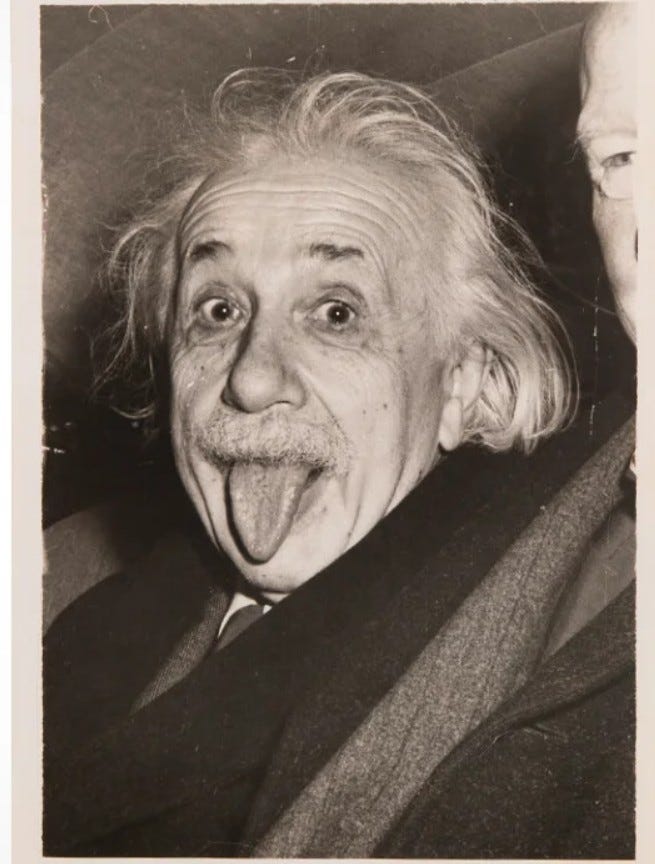
Looks right to me, and I don’t see any experimental proof that the situation is otherwise. It’s possible there could be such an experiment demonstrating that wave functions apply to individual quantum particles somehow, but nobody I know of is thinking about doing such a thing (PBR is fake and gay and doesn’t count).
At some point everyone reading this who has actually looked at quantum mechanics to the point of solving differential things, you will have seen the Hamilton-Jacobi equations. If you take the Schroedinger equation to the classical limit (ℏ→0), it is the Hamilton Jacobi equation. The Hamilton-Jacobi equations are also to be interpreted statistically. It’s solving for equal-action surfaces: that’s the wavefront piece. The ℏ piece represents our ignorance of the “microstates” of the individual particle: otherwise Schroedinger is giving us the equal-action surfaces like in the regular Hamilton-Jacobi picture. That’s why the solutions to energy conserving systems are stationary.
People rattle on about decoherence theory solving the “measurement problem.” It is an interesting effort, but the Shroedinger equation remains time-reversible and unitary. The nicest thing you can say about decoherence theory is it is a reasonable if convoluted way of deriving the Born rule, but Born didn’t need decoherence theory to derive the Born rule. There ain’t no collapsing wave functions in decoherence theory, and anyone who thinks there is doesn’t know what they’re talking about. Of course if you just look at quantum mechanics as something that tells you what the outcome of a statistical ensemble of similarly prepared systems will be, you don’t need to think about collapsing anything.
There are various experiments on single quantum systems in some sense. For example, there are quantum non-demolition experiments. These also effectively are statistical in nature, and show that you don’t get interference at the detector when you block one of the arms of the interferometer or two-slit whatever. Sure, you’re observing single photons at a time, but they behave like, well, light, which very obviously has a wavelength. They seem pretty classical to me. Bell inequality: this is 100% a statistical experiment, one involving very weird noisy detectors. Same story for Leggett-Garg inequality experiments, which is a sort of Bell inequality smeared out over time rather than space.
One that should come to mind is the Serge Haroche cavity experiments. He shot a Rydberg atom into a single photon in a “Schroedinger’s cat state” (aka circular polarization) in a cavity which performed a “measurement” on the photon’s state. Then does it again and it is measured again to be in the same state. For some reason people call this collapsing the wave function of the photon, but in reality the photon was happily doing its own thing, and Haroche measured it doing its thing, then measured it again and it’s still doing the same thing. While a considerable technical achievement, I could do the same thing with an ensemble of red and green M&Ms. Take one at random, look at it and look at it again: it’s the same! You don’t need any quantum anything to observe the M&M either.
This Simon Fraser guy Leslie Ballentine has kept the statistical picture idea alive under the term “ensemble interpretation of quantum mechanics.” I remember him from the days when I was following the quantum chaology stuff. I probably even thumbed through the first edition of his quantum mechanics book. Karl Popper of all people was also involved in the development of the ensemble interpretation. Popper rightly pointed out that quantum probabilities were kind of weird propensities rather than probabilities as conventionally defined (Bayes law doesn’t work: this is true in a lot of machine learning type probabilities as well, which should be concerning to people who use them). Ballentine’s the go-to guy for this stuff though, if you feel like reading up on it. He’s got a good textbook on quantum mechanics in general which contains some of the insights, but it’s fun to read through his various attacks on objections to the most common sense view of quantum mechanics.
....we may be reassured that mystics, psychics, and other irrationalists who have attempted to use misinterpretations of QM in support of their views have nothing to gain from this subject.
I’m a simple man, and physics is supposed to be simple rules describing reality, so we can, like, invent transistors and stuff. The Born rule pretty much says what the thing you’re measuring is. Attributing mystical many worlds to solutions of the Schroedinger equation or the act of measurement seems to be self indulgent piffle to me. At the very least, “shut up and calculate” seems to apply here, even though the observer created universe idea impresses women with large collections of quartz crystals. Born rule is the answer: the end. The other stuff is making the category error that the wave function describes the dynamics of an individual particle, or is physically real somehow. It just doesn’t. There is no evidence that it does. People should stop stabbing themselves in the eye asserting otherwise. Don’t take the cork off the fork. Personally I happen to think there’s work to do on pre-quantum stuff a la Khrennikov or t’Hooft, or Stochastic electrodynamics or Zitterbewegung (fine, the wave function is ontic here, but it doesn’t bother me in this case) or whatever, but that’s another argument. Leave Born’s rule alone and keep the cork on the fork.
Do feel free to try to convince me in the comments about Quantum Zeno (watched pots) or PBR nonsense; I’m pretty sure I have good answers to all of them. Throwing away the obvious interpretation of quantum mechanics because the fruity one sells more books is just moronic. I mean, maybe there is a good reason to do so, but Einstein’s view seems quite reasonable to me.
Comments
Nothing yet. Say the first thing.
Sign in to join the conversation.