
I was always a fan of de Broglie and Bohm’s “pilot wave“ idea. This is a fully deterministic theory of quantum mechanics which physicists don’t like because “le hidden variables” (also it isn’t yet relativistic I guess). The original pilot wave idea didn’t work out because de Broglie couldn’t calculate scattering cross sections, though Bohm later figured the multi-particle case for pilot waves, which is why his name is associated with it. John Bell of all people was also a fan of this approach. I remember early in my physics career being informed it must be nonsense by Herbert Walther and friends “Surrealistic Bohm Trajectories” paper. Apparently someone later managed to observe the surreal trajectories. It’s a shame, but it appears thinking on this stuff is insufficiently clear, the experiments aren’t telling us much. Either way, there’s a nice set of classical experiments that show us how something like this could work.
There’s a funny group of experimental physicists who simulate quantum systems with bouncing droplets on a vibrating puddle of liquid. The experiments are dirt cheap; cheap enough I am tempted to try to build one of these gizmos myself. The experimental manifestations are all in support of pilot-wave theory, and they manage to reproduce most “weird” quantum effects from quantized bound states, to spin glasses, to spin 1/2 characteristics, to Anderson localization, to the two slit experiment (sort of), to entanglement. There’s even an analog to quantum field theory. Maybe someone will try to build a quantum computard out of bouncing liquid droplets. Personally if I had one of these, I’d stick the droplets in a stadium billiard, which I don’t think has been done yet. Mostly because I have thought a little about sonic wave chaos in stadium billiards a little bit; would be fun to see what happens, though the billiard might have to be unreasonably large to be really interesting (acoustical/quantum chaos only manifests over large time domains).
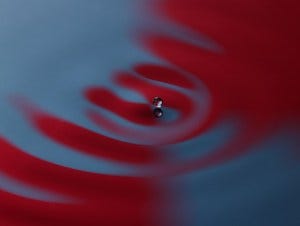
This sort of “big questions, small budget experimental physics” research meets with thorough approval from the likes of me. Sure it isn’t “real quantum mechanics” since the pilot waves are simply waves on the surface that push the droplets around via air pressure, and of course it’s limited to two dimensional experiments. But it sure looks like real quantum mechanics arising from a human sized physical system. If nothing else it allows people to reason about the numerous quantum absurdities we’ve been confronted with for over a century now.
One of the cool things about this is when you go back and contemplate the physics content of Khrennikov’s PCSFT mechanics, things sure do start looking like that. Little thing bounced around by high frequency random field. You get a diffusion/Schroedinger equation (with phase: take that complex number obscurantists); you can go look at some equations here: https://arxiv.org/abs/1401.4356
While the bouncing droplets don’t hit a particularly random field a la Khrennikov, if you squish it out spatially in addition to time, which is the kind of thing, ultimately that physics does, it probably looks Gaussian in some sense. As such, it is probably the case you can find some higher order correction to the Born rule in asymmetric potentials.
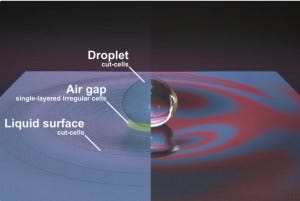
There’s a lot to unwrap with this kind of table top physics. Schroedinger equation and Born rules fall out naturally. You get an analogy to ħ in ƀ, which is defined the same way as ħ: aka mc2/ω. You get something like a Coulomb force. You get an analogue to Lorentz invariance, hence you also get analogues to magnetic forces. Hence you also get propagating waves. You get something that looks like angular momentum. You get spin-1/2 particles. That’s a pretty impressive physical analogy from a puddle of vibrating oil. Unfortunately you only get 2 dimensions, but nothing is perfect. Still very impressive and it should be the kind of thing people study in great detail to think about how the reality of how small things work in three dimensions.
Going back to Khrennikov’s views of quantum mechanics arising from interactions of random fields, if you could squeeze this sort of thinking onto this precise problem, you could probably say a lot more about the class of random fields which produce all these phenomena. The stimulating sound-waves which give rise to this phenomenon have to be constrained. Of course, the thing doesn’t work without gravity orthogonal to the pre-wave surface, but someone smarter than me should be able to constrain down the randomness down to the conditions which give rise to this sort of behavior in two dimensions anyway.
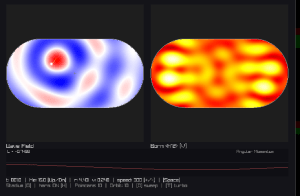
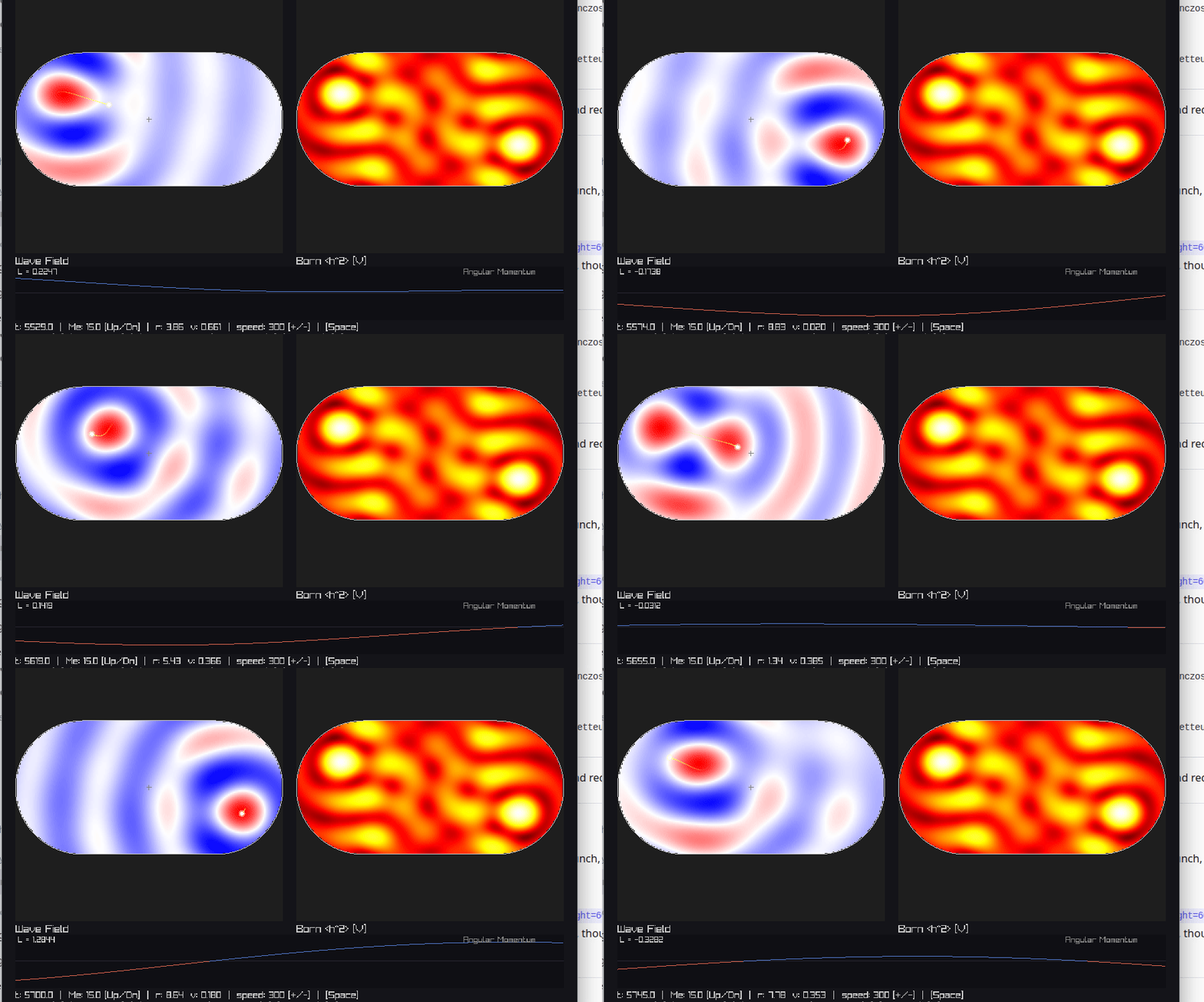
I clauded up a simple simulator which captures some of the dynamics of these things. It’s not the best a man can get, but it’s aite. Pretty sure it won’t do much which is more interesting than stadium problems, and it doesn’t really do those right (fuck doing Navier-Stokes), but it might be fun for you to noodle around with.
https://github.com/locklin/bouncing-droplets
There’s various options here which may not be obvious: G changes geometry, V changes view of stuff like the eigenmodes, histogram and Poincare surfaces of section. Up and down change some of the parameters. Looking at the Poincare surfaces, I think there’s more work to be done to get it right, but it’s OK for getting a sort of qualitative feel for how the bouncing droplets work. Most of ‘em you have to poke at it with the mouse to start the dynamics. There’s ways of slowing the dynamics down so you can look at it, and speeding it up to build up Poincare surfaces. walker is a very simple simulation; a map basically. Oza and Harmonic are two approximations which include more physics (you can read about the differences in the /docs directory). Schrodinger solves the Schroedinger equation. Billiard is the bouncing balls approximation. None of this is bug-free, I see a lot of problems with it, but looking at the Born rule for Harmonic and higher energy Schroedinger solutions, they look pretty samey. Anyway fun and cheaper than building silicon oil puddles and taking movies. I’ll keep screwing around with the code on my off hours, feel free to dump a PR if you see problems with it (there are many problems).
https://www.quantamagazine.org/fluid-experiments-support-deterministic-pilot-wave-quantum-theory-20140624/
https://dotwave.org/
Comments
Nothing yet. Say the first thing.
Sign in to join the conversation.