
In Parashat Shoftim, Moses relates the laws of the future Israelite kings, who will ultimately rule over the people once they have entered the Land of Israel. Despite his status as a monarch, the Israelite king must follow specific restrictions outlined in the Torah, including three prohibitions: he must not possess a large number of horses, he cannot marry a large number of wives, and he cannot amass a large amount of money. Naturally, the prohibitions regarding horses and capital only refer to his personal possessions; there is nothing wrong with having many horses in the king’s army, or retaining significant sums of money in the national treasury.
Interestingly, when the Sefer HaChinuch1 relates the consequences of disregarding these laws, he states that the king who amasses too many horses – defined as having even a single horse which has no purpose other than to trot before the king – is punished with lashes. Similarly, a king who marries more than eighteen wives2 is expected to divorce all those beyond this number, and is also punished with lashes. In the case of acquiring too much money, however, the Sefer HaChinuch does not mention lashes at all; instead, he writes, “His punishment is very great, for the entire people are dependent upon him; accordingly, he must give all his attention to the welfare of his nation, and not to his personal honor and the satisfaction of his personal desires.”3
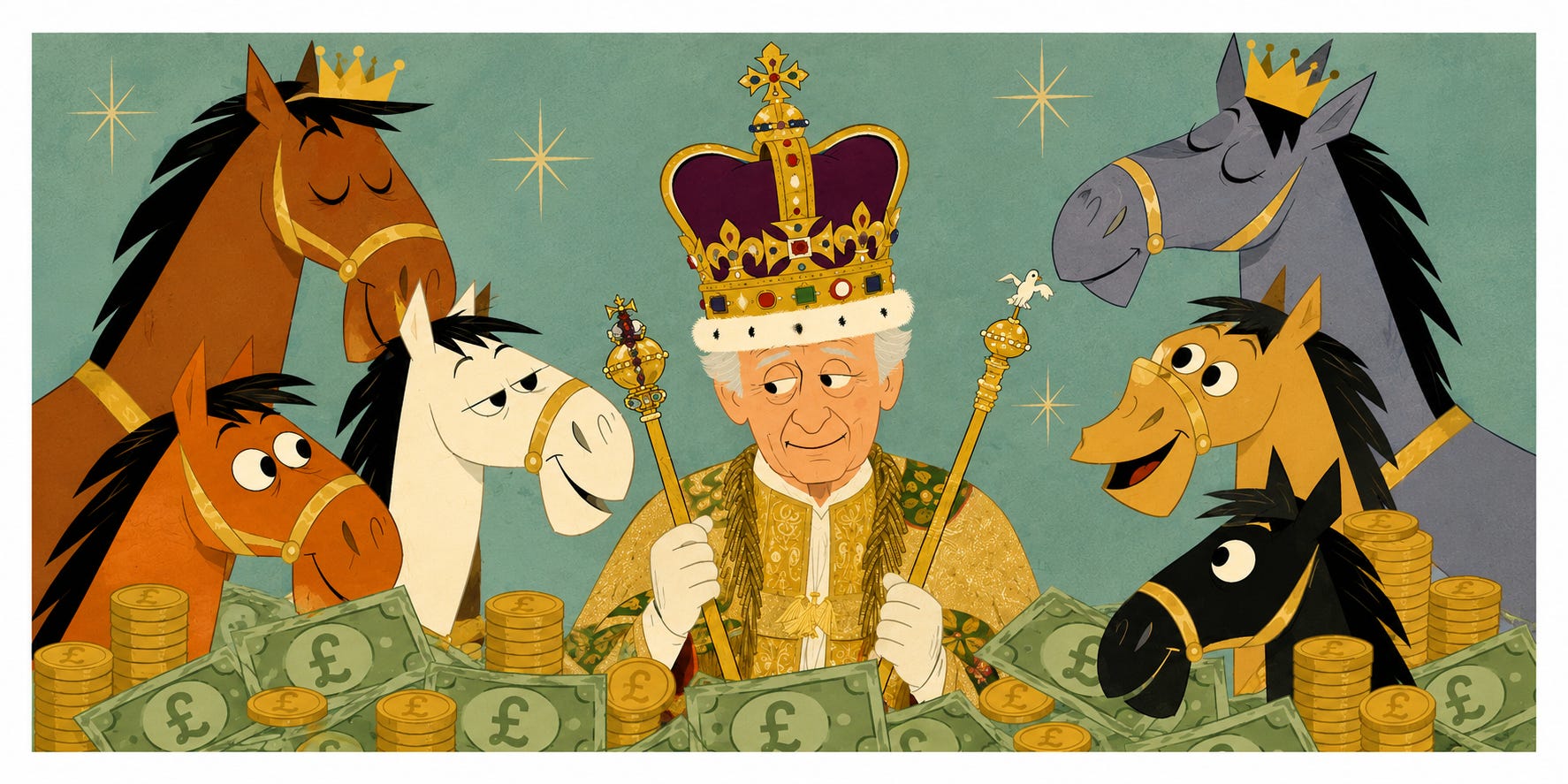
Why does the Sefer HaChinuch omit the punishment of lashes from a king who amasses an unacceptable fortune? What, in his view, distinguishes this mitzvah from the other two prohibitions? Moreover, why does he include the additional lines regarding the king’s giving his attention to the welfare of the nation, when this statement is lacking from the Chinuch’s discussion of the punishment for the other two prohibitions?
The Minchat Chinuch, while not addressing this question directly, alludes to an answer by explaining that we do not know the amount which is considered too much money, and consequently deserving of punishment. Moreover, even if that amount were known, it is difficult – if not impossible – to know if the king has violated the prohibition, given that it is dependent upon his motivation. While the amassing of too many horses can be seen through the use of an extra horse to run before the king’s chariot, there is no such easy method to determine why the king has acquired his fortune. Perhaps he plans to use it for the betterment of the people, in which case he has done nothing wrong. This ambiguity makes the determination of wrongdoing almost impossible, and impedes the practical implementation of the punishment.
Halacha, our system of divine law, has provided every individual Jew with a means to determine right and wrong. Every act a Jewish person performs can be analyzed using Halachic formulae to assess its religious value. Nevertheless, there always remain numerous activities which can only be judged based on the internal motivation of the individual. Halacha states that the unending acquisition of money is inappropriate for a king, but only the king himself knows when he has violated this norm. This analysis of the heart, the dispassionate judgment of one’s own motivations, is one of the most difficult activities for any individual to perform, for every person naturally tends to justify his own actions. Perhaps this is why the Sefer HaChinuch adds the unexpected lines, “for the entire people are dependent upon him - he must give all his attention to the welfare of his nation, and not to his personal honor and the satisfaction of his personal desires.” When there is a clear-cut prohibition, there is no great difficulty in determining if it has been violated. When the prohibition’s violation depends upon the private judgment of the individual involved, however, that individual will rarely be honest enough with himself to render an appropriate verdict.
The Chinuch thus reminds the king of what his true motivations should be. By doing this, he enables the king to analyze his own acquisition of money according to the formula he presents: does he truly have the nation in mind? Is he authentically looking out for the people rather than himself? Is his collection of capital meant to further the welfare of his subjects, or simply to enrich his own family? When one must judge one’s own motivation, that individual will likely succeed only if he is given an external means of determining what is appropriate and what is not, for the development of true self-awareness and authentic self-evaluation are among the most difficult activities possible for a human being.
This is the challenge facing every one of us as we begin to look toward the Days of Awe. The month of Elul, which begins today, is a month dedicated to authentic introspection. The shofar is blown daily at the end of Shacharit to help facilitate the weighty task before us – to help us begin, in the words of the Rambam, to “awaken from our slumber and investigate [our] actions.”4 The shofar not only tells us to improve our deeds, but also directs us to look inwardly, and to determine that which truly drives us, thereby enabling us to improve our deepest motivations from which all actions naturally flow. As the king sees his own acquisition of money through a cloudy, self- justifying prism, most people typically judge their motivations as being pure and unblemished. Elul gives us a month-long opportunity before the Day of Judgment to break through our denial, and to try to see the genuine driving forces behind everything we do.
Through an honest reckoning, and by recognizing those aspects of our character which need improvement, we can eliminate the dross, expel that which needs discarding, and prepare to enter Rosh Hashanah in a true state of righteousness.
An additional note: the laws that apply to kings may seem anachronistic in a world which has not had a Jewish monarch for millennia. Nevertheless, even without a living king, we can still learn Torah values from the rules that apply to him - and it seems clear to me that our Sages did exactly that.
According to the Sefer HaChinuch’s explanation, the three prohibitions regarding money, horses, and wives represent restraints on unrestricted materialism, untamed satisfaction of carnal desire, and a demand for honor. While these rules as such only apply to kings, the values behind them are relevant to every individual. Accordingly, just as a king who violates these prohibitions will lose his position,5 any person who ignores these values commits a serious transgression: “Rabbi Eleazar HaKapar says: Envy, lust, and [looking for] honor removes a person from the world.”6
There is also a fourth requirement for a king: namely, that he write a Torah scroll and read it all the days of his life. And in a comparable manner, Ben Zoma famously redefines four essential attributes: wisdom is a willingness to learn from every person, strength is overcoming desire, wealth is being happy with one’s lot, and honor is honoring others.7 This again seems to be an echo of the king’s three prohibitions and his obligation to study, reframed for every individual.
The laws of kings may be largely irrelevant today, but the values that they represent are as vital as ever. Particularly in a world which places a premium on fame, and in which materialism is not seen as a problem but as a desideratum, we would do well to remember that Torah values that warn against unbridled acquisition and honor, even if uncodified, remain central and essential.
Sefer HaChinuch Mitzvot 499, 501, and 502.
It is worth noting the cultural divide between the world in which the Torah was given and our own. Treaties between different states were often finalized by one king marrying the daughter of another; hence the Torah’s acceptance of a king’s marrying so many wives. Without putting too fine a point on it, these marriages were more akin to diplomatic postings than to anything comparable to our own conception of marriage.
The Rambam himself makes no such distinction, and prescribes lashes for a king who amasses too much money, as well.
Comments
Nothing yet. Say the first thing.
Sign in to join the conversation.