

Correggio, detail from Allegory of Virtues (c. 1529–1530)
Well, the election is done and dusted, and the result is as expected. Tragically, the national question up here appears to block out many concerns about everyday life and indeed about education, and so the ‘progressive’ Scottish establishment continues to rule.
Nevertheless, some of the important issues about education – not least of all the declining standards and the need for a knowledge-rich curriculum – were aired during the campaign, and we have Conservative and Reform MSPs who will hopefully continue to raise these concerns.
SUE’s job over the next five years will be to research and highlight where things are going wrong and also where things are improving.
The lack of state-funded free schools in Scotland makes it difficult to challenge or replace failing state schools, but there are efforts being made to develop some schools that are fee-paying but affordable.
We’re keen to see how these initiatives develop and are also thinking about alternative ways of educating children.
The fact that the Internet exists means that online education is now a possibility. I was thinking, for example, of creating a History of Western Civilisation course. Ideally, this would be accredited, but as there is currently no such qualification – or at least none that I can find – certification seems unlikely. Perhaps it would be worth doing anyway, simply to have it there for parents and children to access?
As well as questions about the curriculum, there is the wider issue of the types of values that schools promote.
This was one of the most interesting aspects of the discussion we had with Katharine Birbalsingh, who runs the remarkably successful Michaela Community School in England, and James Sibley, who having worked at the school is now trying to set up a similar school in Scotland.
When describing the values that Michaela promotes, Katharine put it all rather simply. Gratitude, kindness and personal responsibility were things she identified as being important, and as she pointed out, these are things that even ‘woke’ educationalists would support.
But then she explained that this falls down in too many schools today, when the idea that personal responsibility for doing your homework or behaving is replaced by a victim mentality that is encouraged in these schools. Of course, Katharine noted, all teachers want children to do their homework, but too many see the issues of racism, or gender identity, or poverty, or special needs and mental health as reasons why children should be treated differently and not be held to account by teachers.
In the end, personal responsibility is lost in this sea of victimhood, and the idea of something such as duty to others starts to disappear. The idea of making sacrifices for something bigger than yourself – your classmates, the school, your family or community – is something that is agreed with in theory but in a ‘woke world’ quickly disappears.
‘Progressive’ schools talk about being kind and caring, she pointed out, but this is a performative form of kindness – one where you describe yourself as a kind person but never actually do anything for other people.
This is a brilliant summary of what is fundamentally wrong at the heart of the social justice–based system we now have in Scotland, because it is one based on a political and therapeutic idea of kindness, as opposed to personal acts of truly useful kindness. Those subjected to this approach to education may believe they are kind because they are aware of trending causes (transgenderism, racism, etc.), but then they do nothing to help their family or neighbours, or, for example, by offering their seat to an elderly woman standing on the bus. Worse still, many have been encouraged by school-based social justice activism to adopt the grievance mindset that accompanies it, with fellow citizens cast as either allies or enemies: ‘I know these old people don’t share my kind view of the world, so f*** them. They don’t help me, so why should I help them?’
The tragedy in all of this is that through the language of kindness we are actually encouraging a generation who increasingly think only of themselves, of their identity or their supposedly virtuous feelings about the world, while doing nothing for others and, in fact, becoming increasingly distanced from their own family, neighbourhoods and community.
Small rituals of sacrifice, James Sibley noted, educate children to respect other people and think of other people ahead of themselves. These are values that are informative for a dignified life, he notes, at both an individual and a collective level. Woke values, on the other hand, are a form of political ‘kindness’ that is being indoctrinated through progressive education.
The values at Michaela, James noted, encourage a young working-class boy to grow up to be a good husband, to care about his work and the people he works with, to be a good boss and to live a dignified life. The kindness of progressive educators is one that says you should vote Labour in England (or SNP or Green), or you should care primarily about Palestine, or systemic racism, or the latest ‘correct’ cause. It all sounds very social and caring, but behind it we find individuals who are, at the level of real moral values, being educated in a miserable form of selfishness: ‘I feel therefore I am.’
The educational ethos of progressives, as Nigel Biggar explained in a previous SUE newsletter, has become one that institutionalises vices rather than virtues – encouraging intemperance, thoughtlessness, impatience, selfishness and arrogance. Katharine and James brought these ideas to light and gave a brilliant illustration of how they can be countered.
You can watch the interview with Katharine and James here.
One of the issues of concern regarding the promotion of social justice – specifically critical social justice – perspectives in education comes in the form of teaching training. Below we have a ‘pilot project’ – an initial look at the nature of teacher training in Scotland – a piece of work we hope to build upon to assess the extent to which our teachers are being trained to be not educators but social justice activists.
We are keen to talk to trainee teachers or anyone who has a knowledge and experience of what teachers are being taught. If you can help with this work, please get in touch: info@sue.scot
Stuart Waiton, SUE Chair
Jane Fenton is Emeritus Professor of Social Work Education at the University of Dundee
This paper examines the programme handbooks of university-provided teacher education in Scotland to evaluate the extent of their critical social justice (CSJ), as opposed to liberal, orientation. Eleven universities in Scotland provide teacher education, and I was able to access four programme handbooks for analysis: two undergraduate, two postgraduate. It proved very challenging to obtain the material.
The initial systematic review of programme handbooks was conducted with the assistance of Claude (Anthropic’s Claude Sonnet 4.5), a large language model AI assistant. The AI was used to:
Identify and code CSJ terminology and frameworks within the handbook documents
Create comparative tables of findings across institutions
Apply the CSJ indicator framework consistently across all handbooks
The analysis searched for two categories of CSJ markers:
Explicit CSJ or identity politics language:
Anti-racism / racist / racism
Patriarchy / patriarchal / misogyny
Heteronormativity / heterosexual / LGBTQ / transgender / gender identity
White privilege / whiteness
Decolonising / colonial
Ableism / ableist
Intersectionality
General CSJ framing terminology:
‘Social justice’ (especially when defined as systemic change)
‘Equity’ (versus equality)
‘Transformative’ (learning, practice, teaching)
‘Anti-bias’ / ‘surface bias’
‘Challenge assumptions’
‘Problematise’ (critical theory–specific term)
‘Way of being’ (identity focus)
BAME/identity-based programmes
‘Lived experience’
‘Systemic’ / ‘structural’
‘Wider societal structure’
‘Challenging meritocracy’
‘Cultural shift’
References to inequality as systemic
‘Agential’
‘Socially transformative’
All AI-generated analysis was reviewed, verified against the original source documents, and critically evaluated by the researcher. The final interpretations, conclusions and implications drawn from the analysis are the researcher’s own.
The analysis found no instances of explicit identity politics language across the four university handbooks examined. However, there were abundant examples of softer CSJ-informed framing throughout all programmes.
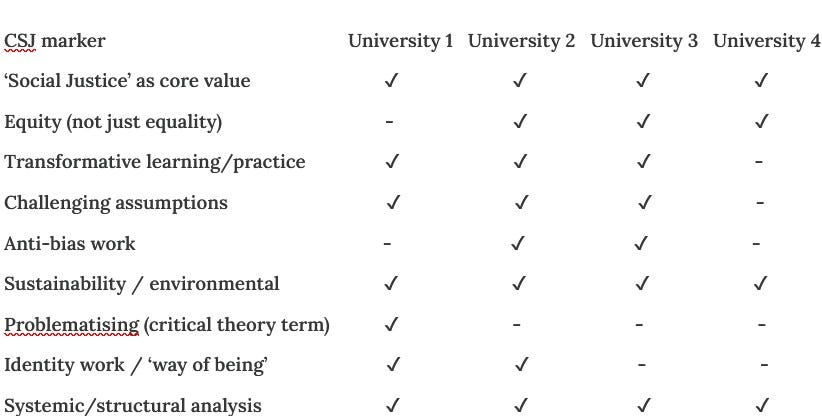
Of equal significance was the marked absence of traditional liberal education markers. None of the following appeared in any of the handbooks: knowledge transmission as primary goal; equality of opportunity (versus equity of outcome); viewpoint diversity as a professional value; multiple perspectives on contested issues; freedom of conscience for teachers; teaching as profession versus activism; evidence-based practice (without ideological framing); or neutrality and impartiality in contested areas.
The analysis provides evidence of CSJ capture at the programme level across all four institutions examined. While explicit identity politics terminology (anti-racism, patriarchy, heteronormativity, white privilege, decolonising, intersectionality) was absent from programme handbooks, the pervasive use of CSJ-framework language (social justice as core value, equity over equality, transformative practice, challenging assumptions, anti-bias work, and systemic analysis) indicates substantial ideological embedding.
The absence of hard identity-politics language from these general, high-level documents may reflect strategic ambiguity rather than ideological neutrality. The CSJ frameworks evident at programme level, particularly the emphasis on transformative practice, challenging assumptions, and systemic structural analysis, create the conceptual architecture within which more explicit identity-politics content can be introduced through module-specific teaching, reading lists, and classroom discussion. Further investigation into module specifications, required reading lists, and actual teaching materials would be necessary to determine the full extent of CSJ embedding at the content level.[1]
However, the complete absence of liberal education markers from all four handbooks is perhaps the most concerning finding. The systematic exclusion of knowledge transmission as a primary goal, institutional neutrality, viewpoint diversity, multiple perspectives on contested issues, and freedom of conscience suggests that Scottish teacher education has comprehensively rejected liberal educational principles in favour of a transformative, activist model. This is not simply the presence of one ideological framework alongside others; it is the replacement of liberal education with CSJ as the organising principle. This has significant implications for the intellectual and pedagogical diversity of the teaching profession in Scotland, for the neutrality expected in state education, and ultimately for the educational experiences of children and young people whose teachers have been trained within this monocultural ideological framework.
Note
[1] I was able to obtain a module grid for only one of the programmes and found core modules entitled ‘Race, Colonialism and Decolonisation’ and ‘Inclusion in Scottish Education: Diversity and Difference’, as well as optional modules entitled ‘Gender Justice: Feminist Approaches’ and ‘Queer Theory’.
Share Scottish Union for Education
A selection of the main stories with relevance to Scottish education in the press in recent weeks, by Simon Knight.
https://archive.ph/ZcJHf Toby Young, Worried your child is being radicalised? Try this tip. 30/04/26
https://archive.ph/LjYcF Catriona Stewart, Women to take union to court over concerns its ‘non-binary’ equality policy is unlawful. Women members of the Community union said they tried to raise their concerns internally but faced threats of disciplinary action. 02/05/26
https://archive.ph/2026.05.03-192428/https://www.thetimes.com/uk/scotland/article/scottish-pupils-are-falling-behind-how-will-politicians-help-njjv0bw6h Douglas Fraser, What Are Politicians Doing To Stop Standards Falling in Schools? We look at the curriculum changes introduced by the SNP. 03/05/26
https://archive.ph/2026.05.05-223821/https://www.scotsman.com/news/opinion/columnists/snps-track-record-on-education-has-been-unmitigated-disaster-heres-what-needs-to-happen-8498419 Cameron Wyllie, SNP’s track record on education has been unmitigated disaster. Here’s what needs to happen. Cameron Wyllie highlights the lack of focus on education in the Scottish election campaigns and the need to restore discipline in the classroom. 05/05/26
https://www.dailymail.com/news/article-15804293/Exam-board-pupils-GCSE-language-classes.html Will Hallowell, Fury as British exam board to allow pupils to use gender-neutral pronouns in GCSE language classes - despite terms not being recognised by countries. 09/05/26
https://www.gbnews.com/news/woke-madness-triggered-students-walk-out-lectures-unpunished-offended Dan MCDonald, Triggered students given the right to walk out of lectures unpunished if they feel ‘offended’ 11/05/26
https://www.telegraph.co.uk/news/2026/05/09/teach-us-quit-students-confront-striking-staff-school/ Janet Eastham, ‘Teach us or quit’: Students confront striking staff outside school. Up to 80 students taught in assembly hall by only one teacher at London school after mass walkout. 09/05/26
https://www.uklfi.com/concerns-grow-over-scottish-teachers-group-promoting-anti-israel-propaganda-in-classrooms UKLFI, Serious Concerns Raised Over Scottish Teachers’ Group Promoting Anti-Israel Propaganda in Classrooms. A teachers’ organisation in Scotland is promoting politically partisan and arguably antisemitic materials for teachers to use in Scottish classrooms including to very young children. 09/05/26
https://archive.ph/Somm3 Anon, A trans clinic is pumping my daughter full of testosterone against my wishes. The NHS has banned the use of cross-sex hormones in the under-18s, so why are private clinics still offering them? 11/05/26
https://www.bbc.co.uk/news/articles/cx21j20l9wlo Mark McCool, Pupils hopeless and crying after ‘poorly worded’ Higher Maths exam. 11/05/26
Thanks for reading the SUE Newsletter.
Please visit our Substack
Please join the union and get in touch with our organisers.
Email us at info@sue.scot
Contact SUEs Parents and Supporters Group at psg@sue.scot
Follow SUE on X (FKA Twitter)
Please pass this newsletter on to your friends, family and workmates.
Comments
Nothing yet. Say the first thing.
Sign in to join the conversation.