
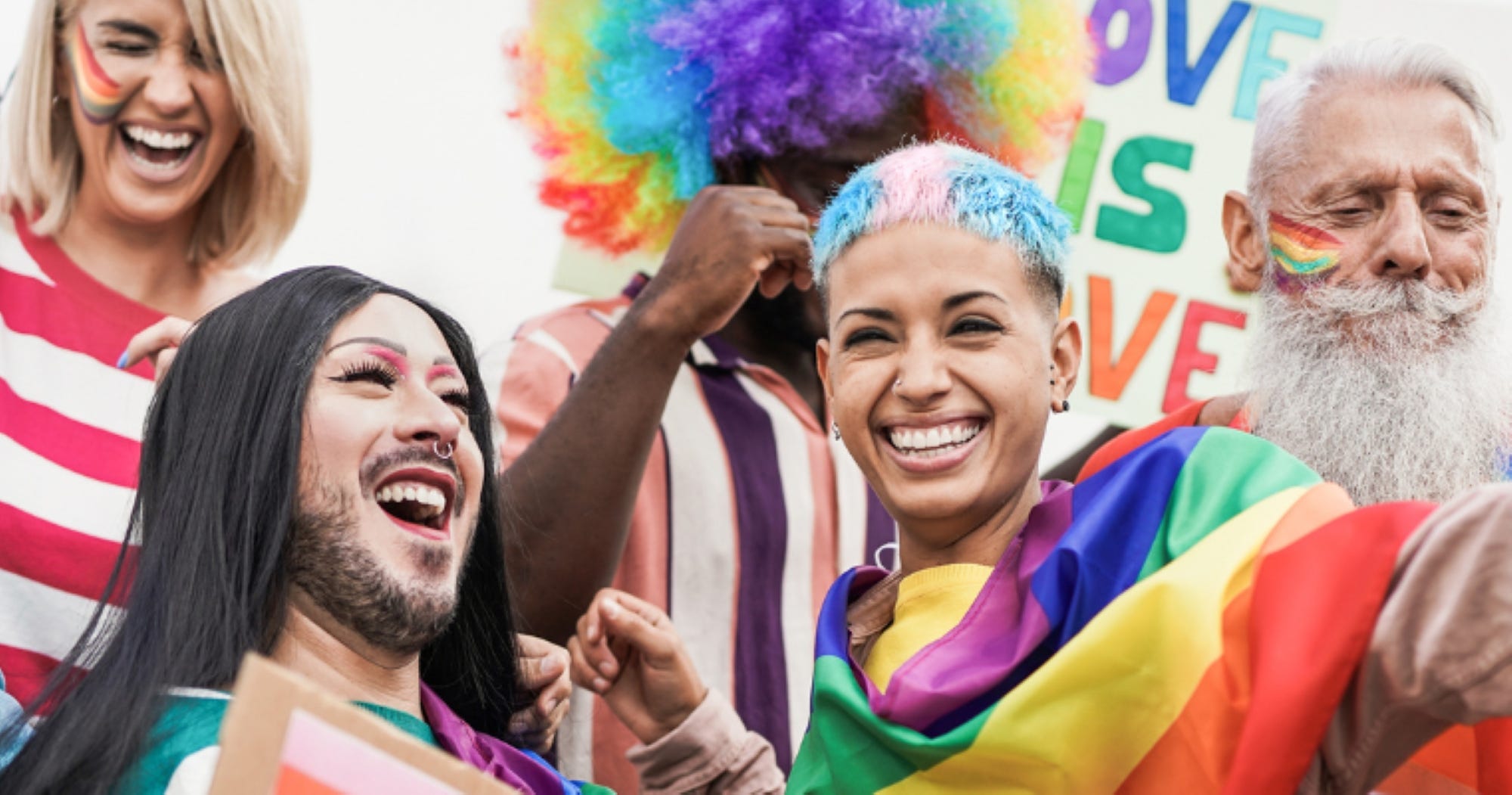
As it’s Pride Month, I thought I might take a look at some of the discussions about this ‘pride’, helped by a great article from Lucy Beney, whose work we have mentioned before. But as we have a month of ‘pride’, I thought I would save this article for next week, while making this one point.
For many people, when they see the Pride flag – or what could be said to be, in reality, the ‘trans’ flag – hanging in their school classrooms, or hoisted on university flagpoles, there is a sense that something is being imposed upon them.
The discussion is often posed in terms of a culture war, and it can feel like one outlook or set of values is pushing out another one.
There is truth to this, but alternatively, we could ask what other forms of pride are there? Or at least, what other types of pride exist within our institutions?
I raise this, because another way of thinking about the rise and rise of this one form of pride, in our schools and educational establishments, is to note that perhaps it is not (or not just) that there is this powerful, lobbying, or forceful form of pride being imposed upon us, but rather that the adoption of the Pride/trans flag, and all the apparent ‘pride’ that goes with it, has emerged because there is nothing else. Or at least, there is nothing else – no sense of pride – among significant sections of the professional class and those who now run our institutions.
If there is some truth to this, we have to ask the question, what has been lost, and why?
With this question in mind, this week’s article is about Nigel Biggar’s book The New Dark Age. Here, Graeme Arnott discusses the book and raises the question about who and what values can replace our (post) modern embrace of the rainbow world.
As it happens, I generally agree with Biggar’s approach that he spelled out in a previous SUE newsletter. But the question of values – and especially the values promoted in our schools – is one that deserves more thought, and Nigel’s book is a great starting point for this discussion.
Before that, and as we are in the process of publishing a pamphlet on reading, I thought it would be worth checking out a recent discussion about why some children are ‘unable to read by secondary school’.
Going back to my previous point, it is noticeable that in this discussion about reading in Glasgow, Councillor Aitken observes that part of the difficulty is that ‘over a quarter [...] of pupils in the city speak English as an additional language’ and that there are ‘175 different languages spoken by pupils in Glasgow’s schools’.
As a big fan of the city of Glasgow, where I lived from almost 20 years, I like the idea that this great city is, or can be, an international city of significance. However, despite the ‘diversity is our greatest strength’ mantra, the point that our ‘betters’ need to get a handle on (and quickly) is that if a city has so many different people and nationalities, it’s important that at some point, and around some key ideas, there is an assimilation or a coming together of people. And this, one would suggest, is not going to happen by enthusiastically waving a rainbow flag.
As the old politically correct poster used to say, ‘Scotland: One Country: Many Cultures’. The reality of course, is that without a cohering set of values, without pride in something other that your own culture, all we will be left with is ‘many cultures’, and no country to speak of.
The solution to the reading problem being offered is to use synthetic phonics, the very system that Scotland turned its back on, and a system that was ‘introduced in England by Michael Gove when he was education secretary’.
It is a highly welcome sign to see that some councils are now recognising the error of their ways and adopting this approach.
To get a better assessment of this change, I asked SUE contributor and reading expert Gillian Evans what she thought. This is what she had to say:
‘The most revealing aspect of this story is not that Glasgow has discovered some children are reaching secondary school unable to read. The more important question is why Scotland’s education system failed to identify and address these difficulties much earlier. In reality, Glasgow is not ahead of the curve, it is 30 years behind it!
‘The proposal to introduce systematic synthetic phonics (SSP) across Glasgow schools should be welcomed, but it is important to recognise that SSP is not a new discovery. Scotland was one of the pioneers of modern systematic synthetic phonics through the work of researchers such as Rhona Johnston and Joyce Watson more than 25 years ago. The Clackmannanshire Study provided some of the strongest evidence in the world for the effectiveness of SSP. The issue has never been a lack of evidence. The issue has been the inconsistent implementation of that evidence across Scottish education.
‘Glasgow is considering creating a register of children who cannot read. However, if Scotland’s assessment system routinely measured and reported reading attainment in a meaningful way, such a register would already exist.
‘The Scottish National Standardised Assessments (SNSA) do not provide parents, schools or policy-makers with a clear measure of reading age. As a result, pupils can progress through the system without anyone having a transparent understanding of whether they are reading at, above or below age expectations. A separate register of non-readers is effectively an acknowledgement that the current assessment framework is not providing the information needed to identify literacy failure early.
‘A child does not suddenly become a non-reader at the age of 12. Reading difficulties are typically identifiable within the first years of schooling and can often be corrected through timely intervention. When a pupil reaches secondary school unable to read, this represents a failure of identification, monitoring, intervention and accountability.
‘The lesson from Glasgow should therefore not simply be that more phonics is required. The lesson is that Scotland already possessed much of the necessary evidence over two decades ago but failed to ensure its consistent implementation. Future reform must focus on evidence-based instruction, routine monitoring of reading attainment, transparent reporting to parents, and early intervention before literacy difficulties become entrenched.
‘If reading attainment were measured and reported with the same rigour that we expect in public health, schools would not need to create separate registers of non-readers. They would already know who these children are, when they first began to fall behind and what support they needed to catch up.’
It would appear that our ‘progressive’ educators may be learning their lesson on this fundamental question of reading. Perhaps I would suggest that they also set their minds to thinking more broadly about how to create a country that inspires a sense of pride among all of the children, from all of the different backgrounds, about being Scottish and British. Then perhaps, children from different cultures, helped by an education system that actually knows what it is doing, will have a passion and drive to learn to speak, read and write one of the world’s great languages.
Stuart Waiton, Chair of SUE

Graeme Arnott works as a vocational assessor with apprentice electricians. He’s currently reading lots of C. S. Lewis.
Nigel Biggar is an Oxford moral philosopher and theologian who has spent recent years being monstered by the very institutions he spent his career serving. He is therefore not writing about the culture wars from a safe distance. He has been smeared by association, misrepresented, and professionally intimidated by colleagues he naively expected to share a commitment to honest inquiry. His experiences give this book something that purely academic treatments of the subject lack: the authority of testimony.
His central argument is straightforward and, once stated, one difficult to dispute. The culture wars are real. They are not, as some on the Left would have us believe, a distraction manufactured by conservatives to deflect from economic grievance. The culture war is a fundamental clash over our past, our present and our future. And, as such, there are fronts in every institution, every area of life that defines a genuinely healthy civil society. Habits of being are systematically driven out and replaced by ideological enforcement, bad-faith argument, and the professional intimidation of dissenters. The result, Biggar warns, risks a new dark age of conformity and institutional failure ushered in not by fanatics alone but facilitated by the accommodation and acquiescence of those who should know better.
The book is at its most compelling in its personal account of the intellectual vices corroding academic life. Biggar names names and cites chapter and verse. This is a grippingly furious book which makes it difficult to put down. But Biggar’s fury is always controlled fury; and that control makes its reading even more compelling. In one striking chapter, to keep his temperature down, he refers to himself in the third person. It is a small, wry detail that reveals the discipline the book demands of itself and implicitly of its readers.
His constructive response is rooted in the tradition of J. S. Mill. What is needed, Biggar argues, is not less liberalism but better liberalism (an argument that reminded me of the argument made by socialists with regard to the Soviet Union). What is needed, Biggar argues, is a muscular recovery of the intellectual virtues that Mill identified as the foundations of free inquiry: self-control, patience, charity, humility, respect for opponents acting in good faith, and the courage to speak clearly. These are the foundational virtues upon which the entire edifice of academia rests. Without them, the institutions which we depend on for truth-seeking will accelerate their drift toward enforced intellectual conformity.
So far, so compelling. But then there is the book’s subtitle: Why Liberals Must Win the Culture Wars. That subtitle coloured my entire reading of the book. It is a striking formulation from a Conservative peer who has been careful throughout to distinguish between the civility of liberal approach at getting to the truth, and liberalism as ideology. The distinction, that transformation from liberal to liberalism, is highly significant for Biggar’s argument. But it raises a question that the book doesn’t quite answer: if the Millian method and the liberal ideology are as separable as Biggar states, why have liberal institutions so consistently chosen the latter over the former? The universities, the museums, the professional classes are not illiberal outsiders who have captured liberal institutions from outside. They are the liberal establishment, doing what liberal establishments, given sufficient time and autonomy, apparently do. There was no need for liberalism to knock down the castle’s walls because the liberals were on the inside sitting at their desks.
This brings us to the irony, or the fundamental problem, at the heart of the subtitle. The call for liberals to win the culture wars may be less a strategic prescription than an expression of guilt. To ask liberals to cure what liberalism has produced is not unlike asking the Conservative Party to repair the damage of 14 years in government. The diagnosis may be accurate. The diagnostician may be entirely sincere. But the prescribed agents of change have already demonstrated that they were part of the problem. I think the people in this country have had enough of experts, Michael Gove once famously said. It might well be the case that we’ve had enough of liberals too.
This is not a reason to dismiss the book. Quite the opposite. Biggar’s diagnosis is precise, his evidence is carefully marshalled, and his account of the intellectual virtues required for genuine truth-seeking is as clear a statement of what has been lost as you will find anywhere. For those working in Scottish education, in museums, in public institutions of any kind, this book provides both intellectual backbone and practical orientation. It clarifies why isolated battles over curriculum content or open debate feel connected to larger forces: because they are.
Read it for the diagnosis. Read it because Nigel Biggar is a good man who has been treated shoddily. Read it and admire it for the courage it took to write. But when you read it, bear in mind that subtitle. Because if not the liberals, whom?
The New Dark Age: Why Liberals Must Win the Culture Wars.
Nigel Biggar, Polity, £20.00
Share Scottish Union for Education
A selection of the main stories with relevance to Scottish education in the press in recent weeks, by Simon Knight.
https://archive.ph/oGx72 Josephine Bartosch, Institutional feminism against women. The likes of Julia Gillard and Jess Phillips have enabled misogyny. 31/05/26
https://archive.ph/dKr1q Daniel Sanderson, Murrell ‘trying to protect’ Sturgeon over items dropped in plea deal. Purchases including women’s sportswear and briefs and hair stylers were remov from the indictment before Peter Murrell pleaded guilty in the embezzlement case. 03/06/26
Biology in Medicine, Response to NHS England consultation on cross-sex hormones in children. Clinical policy for prescribing of masculinising and feminising hormones for children and adolescents who have gender incongruence or dysphoria. 03/06/26
https://archive.ph/gPFKv Joanna Williams, Gareth Southgate has exposed the real crisis young men face in Britain. The toxic masculinity panic gripping our nation ignores the true challenges and lived experiences of white working-class boys 05/06/26
https://archive.ph/aMaVj Janice Turner, Please, don’t bring your whole self to work. 05/06/26
https://news.stv.tv/west-central/some-children-unable-to-read-by-secondary-school-glasgow-councillors-hear Sarah Hilley, Some children ‘unable to read by secondary school’, councillors hear. It comes as Glasgow primary schools are rolling out a new system to ensure every child can read 06/06/26
https://archive.ph/yxgOl Albert Tait, Oxford professor cancels lectures after abuse from pro-trans protesters. Law academic abandons series of talks following interruptions from ‘intimidating’ activists. 07/06/26
Sarah Phillimore, The police have a duty to be impartial. 11 months after victory against Northumbria, we are here again against Wiltshire Police. Of all the organisations we have lost to gender identity, the police are among the most serious casualties. 08/06/26
https://www.spiked-online.com/2026/06/08/starmers-social-media-ban-is-driven-by-pure-hysteria/ Joanna Williams, Starmer’s social-media ban is driven by pure hysteria. The PM’s crackdown on teens’ social-media use is illiberal, irrational and will have vast unintended consequences. 08/06/26
https://archive.ph/yQwfl Georgia Lambert, Number of children with Send support plans rises 11.6% in a year. The total number of pupils classed as having special educational needs has risen to 1.9 million as ministers promise to overhaul ‘unsustainable’ system. 11/06/26
Thanks for reading the SUE Newsletter.
Please visit our Substack
Please join the union and get in touch with our organisers.
Email us at info@sue.scot
Contact SUEs Parents and Supporters Group at psg@sue.scot
Follow SUE on X (FKA Twitter)
Please pass this newsletter on to your friends, family and workmates.
Comments
Nothing yet. Say the first thing.
Sign in to join the conversation.