
The morning mist that clings to the dark, peaty waters of Loch Kinnord has always possessed a quality of profound stillness, acting as a veil over the deep history submerged beneath its surface. In the early years of the nineteenth century, the loch sat in quiet isolation, shadowed by the brooding mass of Morven and surrounded by a landscape that had witnessed centuries of blood, rebellion, and Highland feudalism. The Gordon family had long dominated this territory, their legacy etched into the very soil of Aberdeenshire. Yet, by the spring of 1805, the era of clan chieftains and fortified island strongholds had definitively passed. The sharp ring of swords had been replaced by the rhythmic strike of the stonemason’s hammer and the meticulous scratch of the surveyor’s pen. Scotland was in the throes of a sweeping agricultural and industrial transformation, and the relentless march of progress demanded infrastructure. It demanded roads, enclosures, and most critically, bridges to span the rushing rivers that carved through the glens.
To stand on the shores of the loch in 1805 was to stand on the precipice of a new, uncompromisingly pragmatic age. The Scottish Enlightenment had trickled down from the philosophy halls of Edinburgh into the calloused hands of estate managers and local engineers. The natural world, along with the crumbling ruins of the medieval past, was no longer viewed with superstition or romantic reverence. It was viewed as a quarry. The landscape was a repository of raw materials waiting to be harnessed for the economic salvation of the North. This utilitarian zeitgeist would soon bring a crew of laborers to the tranquil shores of Loch Kinnord, armed not with the antiquarian’s gentle trowel, but with block, tackle, and an insatiable hunger for timber.
The immediate catalyst for the tragedy that would unfold at Loch Kinnord lay a few miles away on the banks of the River Dee. The settlement of Ballater was undergoing a rapid transformation. Founded in the late eighteenth century as a spa town to capitalize on the purportedly healing waters of the nearby Pannanich Wells, Ballater was swelling with visitors and commerce. To facilitate this burgeoning local economy, a vital piece of infrastructure was required: a robust stone bridge over the formidable River Dee.
Constructing a stone bridge across a river known for its powerful, sweeping currents and devastating winter spates was a monumental engineering challenge. The masons had ample access to local granite to build the soaring arches, but securing the foundations deep within the riverbed presented a severe logistical hurdle. To stabilize the stone piers, the engineers required massive quantities of enormous, durable timber piles to drive into the riverbed. Procuring, felling, and transporting fresh oak of sufficient girth and length from the surrounding depleted forests would have been an incredibly expensive and time-consuming endeavor.
The engineers and estate managers cast their eyes across the landscape for a cheaper, more immediate solution. Their gaze settled on Loch Kinnord. Local memory and the visible remnants jutting from the shallow waters near Castle Island confirmed what the locals had always known: a colossal medieval drawbridge had once connected the island fortress of the Gordons to the northern shore. For generations, these massive wooden bones had rested silently in the mud. To the modernizers of 1805, this was not a sacred archaeological site or a monument to the region’s heritage. It was a sunken stockpile of perfectly seasoned, free lumber. The decision was made with brutal, bureaucratic swiftness. The ancient drawbridge would be cannibalized to build the future.
To understand the sheer magnitude of what was destroyed, one must look at the architectural marvel the laborers were tasked with dismantling. The drawbridge of Loch Kinnord was not a flimsy wooden gangway. It was a massive, highly engineered defensive structure designed to withstand sieges and support the weight of armored men, horses, and heavy supplies. It formed the vital artery to Castle Island, a site that had seen human habitation since the Iron Age when the first inhabitants drove timber into the loch bed to create artificial islands known as crannogs.
By the time the Gordon family utilized the island as a stronghold, the bridge had evolved into a formidable piece of medieval engineering. It spanned approximately two hundred yards of open water. The foundation of this bridge relied on rows of gargantuan oak trunks, some measuring over thirty feet in length and more than a foot in diameter, driven vertically deep into the glacial till at the bottom of the loch. These upright piles were then intricately mortised and connected by massive horizontal coupling beams, secured with heavy wooden pins.
Because the oak had been submerged in the cold, anaerobic mud of the loch for centuries, it had not rotted. Instead, the lack of oxygen and the dark peat water had acted as a perfect preservative. The wood had cured over hundreds of years, transforming into a dense, blackened material that was practically as hard as iron. This ancient timber had survived the elements, the freezing winters, and the turbulent history of the Highland clans. It had borne witness to the rise and fall of Earls and Marquises. Now, its very durability—the brilliant engineering of forgotten craftsmen—sealed its doom.
The physical extraction of the drawbridge in the spring and summer of 1805 was a grueling, violently destructive process. There was no careful cataloging, no sketching of the mortise joints, and no consideration for the historical context of the site. The objective was purely extractive. Men waded deep into the freezing, dark waters of the loch, feeling blindly in the silt for the massive wooden crossbeams.
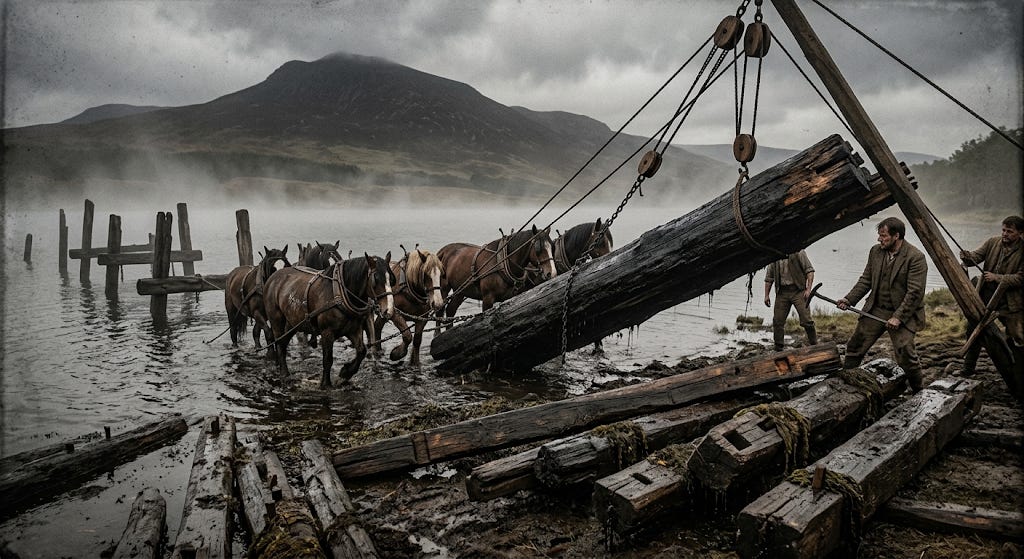
Heavy ropes and iron chains were wrestled beneath the submerged wood. On the northern shore, teams of heavy draft horses were harnessed to complex systems of block and tackle. When the signal was given, the horses strained against their collars, their hooves tearing deep trenches into the muddy banks. The loch protested the theft. For centuries, the mud had swallowed the oak, creating an immense vacuum of suction. The laborers had to break the seal of the earth itself.
The air filled with the sharp, cracking sounds of ancient wooden joints being torn apart by brute force. Massive coupling beams, intricately carved by medieval adzes, were snapped or violently dislodged. As the enormous blackened oak piles were finally wrenched from the loch bed, the water boiled with centuries of disturbed silt, releasing the heavy, sulfurous stench of ancient rotting vegetation. One by one, the colossal monoliths of the drawbridge were dragged onto the shore, dripping with mud and lake weed.
The laborers systematically worked their way across the water, erasing the structural footprint of the bridge pile by pile. Once on land, the majestic timbers were treated as mere raw material. They were loaded onto heavy timber wagons, the iron-rimmed wheels grinding into the dirt tracks as the convoy began the slow, arduous descent toward Ballater. The site at Loch Kinnord was left scarred, a chaotic underwater ruin of splintered wood and displaced stones, the structural integrity of the ancient crossing completely annihilated.
The oak of Loch Kinnord ultimately found its new home in the rushing waters of the River Dee. The massive, blackened timbers were driven into the riverbed to form the stabilizing foundations for the Ballater bridge. The masons laid their heavy granite blocks upon the ancient wood, and the sweeping stone arches rose to connect the banks of the river. The project was hailed as a triumph of modern engineering and civic improvement, a vital artery that would bring wealth and connectivity to the region.
Yet, the irony of this triumph is profound. The grand symbol of nineteenth-century progress literally rested upon the butchered remnants of the medieval past. The engineers of 1805 did not realize the catastrophic loss of archaeological data they had orchestrated. They had erased a primary physical link to the ancient methods of warfare, architecture, and daily life in the Highlands, trading irreplaceable historical knowledge for a few months of saved labor and material costs.
Twenty-one years later, during the devastating drought of 1826, the waters of Loch Kinnord would recede drastically to feed a failing local mill. The retreating waters exposed the muddy floor of the loch, revealing the broken, jagged stumps of the drawbridge piles that the 1805 laborers had been unable to extract. These shattered remnants stood like gravestones in the drying mud, a silent, haunting testament to the violence of progress, and a tragic reminder of the magnificent ancient highway that had been sacrificed on the altar of the modern world.
Adapted from: Michie, J. G. (1877). History of Loch Kinnord.
No posts
Comments
Nothing yet. Say the first thing.
Sign in to join the conversation.