
The biting frost of January 1767 gripped the shores of the Firth of Forth. Down in the coastal village of Grangepans, the salt works belched thick, acrid smoke into the winter air, a constant reminder of the grueling industrial labor that defined the lives of the local commoners. But inside the small, dimly lit home of Robert Scott, a salt watchman, the industrial din felt miles away. A terrible quiet had settled over his hearth. On the twentieth of January, his infant son had died.
The child lay in the center of the room, as one witness would later recall in official depositions, “coffined and mortclothed, and all in decency.” Yet, the grief of Robert Scott and his wife was about to be eclipsed by a violent clash of social classes, ancient rights, and the relentless march of aristocratic estate improvement.
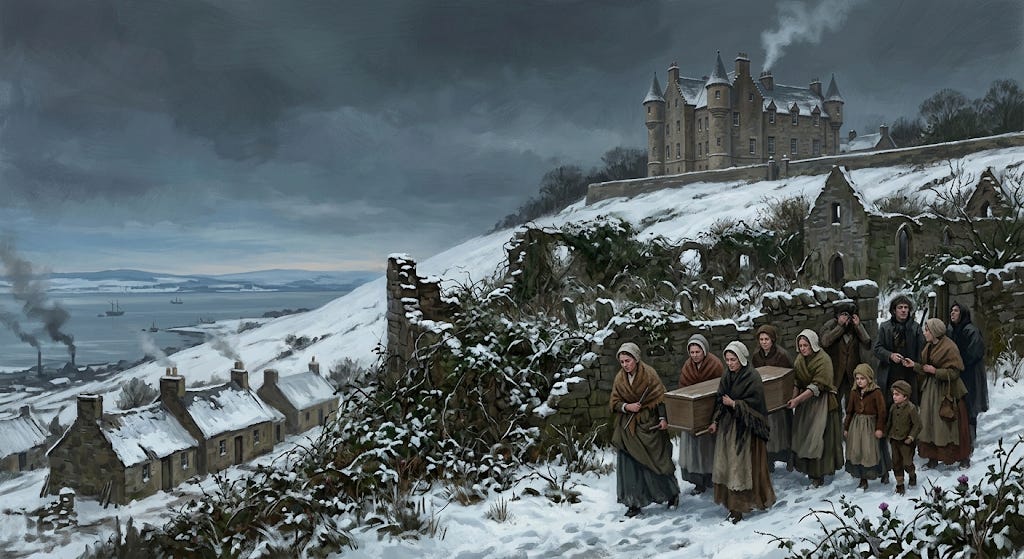
To understand the riot that was about to engulf Grangepans, one must look up the hill toward the grand, turreted mansion of Carriden House. For centuries, the local parish church and its ancient burying ground had sat just a stone’s throw from the manor. It was a feudal arrangement, a place where generations of the local working class—salters, sailors, and miners—had laid their dead to rest in the shadow of the great house.
But by 1765, the estate’s owner, Colonel Campbell Dalrymple, had grown weary of looking out his windows at a crumbling churchyard. Arguing that the church dykes were ruinous, the Colonel and the local heritors successfully petitioned to move the spiritual center of the parish to the village of Cuffabouts. The old church was abandoned. The ancient graveyard was closed. The parishioners were instructed to take their pews and their dead to the new site.
The old burial ground near Carriden House was left to the mercy of the Scottish weather. Unkempt and entirely unmaintained, it quickly became an impenetrable thicket of wild nettles, thistles, and creeping raspberry bushes. Yet, despite its wretched condition, the people of Grangepans and Muirhouses fiercely fiercely fiercely clung to it. It was the earth that held their ancestors. It was the soil that held Robert Scott’s three other deceased children. He was not about to leave his infant son alone in the sterile new ground at Cuffabouts.
On the morning of January 21st, Robert Scott walked to the village of Muirhouses to find Thomas Brown, the parish beadle and gravedigger. His instructions were quiet but clear: dig a grave in the old, ruined churchyard of Carriden.
Word of Scott’s errand spread through the coastal villages like wildfire, but it carried a deadly distortion. Rumors swirled that Scott, pressured by his superiors and the promise of a bribe, had actually ordered the grave dug in the new churchyard. To the fiercely independent locals, this was a betrayal. Yielding to the heritors’ new burial ground meant surrendering their ancestral rights forever.
As Scott walked home toward Grangepans, near the area known as Coulthenhill, a mob descended upon him. Men and women, armed with sticks and packed snowballs, surrounded the salt watchman. They beat him relentlessly, shouting threats and demanding he change his mind. Bleeding and battered, Scott barely made it back to his home.
But the mob was not finished. That evening, they besieged his house. They broke open his doors, attempting to physically seize the tiny coffin and carry it to the old churchyard themselves to force the issue. Only after desperate pleading did they retreat, though they spent the rest of the freezing night hurling stones at Scott’s door, shouting threats into the darkness until three in the morning.
The next day, the tension in Grangepans reached a breaking point. The bellman walked through the town, ringing his bell and announcing the afternoon burial in the old churchyard. He arrived at Scott’s house with the wooden hand-spokes used to carry the coffin.
But the local gentry had also heard the bell. Sir Alexander Brown, a man of significant local authority and a staunch supporter of the new churchyard, arrived at Scott’s door. He stepped inside the small, crowded house and delivered a swift, chilling command. Within minutes, the bellman was sent packing. The funeral was officially halted. Sir Alexander emerged, telling the gathering crowd that he had “got orders to go away.” The establishment had put its foot down.
Robert Scott was trapped. If he obeyed Sir Alexander and used the new churchyard, the mob waiting outside might tear his house apart. If he openly defied the gentry, he risked his livelihood as a watchman and faced the wrath of the estate owners.
Scott chose the only path available to a desperate man: he took to his bed. Feigning a sudden, incapacitating illness from his beatings, he told his wife and the neighborhood women that he simply could not attend the funeral. He lay back and left the rebellion to the women of Grangepans.
With her husband incapacitated, Mrs. Scott stepped to the threshold of history. She called upon two local women, Barbara Nicol and Catherine Drummond, who had come to pay their respects. Scott, speaking from his bed, explicitly told them that the child was ready, and he wished it buried beside its three siblings.
The women lifted the small coffin. Mrs. Scott followed them out to the stairhead, calling down to a neighbor, James Gibb, demanding he take the child. When Gibb hesitated, asking where the father was, Mrs. Scott loudly declared that her husband was unwell, and that it was “perfectly agreeable to her inclination” that the neighbors should inter the child.
Then came a fascinating act of public theater—a ritual designed to legitimize an illegal burial. Mrs. Scott produced a single silver shilling to pay the absent gravedigger. She handed it to Walter Miller. Miller handed it to Thomas Walker. Walker was instructed to give it to the bellman. By passing the coin through the community, the burial became a paid, witnessed, communal contract that no aristocrat could easily undo.
The small procession of defiant commoners—mostly women and children—carried the baby up the hill, past the grand gates of Carriden House, and into the tangled thorns and raspberries of the old churchyard. There, amidst the nettles, the child was laid to rest with its siblings.
The aftermath was swift and bureaucratic. A month later, Thomas Brown, the gravedigger who had dared to dig the rebel grave, was fired by the Duke of Hamilton’s tutors and stripped of all his perquisites. The procurator-fiscal dragged the mob into court, sparking a grueling legal process that dragged on for nearly a year. Yet, despite the fines, the threats, and the aristocratic outrage, the people of Carriden had won a profound moral victory. They had drawn a line in the Scottish soil, proving that while the lords of the manor might control the roads, the lands, and the church roofs, they could never sever the ties between the living and their ancestral dead.
Adapted From: Salmon, T. J. (1913). Borrowstounness and district: Being historical sketches of Kinneil, Carriden, and Bo'ness, c. 1550–1850. William Hodge & Company.
No posts
Comments
Nothing yet. Say the first thing.
Sign in to join the conversation.