
Every presidential administration puts its mark on the White House, and much is being made of President Trump’s demolition of the East Wing of it in preparation for construction of a new one, including a ballroom. Makes one feel sorry for the East Room. You are as yesterday as Abigail Adams’ laundry!
It made me think of the evolution of the “people’s house,” both a place of work and a residence. Harry Truman thought it a prison. Perhaps that got Trump thinking, “this is so NOT a prison I’m going to alter it big time.” What convicted felon would be allowed to do that?
Truman escaped its confinement by moving across the street while having the place gutted, right down to the limestone outer walls, and when he moved back he took the air on the new south balcony, putting his name to it. His successor, Dwight Eisenhower, who moved into the White House after already making his mark on history saving the free world, was content to trick out the roof deck with a charcoal grill.
Some presidential changes last longer than others. Richard Nixon had FDR’s heated swimming pool, paid for with private donations urged on by forty one New York newspapers, paved over to create a press room. Ronald Reagan had Jimmy Carter’s solar panels removed, and the Rose Garden is now a paved patio.
The present controversy drove me to the excellent two volume 1986 history “The Presidents House” by William Seale for the White House Historical Association. First off, it’s amazing how often in our history there were plans to abandon the place entirely for a new location, including the Naval Observatory where the Vice President now resides. JD Vance wishes!
Before the wings, East is east and West is west, were added in the Theodore Roosevelt Administration, the president lived above the store. The relatively modest additions, their profiles prone so as not to distract from the Hoban designed original, led with function over form. The wings were not meant to be grand, and were thought perhaps temporary, but what has happened in those wings over the last century is what matters. Betty Ford said “If the West Wing is the mind of the nation, the East Wing is the heart.”
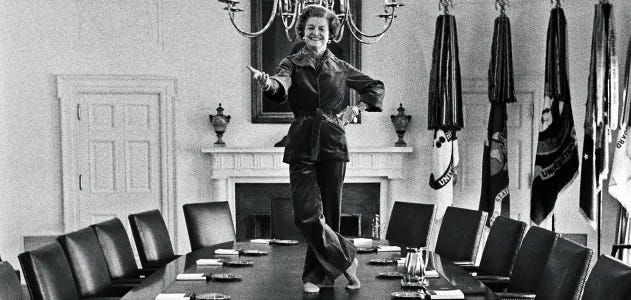
photo credit: David Hume Kennerly
Seale points out that many thought the White House had been “destroyed by Roosevelt’s renovations.” One, a Mrs. Abby Gunn Baker wrote at the time, “It cannot but be regretted that the Congress of the United States has not pursued a more far-sighted policy toward the White House.” She would have preferred that the house remain intact and unchanged, a preserved museum of the first 100 years of Executive leadership, and a more functional presidential residence and workplace be constructed.
On Christmas Eve 1929, a fire destroyed the West Wing while the Hoover’s were gathered in the residence, Herbert Hoover being alerted during dinner, the president’s son’s helping carry out the drawers to the presidential desk into the falling snow while the blaze consumed the Oval Office.
Hoover’s successor, Franklin Roosevelt, had grand designs on an expanded West Wing, but the various commissions overseeing district and federal construction smothered that particular presidential spark before it could take hold. The prevailing thinking at the time was the Executive offices should move eventually into the State, War and Navy Building (now the Eisenhower Executive Office Building) next door.
Roosevelt was persuaded that he could more than double the space, while relocating the Oval Office to the southeast corner of the wing, making it easier to navigate in his wheelchair, without increasing the footprint or massing of the whole. Even so, Roosevelt felt it necessary to address the inevitable criticism of any alteration:
“If I were to listen to the arguments of some prophets of calamity who are talking these days, I should hesitate to make these alterations. I should fear that while I am away for a few weeks the architects might build some strange new Gothic tower or a factory building or perhaps a replica of the Kremlin or of the Potsdam Palace.”
The White House was the biggest residence in the country when it was built, a grand gesture for such a small concern as the United States of America in the grand scheme of world powers at the time. Such hubris! But as the country grew, in geography, population, and world position, the walls bulged and the calls for expansion, or for an entirely new building, grew as well. This was abundantly evident post Civil War and after Grover Cleveland, who entered the White House a bachelor in 1885 and married while there, the Benjamin Harrison’s arrived in 1889 in need of more space.
Caroline Harrison, the First Lady, had the kids and grand-kids doubled up in the upstairs rooms and when taking over the public rooms on the first floor proved unworkable thought expansively herself, about the White House as both residence and work space.
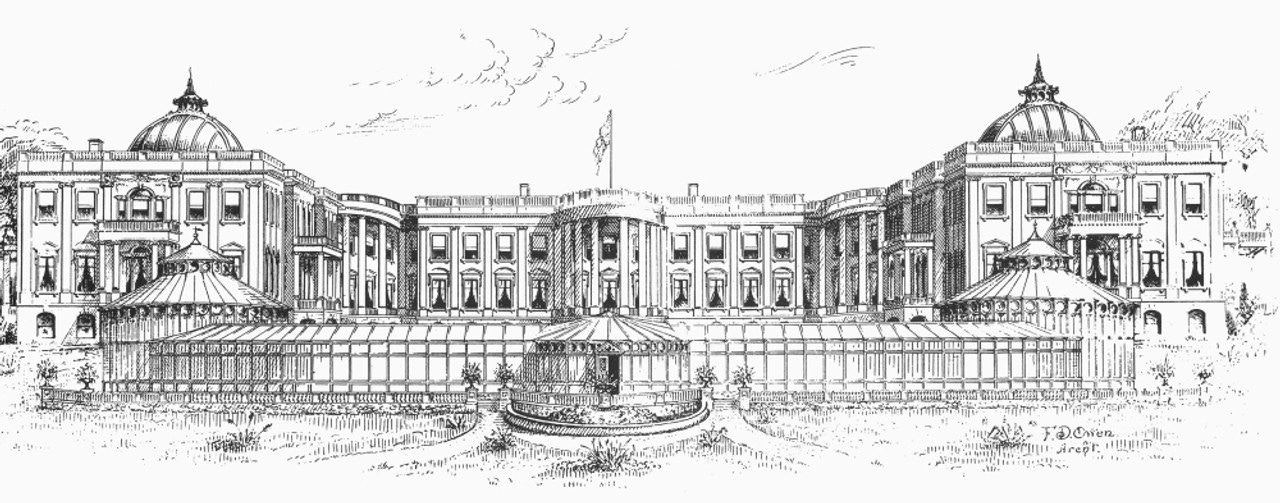
Her plan called for two White House sized wings, one for work and one for a loosely defined art museum, with connecting greenhouses around a private square. Love it or hate it, it brought the question of need front and center. No one could deny the need. Her focus on satisfying this need in the existing White House plot perhaps helped save the building from abandonment to a new structure at the Naval Observatory.
Mrs. Harrison got some traction with this plan, and buy in from the various oversight authorities. She proved to be a good politician too, building a coalition for its concept and urging funding for its design through congress. Republican Speaker Thomas Reed of Maine killed the dream by not taking up the measure at the end of the 51st Congress, reportedly because Mrs. Harrison’s husband did not appoint Reed’s preferred candidate for the office of the port of Portland.
Colonel Theodore Bingham, who served as superintendent of the public buildings and grounds in Washington from 1897 to 1901 would try a grand plan again.
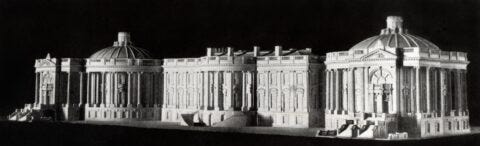
His push, after the conclusion of President William McKinley’s Spanish American War, his assassination, and the ascension of Theodore Roosevelt to the presidency, ultimately failed as well. He ran afoul of Mrs. Roosevelt, who was happy to let the menagerie of Roosevelts, human and animal, run rampant all over the existing place.
President Roosevelt was content with the more modest plan, even if it offended Mrs. Baker. His hand-picked successor, William Howard Taft, was the first to occupy the Oval Office.
No posts
Comments
Nothing yet. Say the first thing.
Sign in to join the conversation.