
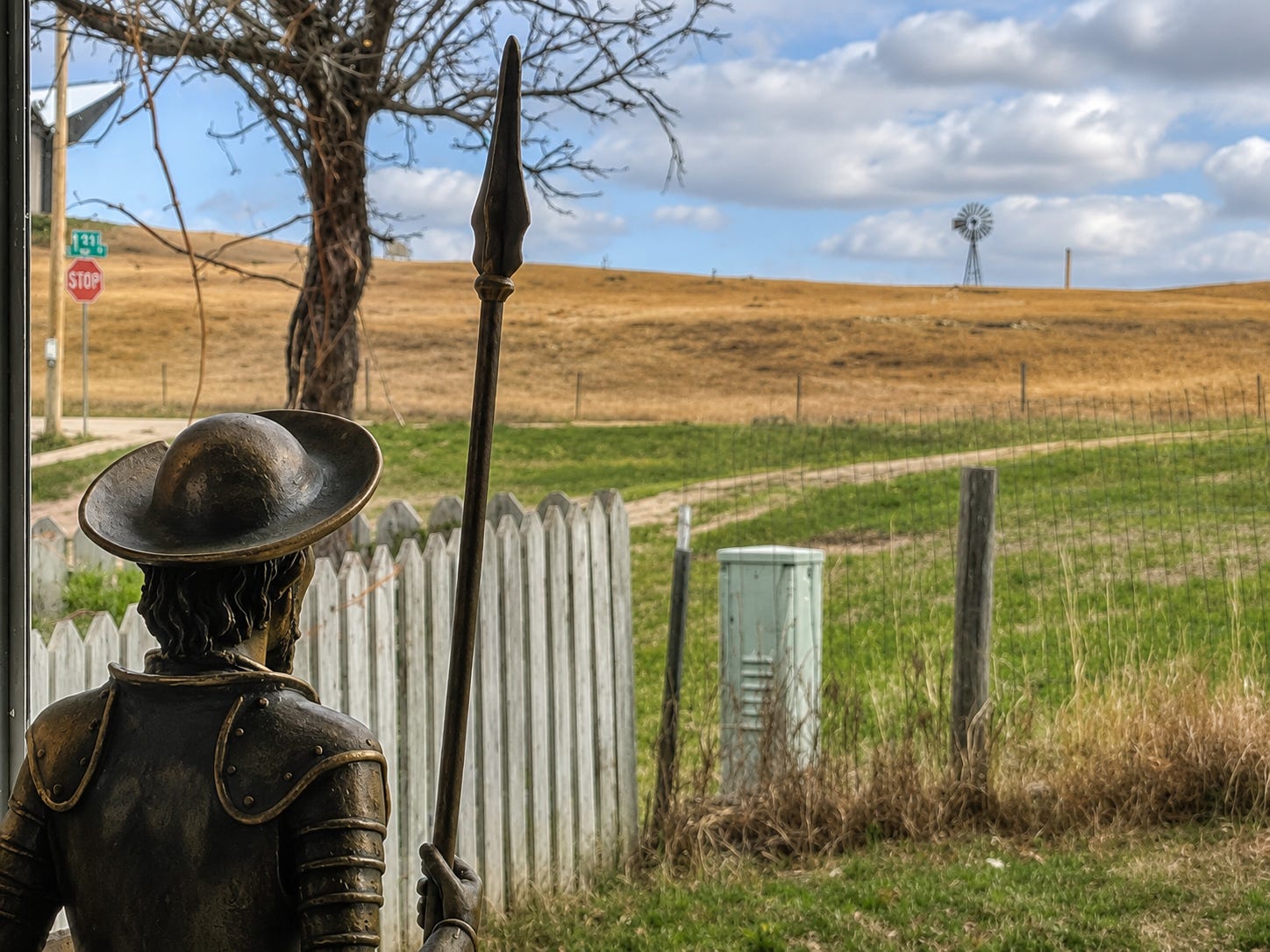
I sit in the wi-fi lobby of a budget motel, my computer screen filled with research on love's history, physiology, literature, and psychology, while great musicians and songwriters play through my earbuds, offering their heartfelt takes on the theme. A framed print of Don Quixote and Sancho Panza hangs above the mantle of the cold, faux fireplace, reminding me of my own little figurine of Don Quijote de la Mancha, a gift from a dear friend, standing with his lance on the windowsill of my home office in Spearfish, South Dakota.
Contemplating the inspiration and irony of having Don Quixote as my imaginary friend, I begin to wonder whether the big answer we seek out here on the road is just a windmill after all, and our quest for the nature and definition of love is simply romantic madness. But then I hear the knight's voice whispering to me, reminding me that "hope is ever born with love." With Don Quixote and Cyrano by our side, one who could never quite see what stood in front of him and one who could never quite say what stood inside him, we will never be without asterisks on this adventure. [1]
As I learned over my years teaching young writers, literature is just a fancy word for storytelling, and we are all storytellers from our earliest days. From ancient times to the present, we turn to stories to understand our origins, define social order, carry traditions and morals, simplify complicated histories, and, of course, to express love. But as I always tried to teach my students, words themselves are only the tools. The real cargo of language is the images and ideas it conjures in the minds of readers, and while it matters to have the right tools, the key is a really shared understanding that lets us get directly to those images and ideas. But even then, we can be certain there will be differences between what we imagine when we tell a story and what our words awaken in the minds of others.
Consider, for instance, writing a scene in which a lazy princess delivers a monologue on the woes of the ruling class and the burdens of rulership. She reclines on a divan with two servants in attendance, one peeling her grapes while the other slowly fans her. Before you write her dialogue, are those gauzy details enough to ground the scene? Do you need the colors or texture of her clothing, or of the servants’? Is incense burning, lending sensual notes of exotic spice and drifting smoke? Do the expressions on the servants’ faces reveal any context for what she’s about to say? All of this will shape the fullness of the scene your reader imagines, along with the emotions with which they receive it. There’s a lot to consider here from a creative perspective. For our purposes, though, let’s dive deeper.
In the images of that scene as they appeared in your mind, was the princess white? What about the servants? Were they male or female? How old was everyone? What era were the clothes - ancient, medieval, contemporary - and were they revealing or modest? Were we in a room, an outdoor pavilion, or somewhere else entirely? We could go on, but these few questions already transcend the simple creative choices. They deal in our biases and relative perceptions of class, culture, gender, age, and race, the products of each storyteller’s personal and cultural experiences, communicated largely through language. And they shape our understanding, perception, and communication of love and love stories in exactly the same way.
The deeper we’ve explored culture and language through these Journeys to Love, the deeper it’s dived. The patterns, metaphors, and inherited concepts of every language help shape how its speakers frame everything from time and space to gender, cause and effect, consciousness, existence, and, of course, love. Mistranslation happens among the roots and structures of different tongues, and again, more quietly, among the ideas and experiences those languages have learned to carry. Chasms like those, between languages in their social and emotional contexts of love, make finding a universal definition a parade of giants and windmills, and we’re not always certain which.
You can hear the challenge of that out here on the road. From the First Nations peoples of the Pacific Northwest to the naval bases of the Virginia coast and all the diverse spaces and communities between, when we ask folks to finish the sentence “Love is...”, the replies come most often as synonyms: love is compassion, forgiveness, trust, or, our favorite, love is hope.
Passion, desire, devotion, connection. To adore, to cherish, to fall for. Set side by side, they read like a menu for the flavors of love people want in their relationships. “Yes, I’d like to start with an infatuation salad; then I’ll have the passion entree and a slice of devotion with a little cherish sauce for dessert. What would you suggest for the wine pairing?” Relationships don’t work that way, of course; they’re usually much more of a chef’s surprise. But you get the idea.
Here’s the truly instructive thing, though. Synonyms, literally “together words,” work alongside their targets and mean something similar without ever meaning precisely the same thing. Each lends subtle shading to our personal and cultural visions of love, and each, by being similar yet different, also helps define what love isn’t. None of them ever quite finishes the sentence “Love is...” Each only manages “Love is like...” And since language helps shape thinking, and belief can be a more potent force than knowledge when it pleases and persists, defining love in relationship words quietly entrenches the idea that love is romance, that it belongs chiefly to couples. The menu starts writing the appetite.
The writers, artists, and other creatives we’ve met tend to reach past synonyms, instead tilting toward metaphor, and some of what they’ve offered us is quite beautiful. “Love is like the wind - you can’t see it, but you feel it when it’s there.” “It’s when your baby falls asleep, and you feel your eyes close.” And this one: “Love is knowing that you’re going to share dinner. And eternity.”
Metaphors get closer, carrying more of their speakers with them, and yet, each one is still a picture of the thing rather than the thing itself. When you ride enough miles to find them, though, you stop hearing that as failure. Instead, every synonym, every metaphor, every story just becomes a hand pointing down the same road, all agreeing on the direction.
Meanwhile, back in the motel lobby, the print above the cold fireplace still has those two riders in it. As a literature teacher and born romantic, I have been looking at that image, or ones very much like it, for most of my life, and I always see the knight first. Sancho is right there beside him the entire time, unconvinced and unromantic and still along for every mile of it. The windmill is what the knight went looking for. Sancho is what he actually had. Every mile we’ve ridden asking folks to finish that sentence, somebody was also riding beside me.
Rostand understood something remarkable about all of this. He gave Cyrano one last word before the curtain, and it happens to be the one word in the play that English has never managed to carry across: Panache.
Some translations leave it in French and let the reader fend for themselves. Others say “my white plume,” which keeps the image but loses the man. The best answer, I think, is to say it in the French with an asterisk; a star guiding those who je ne parle pas français, reminding us how every language has a word it cannot hand over. Ours, it turns out, is love.
Which is what the knight wanted the stars for, too. An asterisk is what you hang on a sentence carrying more than it can hold, a little star that sends the reader down the road, looking for the rest of it.
So, the windmill stands. The lance stays raised. And the sentence, like our quest, stays open on purpose:
Love is...
[1]: “Well, when I write my book, and tell the tale of my adventures - all these little stars that shake out of my cloak - I must save those to use for asterisks!” - Edmond Rostand, Cyrano de Bergerac, 1897.
Scotte Burns is a writer, speaker, and co-founder, with his wife Toni, of Journeys to Love, a multimedia quest to explore love’s origin, nature, and purpose through more than 100,000 miles of motorcycle travel across America.
No posts
Comments
Nothing yet. Say the first thing.
Sign in to join the conversation.