
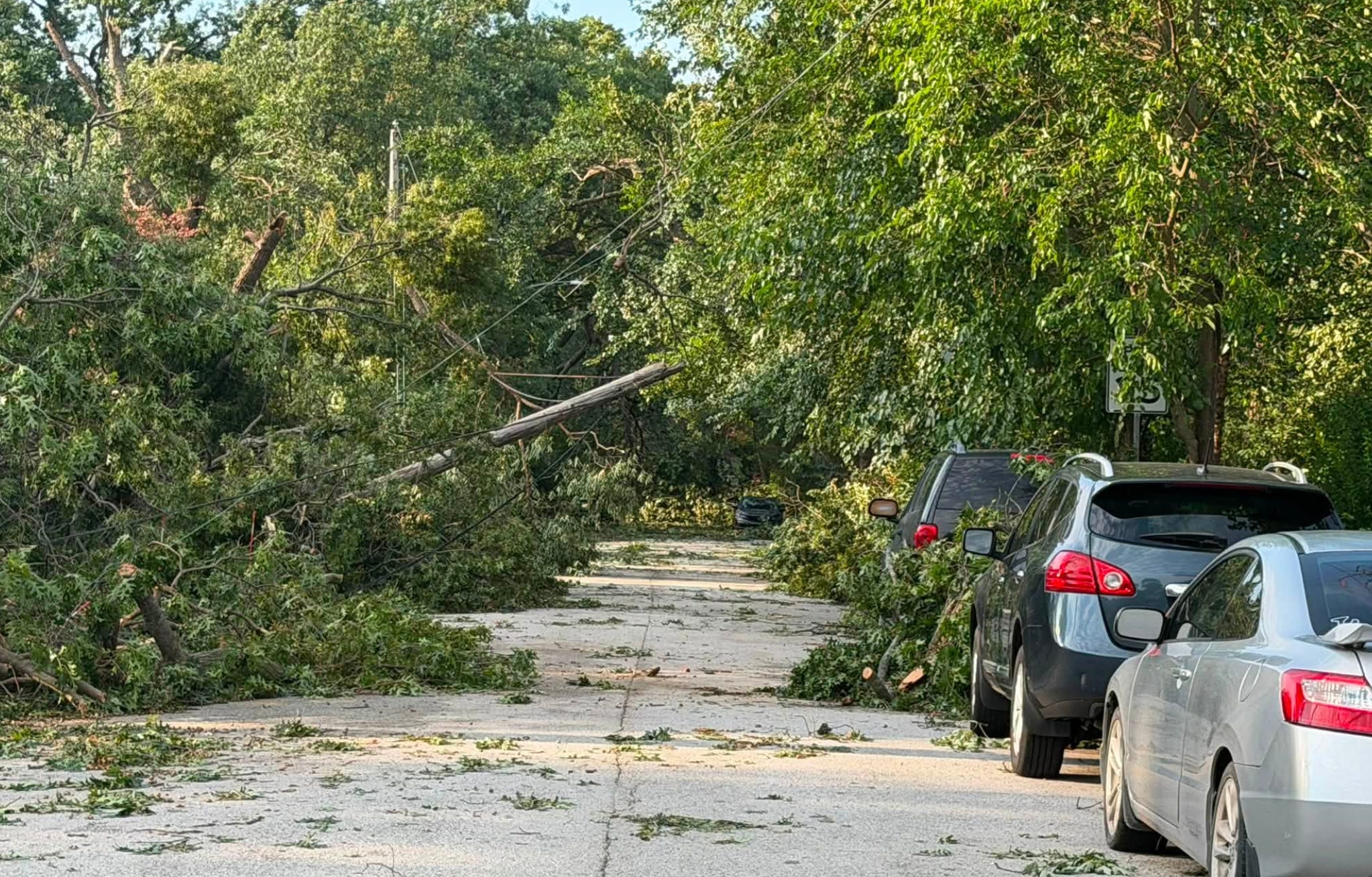
Illinois and its bordering states have been plummeted with rain, wind, and some violent winds. Flooding blankets northwest Indiana especially but our TV news has shown us image after image of uprooted trees and damaged cars and homes. Such are the seasons of the midwest. We are not flyover states. Instead, we are winds-blow-through-us states.
A young man is going from working at a Wendy’s restaurant to attending Yale University this fall, after his bosses at the restaurant chain saw his potential and helped fund his education.
“It changed my whole perspective about life and about what I could actually do because someone believed in me,” Thalles De Souza told “Good Morning America” in an interview that aired Friday.
De Souza first started working at a Wendy’s restaurant in Massachusetts to make ends meet during high school. He thought he would move on to other jobs afterward.
“I thought if I go to construction, I can work hard, make money and eventually go to college,” De Souza said.
But De Souza’s managers at Wendy’s, Usama El-Sehrawey and Terry Smily, offered him another proposal.
“I said, OK, you need to work hard but if you stay with us at Wendy’s, we will make sure you’ll be able to go to college,” El-Sehrawey said. “So just work hard and for every hour you work, we’re gonna put money aside for your college education.”
De Souza eventually earned enough money to fund his studies at Cape Cod Community College but he wasn’t done with his education.
“We saw a bright future in him and so we wanted to help in any way we can,” Smily said.
High school students in Denmark will be required to verbally defend their written assignments as part of emergency government measures aimed at combating AI cheating.
A verbal defense will be needed for all exams written at home, Denmark’s Ministry of Education announced in a statement Thursday, adding that it will work with schools to create the best framework for this.
The rule, which comes into force immediately, applies to students in upper secondary education, which typically begins around age 16. It will include the approximately 9,000 students enrolled in the country’s two-year Higher Preparatory Examination program, who have to submit major written assignments each year, according to the ministry.
The ministry is also calling on high schools to use tools to monitor students’ screens during exams, as well as a firewall to filter the content they can access during exams and in class.
People tend to look for love in the big moments. The grand gesture, the emotional declaration, the dramatic show of support when everything falls apart. Those things are real, but as evidence that someone wants you around, they turn out to be surprisingly weak. The more reliable signals are smaller, quieter, and easier to miss, and a few of them have actually been measured.
Most of the research here comes from the study of couples, so a caveat is worth stating up front: these are findings about romantic partners, not universal laws about every friendship or family tie. Still, the behaviors underneath them are ordinary enough that they travel well beyond marriage.
The psychologist John Gottman spent decades recording couples in a University of Washington observation lab, and one of his most cited ideas is the bid for connection. A bid is any small attempt to get another person’s attention. A comment about the weather, a sigh over an email, pointing at something out the window. Each one is a tiny question underneath the surface: are you there, and do you care.
There are three ways to answer. You can turn toward the bid by engaging with it, turn away by missing or ignoring it, or turn against it with irritation. Gottman reports that in his lab, the couples who were still together six years later had turned toward each other’s bids about 86 percent of the time, while those who had split had done so only 33 percent.
Treat those exact numbers with some care. They come from one research group observing a specific set of couples, and they describe a correlation, not a proven cause. But the underlying pattern is consistent with a lot of relationship research: the strongest signal is not intensity, it is frequency. Someone who wants you in their life tends to answer the small stuff, over and over, without being asked.
Gottman has made an even more deflating observation. When couples drift apart, he argues, it is usually not because of enormous fights or betrayals. It is the slow accumulation of bids that were quietly turned away from, until one person stops making them.
Conservative evangelicals griping about PINOS:
At last month’s Family Leadership Summit in Des Moines, Iowa, Joe Mitchell, a Republican running for U.S. Congress in the state’s second congressional district, jabbed at his Democratic opponent, state representative the Rev. Lindsay James, saying she “calls herself a pastor.” He then turned to the crowd of conservative evangelical pastors and coined a term he said applies to James, a Presbyterian minister, and other faith-forward Democratic candidates — namely, Lutheran minister the Rev. Sarah Trone Garriott, an Iowa state senator also running for another seat in Congress, and James Talarico, a state senator and Presbyterian seminarian running for U.S. Senate in Texas.
“I call them PINOS,” he said, explaining the term is an acronym for “Pastors in Name Only.”
“Because they’re not real pastors, right? They don’t profess the true gospel of Jesus Christ,” added Mitchell, who has attended an evangelical church in the past.
It’s the latest in a series of faith-focused attacks that have intensified amid an election cycle featuring a striking number of clergy campaigning as Democrats — and, in recent months, besting their challengers. At least 12 pastors, seminarians and former clergy have run for federal office as Democrats this year, and seven have already become the Democratic nominees as of Wednesday (Aug 5). Some are even competing against each other: In Iowa, James, who is ordained within the Presbyterian Church (USA), had to beat out another pastor, United Methodist minister the Rev. Clint Twedt-Ball, to win her primary.
At least seven current and former pastors, all evangelicals, have also launched campaigns for Congress as Republicans this year, but with less success. Of those seven, only three — Pastor Mark Harris, an incumbent in North Carolina’s 8th district; Pastor John Elleson, who is running in Illinois’ deep-blue 9th district; and Tim Walberg, an incumbent and former pastor in Michigan’s 5th district — ultimately became nominees.
Tensions are high in competitive races with clergy candidates, with Republican opponents sometimes even turning to allegations of blasphemy as they hope to capitalize on longstanding divisions within Christianity to eke out victories. That includes Garriott, whose race is rated by The Cook Political Report as one of only 18 “toss-up” House elections in the country; in addition to Mitchell’s “PINO” remarks, Republican officials have referred to Garriott as the “Wicked Witch of Woke.” House Speaker Mike Johnson has also joined other Republicans in accusing her of having “officiated a Satanist wedding,” even though the allegation appears dubious: while Garriott has spoken publicly about participating in a wedding for people who self-identified as Satanists in meetings with pastors, she could not have officiated the wedding, as she was a pastoral intern at the time, and the service itself was conducted using Christian Scripture and liturgy.
High five for the classics (and Joan):
Joan is eighty-five years old, and I fell a little in love with her on Thanksgiving.
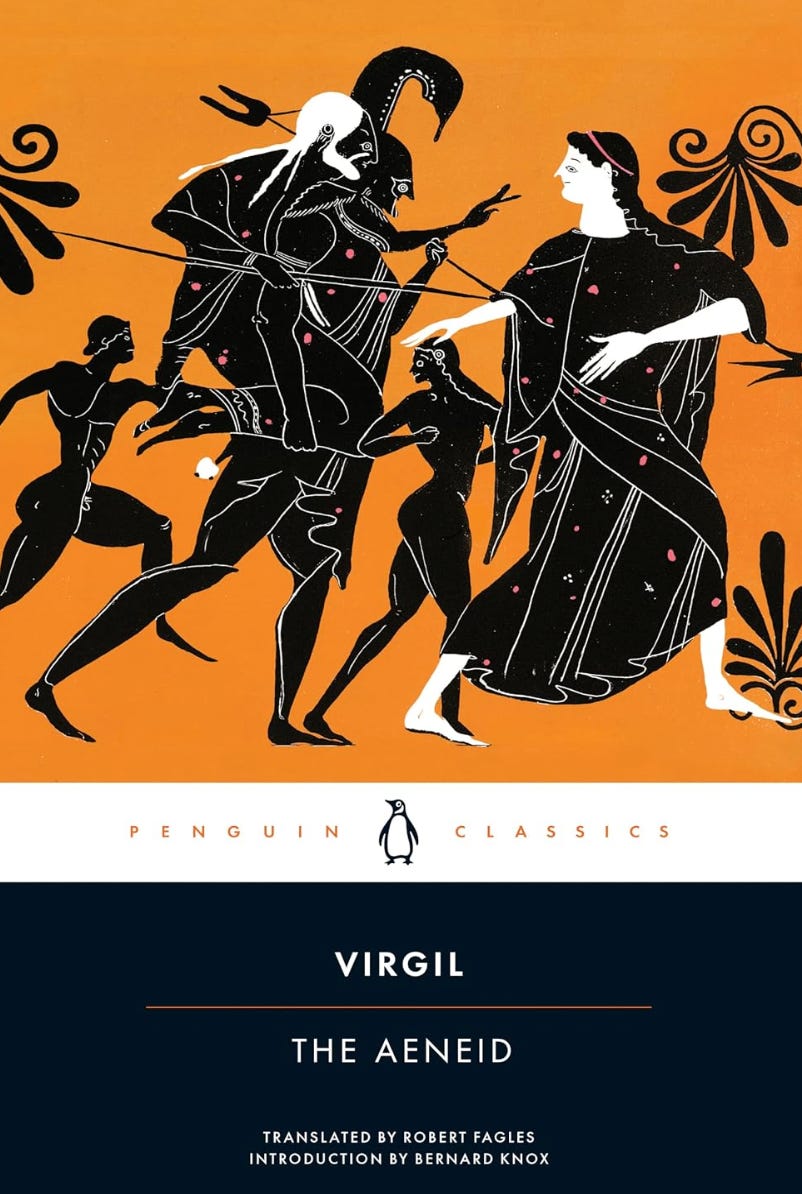
She was sitting on our couch reading a copy of The Aeneid that she had plucked from the bookshelves that line our family room. Around us, Thanksgiving did what Thanksgiving does: football on television, laughter colliding with panic from the kitchen, young children screamlaughcrying in the next room. And there was Joan, in the middle of all of it, considering Virgil’s pages, turning them gently the way you handle something hallowed. I sat next to her. I asked her and she told me.
I didn’t fall in love with Joan the way you’re thinking, or maybe it’s exactly the way you’re thinking. I fell the way you fall for someone who shows you, without meaning to, what you’ve been missing for decades.
I began to bring her other books. I presented Roman Civilization, Volumes I & II and my annotated Fagles and Fitzgerald Odysseys: the spines cracked and pages dog-eared by some younger version of myself who had once cared enough to underline, write in the margins, highlight. I brought them like offerings. I didn’t know yet that’s what they were.
Joan is the mother of a dear friend. She is nearing the end of her days—her words, not mine—and she had decided to spend whatever time she had left trying to understand where everything came from. She had lived through the Beat poets, postmodernism, the entire arc of twentieth-century literature. She chose instead to go backward.
Joan spends four to five hours every day reading Homer and Virgil and Sophocles in their original languages. I asked her why. Why not something alive and evolving? Clutching the books, she said flatly: “Everything comes from this. Western civilization, our ideas about beauty and morality and what it means to be human. It all starts here.” She said it the way you state something obvious with no need for performance or persuasion, only with certainty arrived at through years of sitting with difficult, ancient things.
No posts
Comments
Nothing yet. Say the first thing.
Sign in to join the conversation.