
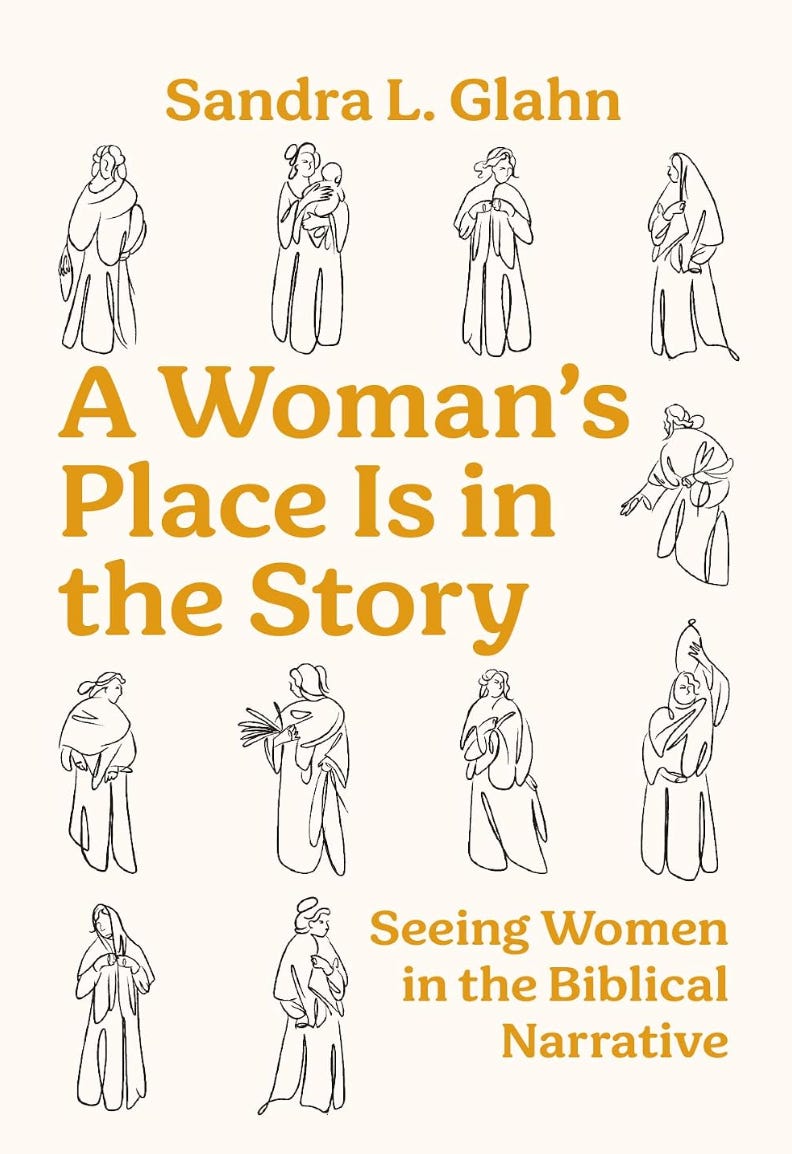
I admit some discomfort with the title for this Substack, though I do know those words as a title of a book by three feminist women, but you will see that those words are put in their place by Sandra L. Glahn. Her new book is called A Woman’s Place is in the Story: Seeing Women in the Biblical Narrative (IVP Academic). So, to “a woman’s place” Glahn adds “in the story.” Right where we need to see them.
I was aware of Sandra Glahn but it was when a couple of her students showed up in my classroom. When they began to talk about her. When they shared her research on Ephesus. When they talked about her mentoring of them… that’s when I too began to read her and follow her. And now we can all read her in a very accessible study of how the women fit into the narrative of the Bible.
My endorsement of Sandra’s book: “Sandra Glahn, a consummate storyteller, presents an expert summary of the elements of stories (story, narrative, plot, characters, setting) and then shows how to read stories about women in the context of the big story of the Bible. We are treated to surprising insights—some of them rightfully unnerving to some—about Tamar, Shiphrah and Puah, unnamed women, Abigail, five named daughters of Zelophehad, the women of Shunem and Job’s daughters, Jezebel, and my favorite, the woman of Samaria. Glahn illustrates the power of stories while showing how to think in story terms about these women. The reality is that many in the church, both women and men, do not know the stories of women in the Bible, and so Glahn offers a conclusion on what the church’s leaders can do to reconfigure the place of women in the Bible story.”
Her “Introduction” is the vibe of the book, and it’s the vibe many today need:
My ancestors four generations back crossed North America in a Conestoga wagon. On their way across the plains, they battled cholera and buried family members. They sacrificed, some to the point of death, to build a better future for themselves and their children.
As a fifth-generation Oregonian, I started learning our state’s history in the third grade. My teacher told our class about Meriwether Lewis and William Clark and they’re forty-nine-hundred-mile journey to the Pacific. I heard about John Jacob Astor, the fur magnet after whom Astoria was named but who never visited Oregon. Native American names such as Chemawa, Willamette, and Chemeketa were as familiar to my siblings and me as Eugene, Salem, and Portland.
When I was ten, my family of seven relocated to the DC area. On our journey the other way across the plains, we visited multiple historical sites. Once we settled in Virginia, we spent weekends touring museums. We drove the grounds of Gettysburg. We watched Civil War reenactments at Bull Run. In the Smithsonian National Museum of Natural History, we gawked at the Hope Diamond. Occasionally on these types of visits, I’d encounter women from history. I especially like seeing gowns worn by Martha Washington, Eleanor Roosevelt, and Jackie O.
Gary and I married in Virginia and a few years later move to Texas for further education. We had heard of the Alamo but never studied the Mexican-American War (or, from Mexico’s point of view, the invasion of Mexico), which made ‘Remember the Alamo’ famous. We quickly learned how much Texans love their history. The company I worked for even gave employees the day off on March 2, Texas Independence Day.
After we had lived in the Lone Star State for about twenty years, we won a Texas Independence Day trip to Austin, where we watched the annual parade from our hotel window. Afterward, we wandered into the Bullock Texas State History Museum, where we saw artifacts that spanned four thousasnd years. I stood amazed at how the curators had woven women into the story line, because—after spending years in museums—I’d seen a lot about great men but only an occasional cameo of a woman. In the Bullock Museum, for the first time I saw exhibits in which both men and women participated fully in the main story.
First I’d learned men’s history. Then I saw women as walk-ons. But at the Bullock Museum, I saw how history included both.
So does the Bible, if we would be tell their stories.
Which is why we need Sandra Glahn’s book.
No posts
Comments
Nothing yet. Say the first thing.
Sign in to join the conversation.