
Counterweight, by the Korean writer known as Djuna, tells its complex sci-fi thriller story at a face pace in an excellent translation by Anton Tur. As plot complications abound, it becomes clear that the story is driven by powerful themes - the unknowability of anyone’s identity and inmost thoughts, the effect of a hidden and unachievable love, the spreading impact of AI and the colonizing transformation of a powerful corporation on a small Southeast Asian country.
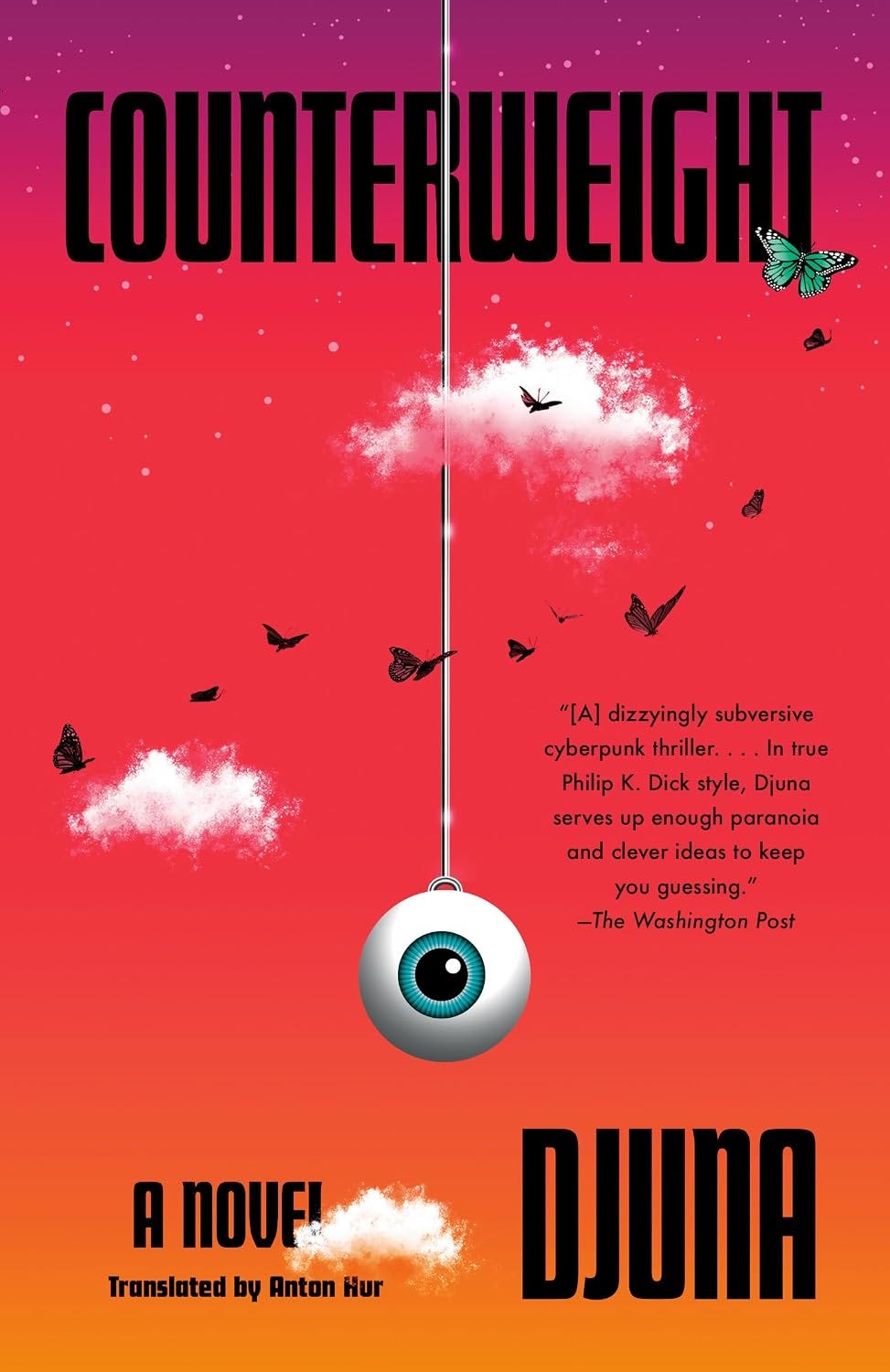
The setting is the fictional island of Patusan where the world’s first space elevator has been constructed. The LK corporation is the owner of the elevator and master of the island, while the native Patusans have been pushed aside and have formed their own liberation army. Patusan is one of three islands in an archipelago near Malaysia. Its population had dwindled to a few thousand until construction of the elevator began. LK took over the local government and brought in tens of thousands of people from all over the world, forcing many native inhabitants to flee to neighboring islands where some formed the rebel army.
The space elevator is the first of its kind in the world, beginning about 200 meters above the surface of Patusan, reaching up to a space station, and held in place by a counterweight. This consists of asteroid remains and organized space junk that is constantly worked over by specialized robots.
The narrator, Mac, has been head of External Affairs for LK and had been brought in from an obscure background by the recently deceased CEO, Han Junghyuk. He is one of many such employees whose position became precarious with the death of their benefactor. Han Junghyuk brought Mac’s organization into LK to use him and his associates as fixers and generators of cover stories for anything LK wants hidden, including a massacre of local rebels.
Since they had owed their roles to the deceased CEO, Mac, the narrator, wonders how long it will be before the security staff might be turned out of the organization. It is a concern that worries him throughout the story and adds to his feeling that there are plots within plots surrounding him, making it hard to discern true motives. The new CEO, Ross Lee, seems uninterested in exercising the power of his position, while Han Suhyun, another member of the ruling family, is angling to take his place. A key figure standing in his way is the beautiful but remote and emotionally armored head of LK Space, Kim Jaein.
After a brief prologue, the story opens with an action sequence as Mac witnesses Rex Tamaki, head of LK Security, descend from a small plane with a squadron of heavily muscled operatives into a city where they track down and neutralize members of the Patusan Liberation Army. They retrieve information from memory devices in the head of one dead rebel that reveals a long list of suspects. One name stands out to Mac, that of Choi Gangwu, someone he had noticed at first for a trivial reason. The man had a five o’clock shadow, a strange anomaly among ordinary white collar workers who laser off all facial hair. But there is more that sets this seemingly unremarkable man apart, as Mac looks into his past.
After twice failing the exam to get employment with LK, Choi Gangwu suddenly aced it on the third try, then went on to impress the staff at an extended interview. Hired at last for a modest position, his strange transformation from non-entity fascinated by butterflies, to sudden success brings him to Mac’s attention. One day, when talking to him, Mac hears Gangwu use a phrase that only the late CEO, Han Jangyuk, ever used. As he probes more deeply, Mac finds that this strange man has multiple memories that belonged to his old boss.
Choi Gangwu admits that there are times when all sorts of knowledge and recollections flood through him, things he had never learned on his own, especially detailed knowledge of the space elevator. And not only knowledge but a love for that huge creation. There is also a love and fixation on Kim Jaein, indicating that Han Jungyuk, an older and unattractive man, must have secretly harbored strong feelings for the young woman who was considered his niece, though the two were not related by blood.
Choi Gangwu, like all LK employees, has had a device, called a Worm, inserted in his brain that links everyone to the company AI, but there is something else in Gangwu’s mind. Mac determines that it is a biobot that contains those memories of the dead CEO and segregates them from normal access by LK’s AI mind and makes it hard for anyone else to manipulate them.
When a spy unsuccessfully tries to kill Choi Gangwu and steal his memories, Mac begins a search that quickly becomes a complicated story of plot and counter-plot. As Mac weaves his way through one false story after another, he has to hide his real motives not only from his rival at LK Security but also the head of an independent security agency, the token government of Patusan, offices in Laos and Indonesia, and another member of the Han family trying to push his way to the top of the corporate ladder.
When Kim Jaein herself gets involved, she draws Mac and Choi Gangwu into a final twist to take control of those memories and erase the stain of Han Jungyuk’s past crimes and inappropriate affection for her. For she is truly devoted to not just the space elevator but its promise of future voyages to distant worlds and doesn’t want those achievements blemished in any way.
All the deceptive tactics with false identities suggests an underlying theme of how impossible it is to know the nature of another human being. Each character has constructed one or more superficial personas, or had them imposed through manipulation of memory. Kim Jaein, always known to the narrator as armored and immune to emotion, appears as a completely relaxed and responsive person when her holographic projection takes over. Mac refers to his “real” name, which we never learn, and at a couple of points conceals his facial features to assume other false identities. Even Han Junghyuk is an adopted son of uncertain background who was chosen to lead LK.
In many ways, the whole story belongs to Kim Jaein, though for much of the narrative she is in the background. While she is not identified, she is the young girl we meet in the prologue watching the ashes of her mother explode in a firework display. A version of her also appears in the epilogue when she seems to be achieving one of her great ambitions.
Hanging over all the characters, there is a greater change taking place that threatens all identities, one that the cynical Mac seems to accept as inevitable. It is the gradual absorption of all individual minds into the vast AI of the corporation. The various intrigues to advance the interests of ambitious executives will soon mean nothing because the whole company is being subsumed into the AI. Perhaps it is that perspective that allows Mac, while worrying about his immediate need to survive attacks by rivals, to regard the machinations he sees and engineers every day with detachment. It’s as if he is watching a complex dance of shifting identities that ultimately will mean little.
For a short novel, Counterweight has at once a lot of surface action and thematic depth. This is the first of Djuna’s novels to be translated into English, and I look forward to more, hopefully, coming soon.
Comments
Nothing yet. Say the first thing.
Sign in to join the conversation.