
Perdido Street Station (2000) was China Miéville’s first great success and remains for me one of his greatest achievements. It may be notable for its genre mix of science fiction, urban fantasy, steampunk and horror, but the novel is far more than that. With Dickensian richness of detail, Miéville created the unforgettable city of New Crobuzon, filled it with sharply drawn characters of multiple species, dramatized a society of vast inequality and created a shocking ending that makes the story especially relevant to today’s grim politics.
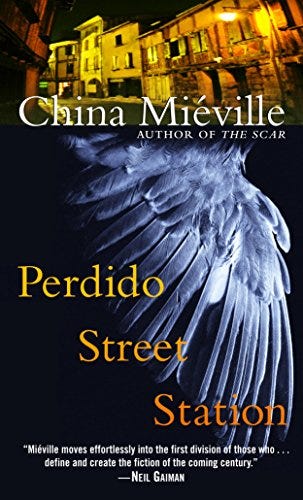
New Crobuzon is a city of imperial power and deep rot. It physically manifests the grime and putrefaction of an economy rife with slave labor, corruption and injustice. I’ve never read a fictional city so rich in physical detail. We first glimpse it through the eyes of Yagharek, an outcast member of the desert-dwelling winged garuda who has committed a crime and been violently shorn of his wings in punishment. It is his shame and anguish that has brought him to:
“…this great wen, this dusty city dreamed up in bone and brick, a conspiracy of industry and violence, steeped in history and battened-down power, this badland beyond my ken. New Crobuzon.”
Kindle edition, Page 4
Miéville skillfully introduces each major character in the opening chapters and the settings in which they live. Isaac Dan der Grimnebulin, a dark whale of a man, is a scientist-outcast who gave up a university position to work on his unfashionable theories. His lover is Lin, a khepri - a reddish woman with the head of an insect. She is a sculptor, also an outcast from her khepri community because she could not be bound by its conventions. She communicates in sign language and sees the world through compound mirrored eyes, consisting of a vast number of tiny hexagonal sections, each of which grasps a detail of a scene in all its color.
Their relationship, frowned on in most places, is accepted in Salacus Fields, a center of bohemian life where this unusual pair can socialize openly with their equally unconventional neighbors and friends. Isaac’s laboratory is in Brock Marsh, near the confluence of two rivers, the Tar and the Canker. They merge to form the Gross Tar, capturing all the industrial effluvia from the dark factories upstream on the Canker, its black water thick with pollution.
But it’s at the heart of the city where we find:
“the knot of architectural tissue where the fibres of the city congealed, where the skyrails of the militia radiated out from the Spike like a web and the five great trainlines of the city met, converging on the great variegated fortress of dark brick and scrubbed concrete and wood and steel and stone, the edifice that yawned hugely at the city’s vulgar heart, Perdido Street Station.”
Kindle edition, Page 22
The language turns the city into a living thing, but one with a corrupted, diseased body, where architecture overflows its normal boundaries, All seems so dark and horrific that the very rain is like dirty water sprayed from a hose. Yet there are cleaner sections along the purer waters of the upper Tar where the wealthy live. The city as a whole, however, is dominated by its poorer and industrial sections. There are many xenians, or intelligent non-humans, each with their own area, most scorned and abused by the humans. There are wyrmen, stocky winged creatures with stubby arms and bird talons, green and thorny cactus people in vaguely humanoid form, and vodyanoi, amphibians who can walk on land but need to be constantly refreshed with water.
Then there are the remade, humans condemned by vicious courts and sent not to prison but to factories where their bodies are cruelly reshaped with mechanical parts into grotesque forms. Many serve as soldiers, many as servants, many as factory hands, all enslaved to masters who treat them with contempt.
There are also the monstrous slake-moths, raised by the city government in secret as a sort of ultimate weapon. These huge creatures with vast iridescent wings mesmerize their victims and suck the dreams, memories and thoughts out of their brains, leaving an insensate human hulk that can never recover its personhood. They also produce a powerful drug to feed their young, much of which is sold to the powerful kingpin of the underworld, the grotesque and merciless, Mr. Motley.
There is a self-organized mechanical creature of enormous size that has arisen out of the heaps of discarded machine parts and intelligence engines. It has a network of human followers who worship it as a god. And there is a multidimensional giant spider, known as the Weaver, that dances across a vast web that seems to tie together moments of time as well as objects, as it disappears into spaces humans cannot perceive.
The city is ruled ruthlessly by Mayor Rudgutter and the richest class of merchants and industrialists. Great dirigibles patrol the skies. Militia occupy huge towers called spikes. and travel in pods on monorail lines connecting the fortresses high above the putrefying city streets. They brutally suppress strikes and dissident groups, sending the offenders off to the remade factories.
All of these characters, as well as the strange city environments that support them both physically and socially, come together in several intertwining plot lines. First, the garuda, Yagharek, seeks out Isaac and asks his help in regaining the capacity for flight. Though he says he has accepted his punishment and shame, life without flying is unbearable. Isaac agrees to take on this new challenge and begins by putting out word that he wants specimens of every sort of winged creature imaginable.
A city official in charge of the slake-moths tries to make extra money by selling to one of Isaac’s intermediaries a caterpillar of this horrendous species. When it grows and breaks out of its chrysalis, the young moth sets out to find its home and releases four of its giant kin. They begin a reign of terror in New Crobuzon as living but insensate bodies start turning up, after their minds have been sucked dry of all that makes them intelligent beings.
Meanwhile, Lin has started working for Motley who has offered her a huge sum of money to make a life-sized sculpture of him. She thus becomes one of the few people to see the man who always conceals his strange body from sight.
“She had no clear picture of her boss, only a sense of the ragged discordance of his flesh. Snippets of visual memory teased her: one hand terminating in five equally spaced crabs’ claws; a spiralling horn bursting from a nest of eyes; a reptilian ridge winding along goat’s fur. It was impossible to tell what race Mr. Motley had started out as. She had never heard of Remaking so extensive, so monstrous and chaotic.”
Kindle edition, Page 77
While these things are going on, Isaac develops an alternative approach to getting Yagharek into the air. Instead of trying to graft on artificial wings, he focuses on his theory of crisis energy. This is one of the most remarkable science fictional explications of a new energy source I’ve ever read. Isaac is trying to capture the energy of things that are imbalanced, like an object about to fall from the sky or even a mind in turmoil. He theorizes that if he can build and sustain the state of crisis long enough, the energy can be captured to run an engine that would, in effect, be a perpetual motion machine.
These and other story lines come together in an epic search for and eventual battles with the escaped slake-moths. Isaac assembles a small crew of friends and enlists the help of the god-machine and its followers. Mayor Rudgutter seeks help from the dancing and singing Weaver while sending his militia troops and dirigibles on patrol. And Mr. Motley gets involved when he finds his source of the precious drug is gone.
It takes more than one try to find and fight the slake-moths, and those are some of the most breath-taking and page-churning chapters of the novel. There is victory, and there is tragedy in the grand clash of these forces. Isaac and his friends and allies, along with the crisis engine, prove decisive in the battle, but they also wind up being hunted by the three major forces in New Crobuzon: the City militia, Motley’s private army and the god-machine’s zealots. They are weak, terribly wounded and can only flee New Crobuzon.
This is an exciting but dark story, in which Miéville, without ever being merely didactic, portrays the forces of corrupt government and its criminal cronies, themselves about to be overtaken by uncontrollable intelligence engines, retain their power and control for the time being. The few decent people who fight them are brutally suppressed, as Isaac and his friends can only survive by escaping their grasp through flight to another country.
In the end, it is Yagharek, who tears off what’s left of his garuda nature and commits himself to staying in New Crobuzon as a man. Revealed as a criminal, he accepts his guilt and punishment and stays in the city, his new-found home, “not a half-thing, not a failed neither-nor … not miserable crossbreed,” but a man. He has given up on his desert homeland and can find his new life in “this complexitude of money and slum, this steam-powered god,” New Crobuzon.
In Perdido Street Station, Miéville poured a vast amount of detail about how everything worked, from vodyanoi anatomy to the components of a mechanical construct to the details of food markets and the eating preferences of all the xenians. Even though it’s a big book with a deeply realized world, it flows beautifully because Miéville is a master of every kind of rhetorical device that creates narrative drive. The novel may not be for the faint-hearted, since there is a fair amount of body horror, but it is one of the authentic masterpieces of science fiction and fantasy.
This was the first novel in a trilogy. It was followed by The Scar (2002) and Iron Council (2004), but each of those is quite different, so Perdido Street Station works as a stand alone book.
Comments
Nothing yet. Say the first thing.
Sign in to join the conversation.