
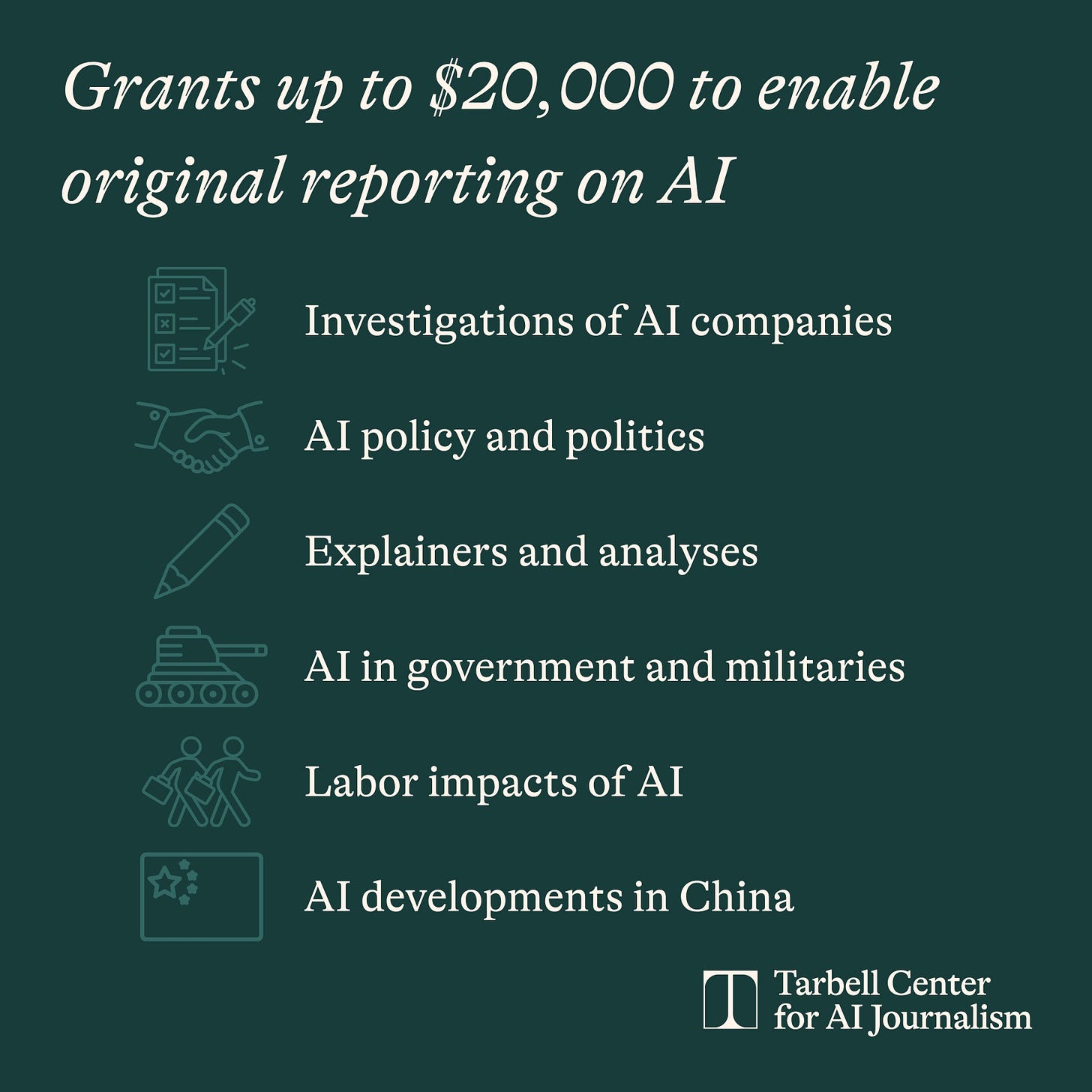
Tarbell offers grants of $1,000–$20,000 to support original reporting on AI published in established outlets, whether from freelancers or staff. This round, they’re seeking applications across six focus areas:
Accountability reporting on frontier AI companies
AI policy and politics
AI explainers and analysis
AI in government and militaries
AI labor impacts
AI developments in China
Applications for this round close July 12.
Welcome! You are reading the Science Writing News Roundup, a newsletter for science writers. You can also read this edition online. Did someone forward you this newsletter? Sign up here.
AI and the future of journalism: Balancing innovation and responsibility. AI can both support and disrupt journalistic work, acting at once as a powerful tool and a potential competitor. At the same time, journalists carry the responsibility of helping the public understand what AI really is – and finding the right angle to discuss it remains far from straightforward.
Writing science that humans and machines can read: Large language models are now routinely used to search, summarize and synthesize the literature at scales impossible for any individual researcher—yet scientific publishing has not adapted to that reality.
NPR Cut Its Climate Desk. These 33 Local Climate Reporters Are Still at It. Laying off two climate journalists is a step backward for NPR. The good news is that local public radio stations are still doing climate journalism.
Expanding and deepening climate reporting through local messengers: A new impact report shows how the MIT Environmental Solutions Journalism Fellowship has brought community-centered climate coverage to nearly 3 million readers and listeners.
A Day in the Life of Myriam Vidal Valero: Myriam is an award-winning science journalist from Mexico covering life sciences, mental health, policy, diversity, and disability, with a special interest in the environment and health.
Ten simple rules for writing a peer review: These are the rules as they stand in 2026, but as publishing and peer-review keep changing, these are likely to as well.
What are ghost guns? Here’s everything a health reporter should know. Ghost guns aren’t just a law enforcement problem; they’re also a public health threat, experts say.
First science reporting guide published for journalists in North Macedonia: A new practical guide aimed at helping aspiring science journalists in North Macedonia to cover scientific topics has been published.
Opportunities and calls for pitches 👉 Bonus content for monthly supporters.
Protect scientific transparency – Submit public comments on proposed federal NDAs. The public can submit comments before the proposal becomes finalized. Please let your voice be heard by submitting a comment by June 26.
Meet the judges of the 2026 Royal Society Trivedi Science Book Prize: An author, comedian, historian, bookseller, radio presenter and palaeontologist join forces to form one of the most interdisciplinary judging panels to date for the 2026 Royal Society Trivedi Science Book Prize.
The World Conference of Science Journalists 2027 (WCSJ 2027) will take place at Central Hall Westminster, London, UK from 6-9 September 2027, with the theme “Strengthening science journalism through global networks”. WCSJ2027 London wants your proposals for content from workshops to fireside chats and panels.
Science Media Centre (New Zealand) announces Winners of 2026 Science Journalism Awards. The winners have covered the damage feral cats unleash on Fiordland’s wildlife, and an unexpected collaboration between Māori and Japan to save our tuna/eels.
Outrider’s Science Media Forum connected journalists with NASA’s latest technology to help them cover local science stories.
Health Journalism 2026 took place in Minneapolis from May 27-30.
Science Journalism, Academic Silos, and the Cost of Being Right with Matt Kaplan
The Chaos of US Vaccine Policy: Helping Journalists Manage Confusion
Public Health Journalism: Reporting on public health in the current political environment
“The future of (science) journalism: AI, trust, and democracy” (June 22, 2026)
“EU regulation on AI: implications for the media, journalism, and disinformation” (June 25, 2026)
Thanks for reading! Subscribe for free to receive the next post in your inbox:
Worried you missed something? See previous posts here. What would you like to see in the newsletter? Please send me your suggestions: sciencewriting@substack.com
Comments
Nothing yet. Say the first thing.
Sign in to join the conversation.