
Imagine a world where kindergarteners, 1st graders, AND 2nd graders don’t read texts during their foundational skills block. They’re not even reading paragraphs or sentences.
Sounds pretty bad, right?
It turns out many kids live in this world today. A team of researchers from SRI International visited K-2 classrooms across four districts that have implemented Science of Reading-aligned curricula. They found that in 58% of observed lessons, students did not read “text greater than individual words” during their foundational skills block.
What could they be possibly doing instead?
Instead of reading sentences, paragraphs, or decodable texts, or uncontrolled texts, these students were reviewing letter sounds, practicing segmenting and blending, and then reading individual words in isolation.
And, as you’ll see in the chart below, the differences between kindergarten, first grade, and second grade classes were negligible.
You can read the full report here. It is well worth your time.
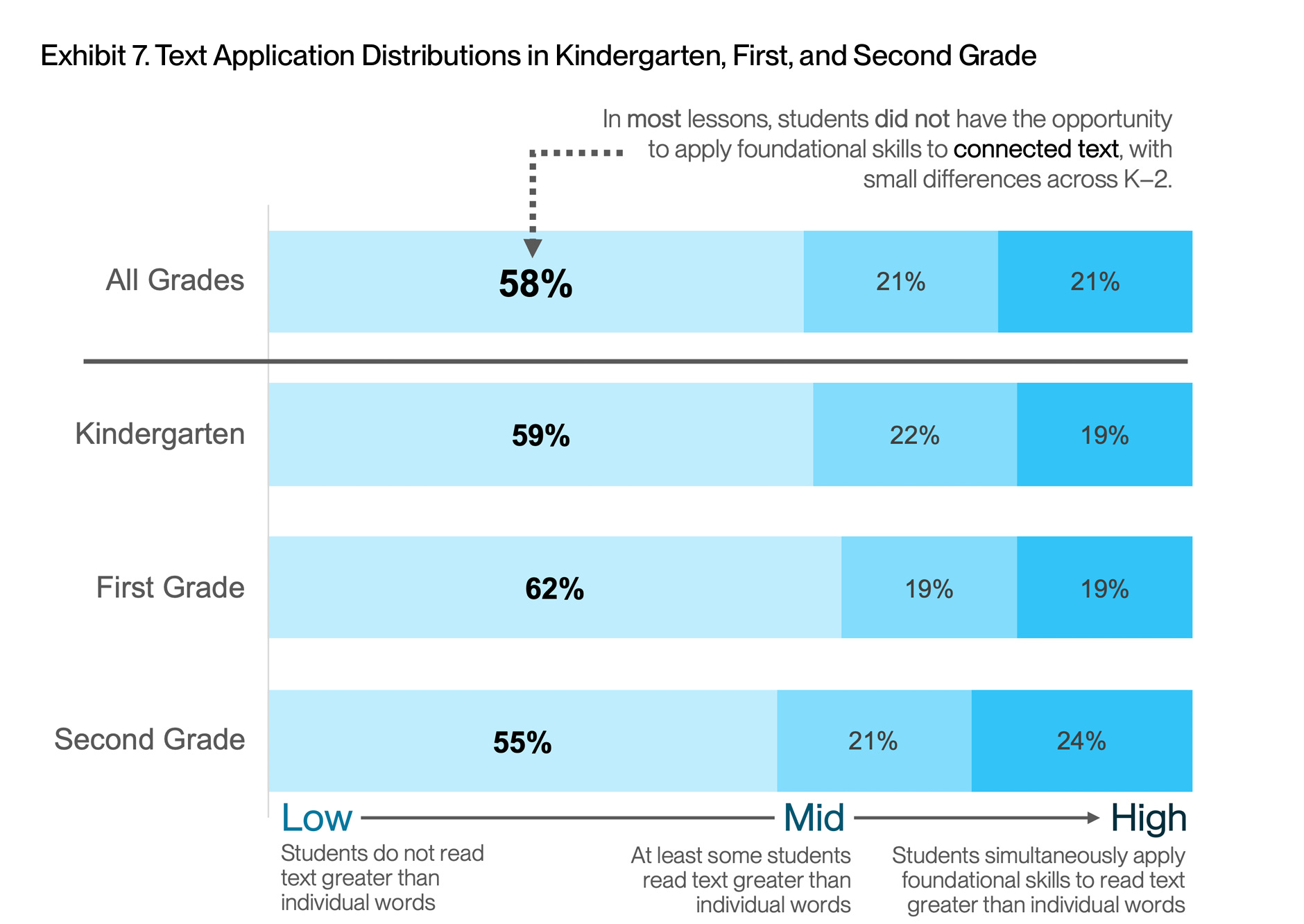
This is really, really, really bad. If you care about teaching children how to read, this chart should terrify you. If you are a part of the Science of Reading community like I am, this report represents a five alarm fire. This is how and why the SoR movement could fail: by overteaching phonics at the expense of actual reading.
Here’s why: word reading accuracy is necessary but NOT sufficient for fluent reading. Even if a student can read words in isolation, sentences and passages - even ones with the same words they can read individually - can trip them up.
In other words, all of that word and sound work we’re doing during our foundational skills blocks does not automatically produce strong readers. Our students need lots of scaffolded reading practice with real texts to become fluent readers. And in the classrooms SRI researchers observed, they simply weren’t getting it.
So where do we go from here? The SRI report has some excellent suggestions, but I want to make some very specific proposals for teachers who don’t have the luxury of waiting for a major system overhaul, better professional development, or a new curriculum.
Prioritize students reading real text every single day. Yes, even in kindergarten. It’s okay to start with simple sentences, but you should scale up to paragraphs and texts rapidly from there. Students need lots of practice with the thing we want them to learn how to do: reading texts. This blog shares many examples of what this can look like.
Cut the amount of time you’re spending on sound work and word work to make time for student reading. In fact, SRI researchers observed that teachers were often spending more time than necessary on reviewing letter sounds and segmenting and blending. The SRI report doesn’t say this, but I will: elementary students don’t need to understand what a fricative – or even a schwa – is in order to read texts. We want to grow excellent readers, not blenders and segmenters.
Start your foundational skills block with reading. If you’re always running out of time for students to read connected text because it’s slotted in at the end of your foundational skills block, just restructure the block. That way, students will always get to read, AND they’ll have the opportunity to practice a phonics pattern they learned the day before, which is better retrieval practice anyway.
Use a simple, replicable routine. One reason why kids aren’t reading longer texts is that it’s logistically challenging. In other words, how do you ensure that 25 five-year-olds get an opportunity to do meaningful reading of substantial text? In order to make this work, teachers need simple, replicable routines they can use every day. The SRI report suggests two: choral reading paired with writing AND partner reading. If you’re interested in learning more about how to set up partner reading in your classroom, this piece from kindergarten teacher Anjanette McNeely is a great starting point.
I’ll end with this. Last year, in Indiana, 87% of 3rd graders passed a statewide foundational literacy assessment. Sounds pretty great, right?
Not so fast.
Only 40% of the same cohort of students passed the statewide ILEARN assessment, which measures grade-level ELA standards and requires longer, more sustained reading. That’s a 47 percent point gap. Of course, we can’t precisely pinpoint what’s causing this gap. But if the trends SRI researchers identified continue, I think we should expect outcomes that look like this: kids who can read words in isolation but continue to struggle to read and comprehend longer texts.
So where do we go from here?
For us at Science of Reading Classroom, the only way forward is to help teachers prioritize students reading real texts everyday by sharing concrete and replicable instructional routines they can use immediately. Teachers can’t afford to wait for better curricula and more relevant professional development and stronger systems. They need to be ready to teach and help their students on day one.I have offered my pieces of advice. Now we want to hear yours. In partnership with the Curriculum Insight Project, we are surveying the field for your practical advice on how to transition kids into work with real texts. If you’re a K-3 teacher or a reading interventionist, let us know how you work with texts here.
No posts
Comments
Nothing yet. Say the first thing.
Sign in to join the conversation.