
Imagine waking up, checking your email, and discovering that you are fifty-two years old.
Not according to your passport. Not according to your birthday.
According to your own DNA.
The result would be strange enough if you had recently celebrated your forty-fourth birthday. But perhaps even stranger is what might happen if you sent another sample to a different company.
That laboratory could tell you that you are forty-seven.
A third might say thirty-nine.
All three could use legitimate science. All three could examine real biological signals. And all three could still produce a different answer.
This is the contradiction hiding inside the rapidly growing biological-age industry.
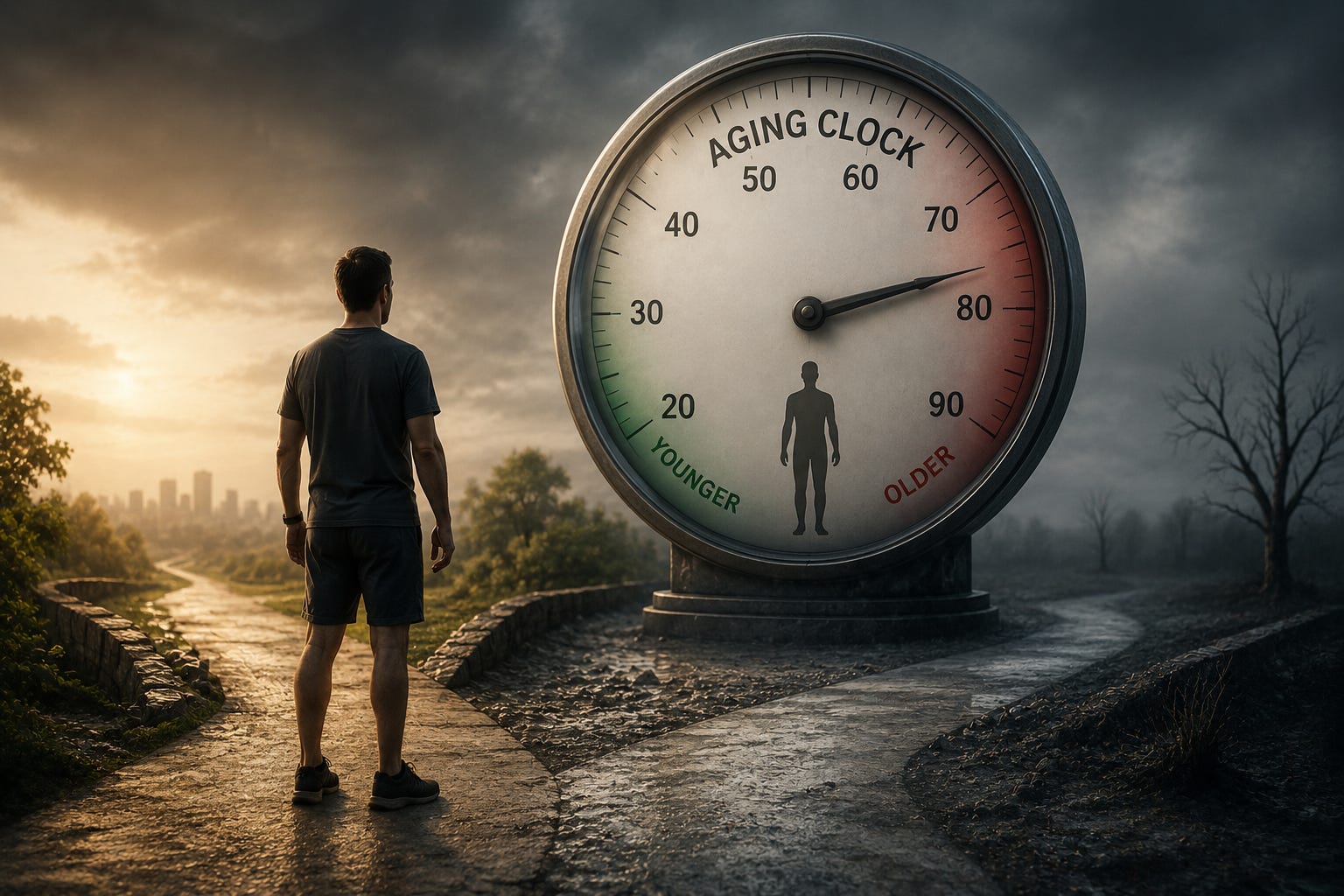
The idea itself makes sense. We already know that people do not age at the same speed. Two people can be born on the same day, yet one may remain energetic and healthy decades longer than the other. Exercise, sleep, genetics, smoking, stress, illness, diet, and environmental exposure all leave marks on the body.
A birthday counts how long you have been alive.
It does not necessarily reveal how well your body has survived those years.
Scientists have spent decades trying to measure that difference. They have studied inflammation, immune function, hormones, proteins, telomeres, organ health, and chemical patterns attached to DNA. Some of the resulting tools can predict disease and mortality risk with surprising accuracy.
That is the real science behind biological-age testing.
But the commercial message has become much simpler.
Take a test. Receive your real age. Change your lifestyle. Watch yourself become younger.
The problem is that biological age is not one universally agreed measurement. Different clocks were built for different purposes. Some are designed to estimate chronological age. Some predict the risk of illness or death. Others attempt to measure how quickly the body is changing.
Calling all of them “biological age” makes them sound as though they are measuring the same thing.
They often are not.
So what does it actually mean when a company says your body is eight years older than you are? Can diet, exercise, or supplements genuinely reverse that number? And does becoming biologically younger on a laboratory report mean that you will live longer?
To answer those questions, we need to look inside the clocks themselves.
Continue reading with a paid subscription
Biological-age tests are built on real and often remarkable science—but the number they produce is far less straightforward than the marketing suggests.
In the rest of this article, we will explore how aging clocks read chemical changes attached to your DNA, why Horvath, GrimAge, PhenoAge, and DunedinPACE can disagree, whether biological age can genuinely be reversed, and how easily apparent improvements can be caused by measurement noise, temporary inflammation, or the way a particular algorithm was designed.
We will also answer the practical question: is a commercial biological-age test actually worth your money?
Comments
Nothing yet. Say the first thing.
Sign in to join the conversation.