
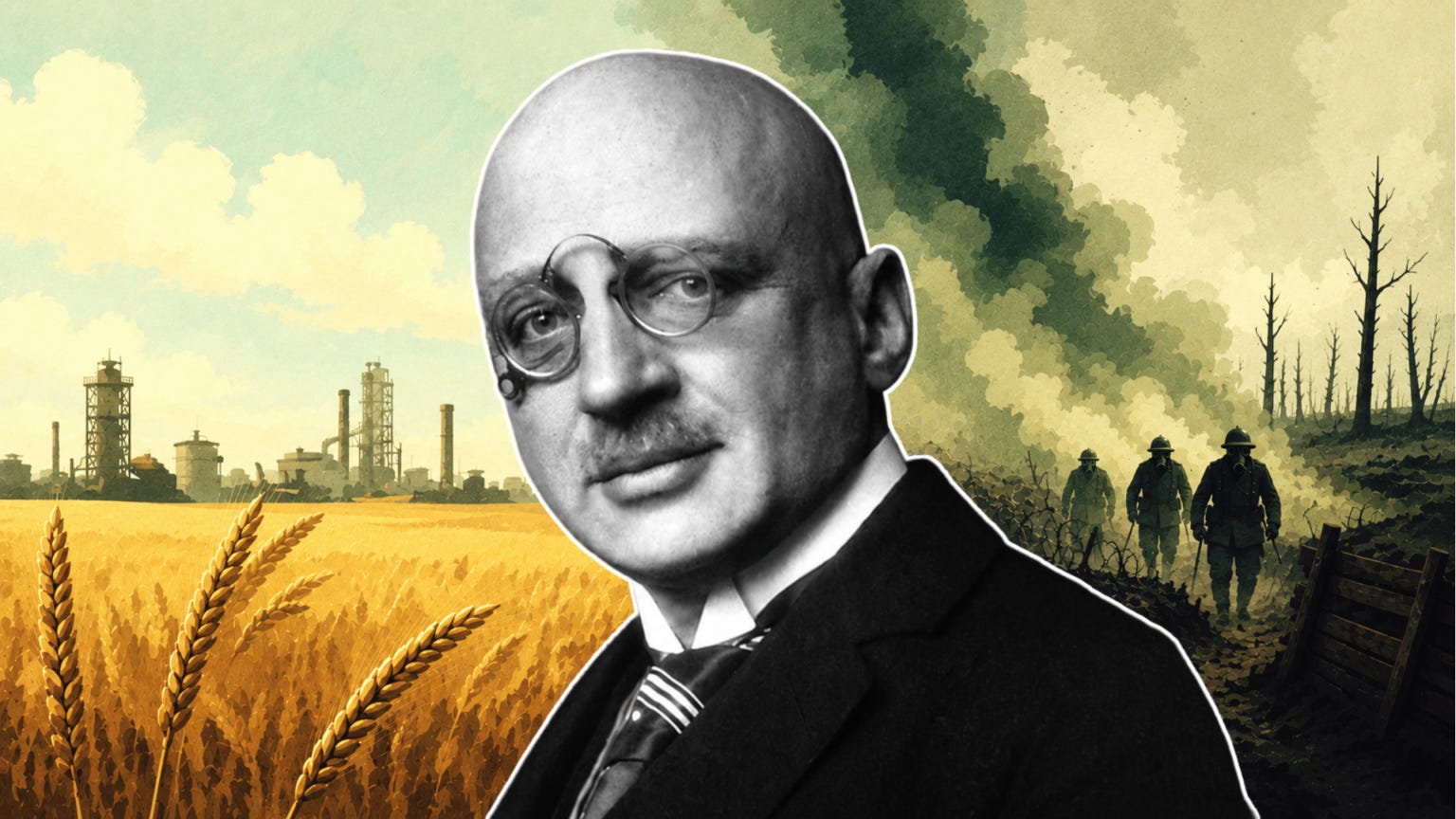
Few figures in history carry a duality as stark as Fritz Haber. One of his breakthroughs is the reason nearly half the people alive today exist at all. The other earned him the title “father of modern chemical warfare”. Both came from the same mind, and he never seemed to feel the contradiction.
Fritz Jakob Haber was a German chemist born in 1868 in Breslau (now Wrocław, Poland), into a Jewish merchant family, and spent years as a fairly ordinary chemistry professor before he cracked one of the field’s hardest problems.
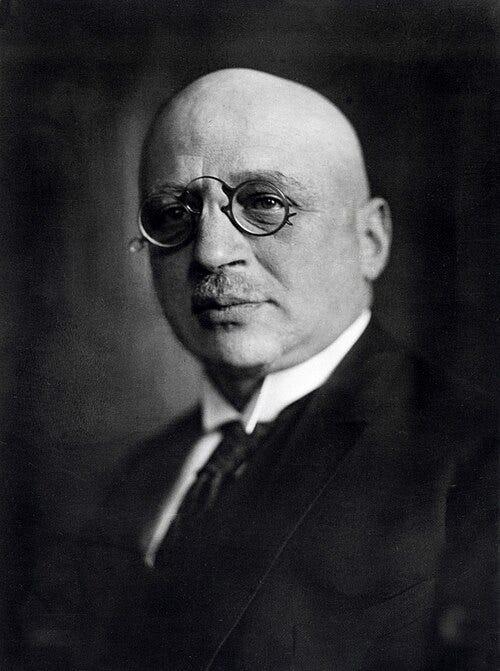
At the turn of the 20th century, the world faced a looming Malthusian catastrophe. Global population was growing rapidly, and many feared it would soon outgrow the planet’s ability to produce enough food. Although nitrogen makes up nearly 78% of Earth’s atmosphere, it is locked in a form plants cannot use. Farmers relied on natural nitrate deposits to make fertilizers that supplied crops with the nitrogen they needed to grow, but those deposits were running out.
In 1909, after years of failed attempts by chemists across Europe, Haber found a way to artificially fix atmospheric nitrogen by combining it with hydrogen under intense heat, high pressure, and a catalyst to produce ammonia. German chemical engineer Carl Bosch later scaled the breakthrough into an industrial process, creating what became known as the Haber-Bosch process.
This process became the foundation for synthetic fertilizers, triggering a global agricultural boom that dramatically increased crop yields worldwide. Today, it is estimated that nearly half of the world’s population – roughly 4 billion people – owes its survival to food grown using those synthetic fertilizers. For that achievement, Haber has often been described as “the man who made bread from air.”
However, the same chemistry that made life-giving fertilizers could also be used to manufacture explosives. When World War I broke out in 1914, Germany was cut off from the natural nitrate supplies needed to make munitions. Haber’s process was swiftly repurposed to produce nitrates for explosives, keeping German artillery shells and ammunition supplied throughout the war, and prolonging a conflict that would ultimately claim millions of lives.
But it wasn’t just his chemistry being used by others; Haber stepped forward himself. Driven by fierce patriotism, he became one of Germany’s leading advocates for chemical warfare, spearheading the weaponization of chlorine gas and personally overseeing its first large-scale deployment at the Second Battle of Ypres in 1915. This horrific milestone marked the birth of modern chemical warfare, killing thousands of soldiers in the trenches.
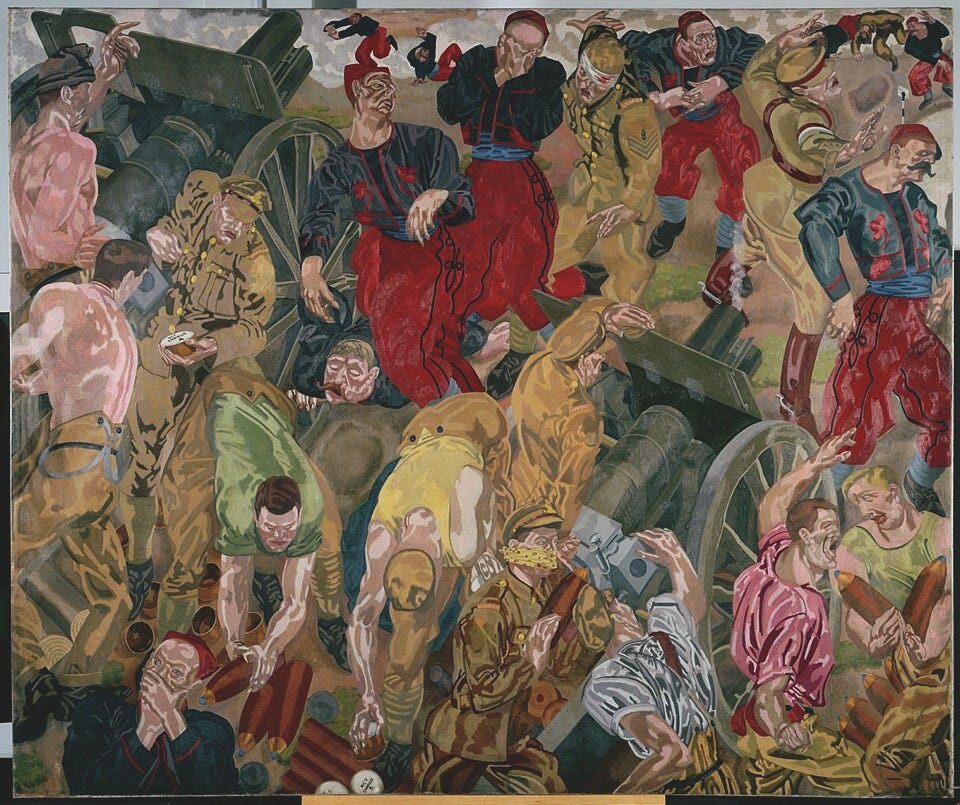
It also affected Haber’s personal life. His first wife, Clara Immerwahr, herself an accomplished chemist and women’s rights activist, had grown increasingly troubled by his role in the war. Days after the attack at Ypres, amid a strained marriage and mounting tensions over his work, she died by suicide. Yet within days of her death, Haber left for the Eastern Front to oversee further chemical attacks against the Russian army.
Despite being labeled a war criminal by the Allies, Haber was awarded the 1918 Nobel Prize in Chemistry for his synthesis of ammonia, a decision that sparked intense international outrage. But Haber saw no contradiction between his scientific achievements and his wartime actions. As he once said, “during peacetime a scientist belongs to the world, but during wartime he belongs to his country.”
History, however, would repay Haber’s loyalty with bitter irony. Despite dedicating his life to Germany and even converting to Christianity years earlier, he was compelled to resign from his own institute in 1933 rather than enforce Nazi racial laws against his own Jewish colleagues. Exiled and disillusioned, he died the following year.
And the darkest chapter came after his death, when the Nazis used Zyklon B – a pesticide developed using Haber’s earlier work, without his direct involvement – to murder more than a million people during the Holocaust, including members of Haber’s own extended family.
Reflecting on Haber’s life, his longtime friend Albert Einstein called it “the tragedy of the German Jew—the tragedy of unrequited love.”
In the end, Fritz Haber’s story is a reminder that science is merely a tool for uncovering the laws of nature and putting them to use. It carries no morality of its own. The same chemistry that gave life to billions could just as easily take millions, depending on nothing but the intent behind it. Science does not choose right or wrong. Only the people who wield it decide whether it becomes bread or poison.
Story Sources: Wikipedia, Science History Institute, Anu Museum, The Golobalist, Scholarly Commons W&L Law
I first published it on my website ScienceClock.com
No posts
Comments
Nothing yet. Say the first thing.
Sign in to join the conversation.