
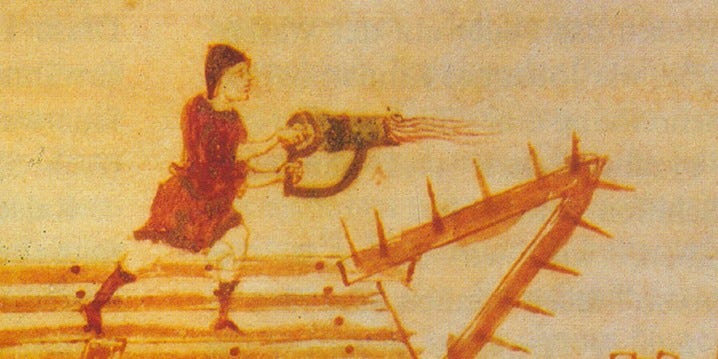
Welcome back to Ancient Technologies, our series where we unearth the forgotten breakthroughs, lost technologies, and ahead-of-their-time innovations of the ancient world. Last time, we explored the mysterious Baghdad Battery, questioning whether it was an ancient electrical device or a modern myth. Today, we’re diving into the ancient-medieval flamethrower.
Long before modern chemistry changed the face of warfare, one substance struck terror into the hearts of medieval sailors, a mysterious substance that could burn violently on top of the ocean waves. We’re talking about the legendary, top-secret superweapon of the Byzantine Empire: Greek Fire.
Greek fire was an incendiary weapon developed by the Byzantine Empire around 672 AD. Its exact recipe was a closely-guarded state secret and still not precisely known, but most modern scholars believe it was petroleum mixed with resins, making its composition highly comparable to modern napalm.
The weapon had many names in Byzantine sources - “sea fire,” “liquid fire,” “sticky fire,” “Roman fire” - before the Crusades popularized the term “Greek fire” in English and other languages.
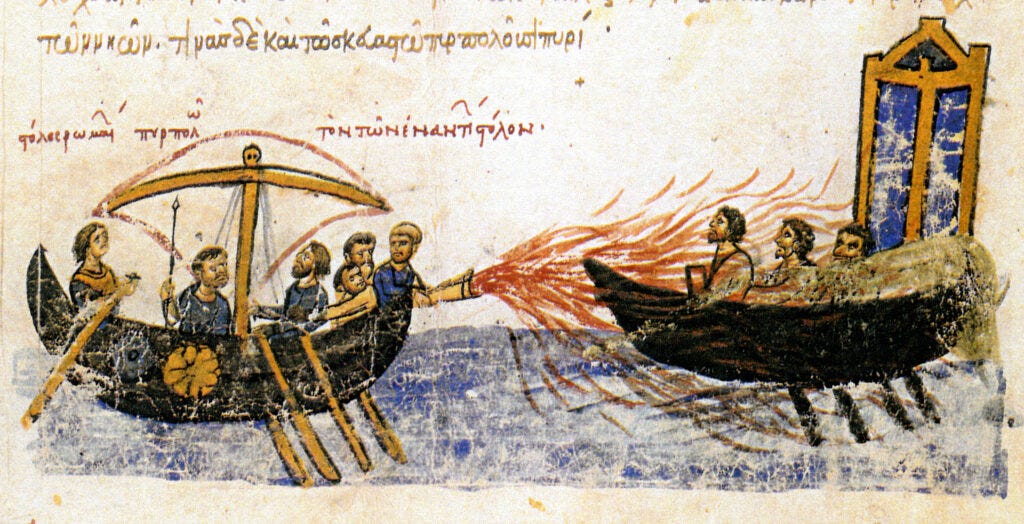
Byzantine sailors would toss grenades loaded with it onto enemy ships or spray it directly from tubes like a flamethrower. Its defining feature was its ability to burn on water, making it devastatingly effective in naval warfare. Rival powers tried repeatedly to replicate it and failed. It was first deployed in the Siege of Constantinople (674–678 AD), where it helped the Byzantines repel Arab fleets.
The invention is historically attributed to Kallinikos, a Jewish architect from Heliopolis in Syria, who fled to the Romans as Muslim conquests swept through the region. He brought with him a formula that would give Byzantium a decisive military edge for centuries.
Despite centuries of speculation pointing to saltpeter, sulfur, quicklime, or various combinations, no one has conclusively reconstructed it. Greek fire remains one of history’s most consequential lost technologies, a weapon so effective it needed no successor, and so secret it left none.
We first published it on our website ScienceClock.com
No posts
Comments
Nothing yet. Say the first thing.
Sign in to join the conversation.