
When the Labor, Health and Human Services, Education, and Related Agencies (LHHS) Appropriations Act was publicly released out of conference on January 20, 2026, many in the scientific community exhaled a sigh of relief. Others gave full-throated cheers. The community had been waiting for Congress’s official response to self-defeating cuts to the National Institutes of Health (NIH) and other science agencies proposed by the Trump administration. While both the Senate and House indicated back in 2025 that they did not intend to acquiesce to Trump’s proposed cuts, uncertainty remained high before the bill was released to the public. Many felt this official rebuke of Trump’s cuts was just the win we needed exactly one year after the administration launched its attack on science.
After the bill’s passage, praise continues from scientists and organizations alike, with some overselling the bill’s wins and obscuring its weaknesses. In the words of an anonymous Congressional aide, “People are celebrating things that not that long ago would have been seen as defeats.”
Here, we review the strengths and weaknesses of the bill, examine why we are celebrating a bill that would have been seen as lackluster in prior years, and explore how this celebratory posture might affect future funding for NIH. As we prepare for fiscal year (FY) 2027 appropriation discussions, we hope to engage more scientists in the process now, and to use our collective power to set our expectations higher and fight for those expectations.
The bottom line budget
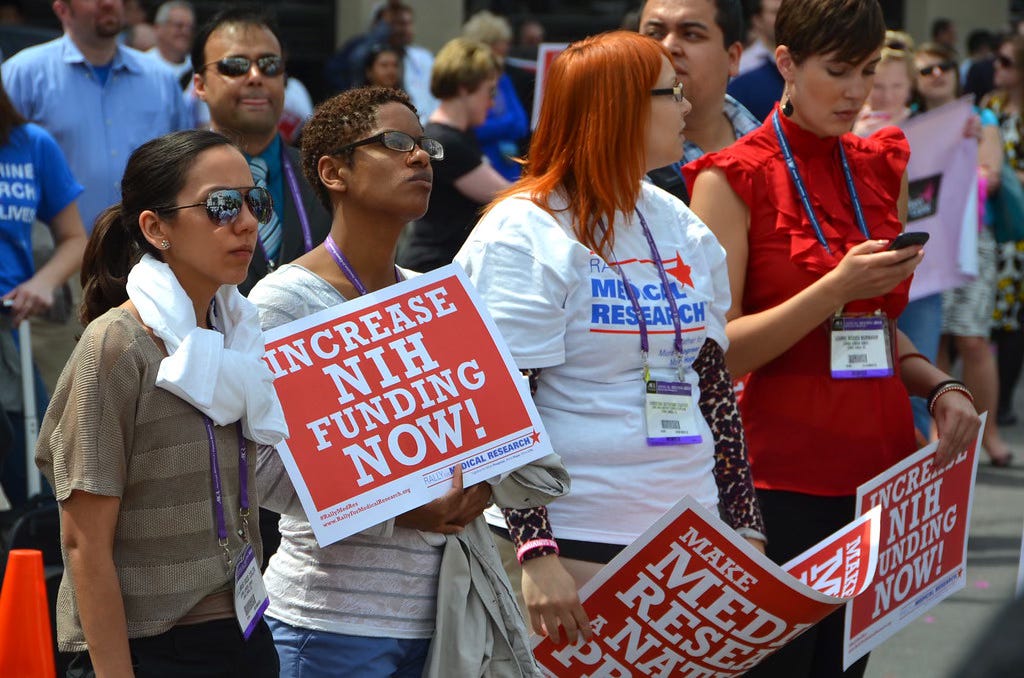
The bill gives NIH $48.7 billion for FY2026 – a $415 million raise in nominal dollars over FY2025. This is certainly far better than the 37% cut proposed by Trump and his Office of Management and Budget (OMB) Director, Russell Vought. Passing a full budget instead of running on a continuing resolution introduces some certainty that will allow previously held scientific work to continue. And the budget reauthorized and explicitly funded some key programs, including programs at risk (or previously cut) by this administration, such as the Office of Research on Women’s Health, Primate Research Centers, and the Safe to Sleep Campaign.
Yet, estimates suggest inflation is driving the cost of doing science up by about 2.6% per year. Thus, accounting for inflation, the FY2026 budget “increase” will operate as a cut of approximately 1.7% in real dollars. This budget can only be seen as a win against the absurd baseline of the proposed Trump-Vought budget. Allowing ourselves to base our expectations on this opening bid—from a man who styles himself an artful negotiator—gives credence to his claims. Trump and Vought gave an incredibly low budget offer, seemingly as a negotiating tactic, which anchored everyone’s expectations at a low point. Now, scientists are celebrating a budget that would have looked anemic last year. As we look toward FY2027, we should recognize that the Trump administration is negotiating from a position of weakness, given broad support for public investment in science and the congressional rebuke of his budget proposal. Every government, autocratic or not, cares about public opinion, and attacks on science and biomedical research are highly unpopular.
Further, these appropriated funds remain in the hands of an administration that is “presidentializing” NIH and has repeatedly revealed an antiscience sentiment. The White House has exerted unprecedented control over how NIH functions, asserting the right to veto new funding opportunities, terminate previously funded research based on partisan priorities, control hiring, arbitrarily fire staff, replace Institute directors with cronies, among other overreaches. As discussed previously on this blog, known conspiracy theorist Secretary Robert F Kennedy, Jr., will continue to determine how these funds are spent, along with covid contrarian Jayanta Bhattacharya. This duo unleashed substantial damage on science in FY2025 with just about the same operating budget. Judging by Bhattacharya’s self-congratulatory stance, they don’t appear to be considering a change of course in FY2026. Whether these FY2026 funds will be spent based on science rather than partisan politics remains in question.
Indirect cost rates
On indirect costs, the appropriation bill also yields a win, but again this win is relative to lowered expectations. The bill language clearly and unquestionably refutes the NIH attempt to impose a 15% cap on indirects. But that cut in indirects was illegal. A district court ruling that deemed the cap illegal was recently upheld on appeal. The new statutory language in the bill does help ensure that a Supreme Court, which has been unabashedly siding with the Trump administration, cannot “play Calvinball” with this issue. But having to pass laws twice so Trump and Vought follow them and the Supreme Court respects the law is an abysmally low baseline. Scientific societies and advocacy groups urgently need to consider how best to confront a rogue Supreme Court and a lawless administration.
The multiyear funding squeeze
With Russell Vought—who is expert at weaponizing the mundane minutia of government buerocracy—at the head of the OMB, we must look beyond the topline budget number. When we do, we find the poison pill of multiyear funding does remain buried within the bill. Multiyear funding acts to cut NIH funding without cutting the NIH budget. In FY2025, the National Cancer Institute payline dropped to 4%, compared to 10% the prior year, and the NCI’s own website attributed this drop to multiyear funding. In FY2025, multiyear funding also contributed substantially to a 24% year-over-year drop in new research funding.
Despite oft repeated claims that the bill allows “no more” multiyear funding, it is important to note that the “more” is relative to FY2025 levels. A last minute change shifted the limit from fiscal year 2024 levels (about 6%), as proposed in the bipartisan Senate version of the bill, to fiscal year 2025 levels (about 39%). This change was driven by the White House and was reportedly delivered to House Republicans by none other than Russell Vought. While limiting multiyear funding to 39% is certainly better than the ludicrous 100% rate the administration targeted, allowing it to continue at FY2025 levels means we will see similar reductions sustained in FY2026.
So why does the Trump White House seem so insistent on this multiyear funding provision? One possible reason: reducing the number of funded grants per year shrinks the research workforce and punishes universities. As Vice President JD Vance said, “Universities are the enemy.” But another reason could be that it sets the stage for much bigger and more destructive changes to NIH. The multiyear funding strategy frees up NIH outyear commitments, potentially enabling a more rapid transition to the block grant funding model that Vought promised in Project 2025. That is, it’s harder to shift from project grants to send money to the states as block grants if a big proportion of the NIH budget remains tied up in out-year commitments. Under a block grant approach model, NIH would in practice cease to exist and science would operate in a disconnected web of state level funding. Also, if NIH follows the pattern of other programs structured as block grants) funding amounts would diminish over time. Block grants are often seen by libertarians who want to cut government as a way to create cuts that are more politically palatable than cutting popular programs.
The limitations of report language
Other wins in the NIH funding bill exist only in report language. Such report language includes direction for NIH to continue its longstanding practice of including external subject matter experts in the search process for Institute Directors. Report language carried forward from the July Senate report directs that, within 90 days of enactment, the NIH must 1) provide the Committees on Appropriations justification for “the training and career development programs that have been terminated since December 2024” and 2) re-enact the “NIGMS bridging programs that support historically underserved students and researchers to pursue STEMM studies,” including the Maximizing Opportunities for Scientific and Academic Independent Careers [MOSAIC] program.
Getting this down in written congressional direction is in many ways a big win. It keeps these issues front and center, and ensures (assuming NIH complies) that these issues land in the Congressional record.
But report language is not law. Given that NIH appears to be under the close watch of “shadow President,” Vought and the administration has repeatedly demonstrated willingness to push hard against the limits of the law, even breaking it, it’s hard to believe Trump’s NIH will be meaningfully constrained by the non-statutory directives from the Congressional report. While this language does not carry the weight of law, we must urge leadership at the NIH to adhere to these directions and demand that Congress hold their feet to the fire.
Where do we go from here?
With the LHHS bill well on its way to passing through Congress and being signed into law, we have little room for addressing concerns by stopping its passage. But that does not mean we can do nothing. Here are steps we recommend in this moment:
Read the LHHS bill. Look at the details of the appropriations bill, including both its wins and weaknesses. Understand what is in the report language–and thus does not carry the weight of law–and what is actually in the bill. Let us know if we’ve missed any major wins or losses!
Keep pressure on NIH leadership to follow the directions from the Congressional report language, including reinstating programs like MOSAIC, using a rigorous search process for hiring Institute Directors, and documenting the impacts of multiyear funding in real time. The administration has caved to public pressure in the past. They should follow congressional intent as expressed in the report, even if it is not statutory law.
Be aware of the multiyear funding language and that Vought can (and likely will) use the provisions to further gut NIH and US science. Especially if NIH fails to follow Congressional directives, we must track the impacts ourselves using tools like NIH Reporter. Also keep an eye out for new bureaucratic tricks inside NIH.
Demand Congress advance legislation that protects the NIH mission. For example, the Follow the Science Act, introduced by Representative Diana DeGette (CO-01), provides a strong start to mitigate political interference in NIH science and prevent future wasteful and harmful grant terminations. Bigger picture, Congress should think about how the president and executive branch have asserted unprecedented power over NIH this year and revert NIH to its pre-2025 governance approach where scientists, not the President, remained in control.
Start communicating with Congress about the FY2027 NIH funding bill now. The President’s budget for FY2027, already overdue, is expected in March. Should the president again propose ridiculous budget cuts, we should recognize this as a negotiating tactic. This Congress has now clearly, in a bipartisan and bicameral way, rejected NIH reorganization and big cuts in the NIH budget. The president is not going to be able, with falling public approval numbers, to force his party in Congress to jam these measures through. We must not wait to discuss what we want in the FY2027 budget to defend NIH and US science.
I would like to acknowledge the contributions of several colleagues for the thinking that went into this blog, including Mark Histed (for his insights on science policy), Ian Morgan (for his reminders on several positive aspects of the bill), Rosa Lafer-Sousa (for speaking the words that inspired this blog’s title) and others who wish to remain anonymous.
No posts
Comments
Nothing yet. Say the first thing.
Sign in to join the conversation.