
This essay was originally published in the Dartmouth Journal of Healthcare Delivery Science, based on a presentation given at Dartmouth’s Moral Courage in an Uncertain Time: The Legacy of C. Everett Koop symposium in October 2025. It is reposted here with permission.
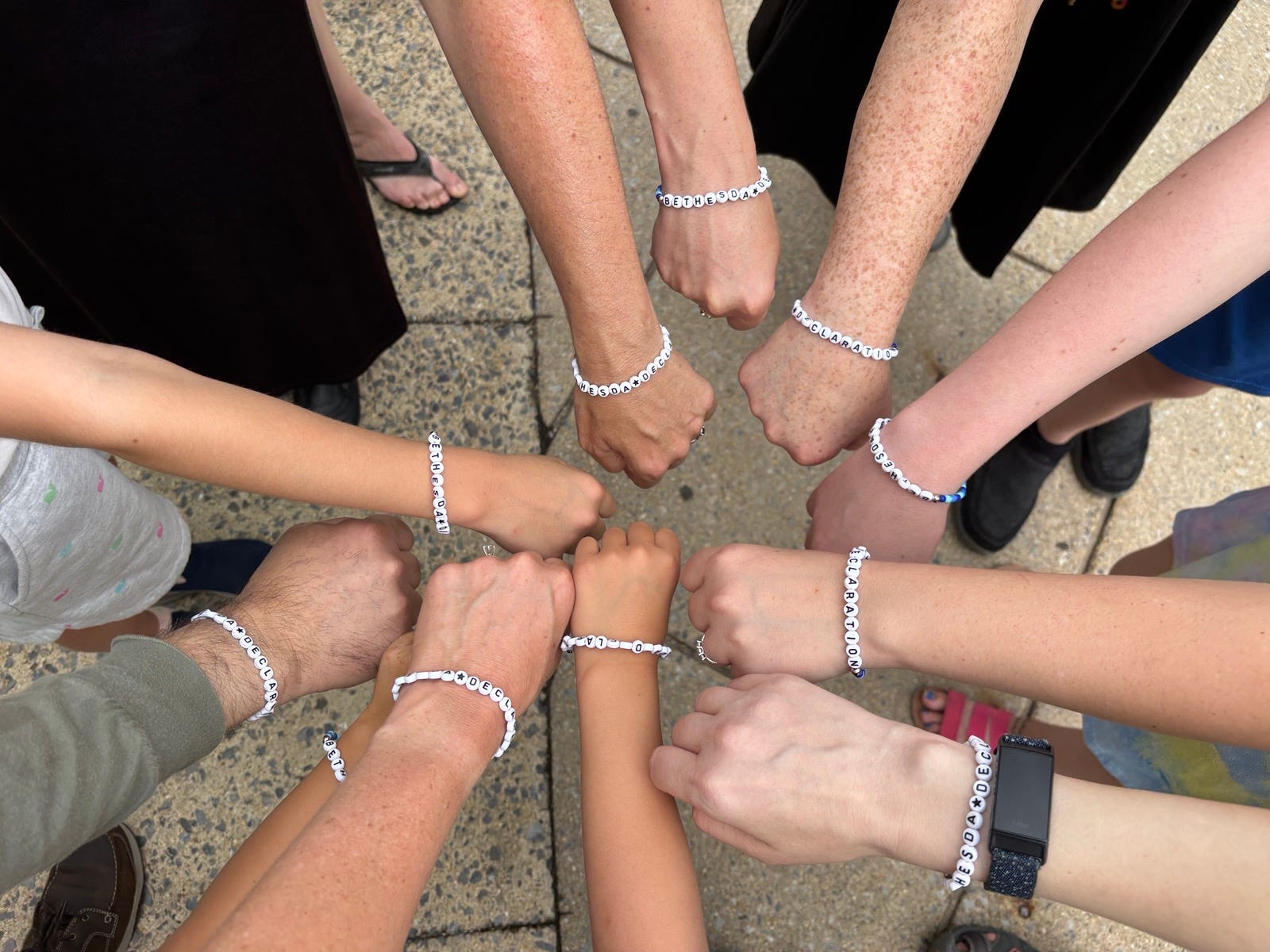
In June last year, hundreds of National Institutes of Health (NIH) staff published the Bethesda Declaration, calling attention to harmful, unlawful policies we were witnessing at NIH under the Trump administration. We were compelled by our belief in the NIH mission and our commitment to the American public to speak up, hoping we might build the awareness, courage, and solidarity needed to save science.
Bethesda Declaration signers have not been alone in speaking up. Some researchers, universities, states, and associations have successfully brought lawsuits to slow unlawful NIH actions. For example, the American Public Health Association, United Autoworkers Union, and several state attorneys general successfully challenged NIH’s unlawful grant terminations. They continue to challenge only slightly altered policies still in use at NIH today. Harvard University won its lawsuit against funding terminations, and several associations and universities successfully challenged a cap on indirect costs.
***
UPDATE: since I originally wrote this back in January, we’ve seen many more wins, including a successful lawsuit led by a coalition of labor unions and University of California faculty, students and staff that has led to two damning admissions by the Trump administration: they terminated grants based on keywords and political affiliation. We also saw an epic turnout of comments on Russell Vought’s proposed OMB rule. (Even if it turns out half a million was an overcount, the publicly posted comments have ticked past 58,000. I know more are still to come because mine isn’t up yet!)
***
Yet, as a lead organizer of the Bethesda Declaration, I know our mission is not yet complete. Many scientists, universities, and scientific associations, both inside the NIH and across the country, are holding out hope that silence will protect them. That if they hunker down, they can simply wait out the storm. But if the pace and scale of disruption continue, there may be little left when the storm clears.
Following Project 2025, a political blueprint to reshape the federal government and consolidate executive power, the Trump administration has fundamentally changed the NIH. The administration terminated or delayed nearly 400 clinical trials, risking the health of 74,000 participants. Although District Court Judge William Young ordered NIH to reinstate unlawfully terminated studies, his order only applied to a discrete set of plaintiffs. Thus, thousands of studies, including clinical trials, remain terminated. Even when reinstated, trial disruptions had lasting consequences: lost trust among affected communities. The White House mandated a multiyear funding (MYF) policy that decreased the amount of new science NIH could fund with the same amount of money. In 2025, this policy contributed to a 24% decrease in newly funded research at NIH, and NIH’s continued use of MYF in 2026 is impeding new science. They froze funding to entire academic institutions, turning NIH into a political cudgel to extort institutions into acquiescing to the administration’s political whims. While NIH has restored the flow of funds to most universities—either through lawsuits or negotiations—the White House has continued to pressure universities to acquiesce to political aims through the Compact for Academic Excellence and proposed rules that would require recipients of federal funding to disavow diversity, equity, inclusion, and accessibility efforts. This attack on science is well documented, thanks in part to brave NIH staff and researchers who blew the whistle on these policies. The administration shows no sign of changing course. Instead, they congratulate themselves on their “wins. And recently, the administration’s Office of Management and Budget released a proposed rule on the regulation of federal financial assistance that would codify these harmful policies at NIH (and across the government).”[20]
But this situation is not hopeless. Protecting science requires scientists—in the United States and globally—to build power together. To encourage more people to engage, I share 9 lessons we learned when organizing the Bethesda Declaration. I originally presented these lessons and actions at Dartmouth’s Moral Courage in an Uncertain Time: The Legacy of C. Everett Koop symposium in October 2025.
Nine Lessons Learned:
Scientists can no longer safely claim the privilege of being outside of, or above, politics.Most US scientists depend on public resources. The sudden loss of the bipartisan support that most fields of research in the United States have received for roughly 8 decades is forcing a choice: engage with what’s happening and act, or abandon science.
Inaction can be riskier than action. People often heavily weigh the risks of taking action while forgetting the risks of inaction. We knew that organizing and signing the Bethesda Declaration would risk our careers. (In November 2025, I was placed on “nondisciplinary” administrative leave. In May 2026, I was recalled to work without explanation.) We also knew that failing to speak would bring greater harm—not just to our own careers but to the entire scientific enterprise and the nation’s democracy.
Progress requires work. Every societal advance has been the product of someone’s blood, sweat, and tears. As former President Barack Obama said (adapting phrases coined by the reformist minister Theodore Parker and the civil rights activist Martin Luther King Jr), “The arc of the moral universe may bend toward justice, but it doesn’t bend on its own. It bends because people like us put our hands on that arc and we pull it.”
Do not wait for someone else. When I and other NIH staff first witnessed the destruction inside the NIH, we looked to our leadership to push back. The few people who did were quickly forced out, and the rest remained silent. Then we waited for the academic community to push back, but most people working at universities were facing the same fears and constraints as we were. Finally, we realized that we needed to speak up ourselves—together.
Rights must be asserted or they are lost. Free speech is a fundamental American right, enshrined by our founders to protect against authoritarianism. Civil servants have this right, when speaking in their personal capacity, as confirmed by a 1968 Supreme Court ruling, Pickering vs Board of Education. Allowing fear to keep us from asserting our rights means giving up those rights.
Everyone has a role. Many of us who organized the Bethesda Declaration (through an encrypted messaging service) used and continue to use pseudonyms, such as “Banana Smoothie” or “Ratson Pollock.” As well as bringing some much-needed levity, these pseudonyms leveled the playing field. Because no one knew anyone’s real identity, ideas from principal investigators were weighed equally to those from administrative assistants. Thus, the leaders of our movement have come from all levels, and people have been able to contribute diverse skills, from congressional and media outreach to copy-editing and creating artwork.
Meet people where they are. Each of us has different privileges, liabilities, and risk tolerances. If you are planning an action, provide options to engage individuals at differing risk levels. By allowing people to sign the Bethesda Declaration anonymously, we engaged single parents and people from already marginalized groups, who are less equipped to deal with financial or other hardship. Such individuals are continuing to find low-risk ways to engage, such as writing anonymously, talking to the press “on background” (where they remain unnamed), or supporting others.
Avoid burnout. The Trump administration acknowledged its strategy to overwhelm by “flooding the zone.” The onslaught seems constant, and pausing for rest can feel like failure. But we are in a marathon, punctuated with occasional sprints. If you are already organizing action, take breaks with family and friends to remind yourself what you are fighting for. If you are yet to start, know that organizing in itself brings sanity and hope.
Courage is contagious. The Bethesda Declaration kick-started a movement to protect science and democracy. Since we published it, staff from at least 8 other US agencies have issued letters raising public awareness of harms happening inside their organizations.
How scientists can take action
Stay informed. Fired and current NIH staff (in their personal capacities) and NIH-funded researchers are actively building organizations to protect science and share information from inside the NIH. Follow organizations and accounts like 27 UNIHTED, Science and Freedom Alliance, Save Health Research (Instagram), The Principled Investigator (Substack), and members of the NIH community (Bluesky) to get updates on ongoing and upcoming NIH policies, and how to push back when those policies are harmful.
Organize locally. Connect with scientists at your institution or in your professional society. Start conversations about what you can do to protect science and democracy. Off-duty NIH staff can help by sharing updates in community assemblies. Strength exists in numbers. By bringing your voices together, you can encourage your society, institution, or state government to protect science.
Talk to your neighbors. The vast majority of Americans want the United States to remain a world leader in science and believe public investment in science is worthwhile, but far fewer understand the crucial role of colleges and universities. The American Association for the Advancement of Science has tools for engaging with the public on science.
Call your members of Congress. Congress oversees the NIH, and they do care about the opinions of their constituents. Make sure your senators and representatives understand how current policies are affecting your science and communities. Find scripts and contact information at 5 Calls.
As the primatologist Jane Goodall said, “Real hope... requires action and engagement.”
Through collective action we can build hope and bring change.
We are stronger together.
No posts
Comments
Nothing yet. Say the first thing.
Sign in to join the conversation.