
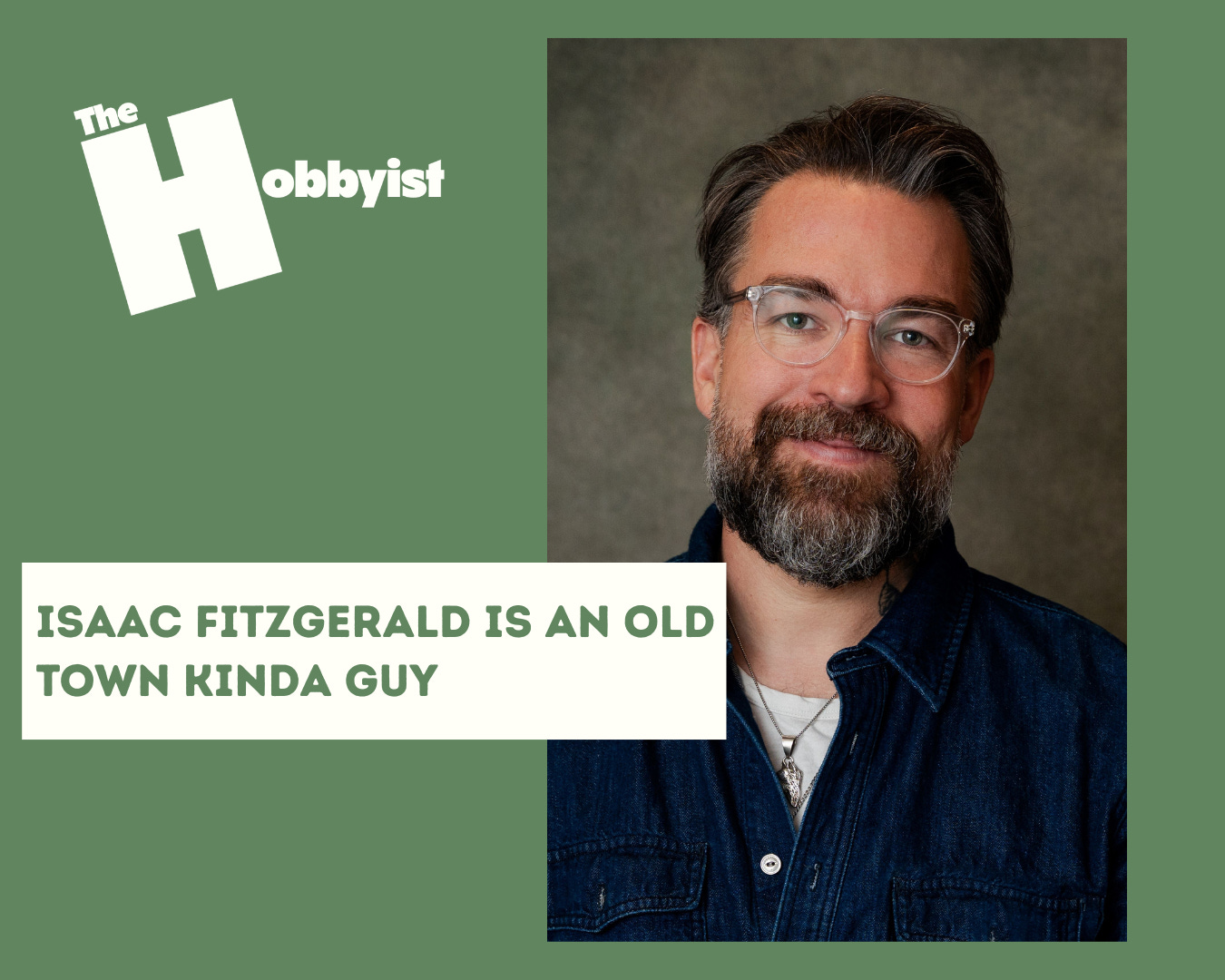
Photo by Ana Murphy
You can understand a lot about a person by learning their favorite bars. For instance, I know that Isaac Fitzgerald as a capital-G Good Person and certified dude because he’s a regular at Old Town on 18th Street in NYC.
When I used to drink, I would drink a lot there, and it remains a delightful place for me to grab an NA pint or a sparkling water while whoever I’m hanging with enjoys a world class martini or Red Stripe or whatever the hell they fancy. It’s a place to guzzle booze, but it’s also a place to hang. All good bars satisfy these criteria, which can be a fine line to negotiate when people who are bad drinkers start drinking a lot. Tl;dr, Fitzgerald knows a good bar, and I think that says a lot about him.
Another thing that says a lot about him? His tremendous new book, American Rambler, which recounts the author’s year-long extravaganza following the Johnny Appleseed Trail. We learn very quickly that the Johnny Appleseed Trail isn’t really a trail at all, which helps illustrate that this book is about walking but it’s also about everything that happens when we walk.
It’s a travelogue, but also a reflection on everything that occurs during these sojourns. Isaac has an inimitable POV, an instantly recognizable voice that is both confident and generous. It’s a true gift, considering hallmarks of most current first-person writing are tedium, monotony, and self-obsession.
I was thrilled to speak with Isaac about the success of his first memoir, Dirtbag, Massachusetts: A Confessional; life on Long Island; and a life spent reading, selling, and talking about books. Purchase Dirtbag, Massachusetts here and American Rambler here (these are my affiliate links and if you buy these excellent books via said link, I will become a millionaire).
Where is home for you?
I am living on the North Fork of Long Island. We’re on the sound side in Riverhead, New York, which is really lovely because it means we can get up into the North Fork easily. We can get to the South Fork without that much trouble. You can still get to the city in an hour and a half. It’s just been a really nice pace.
Is this just a place y’all are staying in temporarily? Or is this home?
This is it. I’ve bounced around a lot in my life, but basically two years ago now, we gave up the apartment in the city because we really love it out here. I use the city better when I’m visiting. I’ve probably gone to more shows since leaving New York than when I used to live in Brooklyn. The other thing my wife points out to me is that Brooklyn and Queens are just the very populated end of Long Island. Technically, I’ve lived on Long Island well over a decade.
Whenever I chat with artists, novelists, musicians, a lot of them have the same favorite hobby: walking. When I started reading your book, I was struck by the power of simply moving your feet. When did your relationship with walking yield this idea of a book?
During COVID, I started walking 20,000 steps a day because we learned pretty early on that if you were outside, you were probably going to be all right as long as you spatially distanced. I was living in an apartment by myself and recognized the need to not just sit at home, wallow and stare at my screen—whatever screen that may be. At that time it felt like laptop to television to phone, to phone to phone to television. I got out into the world and I realized that so much of the brain that I have loves to chew on things. It really brought a lot more peace getting out there.
At the same time, I was having memories of my father. In my early, early years, the way we would vacation is we’d go up to the White Mountains in New Hampshire and New England, and we would hike. They call them the 4,000 footers. We’d hike parts of the 4,000 footers or the Appalachian Trail. We’d sleep outside, sometimes just under the stars, sometimes in the back of his truck that had this really rough plastic covering, sometimes in a tent. The way he would get me to keep pace with him was by telling me these long stories. I was remembering that and I was remembering how much I loved walking with him as a kid. Out of that grew the Substack, which was Walk It Off. I’d go on long walks with authors and interview them.
That turned into an idea for a piece that I finally ended up writing for The Guardian. That’s really what kicked it off. It was a piece for The Guardian about walking through COVID, and it got such a tremendous reaction. That’s when I realized there was an audience out there for, like, ‘Touch Grass: The Book.’ How do I get to something like that? One of the stories my father used to always tell me was Johnny Appleseed. He was also a great walker. In those early days, Dirtbag, Massachusetts had come out, but I really found this love for walking. I was seeing that people were responding to it.
I was just trying to think, ‘What scaffolding could I hang a story onto next?’ American Rambler is a standalone book, but it fits in really well with Dirtbag. Johnny Appleseed came to mind and that’s when I realized that I could follow his path, get out in the country, see the world at an eye level, see the country at an eye level, and away I went.
Comments
Nothing yet. Say the first thing.
Sign in to join the conversation.