Hi, folks. If you didn’t get the pop culture reference in the subject line, here’s a hint: It’s inspired by a TV show that aired its final episode in May of 2004—at the peak of the No Child Left Behind era. And now that I think about it, its ten seasons overlapped with some of the largest achievement gains in American history. A coincidence? 🤔
Today we round up the responses to Ross Wiener’s New York Times op-ed on NCLB and accountability, including those from Robert Pondiscio, Charlie Barone, Kevin Huffman, Dan Goldhaber, Chad Aldeman, and Morgan Polikoff; dig into the “who should go to college” debate with Matt Barnum, Preston Cooper, Emmanuel Lalande, and Scott Laband; plus write up other recent takes from Michael Horn, Jenny Anderson, Mike Goldstein, and Christine Toribio Pitts. Plus we offer an overstuffed Extra Credit section with many more great articles to peruse beachside.
Last week’s big hubbub was around Ross Wiener’s op-ed in the New York Times, arguing that “it was a mistake in the past to treat test scores as the purpose of public schools rather than as partial proxies for what a good education actually delivers.” In SCHOOLED, I offered three quick responses:
Ross is simply wrong about the lack of progress in the consequential-accountability era, especially in reading.
It was strange that Ross didn’t acknowledge that the gains petered out around the time that Congress replaced NCLB with the Every Student Succeeds Act.
Ross sees tradeoffs where I see false dichotomies. Do we really believe it’s impossible to help students find purpose, etc., while also helping them make year-to-year progress in reading, writing, and math?
Accountability systems became very good at identifying struggling schools. They were far less successful at helping schools improve, or even understand how to improve… The central flaw of the accountability era was mistaking measurement for a theory of improvement.
Ross is right about that, Robert argues. But he agrees with me that:
Schools should be expected to produce academic results. That may sound obvious, but it wasn’t always. It’s increasingly common today to hear schools judged by their climate, culture, student engagement, social-emotional supports, or any number of worthy goals. Those things matter. But measuring whether students can read, write, and do mathematics is not a distraction from that holistic mission, it’s central to it.
Robert concludes that “The real story of the past 25 years is not accountability vs. anti-accountability. It is—or ought to be—understanding that accountability alone cannot produce excellence.”
The states and districts showing the strongest results today are not those that abandoned accountability. Nor are they those that relied on accountability alone. They are the ones that paired accountability with coherent instructional strategies, high-quality curricula, teacher support, and a clearer understanding of how children learn. Mississippi’s literacy gains did not emerge from testing by itself. Neither did the progress seen in places like Louisiana or, more recently, Houston. Accountability provided urgency and focus. It did not provide the instructional playbook.
The most reform-oriented districts and states aspire to implementation of excellent curriculum, with strong instructional practices designed to engage kids. They use measurement to ensure that the work leads to student gains. But if NCLB led to drill and kill, modern reform centers much more on strong lessons from really good curriculum, training for teachers and feedback on instruction, and intentional personalized support for kids who are behind.
So Robert (and Kevin) are right that accountability “did not provide the instructional playbook.” But that wasn’t necessarily the point, as Charlie Baronereminds us:
The cringiest part of Wiener’s op-ed was where he described what he sees as the theory of action of accountability proponents: “The strategies that produced the early gains of the No Child Left Behind era depended on a social contract: comply with adult-designed systems, defer questions of meaning and purpose, and the payoff will come.” That sounds downright dystopian. And it belies the real history of accountability reform.
I was the lead negotiator for House Democrats on NCLB. My boss, Congressman George Miller, was arguably the strongest driving force, alongside President George W. Bush, behind its provisions to disaggregate data and to identify and narrow opportunity and achievement gaps. We thought this package dovetailed strong accountability, which at the time was a domain predominated by Republicans, with principles of equity that are held most strongly on the left.
We were disappointed at the time that we didn’t get strong support from legacy civil rights groups. But that support did come later, organically, because legacy civil rights organizations, along with groups representing students with disabilities, saw the positive impact NCLB was having in schools and for students which, before NCLB, nobody was paying much attention to at all.
And as Morgan Polikoffpointed out, those groups made huge progress in the NCLB era:
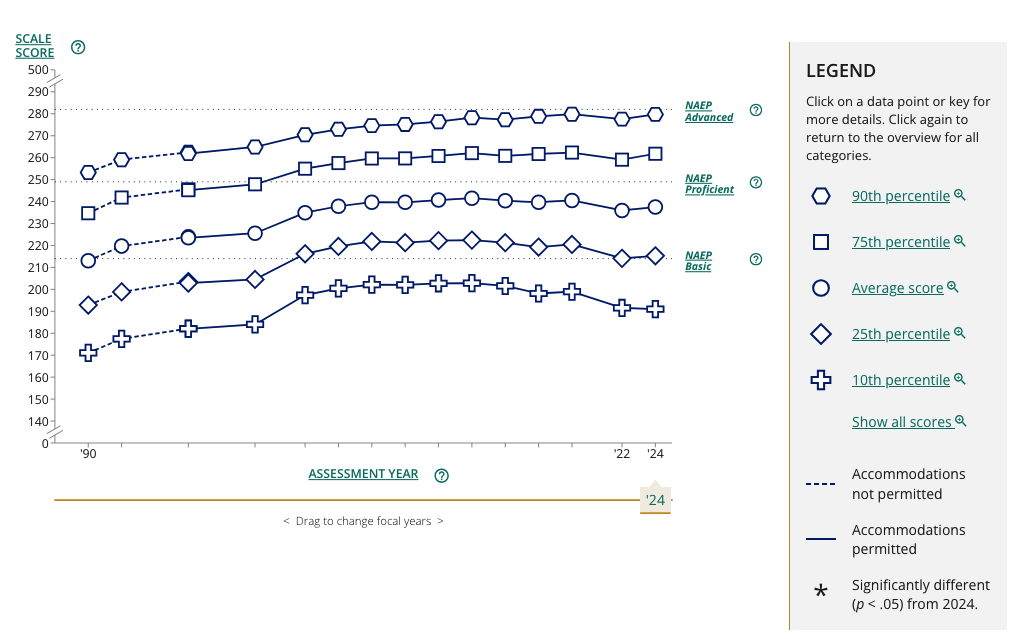
The best causal evidence we have is that NCLB improved student math achievement, period. And some studies also point to more modest gains in reading. NCLB did not widen achievement gaps (though it narrowed them less than its advocates might like). And there is even some evidence of benefits on long-term outcomes, like educational attainment, employment outcomes, and criminal activity.
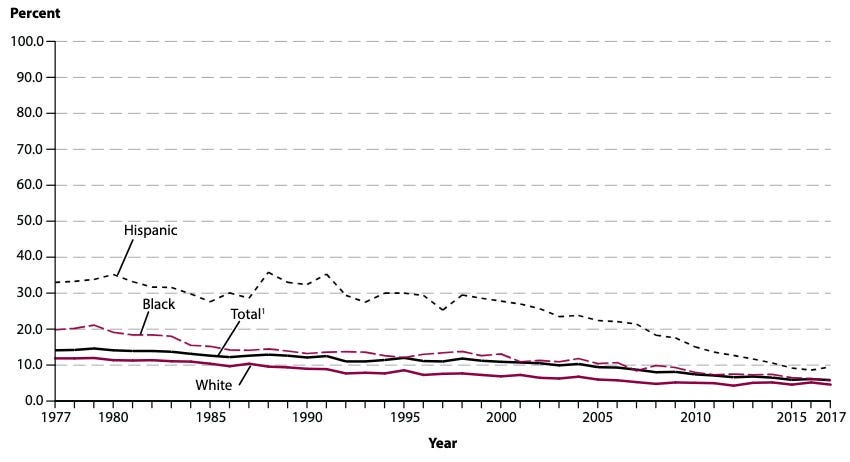
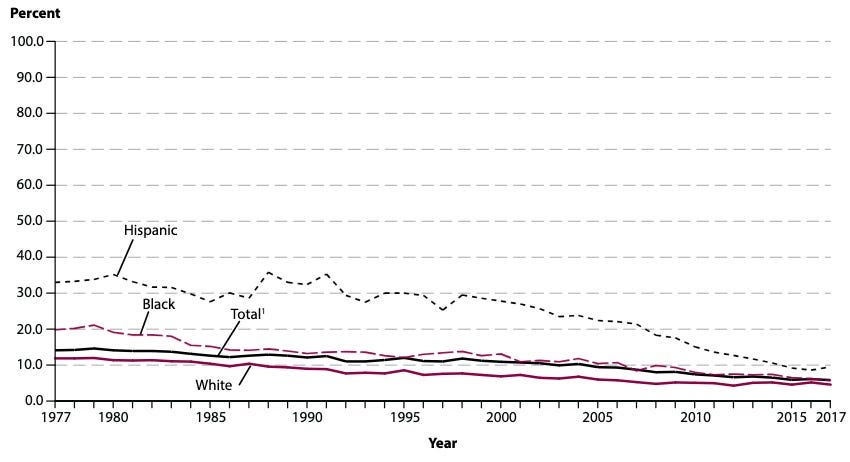
More circumstantially, it is simply impossible to look at the descriptive trends in academic outcomes during the early accountability era and argue that these policies harmed kids’ learning. Both standardized test scores and attainment outcomes like graduation rates went way up during this period–overall and for all student groups.
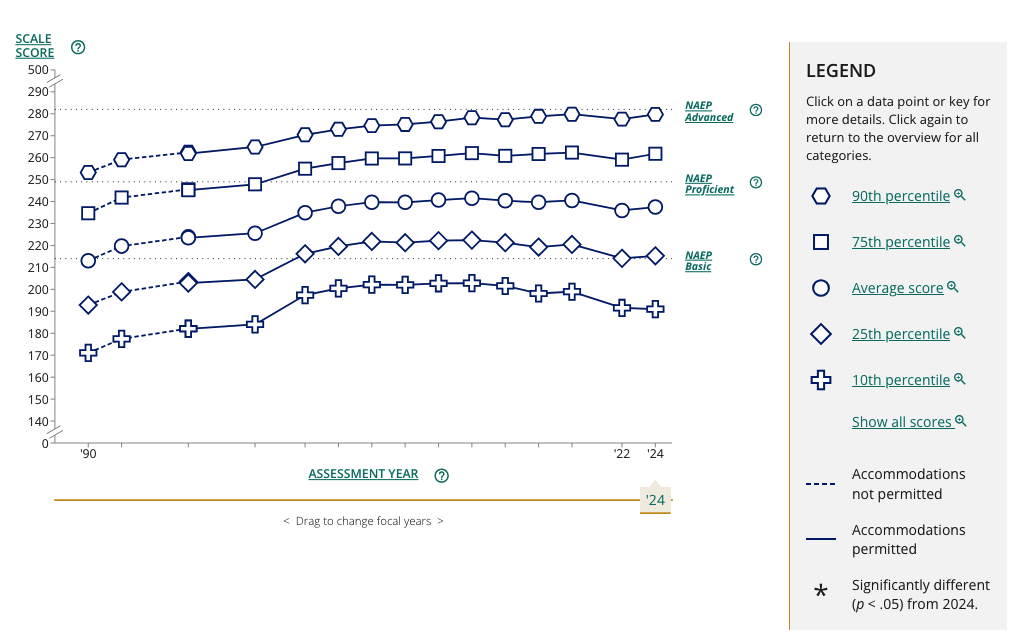
Figure 1 (source): Trend in fourth-grade NAEP mathematics average and selected percentile scores.
Figure 2 (source): Percentage of high school dropouts among persons 16 through 24 years old (status dropout rate), by race/ethnicity: October 1977 through 2017. “Total” includes other racial/ethnic categories not separately shown.
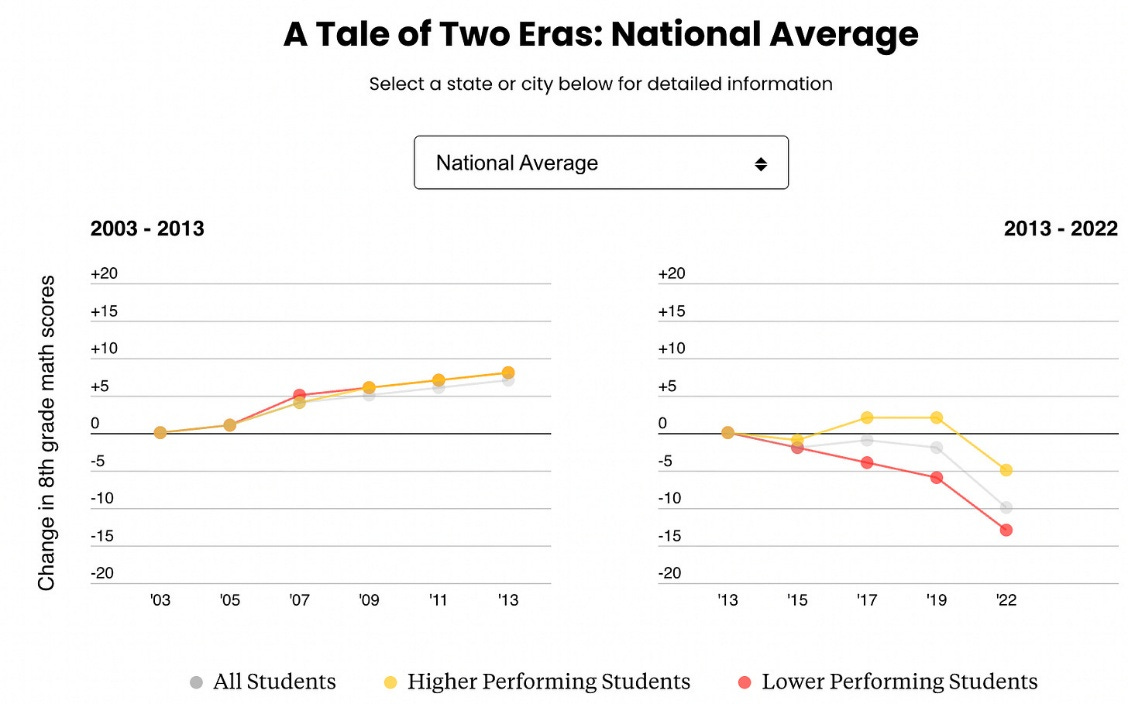
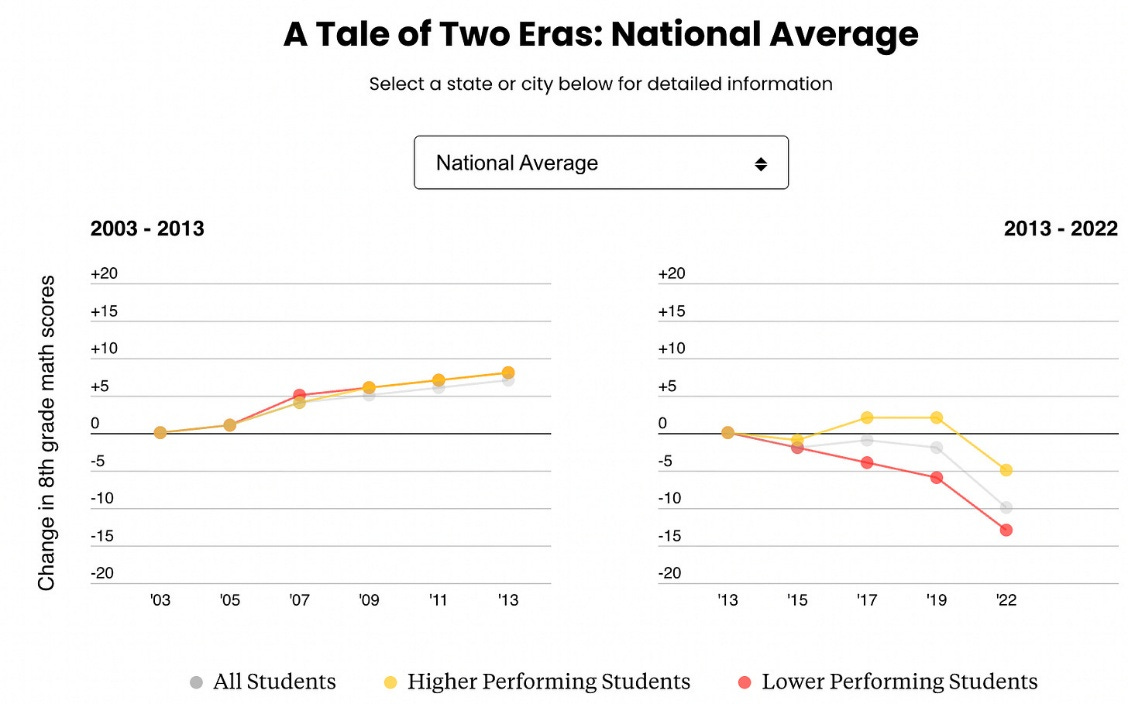
And guess when that progress stopped? Right around the time that Congress replaced NCLB with the Every Student Succeeds act, as Chad Aldemannoted:
Prior to 2013, achievement scores were rising. Those gains were broadly shared, including for the highest and lowest performing students (in yellow and red, respectively). But now look to the right of the graph. When NCLB was no longer in effect, achievement scores fell, and they fell particularly fast for the lowest performing students (in red).
Now, is this just a coincidence? Maybe? There were other things that were going on at the time that could explain some of these trends. In my piece for The 74, I explored some of those other possible explanations, but I argued that school accountability policy could plausibly explain at least some portion of what we’re seeing. Jim Wyckoffand Nat Malkus have done excellent analyses along similar lines.
Finally, Dan Goldhaber writes in with his thoughts about Ross’s point about GPA vs. test scores. Ross explained that:
I still remember when I first encountered research showing that high school GPA predicted college graduation better than standardized test scores. I went to my boss’s office to discuss it, expecting her to help me push back, but she confirmed it was true, and always had been. If so, I recall thinking, why are we fighting so hard for test scores to be the arbiter of quality education?
Dan writes:
It’s funny when people can be completely aligned on the evidence but disagree with what it means for policy. I’m not at all surprised when I see that GPA matters as much or more than tests in predicting later life outcomes. I’ve found that in my own research (and have something coming out about this), and it just makes sense since tests are a snapshot of knowledge and GPA encompasses four years of measures across various subjects. But, as you noted, there’s no reason that it’s an either/or proposition. Moreover, I suspect that the signal value of GPA would be (further) diminished if it were used for anything more consequential in terms of school accountability (which I don’t think Ross is suggesting).
Have anything to add to the debate? Including you, Ross? Respond to this newsletter, email me at SCHOOLED@fordhaminstitute.org, or leave a comment.
The most common non-college jobs make far below the median. For instance, there are over 4 million people who work as home health and personal care aides in America, the largest single occupation. That’s more than the number of plumbers, electricians, carpenters, HVAC specialists, welders, car mechanics, roofers, and power-line installers combined. The Bureau of Labor Statistics predicts more growth in jobs for home health aides than any other occupation. The median salary is about $35,000 a year.
Other large non-college vocations—each encompassing millions of people—include retail sales workers, cashiers, order stockers, waiters and waitresses, fast-food workers, and janitors. All of these pay substantially below the median. One exception is truck driving, a position that pays relatively well and employs millions of people. But many fear the job is at particularly high risk of automation.
All this maps onto other data showing that college-educated workers have a large wage advantage, on average, compared to those without a degree.
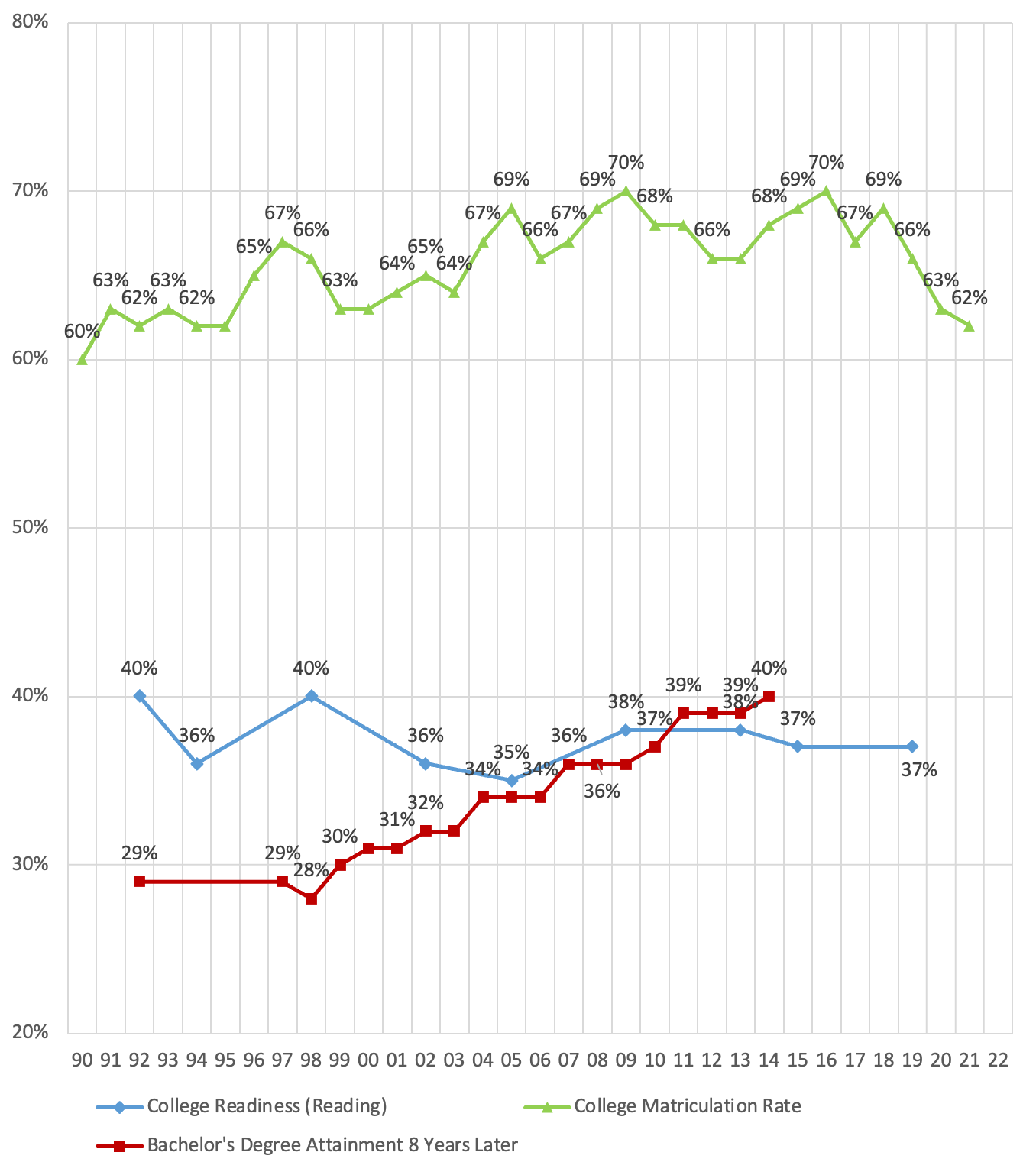
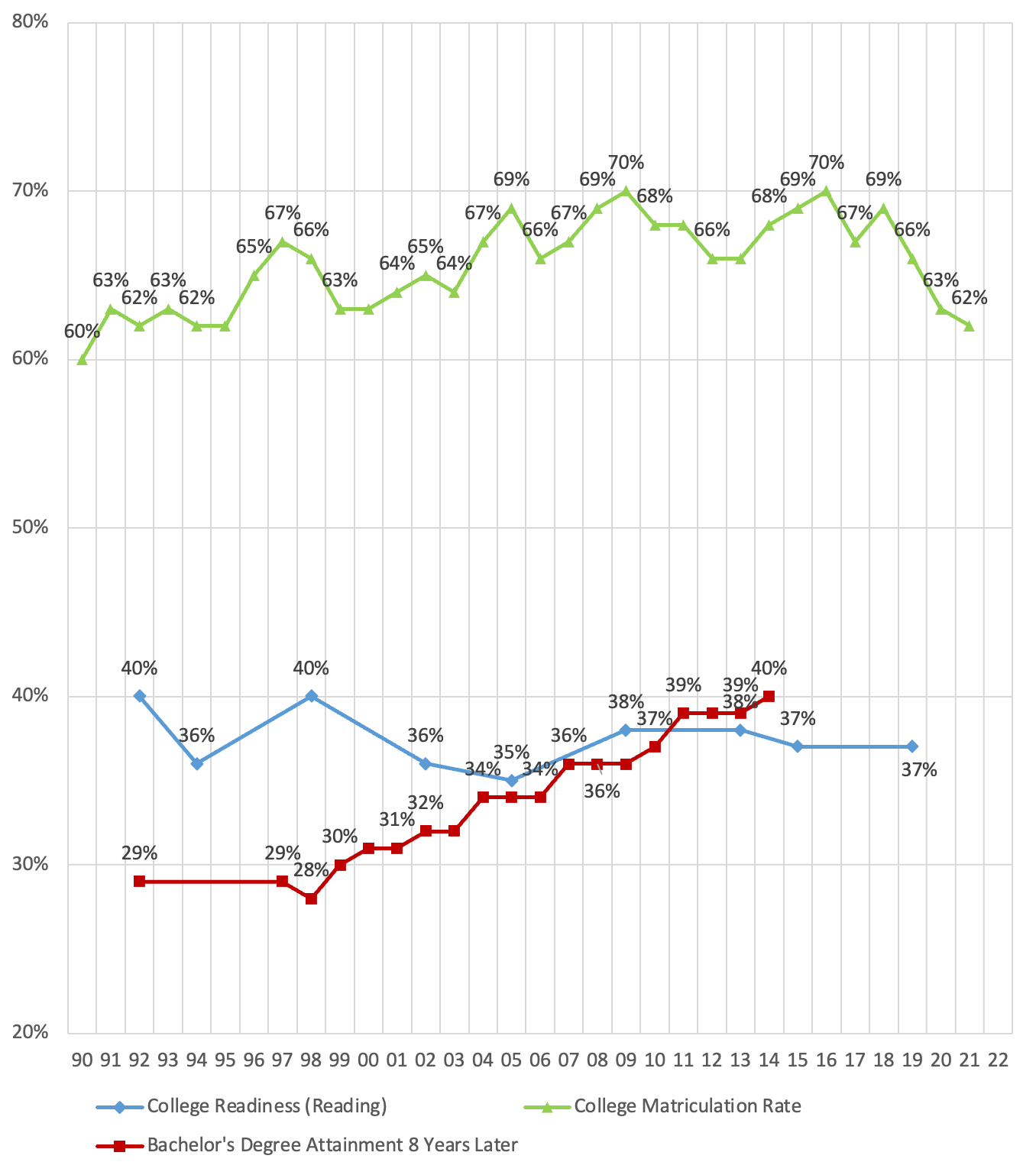
This is all true, but I wish that Matt had written that of course the college wage premium only flows to those who COMPLETE college. And it’s hard to do that if you’re not among the 30 or 40 percent of American 18-year-olds who graduate high school academically-prepared for college. See this chart I published back in 2023, showing that about the same number of students now graduate from college as were academically ready for college, even though many more give college a try:
Chart 1 displays the percentage of twelfth-graders in a given high school graduating class who reached the National Assessment’s “college-prepared“ level in reading over the past three decades, which, according to the National Assessment Governing Board, equates to “proficient.”
[It] also shows the percentage of students in that same high school graduating class who matriculated directly to college, as well as the percentage of that class that eventually graduated with bachelor’s degrees within eight years. The most recent college completion data come from 2022, for the high school class of 2014.
Chart 1: College preparedness, college matriculation, and college completion
To argue that most of the people becoming home health aides, fast-food workers, and the like could have gone to college and ended up with much higher wages requires ignoring the fact that many of those folks were nowhere near college ready at the end of high school. It’s hard to complete college if you’re reading and doing math at a sixth-grade level. Which is a strong argument for education reform and our work to dramatically improve the K-12 system and boost achievement as early as possible! Teenagers with low academic skills face bleak prospects—and taking on student loans they can’t afford to repay only makes them bleaker.
A quality education at a top-level university is right for some, yes, but for many others, the path to success looks like an excellent apprenticeship program, a modern community college pathway, employer-led training, or short-term credentials that are tied to real labor market demand.
All true, as were Scott’s strong arguments for shifting more of our tax dollars away from traditional higher education and into training for the trades. But I wish Scott had said that a “top level university is right” for students with strong grades and high test scores, who are best positioned to complete college and reap the college wage premium.
The tough calls are for students in the middle of the performance spectrum—in NAEP parlance, those who are above basic but below proficient, meaning they have solid basic skills but would likely struggle in college. Matt pointed me to a study by Jack Mountjoy indicating that even kids around 32nd percentile in achievement benefited from attending community college; that’s an argument for thinking that our definition of “college ready” might be too high and too exclusive (or perhaps should only apply to four-year schools).
On the other hand, as Preston Cooper just pointed out, a new Justice Department interpretation of disparate-impact law could make it easier for companies to test applicants again, making a college degree less useful as a proxy for academic readiness and reducing the “sheepskin effect.”
Under disparate-impact doctrine, employers generally cannot rely on hiring tests or screening criteria that produce substantially different outcomes across demographic groups unless those criteria are “job related for the position in question and consistent with business necessity.”
…[R]egulators have interpreted this law to block employers’ use of employment aptitude tests, written exams, and English proficiency tests, among other things. Curiously—and for reasons that are unclear even to legal experts—regulators have not applied the same logic to college degrees…
In a new opinion to the Equal Employment Opportunity Commission, the Justice Department…moves toward placing other hiring practices, such as knowledge or aptitude tests, on a level playing field with college degrees. This gives employers legal cover to shift away from degree requirements towards other measures of job fitness.
So this is my request, fellow writers and analysts: When discussing whether students should go to college, let’s be clear about whether we’re talking about young people with strong academic skills, weak academic skills, or something in between. And we need lots more studies to help the vast majority of 18-year-olds, who find themselves in the middle of the performance distribution, to determine which kind of post-secondary education or training is right for them.
No one disputes the fact that school attendance is highly correlated with student academic performance… But the debate breaks down over whether schools can actually do anything about this. Should they just educate the students who show up in their building in the morning, or is there anything they can do to shape those student (and family) behaviors?
I think the answer is yes…studies have found that relatively low-cost interventions, such as personalized letters or text messages informing parents about their child’s attendance can modestly reduce absenteeism. More intensive approaches, including early warning systems that identify at-risk students, mentoring programs, and efforts to strengthen school climate and student engagement, have also been shown to improve attendance. Sports, tutoring, and other activities can give students a reason to come to school.
Personally, I think the answer is “yes, but.” Yes, schools and districts can do some things to boost attendance, just like they can do some things to boost achievement, but it’s still the case that (like achievement), attendance is highly correlated with family background and socioeconomic status. This new paper by David Knight and Mark Olofson, for example, finds that districts have very little impact on student attendance (though individual teachers and schools have some). But they conclude: “The large majority of variation in student attendance is explained at the student level.”
So does that mean that states should strip out attendance or absenteeism from their accountability systems? Not at all. Instead they should supplement or replace static measures of attendance or absenteeism with “value-added attendance” measures, which control for students’ prior attendance patterns. Those of us at Fordham published a great study by Jing Liu about this approach back in 2022, which found that an attendance value-added measure picked up significant differences between schools and appeared to be related to student perceptions of school climate, especially those around school safety.
Just like an accountability system with achievement measures but not growth measures would be seen as an anachronism (and unfair), so too should be systems that measure attendance without controlling for students’ prior absenteeism patterns.
We’ll finish our regular roundup with an update about AI in education. There aren’t many wonks willing to push back against the techlash these days, but Michael Horn does it and does it well with his article, “Hot Takes Blaming EdTech Lack Nuance.”
Is layering ed tech into the traditional education system ever going to produce great outcomes? No, absolutely not, as I’ve argued since 2008.
Are there, however, some really good edtech products that don’t fall in the narrow categories that [Jared Cooney] Horvath endorses that have strong research behind them and, if used in discrete ways within a coherent blended-learning model, can get great results? Absolutely. Look at the research behind programs like Amira Learning, just to take one example.
What’s interesting to me is that some of the ed tech products out there actually require students to do many of the things Horvath says students should do—for example, taking notes on paper by hand.
An AI tutor may be able to deliver math problems that are perfectly calibrated to a student’s level. But it can’t make the student actually do the problems.
Which is why we need to double-down on human relationships.
Teachers can learn to create a sense of community in their classroom, call on students regardless of whose hand is raised, and hold everyone to realistically high standards.
Cheers to the bipartisan Virginia Board of Education, including Fordham’s Amber Northern, which last week rejected Governor Abigail Spanberger’s effort to delay implementation of higher standards for the commonwealth’s Standards of Learning (SOL) exams. Anna Brysonreports on the vote, noting Virginia’s severe “honesty gap”: dramatically lower NAEP proficiency scores compared to pass rates on the state tests across grades and subject areas.
“Just one in ten kindergartners who start school at the bottom of their class in reading and math skills is proficient by third grade,” writesErica Meltzer, sharing findings from a new NWEA analysis that underscores the need to assess young students to better understand where gaps exist and what interventions may help.
Vermont passed a law restricting federal school choice scholarships to public school and low-income students. Matthew Stonereports on how the state’s new rules—the first of their kind—put Vermont “on a collision course with the Trump administration,” which is expected to prevent states from placing just this sort of restriction on scholarship-granting organizations.
—
Holly Korbeygets us up to speed on the growing trend of integrated math in high school: blending algebra and geometry concepts across multiple years instead of teaching standalone courses. “Some experts say blending algebra and geometry gives more students a shot at learning high-level math later on in high school and college,” she writes, “touting high-achieving European and Asian countries that have taught integrated math for decades.” Still, implementation is tricky, and it’s not clear the approach provides adequate preparation for all students, particularly those continuing into STEM fields.
Last week I wondered whether it was smart for the feds to get into the science of reading business via the Senate’s draft READ act. Christine Toribio Pitts writes in from a blue state to say, “heck ya!”
The READ ACT is 100 percent necessary. Frankly, the lack of federal accountability is a critical (and ignored) part of the education depression that progressive-leaning states, like Oregon, are facing. Mike, I think you have some blind spots; let’s get you outside of your bubble.
Oregon ranks 50th in reading and math when accounting for demography. The reason is very simple: We removed graduation requirements, we toss around the term local control like it is an easy out for any real state-level leadership and governance, we allow (and sometimes push) families to opt out of standardized assessments, and our state education agency claims they have no authority to ensure our students are taught by effective teachers using HQIM.
Now, for a long time, if you asked anyone in Oregon why our schools are performing so poorly, their gut reaction, which they’ve been fed by labor and special interest groups, is that we have chronically underfunded our schools. This is untrue; even when you strip away our ballooning pension costs, we still outspend the “Southern Surge” states. You see, the lack of federal accountability in our state means our leaders can fail our children over and over again without repercussions.
To put it plainly, since 2000, Oregon’s leaders have failed to keep up with pretty basic policy changes the rest of the country has made. We stopped innovating. We stopped using continuous improvement. We stopped requiring quality learning in our schools. As a mother of four and someone who grew up in our state, I am appalled and, most days, feel pretty hopeless.
I share all of this context because the READ Act might actually be the type of federal policy that puts my state leaders on blast and backs it up with the resources and aligned requirements necessary to get past our excuses. Not to mention, the National Parents Union has done the hard work of developing this policy from the ground up, with families in the Capitol, with accountability experts read in, and with a clear focus on re-establishing a safety net around our most decentralized, weakest-led states in the U.S. This is the actual role that we need the federal government to play.
That’s just my two cents from a state that I think would benefit from this bill.
Enjoy America’s 250th birthday, everyone! See you next week.
Mike
Sign up to receive this newsletter in your inbox, usually on Tuesday mornings. SCHOOLED is free, but a few linked articles may be paywalled by other publications.








Comments
Nothing yet. Say the first thing.
Sign in to join the conversation.