
Hi friends. Last week I teed up a debate about LAUSD’s screen time policy, and this week I’m pleased to present some smart reactions from Dan Buck, Sara Mead, Thomas Rodgers, Meredith Coffey, Derek Regensburger, Betsy Tao, Dale Chu, and David Griffith. We also look at the broader techlash with Robert Pondiscio, Lina Eroh, and Anu Malipatil; debate through-year assessments with Dale Chu, Jenn Vranek, Khaled Ismail, and Arthur VanderVeen; and hear from Andy Rotherham, Robert Pondiscio, and Chad Aldeman on Virginia, Texas, and Lexington (MA), respectively. Let’s dig in!

Last week, after summarizing LAUSD’s new screen time policy, I admitted that I was torn. I wrote that I:
…worry that across-the-board bans and strict limits from on high—either from states or from large-district central offices—might get in the way of some instructionally helpful tech use. As Michael Horn argued recently, we can believe that kids are spending way too much time on screens, including at school, while also believing that there are at least a few tools and programs out there that actually add value to student learning (including for the youngest students). I worry, then, that LAUSD may have gone too far.
Still, as a parent, returning to physical books, paper-and-pencil assignments and exams, and screen-free lunch and recess warms the cockles of my heart.
A few readers are not so torn—they are thrilled with LAUSD’s policy. Let’s start with my colleague David Griffith:
Future policymakers will inevitably regard some aspect of Los Angeles’s policy as suboptimal. But after a decade of falling achievement—and overwhelming evidence that screens are often distracting and enervating—the burden of proof falls on tech companies and glassy-eyed proponents of “innovation.”
And Dan Buck:
Directionally, I love L.A.’s approach. Seeing as they’re an early adopter of screen time limits, I’m reticent to offer strong criticisms. Someone has to be the first to try something so that others can iterate, adjust, and improve upon what’s been done.
But others believe L.A. erred by focusing on quantity (of screen time) instead of quality (of digital tools). Let’s start with Thomas Rodgers:
I think you and Michael Horn are right that LAUSD’s policy overshot and the giveaway is that the policy counts minutes. That’s a frame the field spent so much time trying to move past. Even the AAP dropped rigid hour limits in favor of what the tech is actually doing. Capping a student at X minutes a week treats a well-built adaptive reading tool and mindless scrolling as the same thing. Quality and implementation drive outcomes, not dosage. Blocking YouTube and social media during the day is fine. Consumer platforms built for engagement aren’t the same as purpose-built edtech, but the policy’s real error is regulating both by the clock.
My colleague Meredith Coffey shares those concerns:
The first guardrails should go up around the tools, rather than the minutes. If students are engaging in low-quality or off-task activities, that’s a problem for any amount of time. Conversely, if they’re engaging productively with tech, that time shouldn’t face arbitrary limits.
For example, my daughter’s kindergarten class used a digital encyclopedia for independent research on animals. Here, the digital option was clearly superior to print: no massive book sets to replace, plus built-in read-alouds for emerging readers and Spanish-language options for English learners. And for those legitimately concerned about students not retaining what they read on a screen: The kids hand-wrote sentences and drew pictures to convey what they’d learned.
By denying its own kindergarteners access to such opportunities, LAUSD is limiting their digital literacy development, potentially restricting their access to information (depending on what they’ve got in hard copy), and likely exacerbating disadvantages many already face…
Schools need fewer tools, adopted more intentionally. The question for every tool should be: What problem are we solving, and is this the best way to do it?
Derek Regensburger, a social studies teacher in Broomfield, Colorado, agrees with that framing.
The quality of materials and assignments students are being asked to complete online matters far more than how long they’re spending on a device. The better response to concerns over device time would have been to limit what sites students can access while on a school device. Students often figure out ways to mirror social media feeds from their phones or play games or watch YouTube videos while on the device. If these distractions were eliminated, students would be far more efficient with their time.
And even Dan Buck acknowledges that screen time limits only go so far:
While simple, I actually doubt that strict limits will prove the most effective policy lever. They’ll likely be a pain to track, even harder to enforce, and (I’m calling it) will probably prompt a counter-reaction from teachers. “This darn limit being forced on me!” Adding to the problem, the incentives stay the same. Anesthetizing a kid with a computer for the 50 minutes of class is easy, so there will always be a pull towards more screen time.
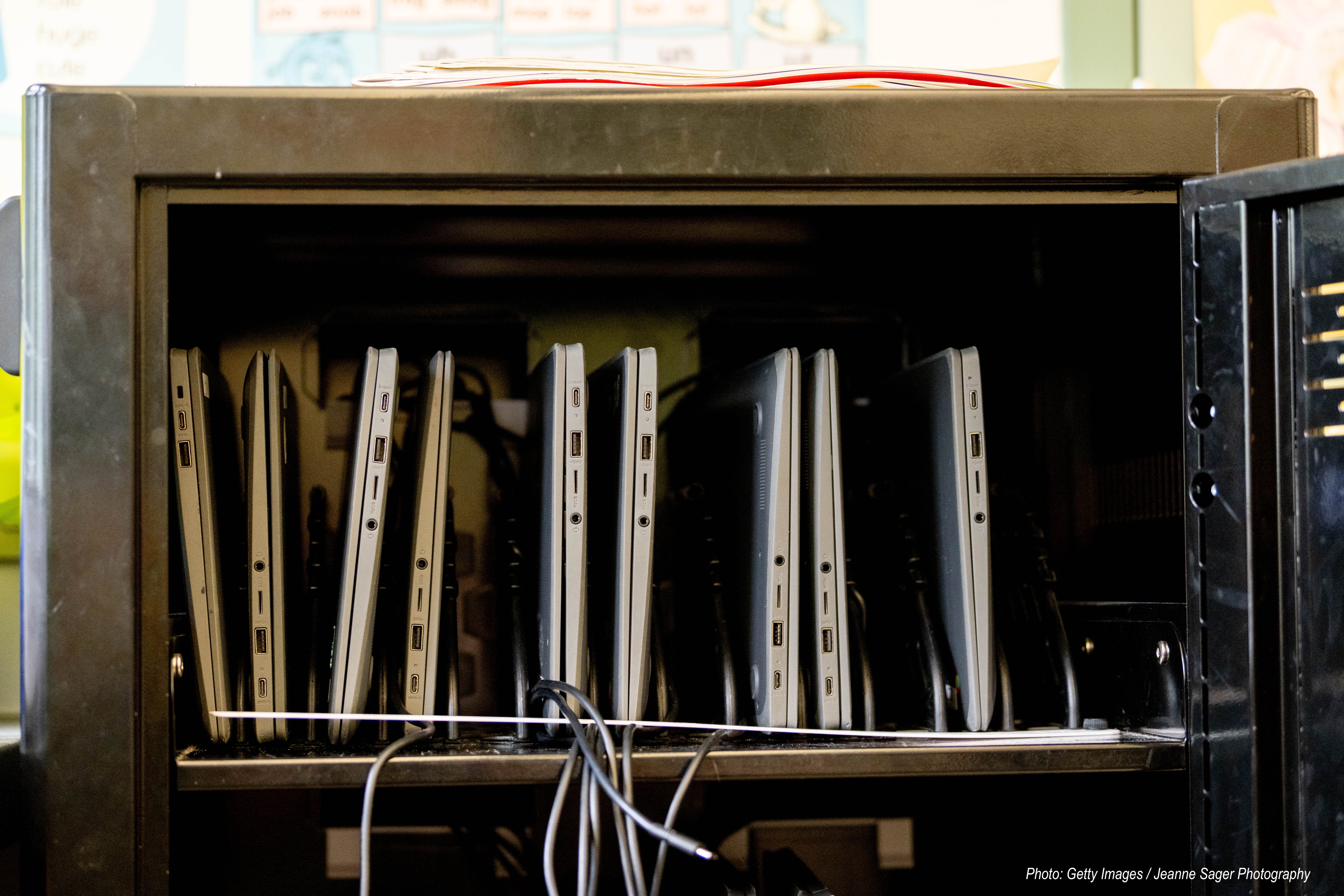
I actually think the use of Chromebook carts is a simple, elegant compromise. It forces teachers to ask themselves why they want to use a computer and then go through the process of actually getting one. Is it worth the effort? That slight bit of friction then creates a counter-incentive. If it really will enhance the learning and is worth the effort to get the cart, go for it. If not, inertia will kick in and teachers will stick to paper and pencils. (And it’s less harsh of a limiting principle so less likely to prompt backlash). As for compromise, it allows teachers to use computers and students to develop computer literacy without shifting all learning entirely online.
I really like Dan’s Chromebook carts point. That’s worth trying in some districts that want to respond to parents’ real concerns about technology in the classroom, without going all the way to strict screen time limits. Betsy Tao, a Montgomery County Public Schools (MD) parent and chair of the county council of PTAs’ Technology Committee, likes carts, too:
L.A. got it right by addressing the problem in a meaningful way, but I don't think time limits make practical sense. It's simpler and more effective to address the conditions of technology access in classrooms. Students K–5 should have limited to no access to technology, so there should be no Chromebooks in classrooms at all. Devices can be available on a cart in the media center to be rolled out when specifically needed for infrequent purposes. State testing should go back to paper for students. Students 6–12 should be getting formal and required technology education, learning actual computer skills like keyboarding, word processing, spreadsheets, but other subjects should not be taught on screens. Again, devices should be restricted to carts and labs. Students should be reading books, and writing papers and solving problems by hand, on paper, because that's what neuroscience supports as the most effective way to learn. This is especially important now that generative AI is everywhere, as not only is technology distracting and a poor way to deliver content, it has now become a way to avoid learning altogether.
Betsy also reminds us that kids are using technology beyond the limits of the school day:
What they need during the school day, 6 to 7 hours a day, 180 days a year, is time away from technology to actually acquire the skills they'll need to navigate and survive an increasingly technologically-driven world.
Dale Chu is also thinking about paper-based state testing vs. computer-based assessments:
As I argued a few months ago, much of the school technology debate is downstream of assessment policy. Because states have moved to computer-based exams, districts have a strong incentive to maintain one-to-one devices and spend instructional time helping students become comfortable reading, writing, and navigating on screens.
Baltimore City Schools is a prime example. Even as the district sought to reduce student screen time, the former CEO (Sonja Santelises) felt third graders still needed laptops because the state’s assessments are administered digitally. She called it “absolutely absurd” that eight- and nine-year-olds have to demonstrate whether they can read on a computer, but she understandably didn’t want her students at a disadvantage. That’s the bind districts are in…
Can districts meaningfully reduce screen time while states continue to require computer-based assessments? LAUSD is betting it can, but to me, this remains an open question.
And we definitely have to think about the politics of how this all plays out. Thomas argues that:
“Trust us to use smart ed tech” is a losing narrative, and it should be. The backlash is earned. Plenty of districts rushed devices out during Covid, skipped the teacher training, and let kids sit in front of low-value apps for years. When parents don’t know what’s happening inside the building, the worst example fills the vacuum. It only takes one kid on YouTube for 90 minutes a day to erode whatever trust was there.
So the move is the opposite of “trust us.” Schools have to show their work: which tools are producing learning, which are wasting time, what they got wrong, and what they’re fixing. Parents are more reasonable than the politics suggest when someone levels with them….
But my real concern is the long-term durability. These policies are easy to pass in a backlash moment and hard to unwind a couple of years down the road. When the mood shifts because it always does, we’ll be left with caps, consent procedures, and tracking mandates on the books long after the politics that produced them are gone.
Yup!
Finally, Sara Mead has a bunch of great points (and questions) from her pre-K perspective:
How is L.A. planning to monitor and enforce the policy? It’s one thing to say pre-K–1 students won’t have screen time; it’s another to make sure it’s not actually happening…
It’s a little unclear, reading the policy, how much the screen time limits are about individual children’s device use versus other instructional uses. (E.g., is a teacher using a smart board during whole or small group instruction screen time or not?)
I’ve been pretty shocked, in visiting pre-K classrooms over the past year or so, how often I’ve seen teachers simply running ambient YouTube videos (think of those “cozy coffeehouse” videos with a sleeping dog and computer-generated easy listening or classical music playing) in the background during other activities. This is troubling since there’s no reason to do this, and there is research showing that leaving the TV on as ambient background is bad for development in children under five. If the YouTube block and/or screen time limits prevent doing that, that seems like a good thing.
There’s a tendency in some early elementary classrooms to use devices or screens to keep kids occupied while teachers are doing small group instruction with a different group of children, but this crowds out more hands-on and engaging center-based activities kids could be doing during that time…
There is some really innovative work happening around technology-enabled assessment for young children, and it would be a shame if concerns about screen time, device use, or policies against screen time prevent progress on better ways of measuring whether/what/how much children are actually learning in early childhood classrooms that impose less burden on adults (current widely used observation-based measures are both not useful for a lot of purposes and very labor intensive for teachers).
Great stuff, folks! I have a feeling that this debate will be with us for a while, so keep the good ideas coming.

Of course, officials in Los Angeles aren’t the only ones thinking about the techlash. Robert Pondiscio is, too, and recently explained “the trouble with tech abstinence.” Echoing several comments above, Robert explains that:
Schools were right to rediscover that attention matters and that not every instructional problem calls for a screen-based solution. They are also right to recognize that it’s not all about test scores, and the learning environment itself matters. Nevertheless, there is a danger in turning a necessary corrective into a general philosophy of technological abstinence…
The useful question is not whether a tool, program, or lesson involves a screen but what it does to students’ attention and cognition. Does the screen have a legitimate instructional role to play, or is it a distraction or merely a mechanism to keep students “engaged”? Broad anti-screen sentiment misses this critical nuance.
That’s one “useful question,” but Lina Eroh and Anu Malipatil offer five! In particular, “5 questions to help schools and districts make smarter ed tech decisions.” Namely:
What problem are we trying to solve?
Is there credible evidence this tool works?
Does the tool support teachers or substitute for them?
How will we know if the tool delivers the desired outcomes?
Can we explain it clearly to families?
That last point is important, but I wonder if it will be enough to stem the backlash. Especially when it comes to AI-infused products. Yet as Robert argues, some of those have the most potential:
I have seen AI systems give students detailed, actionable feedback on their writing—sometimes identifying weaknesses and patterns that I missed, even as a former teacher and professional writer. I have also seen early literacy tools use AI to guide beginning readers with real-time, individualized support, extending a teacher’s reach in ways that would otherwise be impractical or impossible. That is a meaningful breakthrough and a fundamental shift—not because AI promises to “engage” students (a claim we should now treat with deep suspicion) but because it expands teacher capacity.
This is what makes AI fundamentally different from most previous education technology, which was assumed to motivate students and make learning more appealing. AI may actually help teachers teach. Should these tools be banned simply because they involve a screen?
Yet another good question!
Speaking of good questions, a few weeks ago Dale Chu took to The Education Gadfly to ask whether “the assessment that does everything is too good to be true”?
Through-year assessment is appealing because it promises to address multiple longstanding frustrations with existing state tests. But growing enthusiasm for it rests on a shaky assumption: that a single assessment can simultaneously satisfy accountability requirements, improve instruction, provide timely feedback, reduce testing burden, preserve local flexibility, and produce valid statewide comparisons. It slices, it dices, it even juliennes!
Jenn Vranek and Khaled Ismail replied convincingly that when it comes to through-year assessment: It’s good, it’s true, and it’s the way forward for state assessments! They argue:
When state assessments are designed to serve instructional improvement, they can also serve system-level accountability. It’s the reverse that is not true. The dozen states redesigning their state end-of-year tests into through-year tests to support educators to improve learning also can help districts and states see whether all students are being served well, and where the system needs to act.
That does sound pretty good, I must admit. But doesn’t it lead to more testing?
If a state-coordinated through-year system replaces the disjointed commercial interims districts currently buy, total testing time goes down, not up. In fact, during Indiana’s first year of ILEARN implementation, more than 60 percent of surveyed districts reported they are eliminating commercial interims like MAP or STAR because ILEARN provides what they need. Texas soon will explicitly prohibit districts from administering locally mandated benchmark tests that are not aligned to what’s taught as it implements its new through-year assessment system. This should result in fewer tests overall.
OK, but what about the risk of forcing all schools into the Procrustean bed of a single scope-and-sequence? In order to give students the best chance to do well on what are now three high-stakes tests a year instead of one? Arthur VanderVeen explains how Montana addresses that challenge:
In the Montana MAST through-year model, shorter assessment events are designed to align flexibly to local curriculum scope and sequence while still aggregating to a comparable statewide summative measure… These short testlets, administered in a class period every four to six weeks, are not intended to replace classroom formative assessment practices or curriculum-embedded assessments. They are intended to monitor students’ progress toward mastery in a way that applies accountability not simply to the final outcome, but in support of better instructional practice throughout the year: reinforcing the adopted curriculum rather than narrowing it, testing students on what they have had an opportunity to learn, returning instructionally useful feedback while it can still shape instruction, and supporting cycles of inquiry that help teachers adjust instruction before learning gaps harden.
It still sounds a little too good to be true…but I’m starting to come around. What about you? Should more states adopt through-year assessments?
Let’s finish with a look at three locales that have been in the news lately. First, Robert Pondiscio argues that “Texas has a theory of education” when it comes to its social studies standards and ELA reading lists:
Bible stories, canonical books, and “patriotic” social studies standards have each invited familiar charges of culture-war excess. Perhaps. But look again—and look at these three things together…[which] suggest something more consequential than conservative provocation. Texas appears to be developing a coherent theory of education: Knowledge is cumulative, literacy depends on background knowledge, and language proficiency has an unavoidable cultural valence, meaning that it reflects the knowledge a speech community shares and assumes its members possess.
Natalie Wexler largely likes Texas’s approach, too, save for the “divisive” stuff. It’s too bad that’s what gets all the attention.
Meanwhile, Andy Rotherham celebrates the big victory of the Virginia Board of Education in unanimously upholding the commonwealth’s plan to raise standards, overriding Governor Spanberger’s team. But it’s not time to let down our guard:
The main takeaway here is that pressure to keep standards low, and happy talk about how great the schools are, is high—and it’s not going to stop until a more performance-focused culture takes hold. Easier said than done because Virginia doesn’t have an organized parents or pro-kids advocacy group shaping that culture. No education advocacy organization in the commonwealth. That will continue unless philanthropy steps up and helps change the game around parent organizing so there is some effective counterweight to an establishment and political network committed to resisting higher standards and more honest reporting to families and the public.
Finally, Chad Aldeman damns Lexington, Massachusetts, with faint praise for getting strong reading results despite its use of a deeply flawed curriculum.
Lexington’s test results illustrate a broader policy problem. Science of reading reforms have been most successful when they focused on basic skills where the evidence is strongest and the policy solutions are clearest. States can require phonics instruction. They can prohibit three-cueing. They can require universal screening and force much-needed changes at colleges of education.
But literacy involves more than the basics. Strong reading outcomes also depend on vocabulary, background knowledge, writing, and countless other factors that are harder to regulate from a state capital.
And that’s what makes cases like Lexington so complicated. As Massachusetts moves from identifying a problem to implementing solutions, it should remain careful not to confuse compliance with success. A district using the “right” curriculum will not automatically produce strong readers, just as a district using a disputed curriculum will not necessarily fail its students. The best way forward is to keep focusing on the goal of helping more kids learn to read.
That’s right—and it’s also the case that most affluent students will do fine with whatever reading program their school uses. Especially since many of them will arrive in kindergarten already reading. (Children with dyslexia are definitely the exception.)
But the politics of these sorts of cases are clear: Reformers should leave rich districts alone. They may not be perfect, but the juice is not worth the squeeze when it comes to trying to force state and federal mandates on them. Imagine how much better the teacher evaluation reforms of the 2010s might have gone, for example, if they were limited to “schools in need of improvement,” almost all of them high-poverty, rather than all districts. We need to pick our battles.

Alicia Anderson, “Do school closures save money?” (Outside of California: Yes!)
Charlie Barone, “Continuing the Accountability Conversation with Ross Wiener”
Sara Mead, “The $24 Billion Question” (Will the Federal Scholarship Tax Credit benefit pre-K students?)
New York Times Editorial Board, “Bring Back the SAT, California”
Luke Rhine, “We need to ask better questions about how and if career pathways are working”
Colyn Ritter, “Audit ESAs Like We Mean to Keep Them”
Aaron Smith, “The Propulsive Growth of Non-Teaching School Staff”

Cheers (again!) to the Lone Star State, via Chad Aldeman (again!):
In 2023, the Texas Legislature passed its version of an automatic enrollment policy. Going forward, school districts would have to automatically enroll students who scored in the top 40 percent on the grade five state math test into advanced coursework in grade six, putting them on a pathway to complete Algebra I by eighth grade. The idea was simple: Too many capable students were being left out of advanced math pathways not because they couldn’t handle it, but because no one told them they could.
After two years, the latest STAAR results show double the number of students accelerating in math, with low-income students gaining access at the fastest rate. Plus:
When TEA analyzes math results by students’ enrolled grade level rather than the specific test they took, proficiency rates increased across every middle school grade in 2026.

In The Hechinger Report, Kate Taylor reports on how Cambridge (MA) Public Schools placed all eighth graders in Algebra I—and how the majority of those students will have to repeat the course. Expanded access to advanced math is an important element in providing better opportunities to under-identified students, but it only works for students who are academically prepared to succeed. In other words: Not everyone.
—
The Atlantic’s Kaitlyn Tiffany visits psychologist Peter Gray to learn about his work on the value of play, and what it means in a digital world. His views range from provocative (“Kids should be free to play without their parents’ supervision, Gray insists, even when they go online”) to outrageous. Gray, who sent his own son to a school with no formal coursework, blames Common Core for kids’ mental health struggles because a survey showed increasing stress between 2009 and 2013, before and after the standards’ adoption. What he didn’t know until Kaitlyn pointed it out was that the questions on the survey had changed, explaining the massive shifts in student responses. Plus, did he consider that the aftermath of the Great Recession—also happening back then—was awfully stressful? But whatever, #ThanksCommonCore.

Rose Horowitch traces the decline of reading among Americans, which appears to be accelerating as each generation reads less, and as we collectively lose our willingness to devote “sustained attention to longer written works that convey rich and complicated information”—a trend Meredith Coffey has covered in depth from her perch as a former English teacher. Rose’s full piece is worth devoting your sustained attention to (it’s a long one): She looks at the destabilizing societal effects of literacy across eras and the more recent destabilizing effect of new technology supplanting the written word as a source of information, connection, and art.
See ya next week!
Mike
Sign up to receive this newsletter in your inbox, usually on Tuesday and Friday mornings. SCHOOLED is free, but a few linked articles may be paywalled by other publications.
Comments
Nothing yet. Say the first thing.
Sign in to join the conversation.