
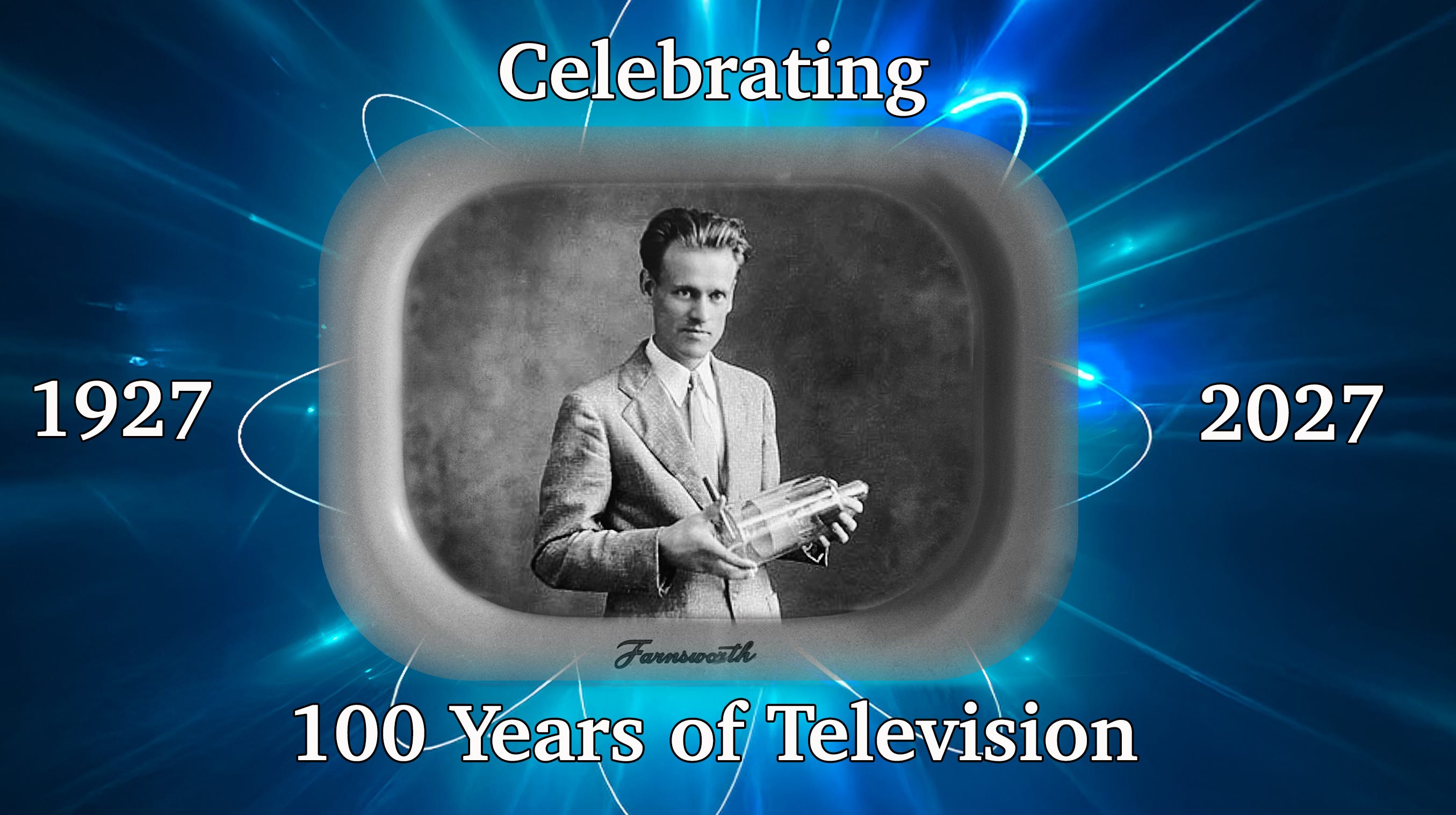
I was reveling in the idea that the Academy of Television Arts And Sciences (aka “The Emmys”) had done me a solid by unwittingly announcing the “Countdown to the Centennial” that I’ve been developing all summer.
They did that by opening this year’s Primetime Emmy Awards telecast with a sketch in which host Nate Bargatze assumed the persona of “Philo T. Farnsworth – The Inventor of Television.”
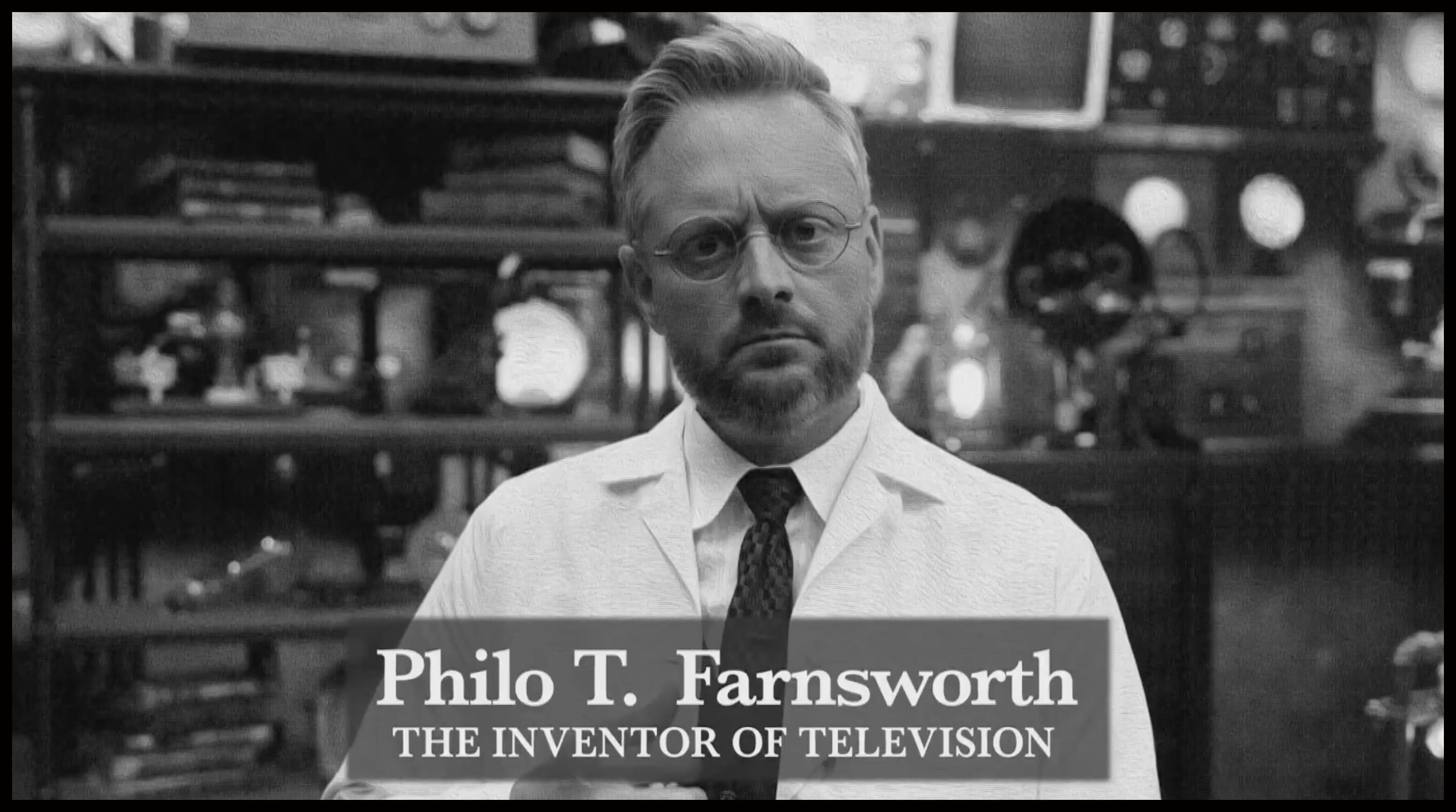
The sketch opened with a crawl that declared that…
Television, the most powerful medium ever created… watched by billions in every corner of the earth…
and then…
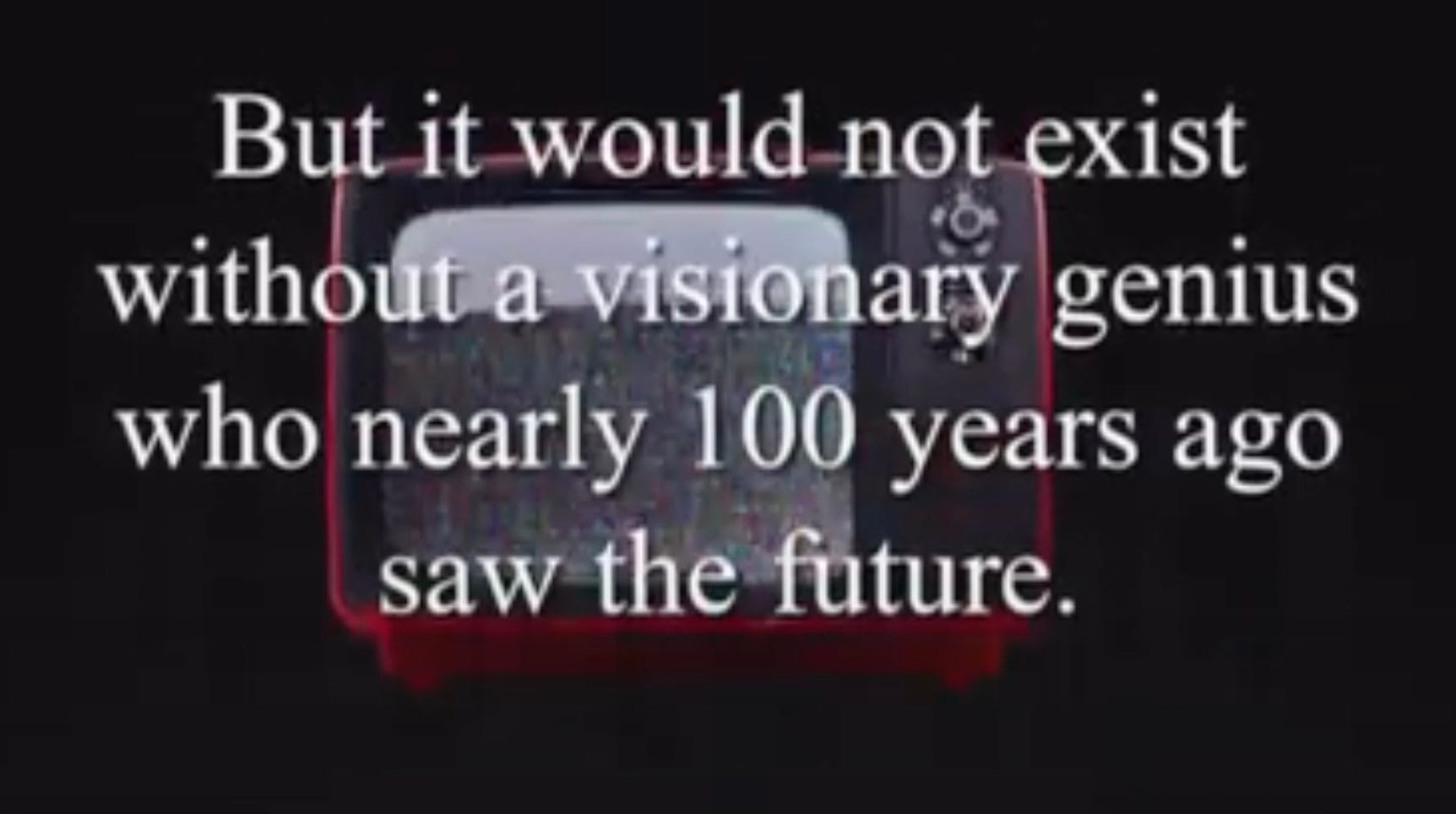
And as I said my post the following morning, I’m inclined to think that statement is a big deal.
Bargatze’s sketch said what I’ve been saying for like fifty years now: that the medium simply would not exist were it not for insight that occurred to a certain teenager while he was tilling a field in Idaho in the summer of 1921:1

The idea for a fully electronic camera tube occurred to Philo T. Farnsworth in the summer of 1921. In the winter of 1922, he drew a sketch of that idea for his high school science teacher. In 1926 – after four long years during which he expected to find his idea written up in the next science magazine he opened – some well-heeled bankers set him up with a grubstake and a loft in San Francisco. In January 1927, he applied for a patent for his idea and went to work to build a fully electronic television system entirely from scratch.
Then, on the evening of September 7, 1927,
…the tiny ‘lab gang’ was ready to test the latest of several systems they had built over the prior months. This time, a glass slide with a simple straight line painted on one side was dropped between a bank of bright lights and the camera tube, which Farnsworth had dubbed the “Image Dissector.”
In the adjacent room, Farnsworth and Co. watched the face of the receiver as it flickered and bounced for a moment. When the system finally settled down, all present could see the straight-line image shimmering boldly in an eerie electronic hue on the bottom of Farnsworth’s magic tubes.
Farnsworth called out, “Rotate the slide, Cliff.”
When he did, everybody could see the image on the receiver rotate as well.
For the first time in history, information was being transmitted from the bottom of one empty bottle to the bottom of another.
The moment was recorded in Farnsworth’s journals:
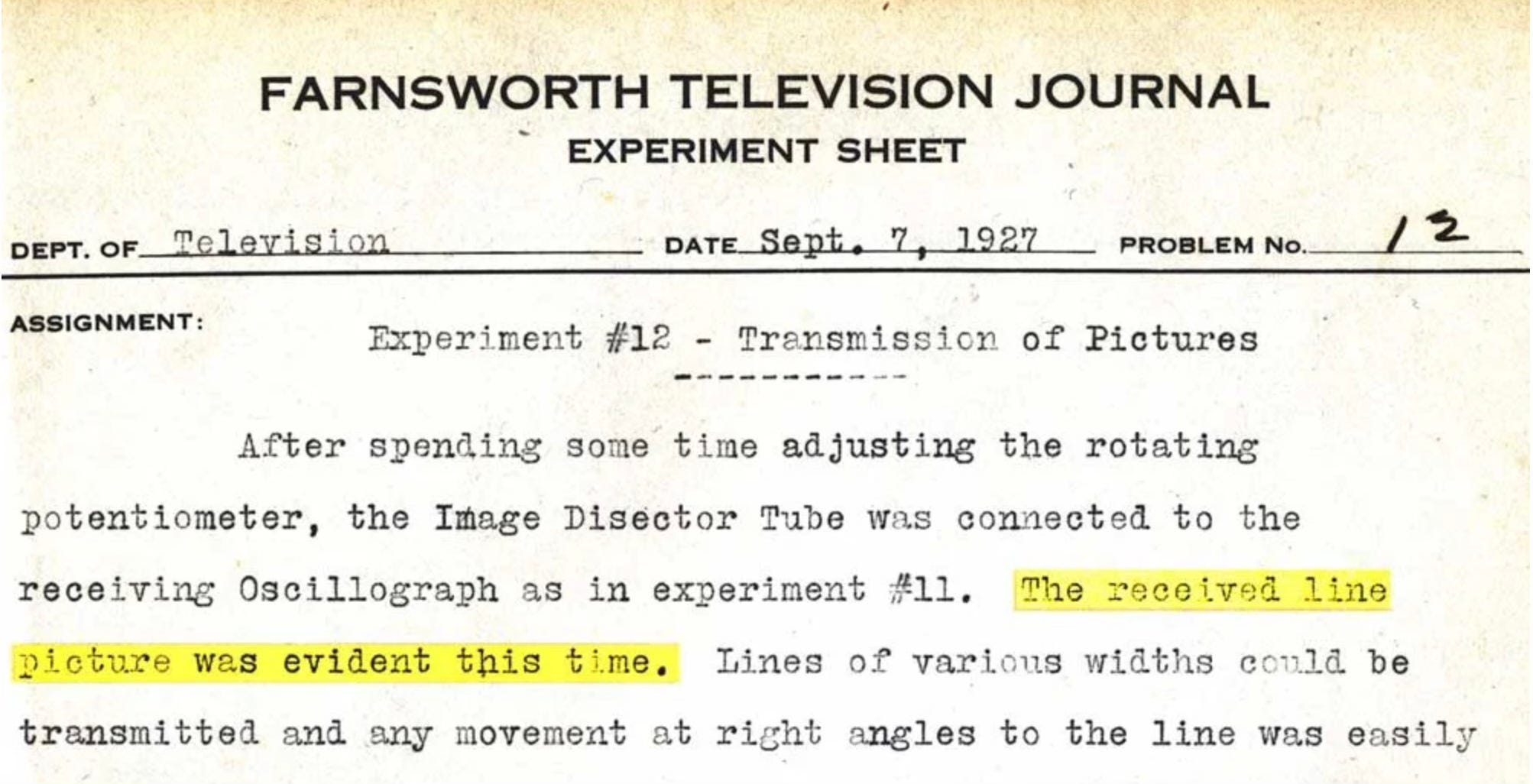
That is the moment that video as we have come to know it over the past century arrived on the planet. And here we are, with video in one form or another dominating almost every aspect of our economy and culture.
But few know the name of the man who “breathed life into all our living room dreams.”
Thankfully, millions of viewers heard that name for the first time in the opening minutes of this year's Emmy Awards telecast.
Given the role this story has had in my own life, it is quite gratifying to see the Academy acknowledge these two essential facts:
“Television… would not exist without a visionary genius”… who saw the future…
“…nearly 100 years ago…”
Today I am posting about that one word…. nearly.
Because “nearly” means that we have (checks the countdown timer….) exactly 700 days to do something about the actual Centennial of Television before it rolls around on September 7, 2027.
It is not yet clear what form the commemoration of that event will take, so it’s good that we’re having the discussion with a two-year lead time to come up with something.
I imagine something like: the City of San Francisco (where video was invented) takes an active interest, and come September 2027 we open an exhibit there that explains why the inventing of television was such a big deal when it happened in 1927.
And just why is that, you ask?
What has been lost to history – because of the the way television was absorbed into the culture and economy in the 1930s – is this nugget that I’ve explained elsewhere, citing the first paper that Albert Einstein published in 1905:
Television comes from the same all of cosmic knowledge that also gave us nuclear energy and atomic weapons. It remains to be seen which will have the more lasting impact.
Einstein published his seminal work in 1905.2 Philo Farnsworth was born in 1906. That seeming accident of fate meant that his genius was nurtured on the blank slate of relativity and quantum mechanics.
And that’s why he was able to come up with the elegant, almost stupefyingly simple idea that had eluded all the great minds of science in the prior decades.
And the rest, as they say, is history. But you wouldn’t know it from the historical record, where too often I run into the dismissal that “television was too complex to have been invented by a single individual.” Well, insert the buzzer sound here, and thank you for playing.
So here we are, exactly 700 days from the Centennial of Television.
And here is what I intend to do about it:
Today, October 6, 2025, I am launching the “Countdown to the Centennial.”
For the next 100 weeks, I am going to post the “Top 100 Milestones in the First 100 Years of Television.”
The Countdown starts with #100, Black Light Machine – in which I go into the kinds of headlines that the anticipation of television generated in the 1920s, and the first public announcement of what transpired at 202 Green Street in San Francisco on September 7, 1927:
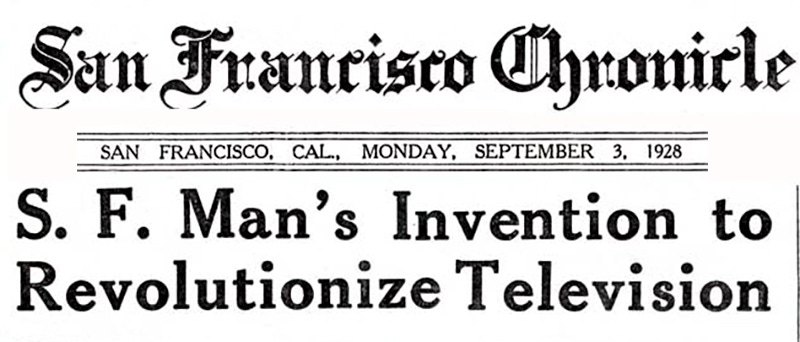
Over the course of the next 100 weeks, I am going to publish accounts of 100 things that even the Television Academy has now admitted could not have happened were it not for a certain “visionary genius” who saw the future “nearly 100 years ago.”
Each episode will be available as both a web post and as a podcast.
Does anybody care?
Should anybody care?
I really don’t have a good answer to that one.
I’m just going to try to make the case that it matters, one post per week, for the next 100 weeks.
That’s 100 things that would not have happened had it not been for what did happen at 202 Green Street in San Francisco on September 7, 1927.
Stay tuned!
Admittedly, the assertion that “that the medium simply would not exist…” is arguable. It’s easy enough to refute such a statement by saying that “if Farnsworth hadn’t thought of it, somebody else would have.” But that would be pure speculation. The actual historical record (however much corporate interests have massaged into near meaninglessness) is that Farnsworth is the one who though of it, and absent the indispensable ideas in his first patents, speculation about alternate timelines is all we are left with.
This surely warrants more than a footnote, but this will have to do for now: Albert Einstein published four groundbreaking papers in 1905. The first articulated and quantified the photoelectric effect, which Farnsworth put to good use in his concept for an electronic television transmitter tube. Subsequent papers revealed Special Relativity and landed finally on the most famous equation in history, E=mc2. Hence my contention that “television comes from the same well of cosmic knowledge…”
No posts
Comments
Nothing yet. Say the first thing.
Sign in to join the conversation.