
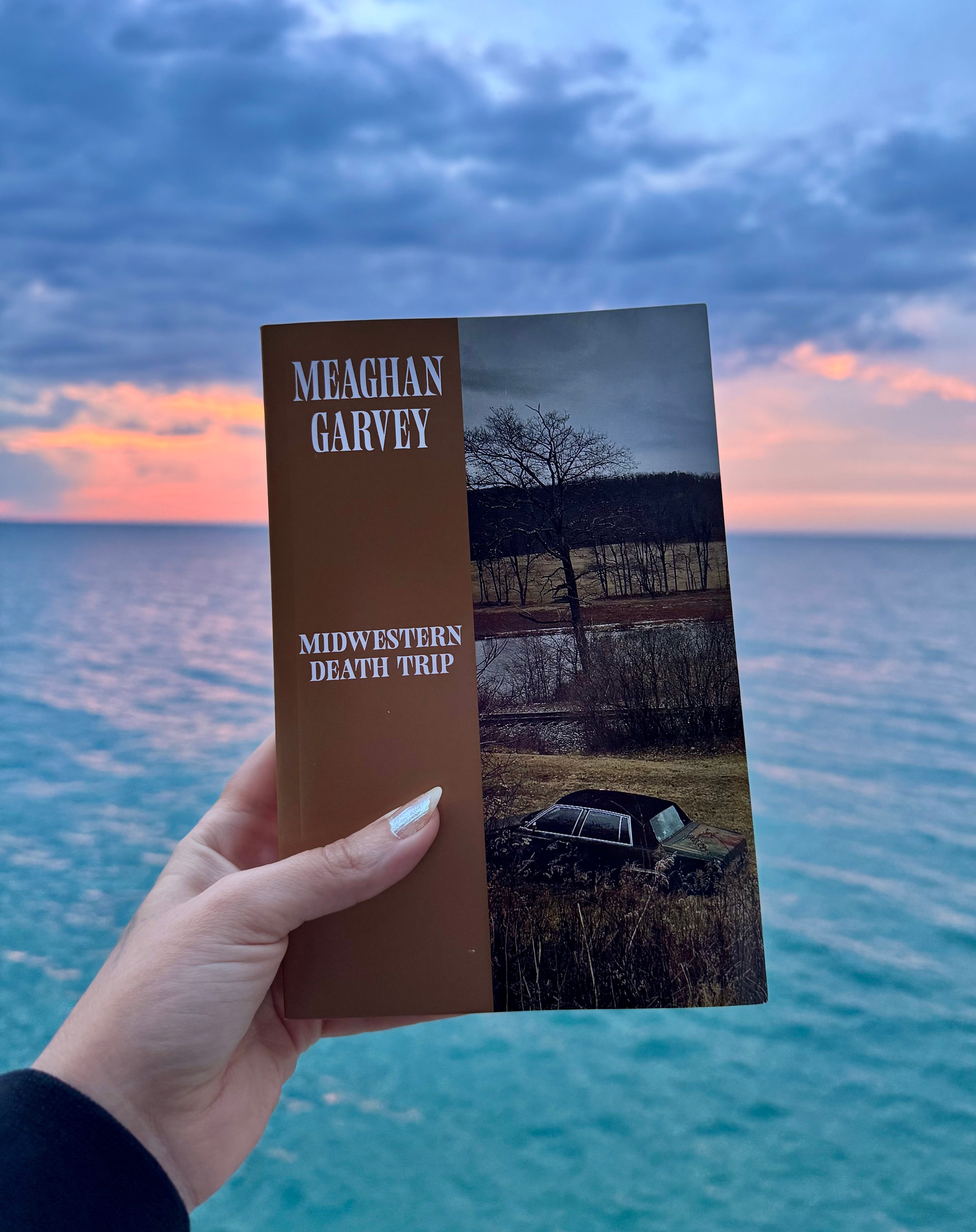
I am pleased and sort of amazed to tell you that my first book, MIDWESTERN DEATH TRIP, is out today! I started on it more or less a year ago, though a few of the chapters I’ve been kicking around much longer. I refuse to get all sappy and sentimental over what basically amounted to a rollicking good time; even the month of February, when I barely left the house and was crying all the time for reasons I won’t get into here. I’ll just say that for the first time in my life, I made something I cared about, and however the rest of it shakes out is fine by me. (But please do buy it so I can stunt on my haters, here or here or wherever else you buy books.)
I have learned in recent months that I am shockingly terrible at describing to people what the book is even about. Oftentimes I default to self-deprecating humor: “Picture Eat, Pray, Love, but replace Bali, Indonesia with Gary, Indiana. Also, the narrator is a demented party rat.” Mostly I grit my teeth as if the question gives me psychic pain. The truth is that, for several months of reporting and writing, I wasn’t sure exactly what the book was “about,” either. I had conceived it as a literary travelogue in the vein of Blue Highways or Travels with Charley — a portrait of America at an interesting time. But what materialized was more personal than I’d expected, revealing something I had known subconsciously but had yet to articulate. I came to see that I felt natural in the role of the stranger, drifting into yet another town, another bar. In many ways I felt more comfortable as a stranger than I did around the people who had known me all my life.
This realization brought up questions that I feel are worth asking at this particular moment in American life. What does one stranger owe to another? What do I want from them? What do they want from me? Here in the Midwest — a whole universe of strangers beneath what is presented as a region of small-town familiarity — what do we expect from an encounter with another? Is it delusional to expect kindness out of the deal?
Readers of this newsletter can guess my answer to the last question, to which I defer to Blanche DuBois by way of Lana Del Rey. (“I believe in the person I want to become / I believe in the freedom of the open road / And my motto is the same as ever: I believe in the kindness of strangers.”) What I believe in most is that people tend to surprise you, and that our lives are far more interesting than modernity has led us to believe. I hold fast to the idea that beauty, wonder, and amusement can be found just about anywhere you look, so long as you are looking, no less so in the ruins of a crumbling empire. To quote for the 100th time Jim Harrison in True North: “There is a beauty in desolation because that’s all we have.”
In that way, I think the title is something of a head-fake or a roguish gothic wink. It’s an homage to Wisconsin Death Trip, Michael Lesy’s 1973 stoner classic, whose own title referred to psychedelic hallucinations of death and rebirth. It bears noting that these were not bad trips, exactly. Often psychic death can inspire a new acceptance of man’s fate and a sense of continuity through all earthly creations. What you thought was the end was just the beginning. The infinite samsara: “It’s so over. We’re so back.”
Another thing I’ve learned from Lana Del Rey over the years is the confidence to wear your inspirations on your sleeve. Maybe you honor them, maybe you don’t; in any case, it’s kinda cool to call your shot. So I’m sharing what you might call a Midwestern Death Trip mood board — a list of books, movies, and music by which I was inspired, more in spirit than in theme. There’s a playlist I made at the end, which I think suits the mood. Thanks to all of you for reading, and I hope you enjoy the ride.
Midwestern Death Trip, in stores now. ♥︎
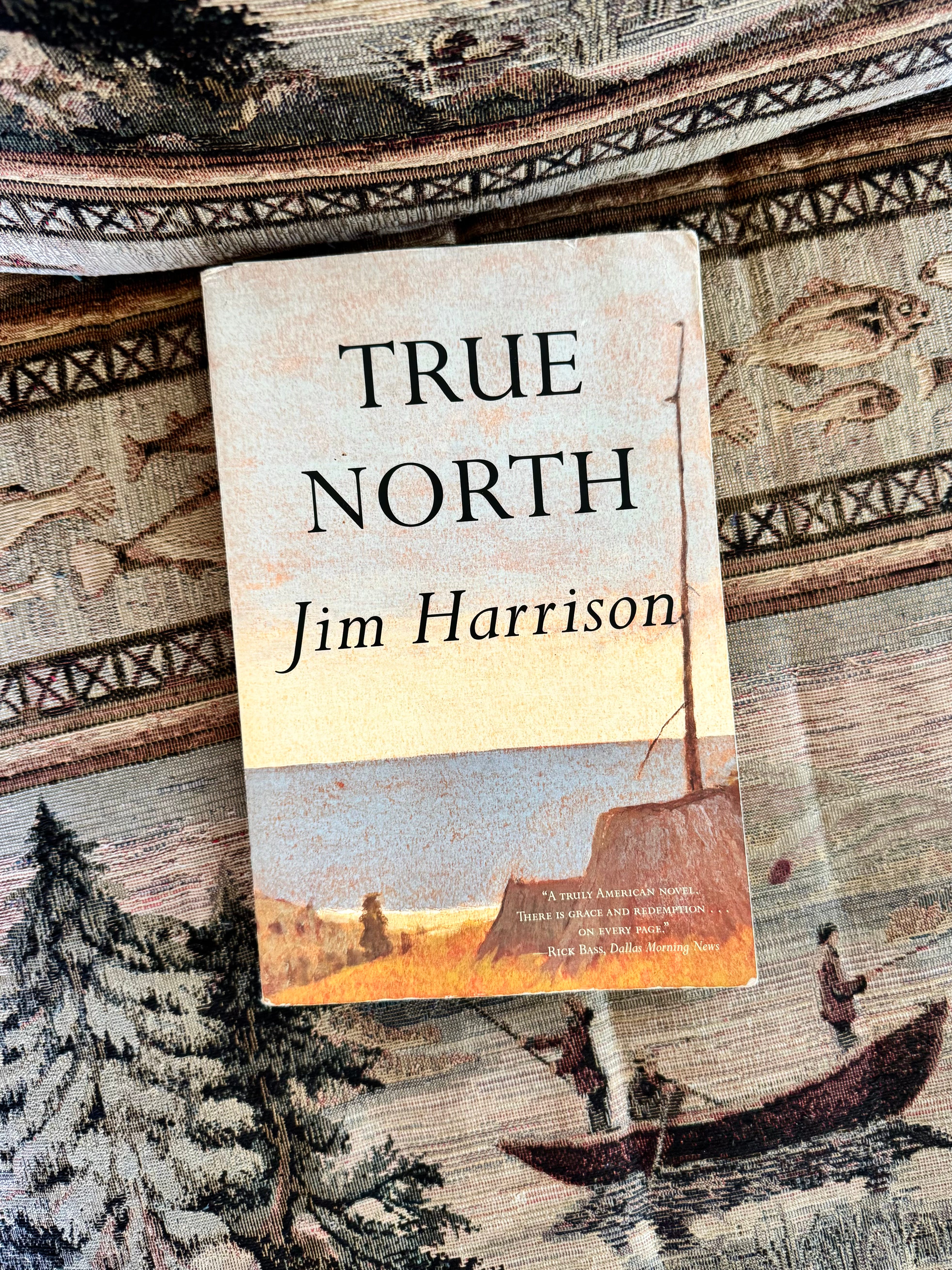
“Fred was close to drunk but that didn’t keep me from taking him seriously. It was the first truly important night of my life. Despite my aching bones and blistered feet I sensed a possibility of strength, of a mission that drew solace and the chance of success or victory from the fire, from the dog, from my fellow human Fred, the night, the bright moon and stars, even the owl we were hearing intermittently. This sounds vaguely absurd now but then so many changes in the direction of our lives come as a result of accidents, happenstances, the slightest pushes in any direction, and on the more negative side the girl you met at a gathering you didn’t want to attend who infected your life to the extent that the scar tissue will follow you into old age.”
JIM HARRISON, TRUE NORTH (2004)
As far as straight-up chops, no writer has inspired me more over the past year than Jim Harrison, the well-fed woodsman poet laureate of northern Michigan. Funny in a sense since his work is driven by a hearty, Hemingway-esque machismo, though his sensuality and earthy mysticism set him apart (and for me, above). Neither Harrison’s best-known nor most acclaimed novel, True North is the one that sticks in my craw: a sprawling family epic set in the Upper Peninsula, it chronicles the scion of a line of timber barons whose despoiling of the Upper Midwest’s forests launches him into a spiral of guilt, estrangement, and patrimonial revenge. The question that hangs over the coming-of-age saga has to do with the great paradox of American life: in a country created on the premise of freedom, to what extent do we truly control our destinies?
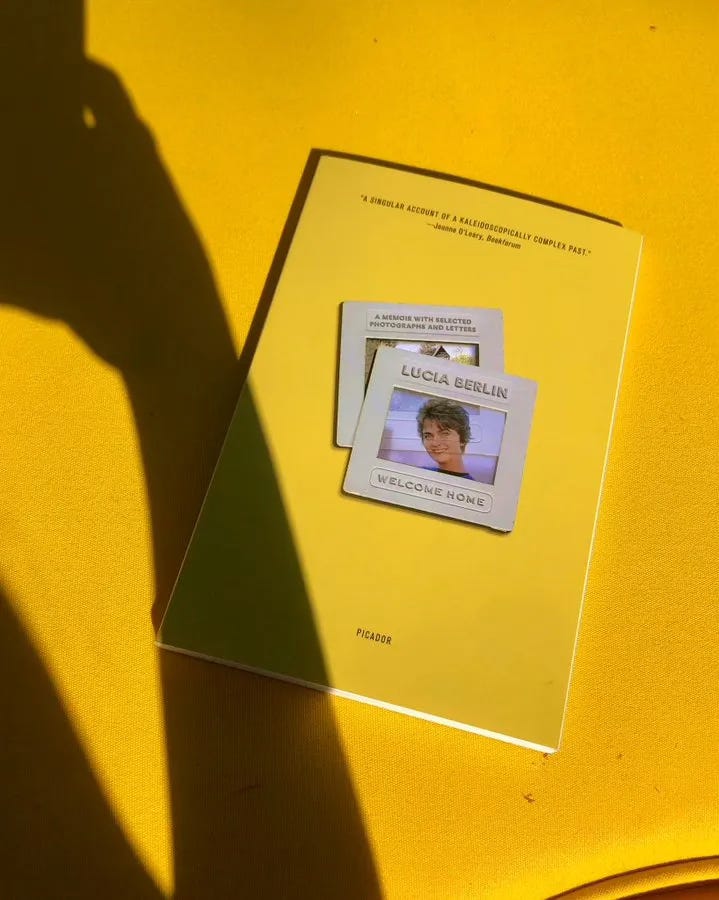
“Oaxaca, Mexico — Herd of goats next door. Mildew. Struck by lightning on Monte Albán... White House, Corrales, New Mexico — Pump broke, well went dry, wiring blew, chickens died, rabbits died, termites, goat broke leg. Shot her... Griegos Road, Albuquerque, New Mexico — I burned it down.” — The Trouble with All the Houses I’ve Lived In
LUCIA BERLIN, WELCOME HOME (2018)
In telling a story, velocity speaks volumes — you can wallow, drag your feet, or you can roll right through. My favorite writer, Lucia Berlin, opts for the latter, breezing through a memoir beginning 1936 in an Alaskan mining camp and ending somewhere near the border of Chiapas 30 years later. (Berlin died in 2004 while writing, hence the ending: trailing off mid-sentence on the road to Guatemala, third husband shivering from withdrawals in the VW’s shotgun seat.) She married four times, raised four sons, and “obliterated her health on Jim Beam over decades,” according to a former student to whom she gave this advice: “Write what you see, not what you want to see. Or what you assume. Look. Really look.” Her work is funny, often brutal, never boring, never indulging in a moment of self-pity; you get the idea that her life was wildly romantic and terribly difficult, that she met its chaos with grace and humor, but also escapism, avoidance. “We laughed about the first precept of Buddhism: life is suffering,” wrote her son, Mark Berlin, in a wonderful eulogy, later the foreword to her story collection Evening in Paradise. “And the Mexican attitude that life is cheap, but it sure can be fun.”
“In the parking lot by the forest preserve
The police had found two bodies — nay, naked bodies!
Their faces had been horribly disfigured by some sharp object
Saw it on the news, the TV news in a black-and-white video
You know what blood looks like in a black-and-white video?
Shadows. SHADOWS! That’s what it looks like.”
JOHN PRINE, “LAKE MARIE” (1995)
“Prine’s stuff is pure Proustian existentialism. Midwestern mind-trips to the nth degree,” said Bob Dylan in a 2009 interview about his favorite songwriters. “If I had to pick one song of his, it might be ‘Lake Marie.’” Inspired by the Chain O’Lakes, a 15-lake waterway near the Illinois/Wisconsin border, the song’s three spoken-word verses are cryptically related: the first verse draws from the region’s history; the second, from his memories; the third, from unsolved murders in the Chicago suburbs. (“We grew up thinking the bad place was being downtown and here, all the sudden, there’s real screwballs out in the suburbs,” Prine explained. “Like it was Blue Velvet, you know?”) The pleasure is not only in the big singalong chorus, but the connections that you forge among its seemingly disparate parts.
In the middle of the fabled Chain O’Lakes is Blarney Island, colloquially known as the “Key West of the Midwest.” One mile offshore from Antioch, the entire island is just a giant bar, a famous party destination for Illinois and Wisconsin boaters where several episodes of Girls Gone Wild were filmed in the late aughts. I took the ferry there one rather twisted summer to hang out with a man I’d met at a bonfire weeks before. He turned out to be a psychopath whose eyes were known to turn completely black on some occasions, but for a while, we had fun. We’d visit cemeteries or drive up to the Twin Lakes, blasting “Lake Marie,” Townes Van Zandt and Silver Jews. Then he tried to kill me, having decided that I was infected by demons, and that was enough of that.
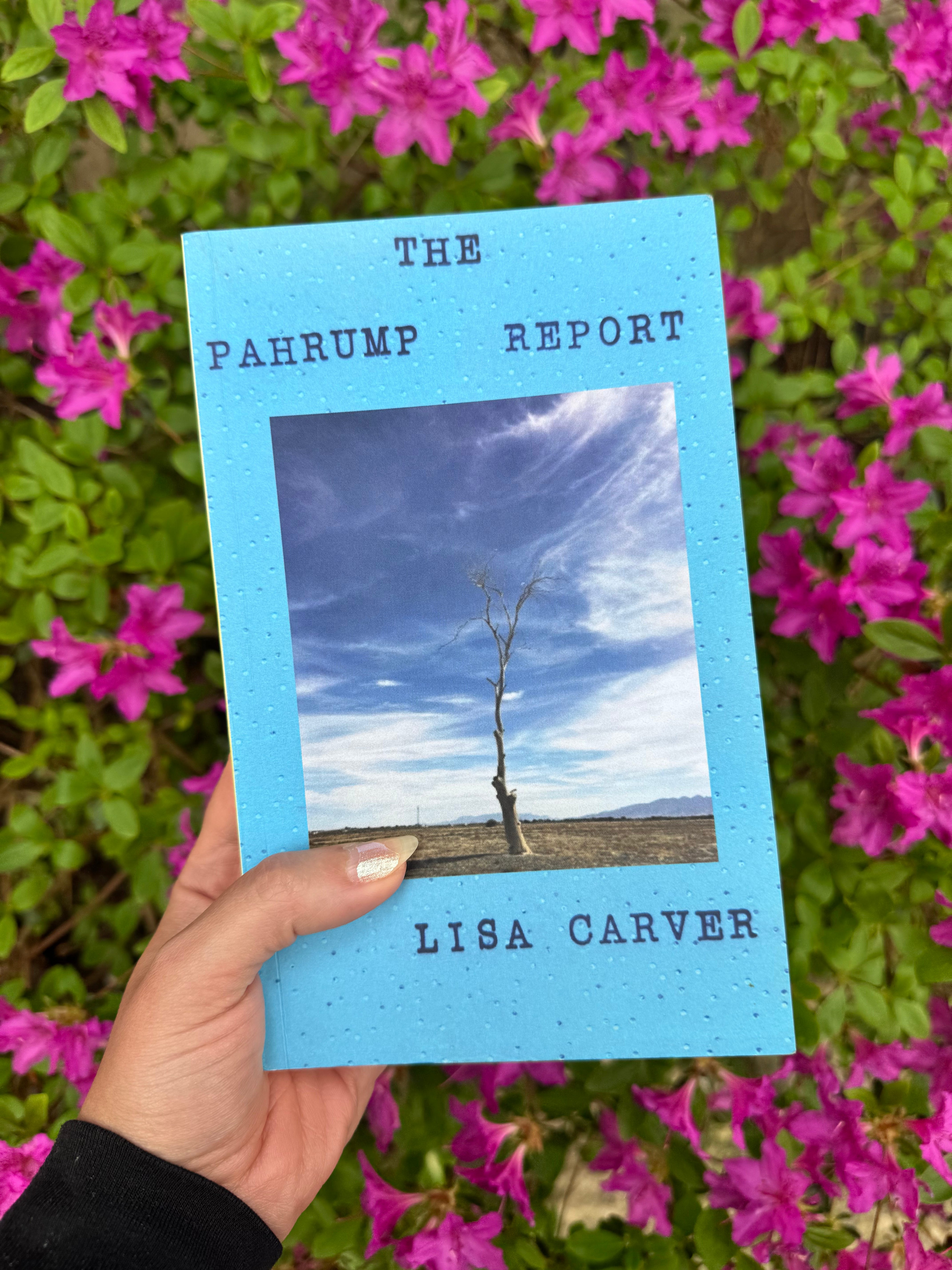
“The fuck-it glory studding the bleak, and the wild creatures, and the old cowboys with life skills — it breaks my heart with a really strange happiness so close to sadness I can’t untwine them.”
LISA CARVER, THE PAHRUMP REPORT (2021)
The best word for the work of Lisa Carver is alive. The ‘90s zine queen and freakazoid performance artist has been sticking it out in today’s “breathtakingly un-punk” world of media. These days lots of people write confessionally, or imagine that they do. But nobody is doing it like Lisa: brutally honest, unflinching, ready for whatever. Her fast, funny, exacting prose brings the transcendent down to earth and shrugs at the tragic — oh well! My favorite of her 16 mostly self-published books is a memoir of her three years living in Pahrump, Nevada, during which she divorces her third husband and rebuilds her life in sordid solitude. “On his birthday, Keith asked for a divorce and for me to buy him out of this house with $85,000 I don’t have,” writes Carver. She has no job in Pahrump, no family or friends. “Yet… I do feel at home in the world in general, and in specific. I feel like everything is going to be okay and even good. I feel loved, nebulously, despite there being no sign of it anywhere around me.”
Four years ago, I interviewed Carver over email while she lay in a French hospital facing a cancer diagnosis and bunch of major surgeries. “Hi Lisa! How’s life?” I asked her sort of stupidly, to which she immediately responded: “Haha, how could it be anything other than good, as a writer? The more you lose the more you win.”
“When I was growing up and drinking, the people that I was around, they were the Americans who were still fightin’ the West with a bottle of vodka in their hand, man. There was still territory out there — in the mind, or around the block, or something like that.”
AMERICAN MOVIE (1999)
“I was a failure,” says Mark Borchardt, the first thing you hear in American Movie. “I was a failure and I’d get very sad and depressed about it, and I can’t be that no more.” For two years, we follow Borchardt — independent filmmaker, Army vet, paperboy, cemetery janitor, drunk, father of three — as he cobbles together a “35-minute direct-to-market thriller shot on 16mm black-and-white reversal” called Coven, with whose profits he hopes to fund his first feature, Northwestern. I imagine many people in the years since its release have interpreted the documentary as a comedy, or felt sorry for Mark and his lowdown band of brothers, who drink vodka to excess, compulsively buy scratch-offs, and have nothing better to do than to help their friend make movies that he may never complete. But Mark, for all his failures, is obviously a genius — a wildly charismatic speaker and genuine auteur with a vision undeterred by the strictures of real life.
The movie has a lot to say about my favorite subjects: alcoholism, the state of Wisconsin, the mythic American Dream. But what keeps me coming back are the profundities of the neighborhood guys — the “religious joy,” as Mark says, of just being around them, hearing all the wondrous things they have to say. Mark’s frail and loopy Uncle Bill is secretly a poet who on occasion warbles strange songs for his dead wife: “So goodbye, dear... hope you’re in heaven where you belong... I was wondering, do they smoke cigarettes in heaven? I don’t think so. I don’t think so... I still love you. I’ll visit your grave every day... not every day, but... I’ll visit it sometime, if I ever find it...” The shimmer in Mark’s eyes as he watches this performance involves a mix of true love, heartbreak, and the ecstasy of witnessing a unique moment in time. “Are these songs you wrote?” asks the cameraman, to which Bill says simply: “This is what happened to me.”
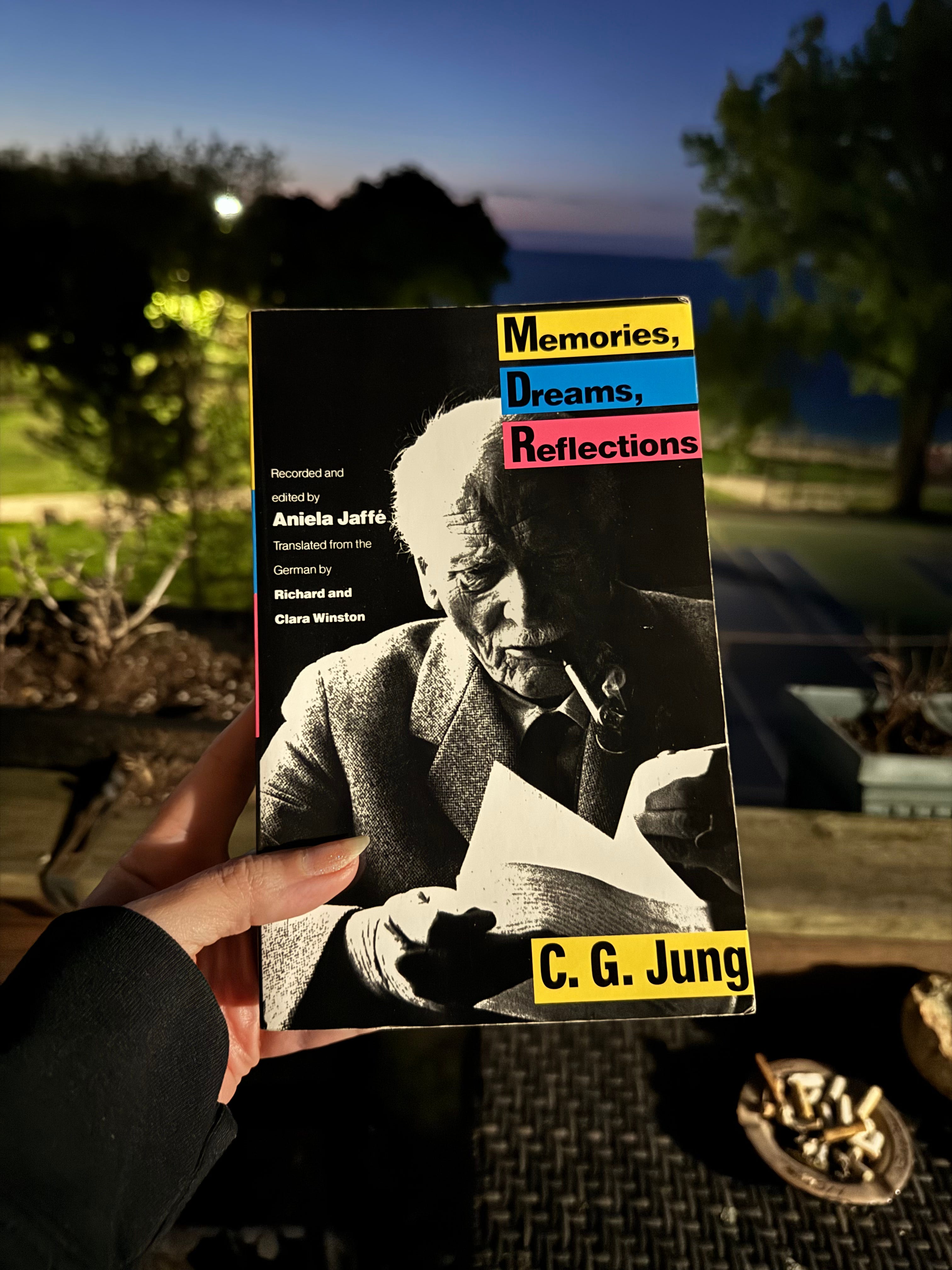
“The world into which we are born is brutal and cruel, and at the same time of divine beauty. Which element we think outweighs the other, whether meaninglessness or meaning, is a matter of temperament. If meaninglessness were absolutely preponderant, the meaningfulness of life would vanish to an increasing degree with each step in our development. But that is, or seems to me, not the case. Probably, as in all metaphysical questions, both are true: life is, or has, meaning and meaninglessness. I cherish the anxious hope that meaning will preponderate and win the battle.”
CARL JUNG, MEMORIES, REFLECTIONS, DREAMS (1962)
The GOAT, the blueprint for everything, and MDT’s philosophical foundation.
Comments
Nothing yet. Say the first thing.
Sign in to join the conversation.