
I found this early draft of what would become “Code Black, Code White,” a story from my recent literary offering, Beyond First Glance. Back in December 2024, two days after Christmas, I wrote this first imagining of their story. In retrospect, I realize that I love Tuesdays and the name Marcus. This story flowed out, and I shared it with my critique group, who tore it apart. It was a telling before Layla became Amara. I plucked phrases and ideas from it for other stories. Left it there, on the floor of MS Word, DRAFT. Still—I love this first telling. Will you read and tell me what you like about this origin story of them?
I noticed her weeks ago. She comes here every Tuesday and Thursday, perches on that same stool like a sparrow ready to take flight. There’s something about the way she holds herself — a familiar tension I recognize from my own reflection.
My mother used to sit that way too. Head high, shoulders back, but always slightly turned, as if preparing for judgment or rejection. Being mixed-race in America does that to you. Mom was never Black enough, never White enough. Just like me.
Today, the woman’s eyes are different — raw. I’ve seen that look before — in the mirror after Dad died. Loss has a way of making us transparent.
I adjusted my wool coat — Dad’s coat, actually. It was the only thing of his I kept. He never understood why I didn’t just “pass” and make my life easier. “Why do you always have to emphasize your Blackness? There’s no need to wear it like a badge.” He was an average White man. Without seeing it, he pulled the privilege card every time. But Mom taught me that denying any part of yourself is its own kind of death. She always identified as Black, but she was light-skinned, quite unlike this woman whose spirit pulled me into this coffee shop each week. Her skin was dark like the velvet shadows of twilight.
Today was the first time she saw me, I think.
She’s looking at me now — really looking — and I see the exact moment she labels me: White man, privileged, probably owns a yacht. If only she knew I could barely afford the rent for the claustrophobic open-concept flat I share with two roommates or that washing and ironing the same three office shirts is a weekly ritual because they’re all I have.
I entered the coffee shop, ordered the small cafe mocha, and slipped onto the stool beside her. I wasn't trying to be stealthy, but she didn't register my presence. A clock ticks loud and steadily, a pitch above the smooth jazz as her gaze is locked on the window before us. There’s something distant in her expression, like she’s here but not here.
I know that look too well — when the present moment becomes a window to the past. The way she fingers her untouched coffee cup, her slight frown, and the occasional blink bring her briefly back before losing her again to whatever memory has claimed her focus.
I feel a selfish urge to arrest her attention.
“That clock’s ticking is loud, isn’t it?” I say, surprised by my own boldness. Usually, I avoid approaching Black women. Not out of preference, but fear — fear of being seen as fetishistic, fear of rejection, fear of being too White.
But something about her pulls me in. Perhaps it’s because, for the first time in years, I want someone to see all of me — the complexities, the contradictions.
My mission is accomplished. She turns to me, the movement causing her braids to sweep across her shoulder.
Ah oh!
She stares at me, speechless, and I feel naked under her gaze.
Fighting the urge to shrink away, I force myself to turn toward her instead. My right hand cradles the tiny coffee cup while my left pulls the coat open to rest on my hip — a pose that aims for casual. My two-toned, bluish-brown eyes meet hers, taking in the fullness of her beauty even as my heart hammers against my ribs. I’m acutely aware of how my large frame must look to her, perched here on this delicate cafe stool, trying to appear smaller and less threatening while simultaneously wanting her to see all of me.
I’ll open for you. Do you see past my skin? Past the DiCaprio comparisons, I’ve heard my whole life?
A long time, or perhaps seven seconds, elapsed in silence. I can’t stand it. I look away, out the window, giving us both a moment to breathe.
What is she thinking?
The wool coat suddenly feels heavy on my shoulders. Dad’s voice echoes in my head: Sit up straight, son. Own the room. But Mom’s wisdom follows: Be true to yourself, baby. All of yourself.
I take a deep breath and turn back to her, ready to be seen again.
Her silence stretches between us like a tightrope. I’m about to retreat when she finally speaks.
“Your coat,” she says, then stops as if catching herself in a confession.
“My father’s, actually.” The words slip out before I can stop them. “He passed away three years ago.”
Something shifts in her expression — recognition, maybe understanding. “Five years for me,” she says softly.
“The clothes thing — wearing their things — it helps sometimes, doesn’t it?” I venture, my gaze shifting to her hands as they tighten around the coffee cup.
It was then I noticed her nails.
How didn’t I see those before?
Her long cuticles frame nails that are dramatic, impossibly long, and tapered to razor-sharp points — like miniature stilettos. Glossy black at the nail beds fades into deep crimson near the center, then tapers to translucent tips flecked with red; each finger wears swirling designs and tiny rhinestones that catch the light. They’re lethal, almost sinister works of art, and…
What would it feel like to have those claws gripping my ass? What are you thinking of, man?! Now? Focus!
She nods, then gives me a tentative smile that pulls me from that lust-filled place into this moment.
“Though I bet yours came from some fancy boutique on Madison, Upper East Side. My dad’s were probably all from the discount clothing store on 125th.”
There it is — that familiar assumption wrapped in a gentle joke. I’ve heard variations of it my whole life. The presumption of privilege based on what people see of me — or think they see.
“Actually,” I say, running my fingers along the coat’s worn sleeve, “My mother bought this for him at that same store. She routinely escaped Greenwich and came back to Harlem so she felt connected to home.” I pause, watching as confusion blooms across her face. “She loved how the owner, Mr. Johnson, always had stories about growing up in Trinidad, just like my grandmother. As a boy, I always came with my mother on those excursions. To be honest, Harlem is home for me too, more than Connecticut ever was. My apartment is on Morningside Drive.”
Her coffee cup freezes halfway to her lips. She studies my face now, really looks at it, like she’s seeing it in a different light. I can almost see her mind recalibrating, questioning her initial assumptions. Her lips stretch into a smile before snapping back into a round, “Oh.”
Yes, woman, I’m Black.
“Yeah.” I smile, letting the moment settle. “Not exactly what you were expecting?”
“You’re… not exactly what you seem, are you?”
I laugh, a sound caught between relief and nervousness. “Story of my life. Mom’s mixed, Dad was White. I got his hair, complexion, but…” I gesture vaguely at my features —the subtle hints of my heritage most people miss: the particular shape of my nose passed down from an African grandfather, or the naturally curly texture of my hair that suggests, despite the blond color, mixed roots.
“That explains it,” she murmurs, more to herself than me.
“Explains what?”
“Why you feel… familiar somehow. Despite…” She trails off, smiling sheepishly.
“Despite looking like a walking Ralph Lauren ad?” I finish for her, and she laughs — a rich, genuine sound that makes me feel warm all over.
“I’m Marcus,” I say, offering my name like a bridge between us.
“Layla.”
“Layla,” I repeat, tasting the name. “Beautiful name.”
She sips her coffee, and those dangerous nails tap gently against the ceramic that resonates deep in my body.
“My father chose it. Said it means ‘night beauty’ in Arabic. Though he wasn’t Muslim or anything — just loved the sound of it.” Her eyes grow distant. “He had a thing for collecting beautiful words from different cultures.”
“My dad was the opposite,” I say, turning my cup between my palms. “Everything had to be…traditionally American. Whatever that means. He’d correct people if they pronounced Marcus with any sort of flair.” I mimic his clipped tone, “It’s Mar-cus, not Mar-CUSS.”
Layla’s laugh is warm honey in my ears. “Let me guess — he also insisted on calling you ‘son’ instead of your name?”
“Always. Even in crowds.” I pause, weighing my next words. “You know what’s funny? After he died, I found all these old photos he’d hidden away. Pictures of him at cookouts with Mom’s family in Harlem, actually smiling. Real smiles. Like he could only be himself with her when no one White was watching.”
Her eyes soften. “The masks we wear.” She glances down at her coffee. “My daddy… he was always telling me to ‘be twice as good, work twice as hard.’ But sometimes I’d catch him singing the blues when he thought no one was listening. Not the sanitized kind — the raw, painful ones. The ones that told the truth about being Black in America.”
“Did he ever tell you why?”
“No. But I understood.”
Her nail taps against the ceramic cup, and I pull my eyes away to prevent my crude instincts from overtaking my thoughts. I force myself to listen to her.
“Sometimes the truth is too heavy for words. I hate this feeling,” she says suddenly, her voice soft but intense. “Like I’m still waiting for him to walk through the door. Even after five years, I keep bouncing between cities, relationships… nothing feels like home anymore.” Her nail taps against the cup, a sharp staccato of frustration. “Everyone says ‘you need to settle down,’ but how do you settle when your foundation is gone?”
I let out a breath I didn’t know I was holding. “I get that. After Dad died, I quit my corporate job. Couldn’t stand the starched shirts and boardroom politics anymore — all the things he pushed me toward.” I pause, studying the dregs of my coffee. “Started teaching elementary school instead. The kids don’t care that I can’t decide what box to check on forms or that my hair doesn’t quite match my face. They just… see me.”
“Teaching?” There’s a smile in her voice.
“Fourth grade. The sweet spot between ‘still believes in magic’ and ‘starting to question everything.’” I glance at her. “Like someone else I know.”
She laughs, but there’s warmth in it. “You’re good at that, you know? Making people feel seen.”
“Thanks.” I fidget with my nearly empty cup. “The work fills me up in a way finance never did, even if my wallet’s a lot lighter. Try explaining to roommates why the guy with an MBA from Columbia is eating ramen for dinner.”
Her eyes widen slightly. “Columbia? I did my residency there.”
Now it’s my turn to be surprised. “You’re a doctor?”
“Pediatric surgeon.” She shrugs.
I glance down at her elaborate nails, my confusion clearly written on my face because she laughs. “Oh, these? My cousin got married last weekend. Full glam package — hair, makeup, these talons. They’re coming off tonight before my shift tomorrow. Can’t exactly operate with Edward Scissorhands fingers.”
The image makes me chuckle. “So the wedding — was it just you catching the bouquet, or…?” I try to keep my tone casual, but my heart picks up speed waiting for her answer.
She rolls her eyes but smiles. “Smooth. Real smooth.” She holds up her left hand, wiggling those bejeweled fingers. “Just me and these temporary daggers. Though my aunties made sure to parade every eligible bachelor within a ten-mile radius past my table.”
“Their loss is my coffee shop’s gain then.”
I nod, feeling the weight of Dad’s coat across my shoulders. “My mother used to say that being mixed-race means learning to translate between worlds. But some things just don’t translate.”
The late afternoon sun slants through the window, painting golden stripes across the counter between us. The clock that brought us together keeps its steady rhythm, but its ticking fades into the background, sounding like a new track.
“I should go,” Layla says, but makes no move to leave.
“Let me walk you?” The words come out before I can second-guess them.
She flexes her fingers playfully, those fierce nails catching the light. “Careful what you offer, I might just take you up on it.”
“I’ll take my chances,” I say, though I can’t help glancing at those glittering claws. “They seem more dangerous up close.”
Her smile is equal parts mischief and promise. “They can be both, dangerous and delightful, depending on the situation.”
Heat crawls up my neck and floods my ears. I try to cover my reaction by reaching for my empty cup, but her knowing smirk tells me I’m not fooling anyone.
She slips off her stool with a grace that makes my mouth dry. Before I can gather my composure, she’s standing close — so close I can smell her coconut-scented hair. Her hand reaches out, the pads of her fingers grazing down my coat sleeve. For a moment, her hands press into the wool, and I see something flash across her face — memory, longing, recognition.
Oh my Lord. This woman.
“It’s soft,” she murmurs, not meeting my eyes. “Worn in all the right places.” Her hand lingers, and I wonder if she’s feeling her father’s coat instead of mine, if she’s lost in the same kind of sense-memory that keeps me wearing this one.
We step out into the cooling evening air, and I notice she walks closer than strictly necessary. The wool of Dad’s coat brushes against her arm. She doesn’t pull away.
“Same time Thursday?” I ask, trying to sound casual.
“Maybe.” She looks up at me, twilight depths meeting uncertainty. “Or maybe we could try dinner instead.”
As we part at the subway entrance, I realize Dad’s coat feels different on my shoulders — lighter somehow. Like it’s finally becoming mine.
Watching her disappear down the subway steps, my grandmother’s voice echoes in my head, the way she used to call out to my mother’s father: “Come home soon, Darlin’.” The word carries generations of love in its lilt, a promise wrapped in that Caribbean warmth.
Standing there in Dad’s coat, breathing in the evening air, I know with bone-deep certainty that Layla is my Darlin’ — the one I’ve been translating worlds for all my life.
© Scarlet Ibis James, December 2024, All Rights Reserved.
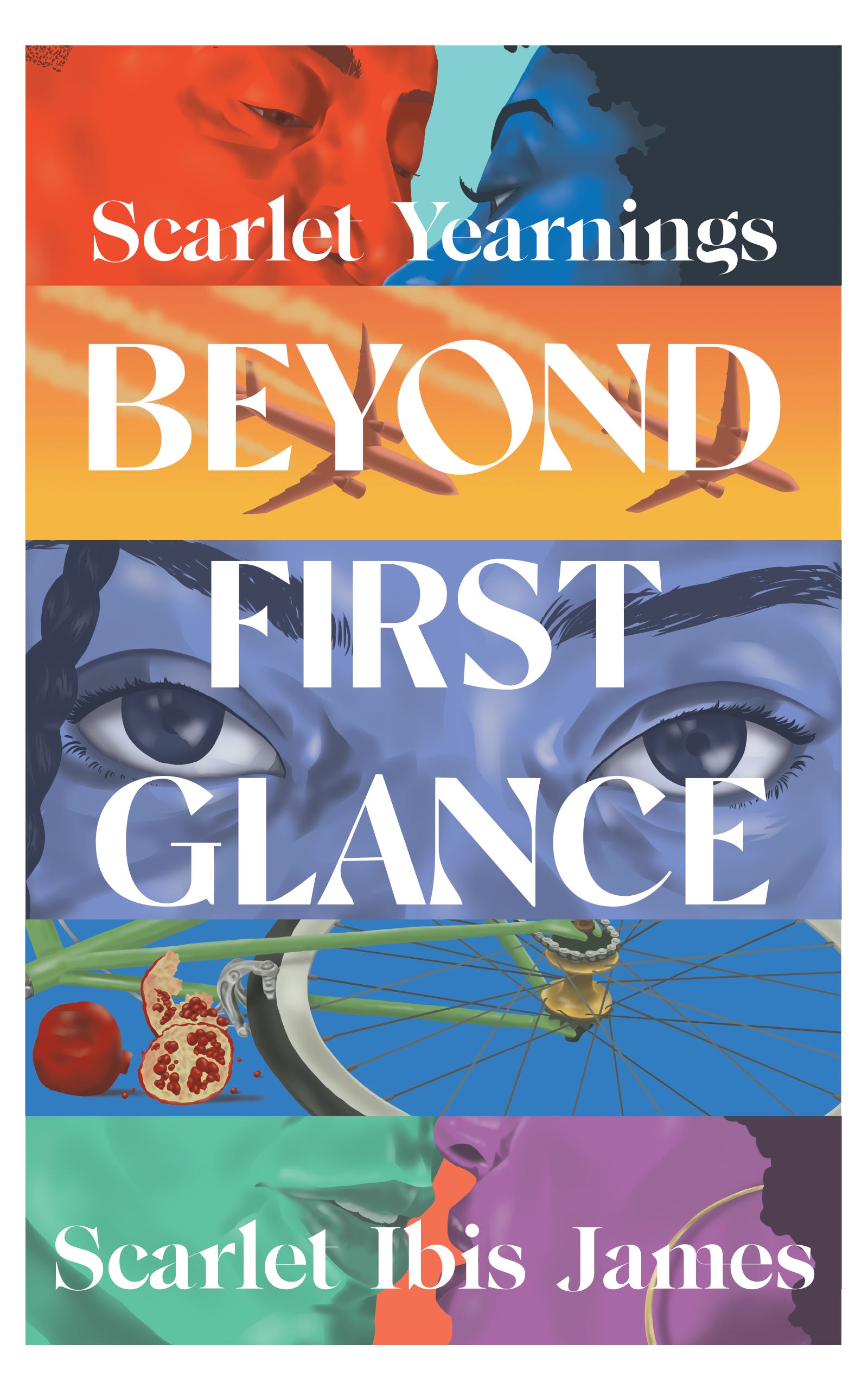
The story featured in this article evolved (a lot) and is a well-loved/cited/highlighted story in Scarlet Yearnings Beyond First Glance.
Comments
Nothing yet. Say the first thing.
Sign in to join the conversation.