
Have you ever invested in something that was supposed to create more freedom in your business and found that it either created more dependency on you OR over time it pulled you right back in?
It’s one of the patterns I find myself regularly talking about with the founders I work with, and it’s showing up more right now than I have ever seen it as more businesses are leveraging AI in new ways to try to solve for it.
While the gap can be related to your team, or your systems and processes, or your tech and tools, none of those are the root cause or the solution.
There is a missing piece that sits underneath all of it.
And without it, no amount of learning to delegate better, hiring managers, working with better clients, documenting SOPs, building AI automations and agents, switching to the shiny new all-in-one platform, becoming a better leader, or any of the other typical advice you hear will fix it.
Before I break down what will, I want you to meet Sarah (not her real name), a client who discovered this the hard way.
Sarah had a seven-figure business and a team of 5, with an operations person she hired to free herself from the day to day by documenting the processes, creating the systems, implementing and running the tech, tools, and automations, and building the company playbook that was supposed to create freedom.
And initially, it felt like it was working.
Sure, she was answering a lot of questions, but Sarah loved having someone to run things and handle all the system, tech, and tool pieces of the business that drained her.
She started stepping back from the day-to-day in the way she had always wanted to and she loved the taste of freedom she experienced.
The person she had brought in as her right hand had a particular way of working, a particular style, and a particular approach to organizing and running things.
And what Sarah began to notice over time was that she had started fitting herself into that person’s model instead of having that person fit into hers.
The team was operating without as much of her direction, but they began producing work that felt disconnected from her vision and style.
And not only did she notice it, but clients started noticing too.
And for the first time, she started to field complaints and refund requests that were bigger than the little things she had dealt with in the past (like call times not aligning with someone’s availability).
People said they weren’t getting the same experience when working with her team as they got when they worked with her directly.
A quote that she lived by was “nothing changes if nothing changes” so she decided to try something different.
She had been watching the AI space and felt a sense of possibility in it, thinking she could build a lighter-weight team, use AI and automations to carry some of what her human team had been doing, and finally get to the freedom she had always wanted (and that everyone was promising).
So she shifted her approach.
She cut her team expenses including her right-hand person thinking they were the root cause of many of the issues.
She started learning and using the tech and tools everyone swore by and leaned into what the market was saying was the future.
And that disconnect that her clients felt when they worked with her team instead of her, or when they consumed content her team created instead of her?
It got amplified! Big time.
The content she created with AI didn’t connect the way her writing used to…
Her email open rates were down. Her social media engagement was down. And worst of all, her conversions were down because people weren’t taking action.
The down trend started when she delegated it to her human team and got amplified when she built out an AI team.
She found herself spending as much time as before, only now it was reviewing and rewriting… yet still getting results that didn’t fully sound like her or connect.
And her operations were now somehow her responsibility…
Because she had built out a lot of the AI herself, thinking it was a skill she needed to learn so she wasn’t left behind, she now owned a heap of tech and tools that she barely understood and had absolutely zero interest in maintaining herself.
She had just finished learning and setting up CustomGPTs and now there were “skills” she needed to learn and develop?!? And everyone was saying she should move it all to Claude?!?
When she came to me, she felt like she was in a worse position than before she had started trying to step back.
Which, in a lot of ways, she was because she had now also lost confidence that a solution even existed…
If you’re thinking that Sarah must have made bad hiring decisions, or didn’t effectively understand how to delegate, those weren’t her issue.
I loved Sarah’s willingness to jump right in and hire a team, invest in a seasoned right hand person, build out her playbook and processes, and explore AI. Her willingness to try new things and embrace change is an incredible quality!
And yet… here is why those things didn’t work the way she expected.
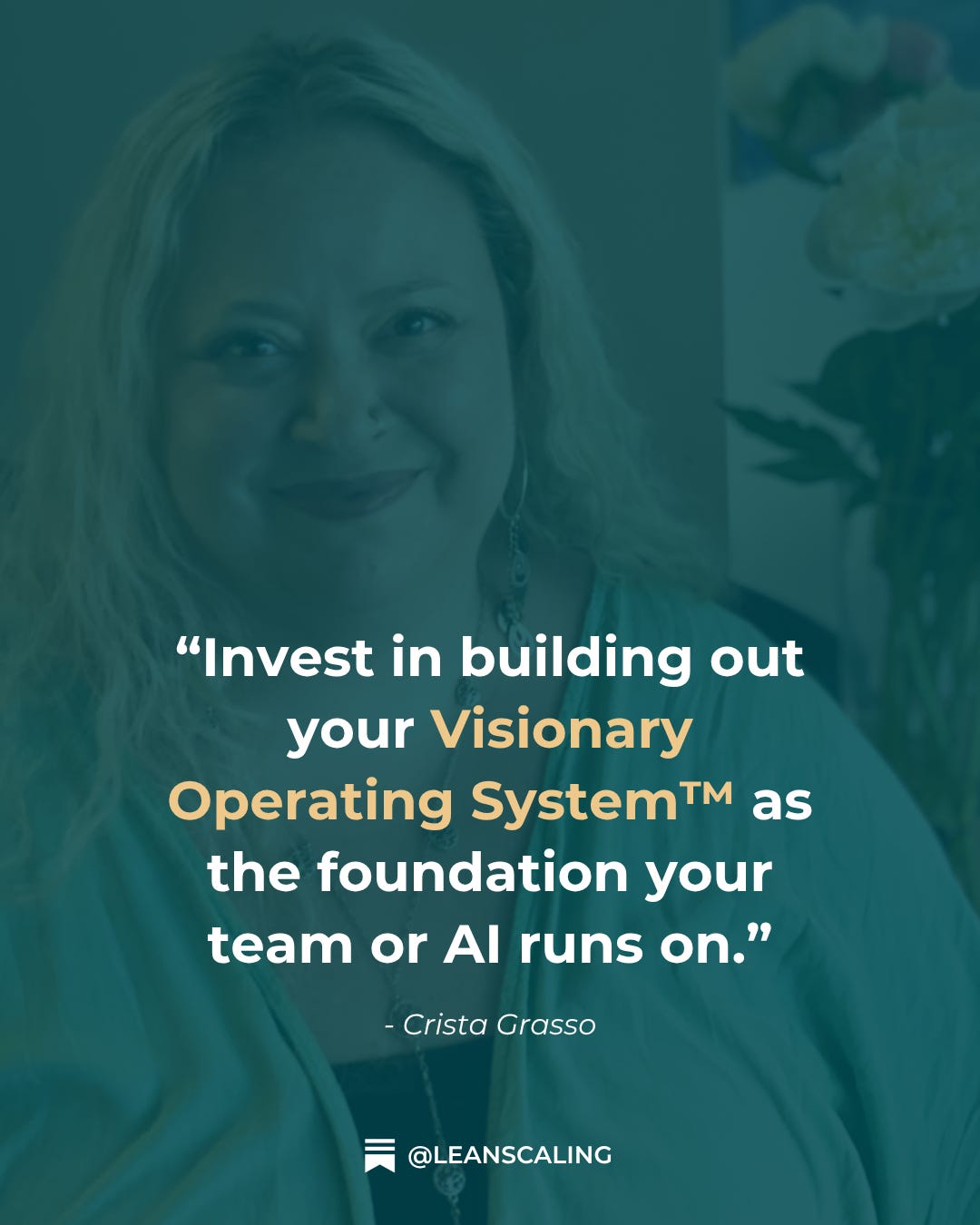
The team, the processes, the AI tools, the company playbook? While they are part of the solution, they will never be effective at extracting a founder from the day to day operations when they aren’t built on top of what I call the Visionary OS (Operating System).
Because the deepest part of how you operate, the vision you hold for the business, the standard you have for every client experience, the way you think through a decision, the discernment you apply when something doesn’t feel right, that is the hardest thing to communicate.
So when your team makes decisions, they are making them without access to the most important thing… the way you actually think.
They don’t have your years of experience that allow you to recognize patterns and instantly “know” if something or someone is a good fit or not.
They don’t have your sense of what makes an exceptional experience for your specific clients beyond what they need to do to technically check the boxes.
They don’t deeply understand the ‘why’ behind what you do and don’t do to guide their decisions and choices (even if you’ve communicated your vision and values to them).
They don’t see what makes something “off” that you can notice instantly.
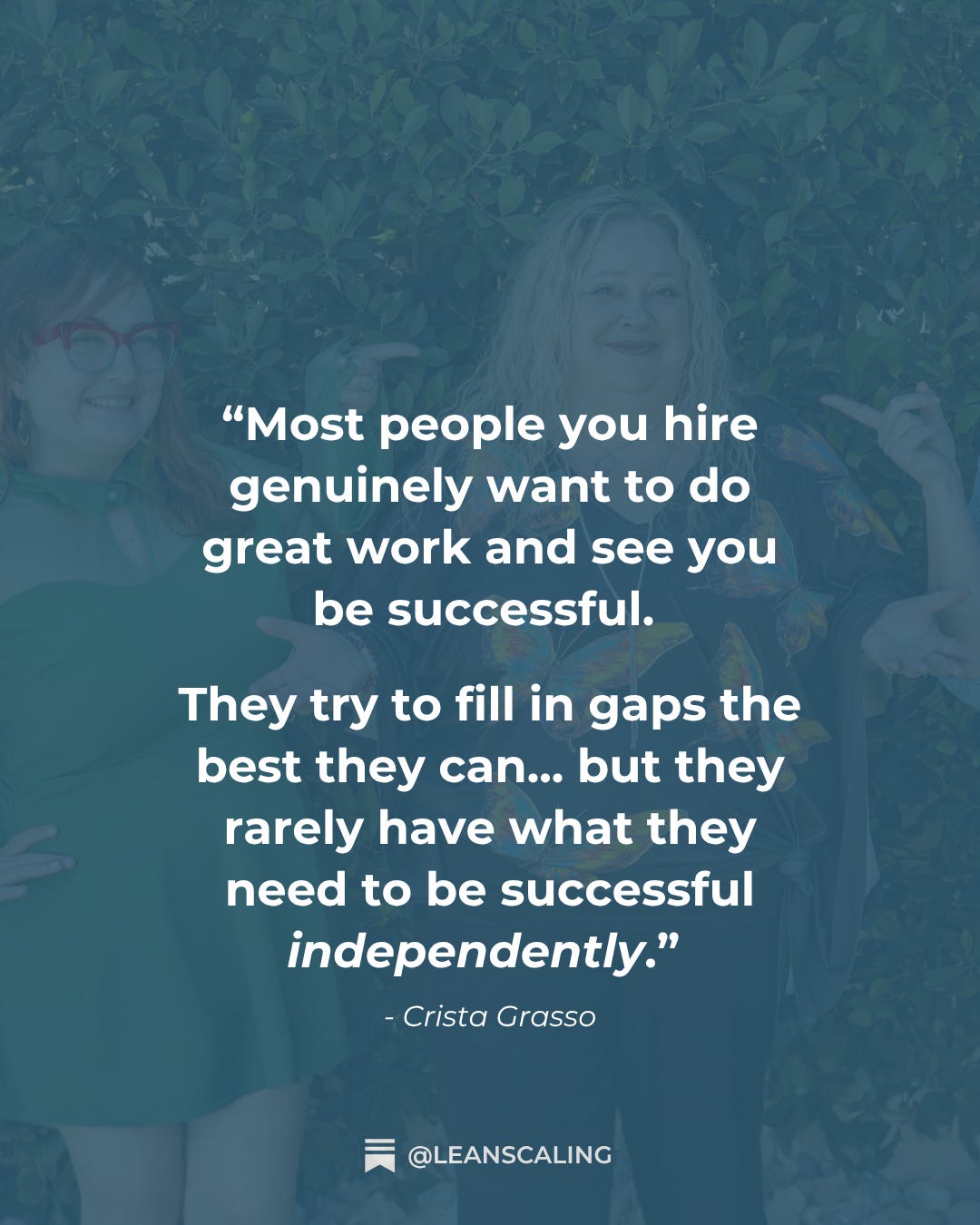
Most people genuinely want to do great work and see you be successful. And sometimes what they do works fine… but more often than not, you experience exactly what happened to Sarah.
Especially as you get to the point of scaling out your business where the impact is greater and your reach is wider.
The Visionary OS is exactly what it sounds like.
It is the operating system of how you think, how you decide, and how you lead… captured in a way that the people and tools in your business can access and use.
It includes things like your decision filters, the criteria you apply when evaluating whether something is a good fit or not.
It includes your client standards, the specific things that make an experience exceptional for your clients beyond what the work technically requires.
It includes your communication voice, not a style guide but the actual internal compass you use when deciding what to say and how to say it.
It includes your operating principles, the reasoning behind why your business is structured the way it is and the things you would never compromise on.
Your team can make decisions that align with how you think because they have access to the context and filters that guide your thinking.
Your AI tools can produce outputs that amplify your voice and thought leadership instead of compromising it.
Your playbooks and SOPs move beyond a set of instructions and how to’s to carry the reasoning behind them, which means your team can adapt when a situation doesn’t fit the script instead of defaulting to asking you.
The thing about a great Visionary OS is that it does not replace your team, your systems, or the high-level strategic decisions that you as a founder will always need to make.
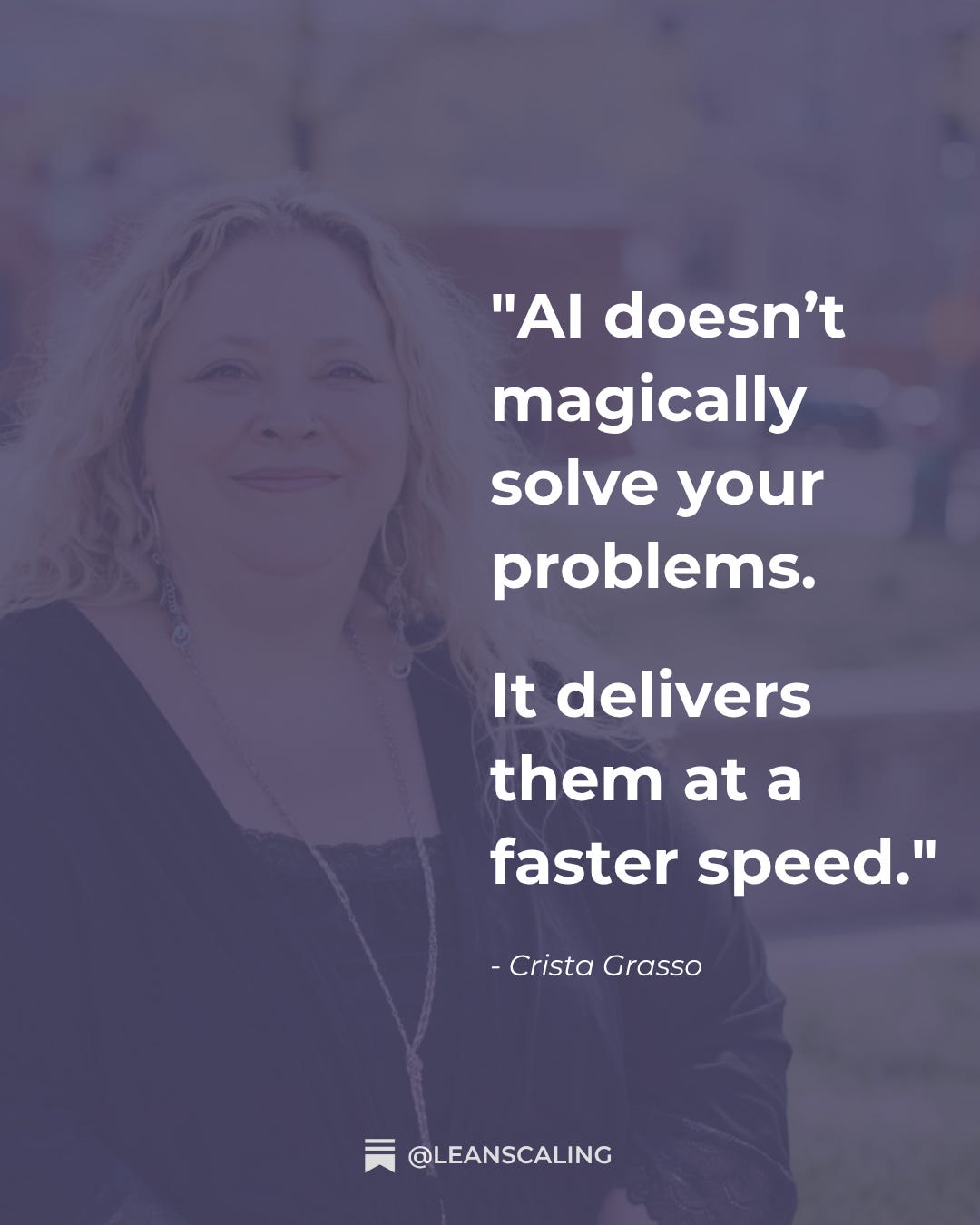
But what it does is give everything else in your business a foundation to operate from so that the gap between how you would do something and how your team or your AI does it gets smaller and smaller.
The path to stepping out of the day-to-day felt possible again in a way that it hadn’t when she first came to me.
The AI hype is everywhere right now.
A blend of FOMO-inducing strategies designed to make you feel like you will be obsolete if you don’t immediately drop everything and begin using AI for absolutely everything right away.
Combined with big promises of instant freedom and it being the magic wand that will immediately get you back 30 hours a week so your team of robots can do all the work while you sip a margarita on the beach counting your windfall of money.
So let’s take a realistic look at what founder freedom looks like (whether leveraging AI or not) and how developing your Visionary OS influences it.
While you have likely already tried to document parts of it…
This is something I have spent decades extracting for visionary founders who think they have it all documented and clearly communicated, but who don’t because there is so much they don’t see or know how to pull out on their own...
Once they do, the shifts that follow happen much more quickly than everything they tried in the past.
- The decisions that used to flow through you start getting made without you.
- The content that used to need a full rewrite starts needing only light edits.
- The client experience that used to feel contingent on your personal involvement starts feeling consistent even when you’re not involved.
- The issues and problems minimize, and when they do happen, your team can handle them the way you’d want them to without you having to intervene.
- The constant slack messages and interruptions - “have time for a quick question?”, “do you have a minute?”, “can you take a look at this?”, or “can I get your feedback on this?” - are a thing of the past.
Sarah’s business did not transform overnight... but it did change direction quickly.
And for someone who had lost confidence that a solution even existed, that shift in direction was everything she needed.
The founders I see step out of the day-to-day for good are not the ones who found the perfect tool or hired the perfect person or implemented the perfect AI agents.
They are the ones who did the foundational work first so that everything built on top of it worked without sucking them back into the middle of everything.
That begins with your Visionary OS, and if you plan to leverage AI strategically, it becomes more critical than ever to have in place so your business isn’t moving faster in the wrong direction.
If you are at the point where you are ready to do that foundational work, click here to learn more about the unique way I help founders like you build their Visionary OS and extract themselves from the day to day.
No posts
Comments
Nothing yet. Say the first thing.
Sign in to join the conversation.