
Some of the biggest periods of growth in our business and life happen alongside an identity evolution.
When you’re in the middle of it, things can feel incredibly uncomfortable and sometimes disorienting as you feel a pull between who you used to be and who you’ve grown into, whether that’s the business itself, you as the founder of the business, or both.
The challenge is that there’s no big milestone event that marks this happening, no goal checked off your list. It’s simply that one day you notice that things feel different, often long after the shift completed.
I dig into this in episode 290 of the Simplify to Scale Show.
You can watch the episode below or listen on Apple, Spotify, or search Recognizing When You’ve Fully Embraced An Evolved Identity on your favorite player.
Or keep reading below.
You are well aware of being in the liminal space when you’re in the middle of a big transition, whether it’s reimagining your business model, offers, marketing model, team, or entire operating structure - hello AI!
The liminal space can linger far longer.
One of the biggest signs you’re still in this space is using qualifying language.
It tends to show up in small, specific ways, such as:
The way you introduce your offer still includes the word “new,” even long after it stopped feeling new to you
You still say things like “I used to work with ___, but now I work with ___”, long after the shift has already happened
You describe your business by walking someone through its history first, instead of simply telling them what it is today
You feel a small flicker of wanting to justify the changes you made, even when nobody asked you to
Sometimes the qualifying language is really subtle. Here are a few examples of what this can look like:
Health and Wellness Coach: “Most people know me for weight loss, but these days I focus more on metabolic health.”
Business Consultant: “I’ve expanded into working with the business’s leadership team instead of only with the founder.”
Ops Agency: “We’re experts at leadership and teams and we’re now helping companies integrate AI into their teams.”
Marketing Strategist: “I develop the social media strategy you can hand off to your team instead of still offering done-for-you posting.”
It usually means the new identity hasn’t fully caught up to the decision to change yet. And decisions almost always move faster than a full identity shift does.
The entire catalyst for this article and the related podcast episode came about a few weeks ago in a text exchange with my ex-husband.
We’ve both gone through our own individual identity evolutions leading up to and following our divorce.
I sent them a video of our dog being ridiculously adorable and I addressed them by name in the video, which is a different name than the one they had while we were married.
We hadn’t spoken since they legally changed their name, so this was the first time I used their new name with them directly.
They wrote back and said “thank you for using my name”, NOT “thank you for using my new name”.
That really stood out to me because while their name is new to me, it just “is” for them.
When you stop explaining what you used to do or who you used to be and you start describing things the way they currently are - no qualifiers necessary.
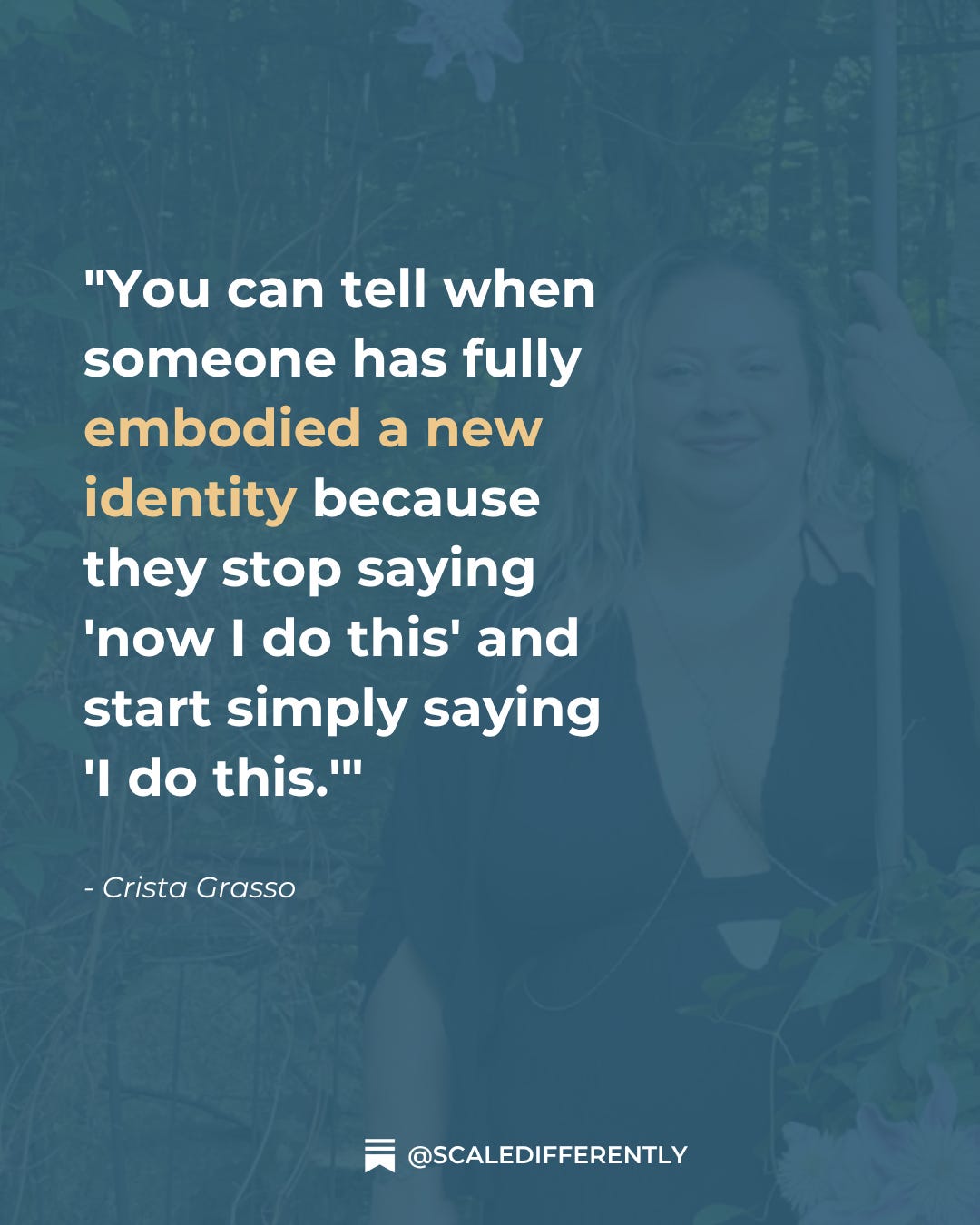
As much as we can want to move quickly through the liminal space, identity evolutions take time and the amount of time can look different for everyone.
1. The first is to pay attention to your language and notice where you’re qualifying things.
It’s one of those things where once you see it, you can’t unsee it, and you’ll start to notice it often in your language.
2. Then, challenge yourself to drop the qualifiers, even if, or especially if, you feel you shouldn’t.
Going back to our earlier examples, here’s what that could look like:
Health and Wellness Coach:
Instead of: “Most people know me for weight loss, but these days I focus more on metabolic health.”
It becomes: “I’m a metabolic health expert.” or “I’m a metabolic health expert who helps women increase their energy, reduce inflammation, and achieve their ideal weight.”
Business Consultant:
Instead of: “I’ve expanded into working with the business’s leadership team instead of only with the founder.”
It becomes: “I partner with founders and their leadership teams to scale the business together.”
Ops Agency:
Instead of: “We’re experts at leadership and teams and we’re now helping companies integrate AI into their teams.”
It becomes: “We’re experts at building AI-enabled teams for growing businesses.”
Marketing Strategist:
Instead of: “I develop the social media strategy you can hand off to your team instead of still offering done-for-you posting.”
It becomes: “I develop high-converting social media strategies.”
When you start speaking as if the new identity has already settled, it has a way of feeling true a lot sooner.
3. The next thing to do is start making decisions from your new identity instead of your old one.
The identity tends to follow the language more than the other way around.
4. And finally, begin thinking as if the evolution has already happened.
Instead of relating to it as something you’re ‘working towards’, begin relating to it as something that simply ‘is’.
Eventually, you’ll stop feeling the need to justify, explain, or qualify and what’s ‘new’ simply becomes what ‘is’.
That’s how you embody an identity evolution.
No posts
Comments
Nothing yet. Say the first thing.
Sign in to join the conversation.