
Please before diving in, read this disclaimer.
In September 2010 a Chinese trawler collided with two Japanese coastguard vessels near the Senkaku Islands, and Japan detained the captain. Within days, rare earth shipments to Japanese buyers stopped arriving. Nobody in Beijing announced an embargo. Customs simply became slow. Paperwork developed problems. Containers sat.
I think Japan understood the message immediately, and this is the part almost everyone forgets. Tokyo did not answer with a press release, they never do, but answered with fifteen years of industrial policy, they always do.
JOGMEC (created in 2004 though) put state money into Lynas at Mount Weld. Sojitz took the offtake. Toyota and Aisin sent engineers back to first principles and came out with magnets using a fraction of the dysprosium they had previously needed. Japan went from importing well over 90% of its rare earths from China to something nearer 60% depending on the source.
Europe read the same events as a news story. Fifteen years later, that is the difference, now we are here and the deadline is approaching.
On 7 November 2025, MOFCOM suspended announcements 55 to 58, 61 and 62.
“The announcement pertains to the pause of four notices issued on October 9 this year. These notices had imposed export controls on certain items related to superhard materials, rare earth equipment and raw/auxiliary materials, medium and heavy rare earths, as well as lithium batteries and synthetic graphite anode materials.” (Per Global Time).
The suspension expires on 10 November 2026. As I write this there are less than ninety days left on it.

What was suspended matters more than anythging else. The framework covers export licensing on rare earth materials, on the equipment used to process them, and on the technology transfer that lets anyone else build the capability. Beijing did not merely restrict the metal (which when you have good partners, can be bought at higher price). It restricted the means of learning to make the metal, which is a considerably more sophisticated instrument and tells you the thinking behind it is long term. China has been humiliated for too long, now that they have the advantage, they’ll sure use it.
The usual figure quoted is that China controls around 61% percent of global mined rare earth supply. That number is largely irrelevant. The number that matters is closer to 91% percent, and it applies to refining. Ore is not the constraint. Nobody is short of rock…
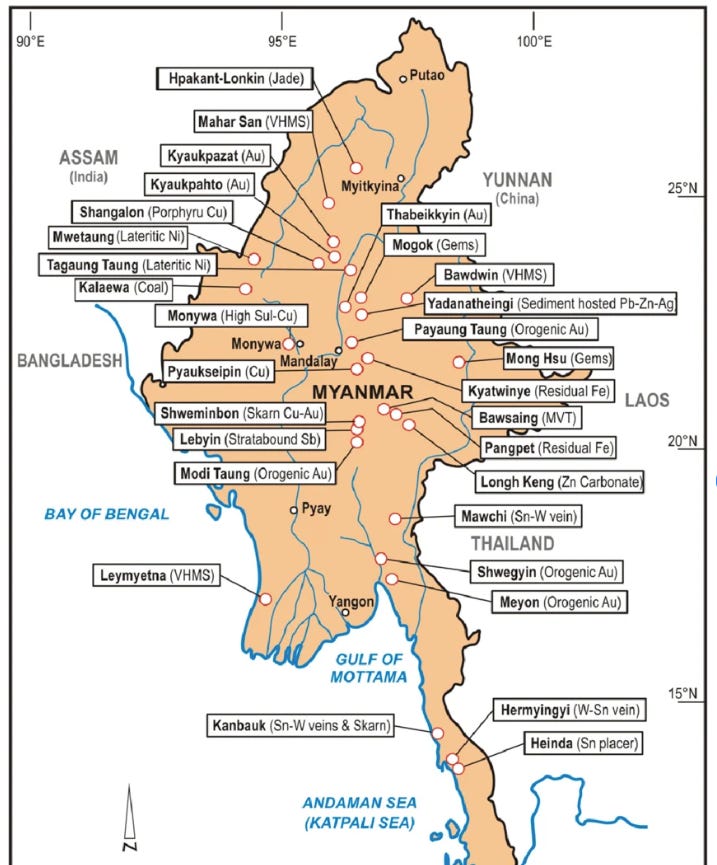
I would add a detail that gets very little attention IMO. A substantial share of the heavy rare earth feedstock feeding Chinese separation comes across the border from Kachin State in northern Myanmar, through territory contested by armed groups in an active civil war.
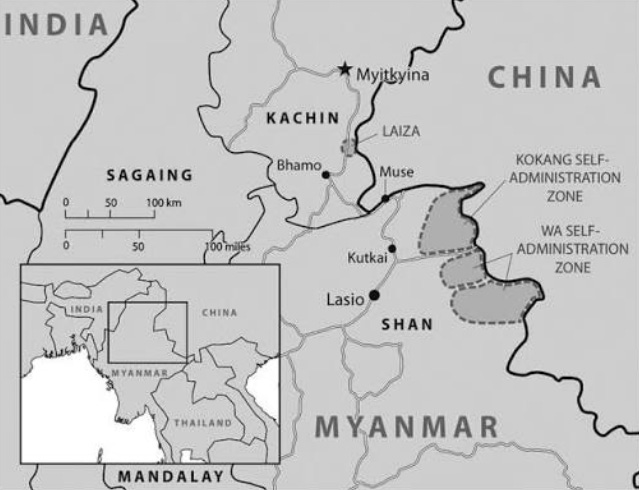
The most consequential supply chain in the Western energy transition passes through a conflict zone that almost nobody in Brussels could locate on a map, these guys cannot even locate Hormuz… When people describe Chinese dominance as a policy choice that could be reversed by policy, I think of Kachin, and I stop believing the reversal is quick.
Meanwhile the continent has set itself a target of ten new mines by 2030, having opened none in fifteen years. I am not going to pretend to take that seriously.
Here is where I part company with most of what is written on this subject.
Rare earths are not rare, period. That is the oldest joke in the sector and it happens to be true. Cerium is more abundant in the crust than copper. What is rare is the willingness to run solvent extraction, hundreds of stages of it, with the effluent and the permitting and the thirty-year payback that comes attached. Separating the heavies, dysprosium and terbium above all, is harder again, and commercial-scale supply of those exists essentially in one country.
I wrote a whole about it.
So the first wall is refining, and that is reasonably well understood by now.
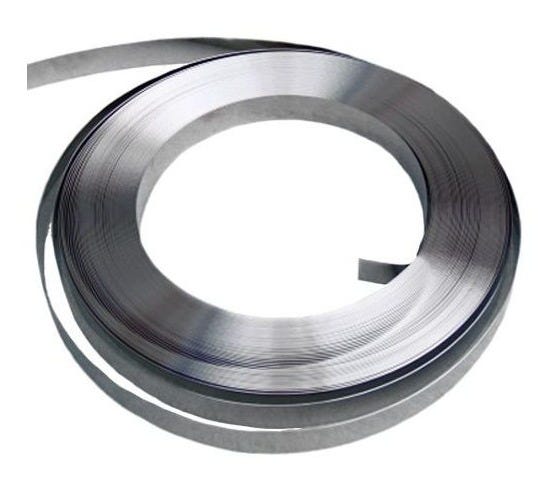
The second wall is barely discussed, and it is the one I care about. Separated oxide is not a magnet. I learnt that Oxide has to become metal. Metal has to become alloy strip. These things:
Strip has to be milled, aligned in a magnetic field, pressed, sintered, machined and coated, and it has to come out the other end holding its coercivity at a hundred and eighty degrees inside a traction motor that will run for fifteen years. That is not in the field of chemistry.
That is a manufacturing discipline, and disciplines live in the people that have it.
I believe that there are engineers in China who have been pressing sintered neodymium magnets since the nineteen eighties. There are not many of them anywhere else, and you cannot subsidise your way to thirty years of accumulated process knowledge in a funding round.
This is why I have close to no interest in the mining side of this trade. A new deposit in Sweden or Greenland does not solve a refining and pressing problem. Because in reality, it adds inventory to a queue that is already blocked further downstream, but anyway.
But finaly as far as I have investigated the matter since my articel Material of Power, the bottleneck of the bottleneck is not the ore, it is the press my friends.
A European electric car carries one to two kilogrammes of sintered magnet in its traction motor, alongside more than twenty smaller motors running the windows, the braking, the steering and the air conditioning.
A direct-drive turbine takes somewhere between six hundred and a thousand kilogrammes per megawatt.
Europe has committed to 510 GW of wind capacity and eighteen million European-built electric vehicles by 2030, against total permanent magnet consumption of roughly twenty thousand tonnes a year today, of which China supplies eighty-eight percent in finished form.
When Beijing tightened export licences in 2025, magnet shipments fell by three quarters and several European carmakers halted production.
If you follow this logic the conclusion for an European is uncomfortable. Europe can sign every memorandum of understanding it likes, and the G7 can formalise a buyers’ club at Évian, which it did more than a week ago, and none of it produces a single aligned, pressed, sintered block before 10 November. Capability is not a policy instrument on that timescale. It either exists or it does not. They can print money and make laws, it won’t magically create the processed material needed.
So the question I have been working on is narrow. Between the Atlantic and the Urals, how much sintered magnet capacity is actually running today, on a real production line, with real customers taking real parts?
Not announced. Not funded. Not under construction. Running.
The answer is one plant.
It belongs to a listed company. A thirty-year-old materials manufacturer that has been quietly holding the exact asset the continent forgot to build, since well before anyone decided the asset was strategic. It also happens to have commissioned, in April, the other capability the West has spent a decade being told it does not possess.
Before I tell you what it is, here are the questions I asked myself and they are my frame for everything that follows.
Who owns the only sintered magnet plant running at scale in Europe, and how did a company from the other side of the Atlantic end up owning it?
Is the tonnage a real answer to the problem, or a rounding error dressed up as sovereignty?
What happens to this thesis if 10 November passes quietly?
The strongest argument against everything I have written sits inside the company itself. What is it, and does it break the case?
At what price is this interesting, and at what price is it expensive?
Answers below, along with the numbers.
Comments
Nothing yet. Say the first thing.
Sign in to join the conversation.