
Please before diving in, read this disclaimer.
Hello everyone
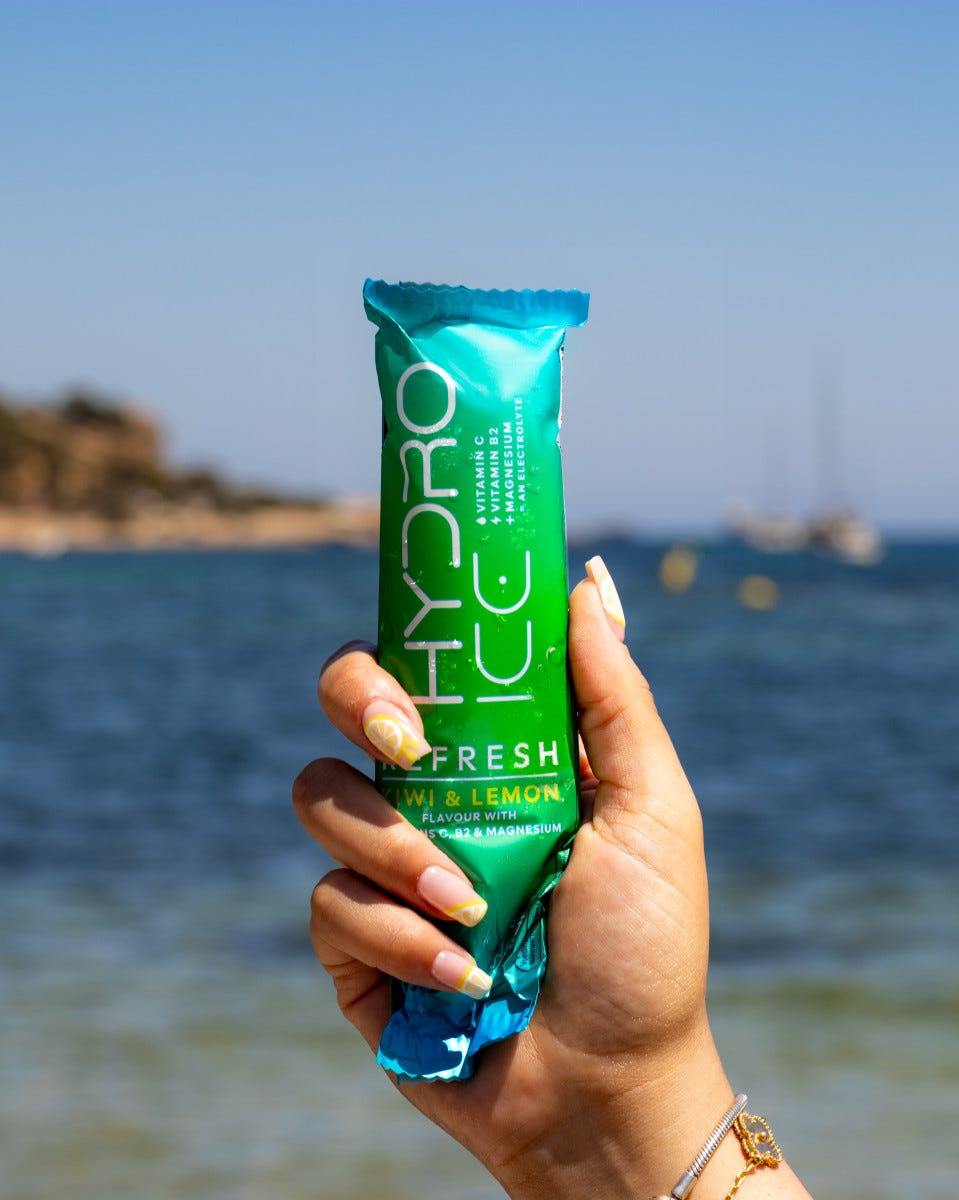
I don’t know if you are like me, but these heat waves we had in Europe (and that are still here btw) made me make a thing that I didn’t do for a long time: buy ice cream.
I am more into salty food than sweetened. So it’s not natural for me.
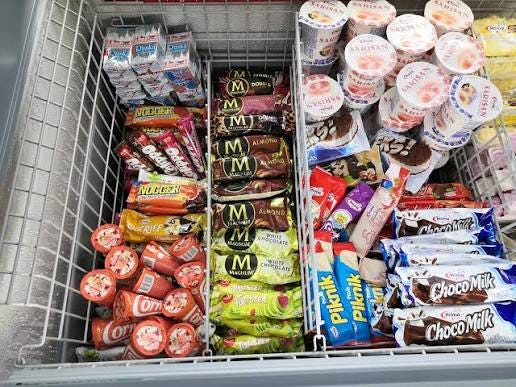
I bought these:
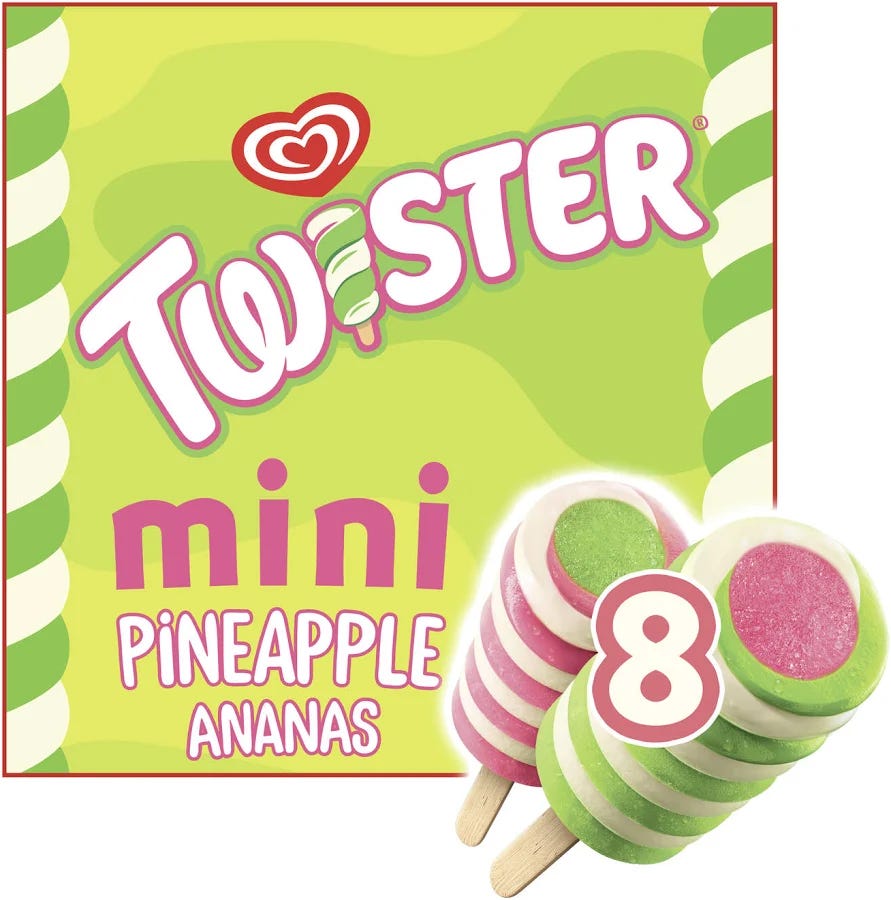
because these are my girlfriend favorite and because she wanted ice cream.
And then I looked around me and realized we were not the only one in the ice cream shelf, and more than that, some shelf were already empty. I looked at the logo (the heart) and ask Chagpt who owned that. This is a thing i do a lot, and even more recently, I ask which public traded company is behind the product or service I consume.
The answer is: Magnum Ice Cream.
For some history in 1923, if I am not wrong, Thomas Wall put men on tricycles and sent them into the streets of London with a cold box bolted to the front. The slogan painted on the side was Stop Me and Buy One.
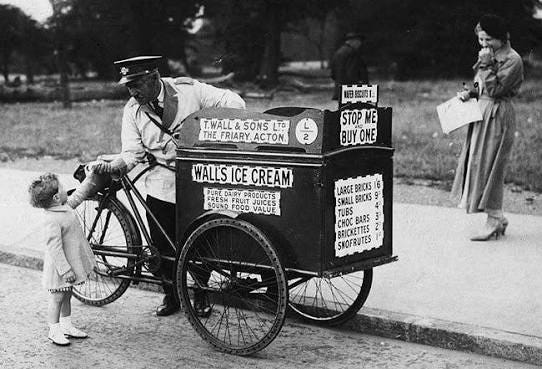
It reads as quaint now, the sort of thing that ends up printed on a tea towel in a museum gift shop. It was not quaint. It was the answer to a problem no other consumer product has, and the same problem is still being solved today, with a great deal more capital and considerably less charm.
Every other packaged good tolerates the journey. A bar of chocolate that spends a week in a warm warehouse is still a bar of chocolate. A tin of soup does not care what happens to it. Ice cream is the only mass consumer product that destroys itself the moment the chain breaks, and it does not simply spoil in a way you can hide; it changes texture, the consumer tastes it immediately, and the consumer does not forgive it. So the manufacturer cannot hand the product to the retailer and walk away. It has to follow the product all the way into the shop. And then it has to buy the shop a fridge.
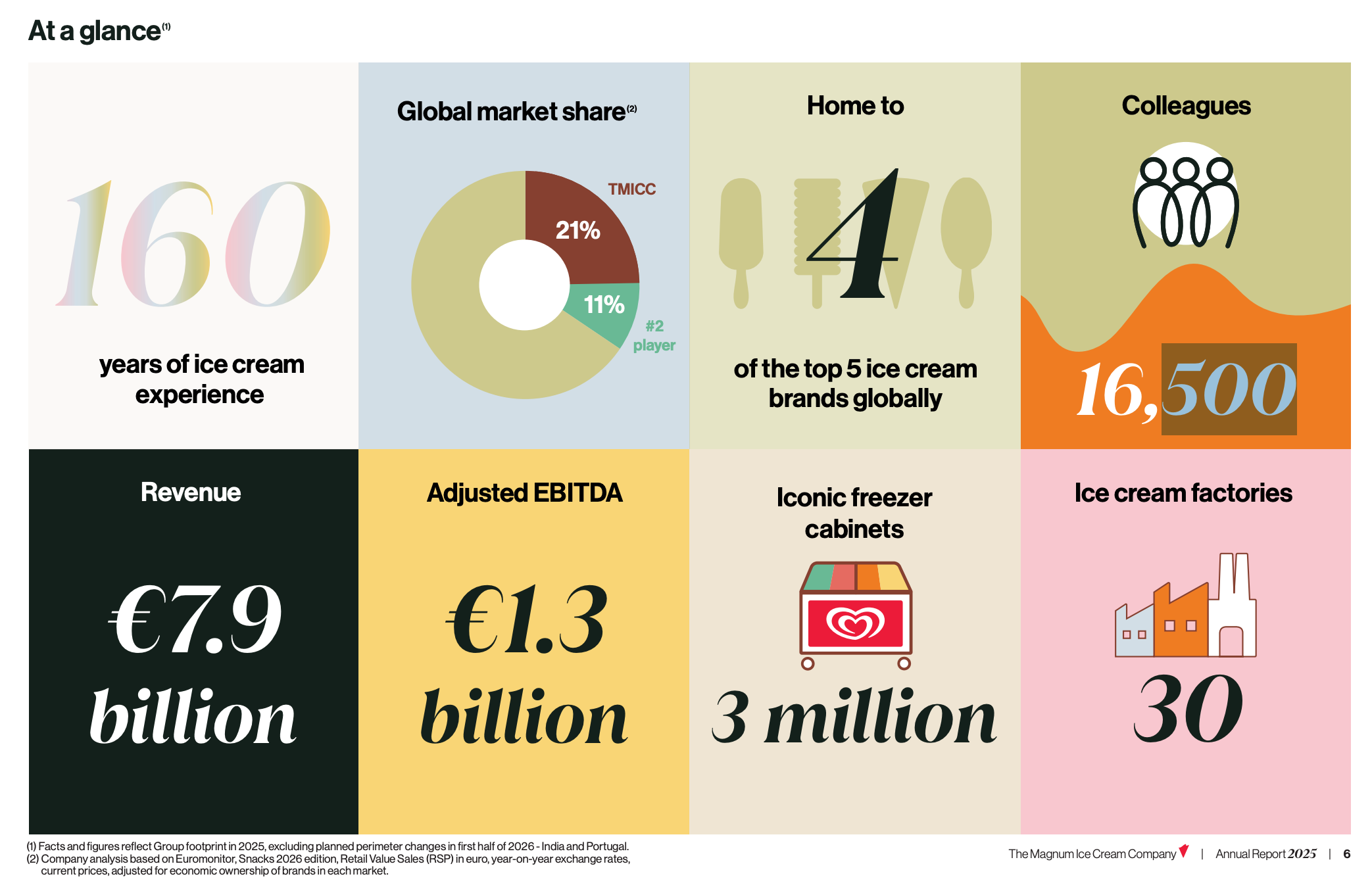
That is the part I find genuinely odd, and I have thought about it more this August than I expected to. In almost every other category, a manufacturer rents shelf space with money, with discounts, with promotional calendars and slotting fees. Here, the manufacturer installs a physical asset that it owns, inside premises that it does not own, and maintains that asset for years at its own cost. The freezer cabinet humming away in the petrol station forecourt does not belong to the petrol station. Somebody else paid for it, somebody else sends an engineer when it fails, and somebody else decides what goes in it.
The Magnum Ice Cream Company owns roughly three million of these boxes.
I think you know, these are the little red and white boxes you have in every little shop! This is what you have inside.
I think many people, as far as I looked at the debate, are having it wrong.
The question is not whether people will keep eating ice cream, I mean with global warming, they will, and without telling you, Magnum anticipates it in its new product (they try to make ice cream a product you’ll consume in lany occasions), that question is boring and the answer is obviously yes, with some erosion at the margin that I will come to. The question is whether a business that spent decades inside a conglomerate, competing for capital against Dove and Hellmann’s and Home Care, can be turned into a standalone system that converts eight billion euros of revenue into eight hundred million to a billion euros of annual free cash flow.
That is the whole file, this is not a ‘Buy Magnum’ file or idk, this is just this. Everything else is texture, or ice cream.
It is worth your time because what you get, if it works, is five things bundled together.
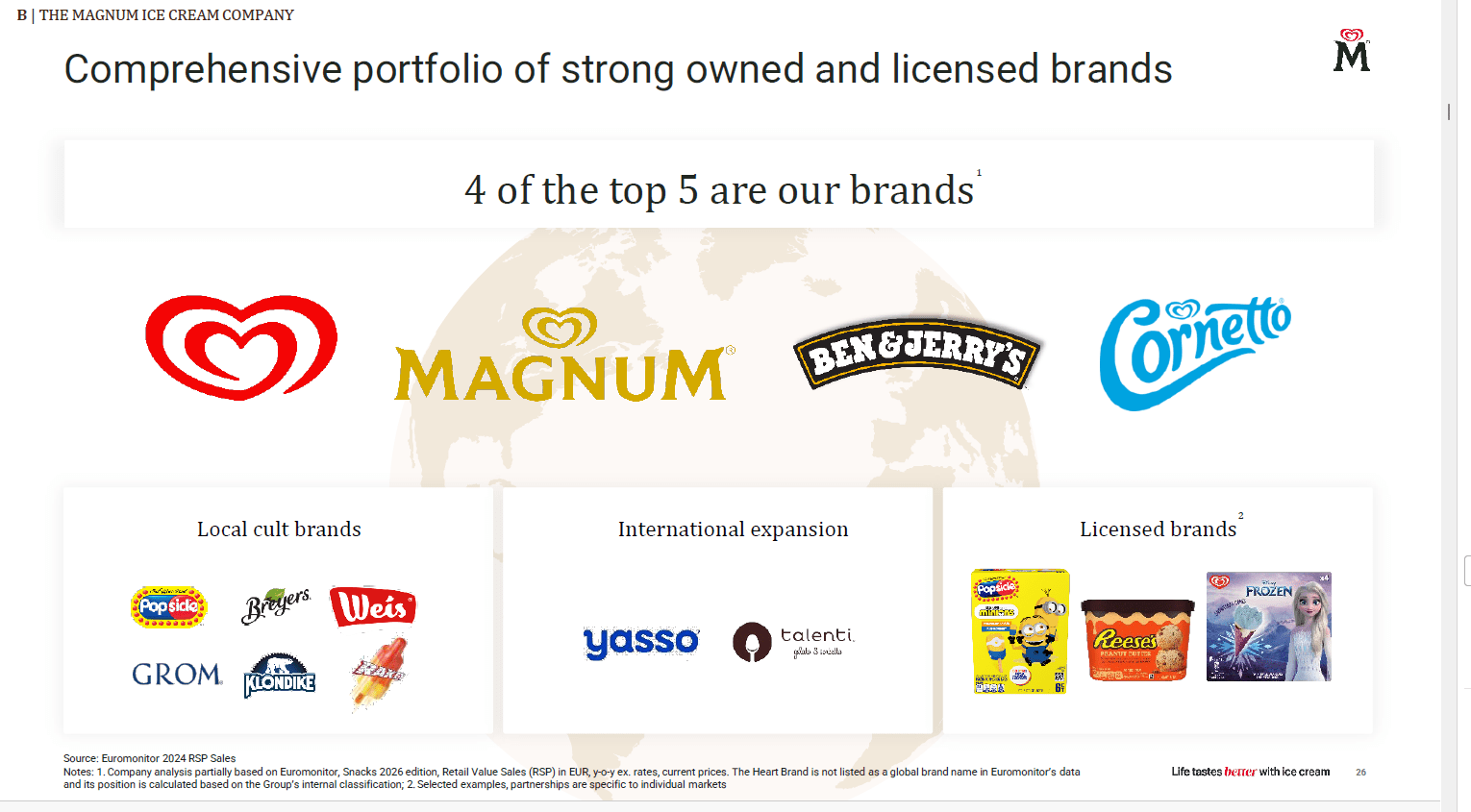
A portfolio of global brands where four of the five largest in the category sit under one roof.
A physical distribution network of around three million cabinets.
A self-help programme targeting roughly €500m of gross productivity savings, concentrated in the supply chain.
A genuine emerging market runway, mostly in Asia, the Middle East and Africa, where per capita consumption is a fraction of European levels.
And a management team whose incentives have been deliberately rebuilt to look like the thesis rather than like a corporate pay committee’s compromise.
What is already visible: organic sales growth of 4.2% in 2025 and 4.7% in the first half of 2026 (no use to tell you that one should make projections on a yearly basis, because this is ice cream), volumes positive at 2.5%, ninety million euros of savings banked in six months, but what remains to be proven: that free cash flow normalises once the plumbing to Unilever is fully disconnected, that margin expansion survives without starving the brands and the cabinets, and that gross savings actually reach the operating line instead of quietly funding inflation.
Three lines will tell you whether this works.
Free cash flow.
Net debt.
Volume growth.
If all three improve together, the thesis is intact. If the company keeps growing at four per cent and still cannot convert profit into cash by 2028, it is broken, and no amount of brand equity will save it, not even my new massive consumption of ice cream..
What strikes me is the strategic shift under way that is a move from a brand-centred logic to an occasion-centred one. It sounds like consultancy language and it usually is, but here it has a physical meaning. The group is no longer only trying to sell more Magnum. It is trying to occupy more of the moments when someone wants something cold (what I said earlier about occasions), whether that moment is ‘premium indulgence’, ‘on-the-go snacking’, ‘refreshment’, ‘sharing at home’, or the newer and more awkward category of mindful choice.
My insights from the brands:
Magnum and Ben & Jerry’s carry pricing power.
Cornetto and the stick formats carry frequency and impulse.
Popsicle and the Heartbrand lines carry penetration and seasonality.
Breyers and the Ben & Jerry’s tubs carry the basket.
Yasso, Breyers CarbSmart and the sugar-free ranges carry the argument that a consumer eating fewer calories is not necessarily a consumer spending less money.
Underneath all of it sits the cabinet.
Think about what that box actually is, stripped of the branding. It is a fixed volume of refrigerated space in a location that cannot be duplicated, because the corner shop has room for one cabinet and not two. And when you think about it for a minute, whoever owns it controls availability, assortment, visibility and, above all, impulse, which is where the margin in this category lives. A rival can outspend you on television for a decade. It cannot conjure a second box into a space that physically holds one.
Why are people drinking coca cola and not pepsi, even if pepsi taste better?
Because… when you are in this situation, you want your fresh coca cola…
(I hope I don’t lose people at this debate)
I want to be careful here, because this is exactly the point at which most write-ups say the word ‘moat’ and move on…
These boxes are a burden. They consume capital every single year, they break, they need service engineers and refrigerant compliance, they sit idle through the winter across half the world, and they chain the manufacturer’s returns to an asset base that a pure brand owner would never willingly accept. Coca-Cola coolers and Red Bull fridges exist for the same reason, but neither company’s economics live or die by them the way this one’s do. If your model of a wonderful consumer business is asset-light, high-return and cash-generative from day one, this is close to the opposite of what you want to own.
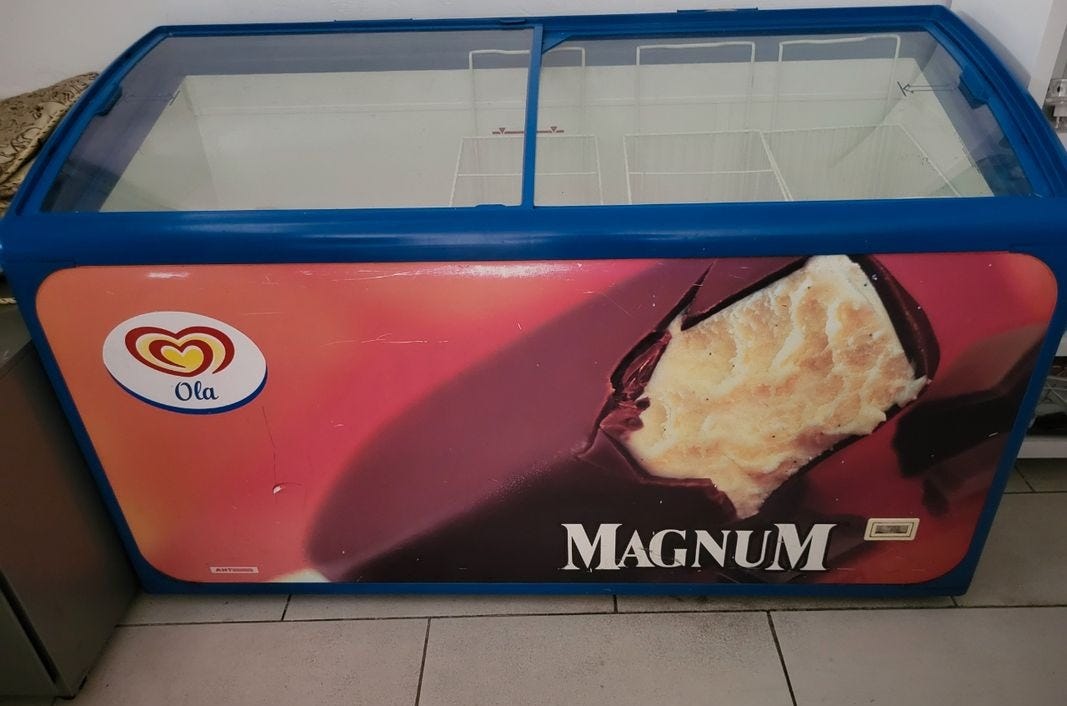
And yet the company is spending money to build more of them, and is now digitalising the estate so it can track sales, stock and replenishment box by box.
The stated ambition is a loop: more cabinets, more availability, more volume, better yield per cabinet, more reinvestment, more cabinets again.
This is also the clearest argument for why the demerger might improve the business rather than merely… relocate it. In fact, inside Unilever, ice cream was a cold, heavy, seasonal, working-capital-hungry business asking for capital in a room full of soap and mayonnaise, and it lost that argument for years. Management has been explicit that historic capital expenditure was ‘insufficient’, and intends to bring it back towards roughly 5% of sales in the medium term. That is good, i like companies that invest a lot and yes 5% of sales is a lot. As a standalone company, the question finally becomes concrete and answerable. Is a euro better spent on a new cabinet in Uttar Pradesh, an automated line in Hungary, a replenishment system, or a marketing campaign? Nobody at Unilever ever had to answer that question about ice cream alone. Now Management is asking this questions and adresses them.
This is for me the one thing i’d like to share to you as an insight. We are moving from a business unit in a massive conglomerate, that was given limited budget, and that also was, a budget line in a bigger book.
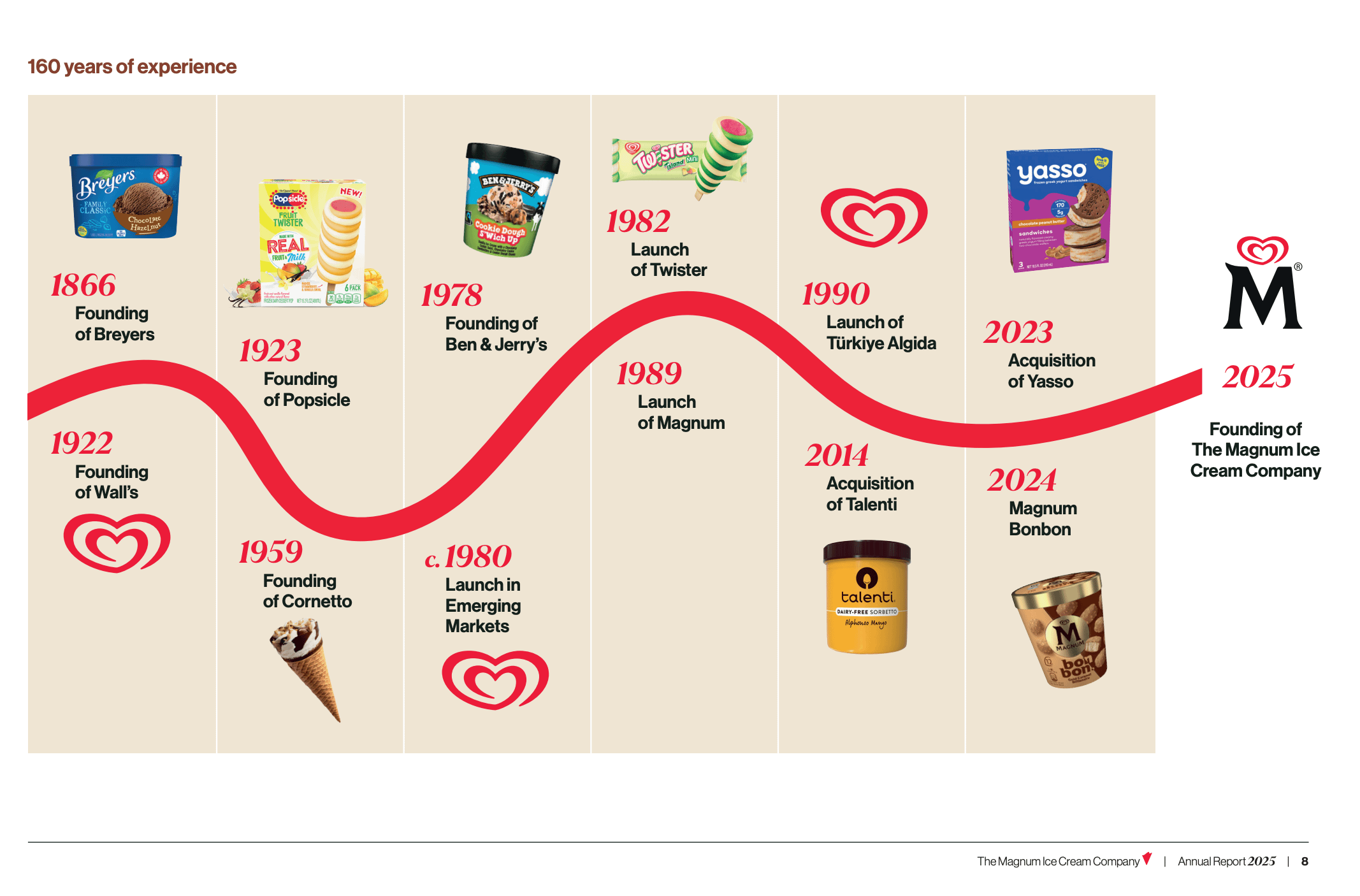
And this, with a massive heritage
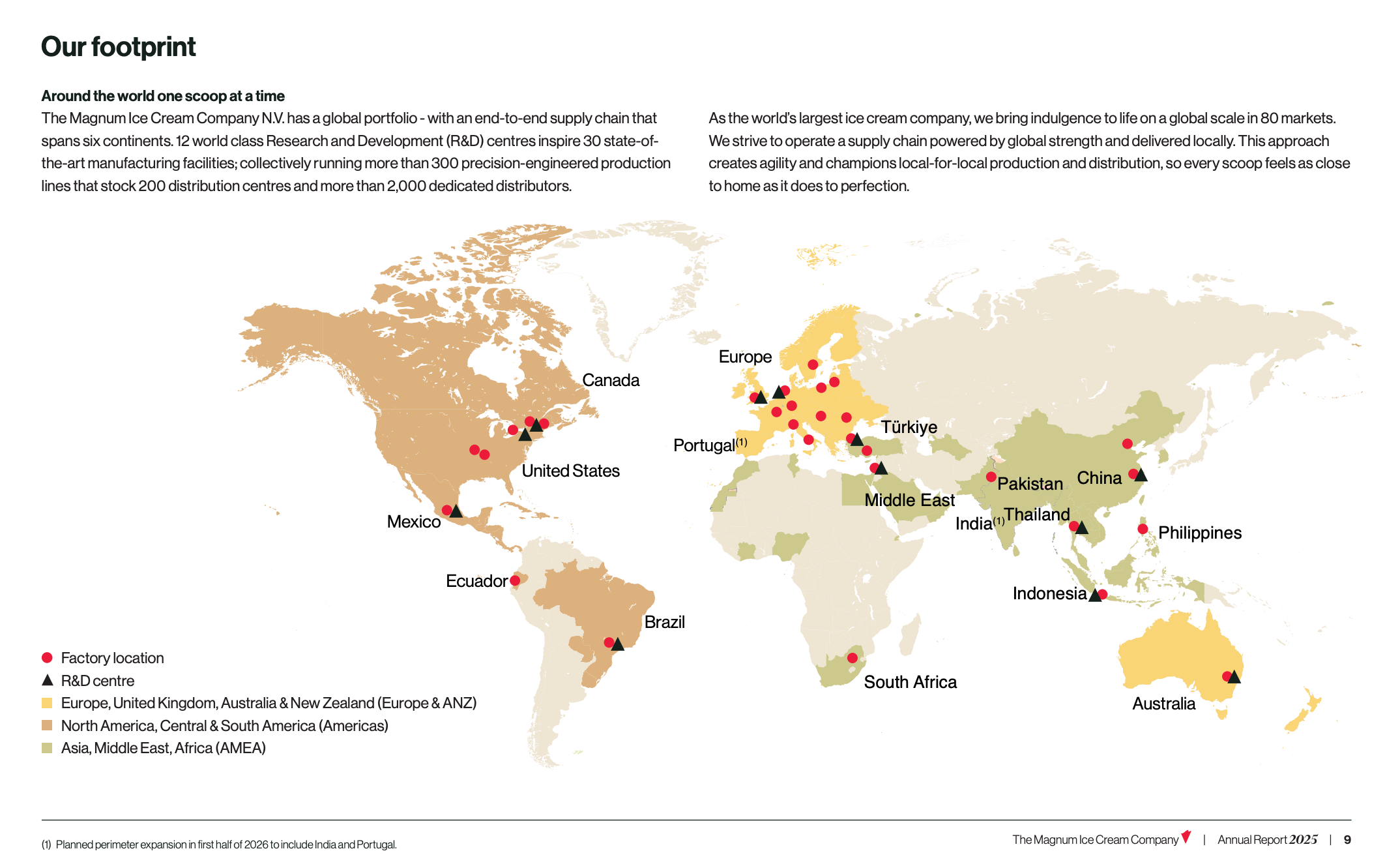
And a massive footprint
On 22 April 2026, in decision number “26-15/434-162” (super prosaic), published on 18 May, the Turkish Competition Board opened a full investigation into Unilever Sanayi ve Ticaret Türk AŞ and Magnum Dondurma AŞ… Alongside the investigation it imposed an interim measure: 30% of freezer cabinet space must be actively reserved for competitors’ products.
Read that again. A competition authority decided that a fridge was a competitive control point, and legislated on the inside of it.
This is not new in Türkiye and it is not an accident. The Board has been circling this asset since at least 2019, and its reasoning has always turned on the same physical fact: in retail outlets smaller than one hundred square metres, the shopkeeper cannot simply add a second freezer, so whoever occupies the first one has effectively closed the outlet to everyone else. The 2021 decision required the same 30% carve-out and fined Unilever for failing to deliver it. The 2026 decision names Magnum Dondurma directly, four months after the company began trading in its own right, and it came with a clock attached. The company had until 15 August 2026 to empty or reallocate that thirty per cent. That deadline passed three days ago.
Competition authorities do not write rules about assets that anybody can replicate. They write rules about assets that nobody can. The Turkish file is a liability, and I will treat it as one later, but it is also the clearest independent confirmation available anywhere that the cabinet network is the business rather than the packaging around it.
Management call it their ‘secret weapon’.
Now the accounts, and they are not flattering at first glance… one could say they are melting under the sun…
Free cash flow in 2025 collapsed from €803m to €38m. Thirty-eight million euros, on nearly eight billion of revenue. Taken alone, that number describes a business falling apart.
The bridge tells a different story.
Net cash from operating activities was €483m. Net capital expenditure took €330m. Net interest paid took €115m. What is left is €38m. The operating line did not collapse; the company simply started paying for two things it had never paid for before, its own capital programme and its own debt.
Underneath that sit the separation costs themselves, and they are large. Acquisition and disposal related items of around €238m, separation related items of around €146m, and the interim operating model with Unilever costing around €180m. None of that recurs indefinitely. All of it makes 2025 useless as a normalisation base, which is inconvenient, because 2025 is the only full year this company has.
The debt arrived the same way. Net debt went from €263m to €2,967m over 2025, and the cause was structural rather than operational. In November 2025 the company issued around €3bn of bonds to settle the payable owed to Unilever under the separation, in four tranches of €750m carrying coupons of 2.75%, 3.25%, 3.75% and 4.00%, maturing between 2029 and 2037. S&P rated it BBB and Moody’s Baa2. At year end, leverage sat at roughly 2.4 times adjusted EBITDA, inside the company’s stated 2.0 to 2.5 times target.
I think those coupons are worth pausing on. A blended cost in the low threes on ten-year money is not a distressed balance sheet, and the maturity ladder is genuinely long. But this is not free debt either, and it converts what would otherwise be an interesting operational story into one where cash conversion and deleveraging are the entire equity case.
The first half of 2026 was better and, on the top of the ice cream, much better.
Revenue of €4,691m.
Organic sales growth of 4.7%, split 2.5% volume and 2.2% price, which is a healthy mix and not a pricing rescue.
Adjusted EBIT of €716m at a 15.3% margin, up fifty basis points.
Adjusted EBITDA of €880m against €853m.
Productivity savings of €90m, of which €70m came from the supply chain and €20m from overheads. Guidance reaffirmed at 3 to 5% organic growth.
And free cash flow of €273m against €138m a year earlier.
Nearly doubled. That is the figure the coverage led with.
Here is where I have to be unhelpful, because this is the point at which a free summer piece could easily become a promotional one. And it’s not, I am not paid, not even in ice cream… snif.
The company publishes a second cash figure in the same release. Excluding factors related to the separation from Unilever, comparable free cash flow was €99m, against €72m. Roughly €173m of the reported number is working capital unwinding out of the interim operating model with the former parent, and it happens once. Ninety-nine million euros is the business.
To be fair, I have some respect for a management team that publishes the number making it look worse when nobody forced it to. But the number is the number. Ninety-nine million euros of comparable free cash flow, against net debt of €3,264m and leverage that has climbed to 2.5 times, which is the ceiling of the company’s own policy rather than the middle of it. Reported net profit fell to €349m from €464m on higher finance costs, restructuring, a €13m net monetary loss in hyperinflationary Türkiye, and an effective tax rate that jumped to 30.4% from 20.7%. The shares fell 4.2% in early trading on the day… You got it.
This is not yet a cash machine. And to be fully transparent, I don’t know the time it will become one, if it ever becomes one. It is a company that has bought itself a long, capital-hungry runway and is asking to be judged in 2029.
Are you ready to wait until 2029. Me personally yes. Long term investing here!
The self-help programme began in 2024 and targets around €500m of gross productivity savings in the medium term.
Roughly €350m to €380m is meant to come from the supply chain, through network reconfiguration, automation, service levels, planning and SKU simplification.
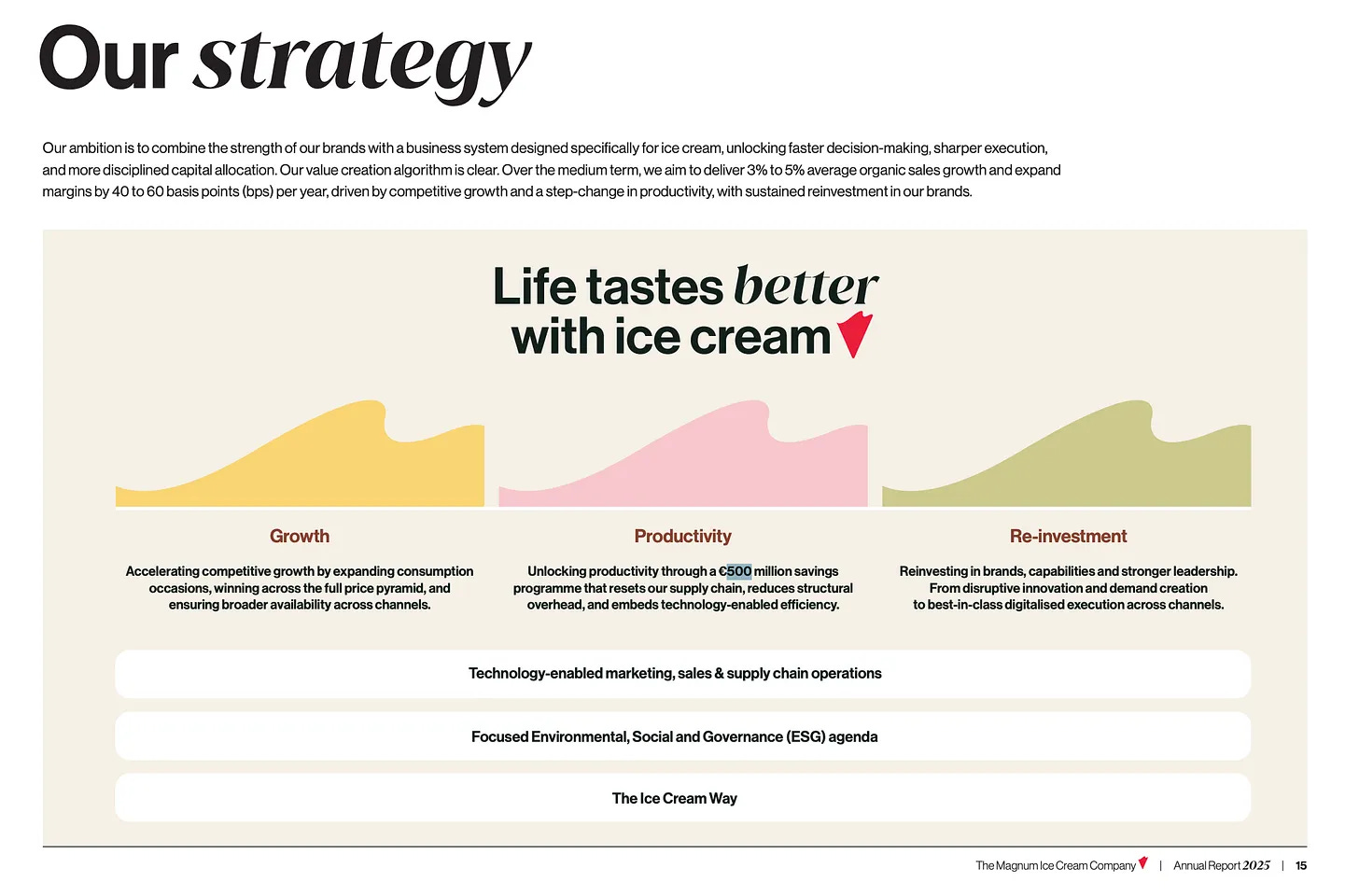
Another €70m to €100m comes from overheads as the standalone organisation settles. The remaining €30m to €50m comes from technology, principally from getting out of Unilever's systems and building its own. It is further along than the headline suggests.
The company delivered €70m of savings in 2024, €180m in 2025 and €90m in the first half of 2026.
Do not add €500m to €1,255m of EBITDA and declare the work finished. Not at all. These are gross savings: meaning, some will be eaten by cocoa, dairy and sugar inflation. There will be by the way some big inflation in the future due to the fertilizer shortage due to Hormuz. Some will be reinvested into brands, cabinets, technology and the industrial catch-up that the Unilever years deferred. The honest way to underwrite the plan is to track the guided 40 to 60 basis points of annual comparable margin improvement and the free cash flow line, and to ignore the headline number entirely, like, entirely.
Supply chain matters more here than in most consumer businesses because the seasonality is unforgiving. A stockout during a July heatwave is not recovered in September; the occasion simply passed. Service levels, plant utilisation, SKU rationalisation and automation therefore improve revenue, margin and working capital simultaneously, which is rare.
Which is why the hire of Sandeep Desai as Chief Supply Chain and Operations Officer is more interesting than a routine appointment. At Unilever he ran a manufacturing transformation in Southern Africa worth around €600m, closing five facilities and building three new plants. That is precisely the shape of the €350m to €380m the plan now demands.
The less visible risk is the technology carve-out. The company has to exit its remaining Transitional Service Agreements with Unilever and build a standalone architecture, and the stated target for that exit is the end of 2027. Mark O’Brien, the CTO, came from PepsiCo, where he ran IT strategy and transformation, after similar work at Reckitt.
I want to be blunt about why that 2027 date matters more than anything else in this file. Until the TSAs are gone, the cost base is partly someone else’s, the working capital is partly someone else’s, and the comparable free cash flow figure is an estimate wearing the clothes of a fact. The good version is that the money spent produces a simpler architecture built for one business. The bad version is a carve-out that runs long, costs more and disrupts operations in the middle of a peak season. Both versions are live until the end of 2027.
Premiumisation and format innovation first, because that is the least capital-intensive lever. The point of a new format is not novelty; it is a new price point at a new occasion. Sticks, cones, sandwiches, minis, bonbons and sharing tubs multiply the number of moments in a day when the same brand can be bought, which raises frequency without requiring the category itself to grow spectacularly. It is also, at the moment, doing the work that pricing used to do. Organic price growth in Europe and Australasia in the first half was negative, at minus 0.6%, while volume grew 4.8%. The region is now buying its growth with mix and availability rather than with the price list, which is harder, slower and considerably more durable.
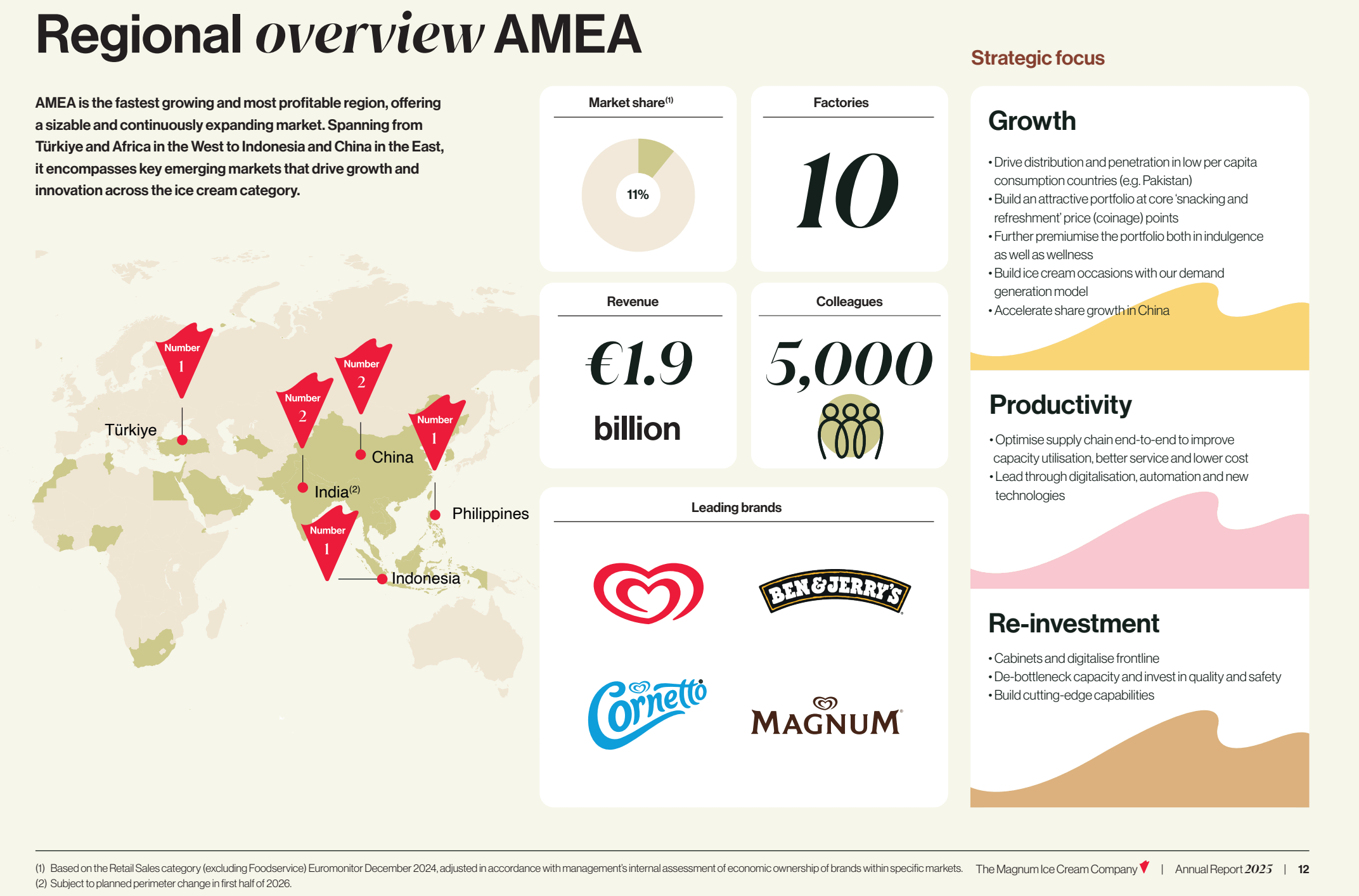
Then AMEA, which is the structural runway and also, right now, the most uncomfortable set of numbers in the company. In the first half of 2026 the region grew organic sales 7.6%, with volume up 1.9% and price up 5.6%, at an adjusted EBITDA margin of 23.5% and an adjusted EBIT margin of 19.0%. A year earlier it grew 10.7%, with volume up 7.1% and price up 3.4%, at margins of 26.2% and 20.9%.
Read that properly, because it cuts both ways. AMEA remains far more profitable than either other region, at 23.5% against 17.7% in Europe and 16.0% in the Americas, and it is still the fastest growing. But the margin fell 270 basis points, the volume growth collapsed from 7.1% to 1.9%, and in the second quarter alone organic volume growth was 0.1% against 10.2% the year before. Management attributes the decline to material cost inflation, hyperinflation, the measures imposed by the Turkish regulator and the Indian acquisition. Every one of those is a real cost being paid now for a position being built for later. Lower per capita consumption, rising incomes, cabinet expansion, accessible formats and gradual premiumisation still point the same direction. They are simply not pointing there this year.
Which brings me to the decision that made me sit up, and which I have not seen discussed, anywhere else, which is the reason you read me?
When Unilever carved the ice cream business out, the carve-out perimeter deliberately excluded three countries: Russia, India and Portugal. Why so? Russia is obvious for a part of people and investor. Portugal is a technicality. India is not. India is one of the largest and least penetrated ice cream markets on the planet, and it was left outside the box. How is it possible? Anyway:
On 30 March 2026, less than four months after listing, The Magnum Ice Cream Company completed the acquisition of 61.9% of Kwality Wall’s (India) Limited from Unilever, under a share purchase agreement dated 25 June 2025. The Indian company remains listed on the BSE and the NSE as a majority-owned subsidiary. An open offer for up to 26% of the public shares was announced on 16 February 2026 and closed on 7 May. It moved the holding from 61.90% to 61.91%. Almost nobody sold. The company paid €279m in cash for the stake, of which €235m was goodwill. On 1 April it also bought back the Portuguese business it had been excluded from, for a further €152m, which makes "a technicality" a slightly generous description of it.
So the first significant capital allocation decision of this company’s independent life was to buy back the market its former parent had deliberately excluded. Not a brand, neither a factory. A distribution position in a country where the cold chain, let’s be honest, barely exists (not an insult to my Indian readers!) and where whoever installs the cabinets first will own the category for a generation. Abhijit Bhattacharya, the CFO, described it as ‘combining global brand strength with local heritage, manufacturing footprint and an extensive distribution network’. Company press releases are written to be boring. That last phrase is not boring.
There is a price for it, and management stated it plainly. Full-year adjusted EBITDA margin improvement is guided at 40 to 60 basis points on a comparable perimeter, but at 0 to 20 basis points as reported, primarily because of India. They bought a business that makes this year’s reported margin look worse. Either that is undisciplined, or they are running a longer clock than the market is.
Now the two growth stories that get argued about most, and where I think the argument is lazier than it should be.
Ben & Jerry's is the part of this file I find hardest to price, and I want to resist the two easy positions. The brand grew mid-single digit across the half and around 9.2% in the second quarter, with new stick and sandwich formats bringing in consumers who had never bought it before. Commercially it is working. Legally and reputationally it is not. The dispute over the dismantling of the independent board that Unilever established in 2000 is now in litigation, the Ben & Jerry's Foundation has suspended operations following a funding cutoff, and Ben Cohen is publicly calling for the brand to be sold to a group of socially aligned investors before, in his words, it becomes another piece of frozen mush. Niall FitzGerald, who was co-chair of Unilever at the acquisition, said the independent board existed to protect Unilever from itself.
I do not know how a court will read that sentence. I know that the founder of a brand campaigning for its divestment, in public, while the company reports its growth, is not a headline risk. It is a governance risk with a case number, and the second quarter's 9.2% does not settle it.
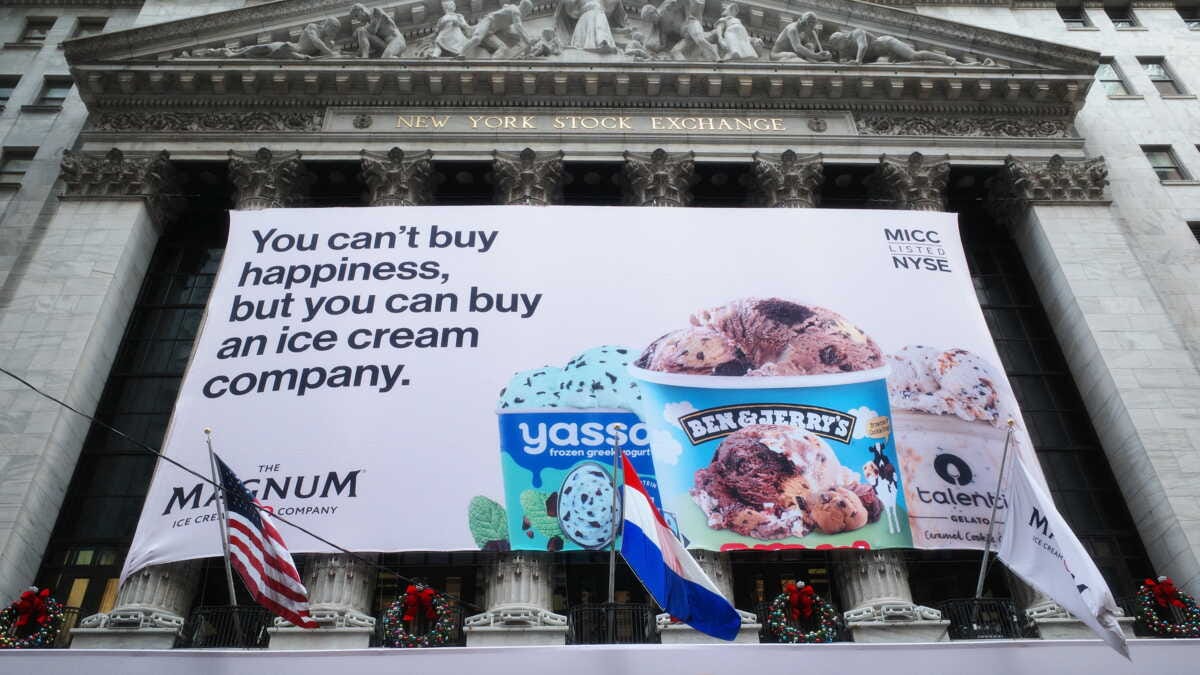
And GLP-1, which deserves better than the dismissal it usually gets from people who own consumer staples. Reuters reported in August 2026 that United States ice cream volumes were down around 1.5%, citing work from BCG suggesting that GLP-1 users cut their frozen treat consumption by at least 10%. Set that next to the company's own numbers. Organic volume growth in the Americas in the first half was 0.1%. Not negative, but not far from it, and the region's 3.2% organic growth was almost entirely price. In its largest market, this company is currently growing by charging more, not by selling more.
My read is that this is currently a mix and innovation problem rather than an existential one. A consumer eating fewer calories can still spend the same money on a smaller, premium, higher-protein, portion-controlled product, and the group has assembled exactly that arsenal. Yasso has compounded at roughly 20% a year over five years. Breyers CarbSmart, sugar-free lines and mini formats sit alongside it. The risk becomes serious, and I mean genuinely thesis-breaking, if category volumes fall durably and the mix fails to recapture the value. That is a 2028 question, not a 2026 one, but it is a real one.
Digital commerce is growing at double digits and I find it much less interesting than away-from-home, for the reason this whole piece keeps returning to. An online order is a transaction. A cabinet in a small outlet is a position.
Before you swear against me in the comment, you have to understand why I ask this question. I have been circling this comparison for weeks and I want to handle it carefully, because it is either illuminating or lazy depending on how it is used…
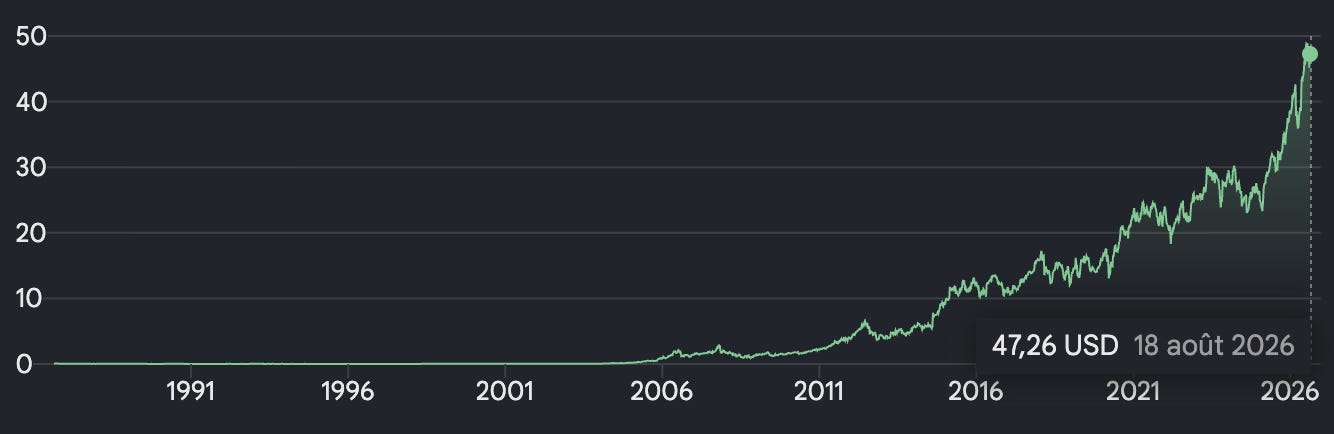
Monster is a multibagger. A perfect example of multibagging.
Monster built a loop over two decades. Some explain it better than me but long story short, drand drives distribution, distribution drives volume, volume buys better distribution, scale funds innovation, innovation opens international markets, international scale creates operating leverage, and the loop turns again. Access to the Coca-Cola bottling system supercharged it. In 2025 Monster did around $8.3bn of sales, up 10.7%, at a 55.8% gross margin, with roughly 41% of sales outside the United States…
The Magnum loop is structurally the same shape and physically different.
Brands drive cabinet placement, cabinets drive availability, availability drives volume, volume improves yield per cabinet, better yield funds more cabinets, and premiumisation and innovation raise the value of each one.
What makes the comparison genuinely interesting is that the two companies start from opposite ends. Monster was small and had to build distribution. Magnum is already enormous, already global, already in eighty markets, and has simply never been optimised. The opportunity is not market entry. It is better use of infrastructure that already exists, plus productivity, plus capital allocation decisions taken for ice cream alone for the first time.
And now the limit, which matters more than the parallel.
In my humble opinion, Monster is a better business and always will be. It is asset-light because bottlers own the trucks and the warehouses. Magnum owns the cold, the factories, the cabinets, the maintenance and a seasonal working capital swing. Monster earns more than fifty-five cents of gross profit on every dollar of sales, before it has paid for a single truck it does not own. Magnum owns the trucks, the cold, the factories and the boxes. Monster’s incremental return on capital is structurally higher and no productivity programme will change that.
So the sentence I am willing to defend is narrow.
Magnum can become the Monster Beverage of ice cream, meaning a system where brand and physical distribution reinforce each other over a long period. It cannot become Monster, and applying Monster’s multiple to it would be an error of the most expensive kind!
This is not the thing I looked at at the beginning, but the part I spend most of my time, because the work is huge.
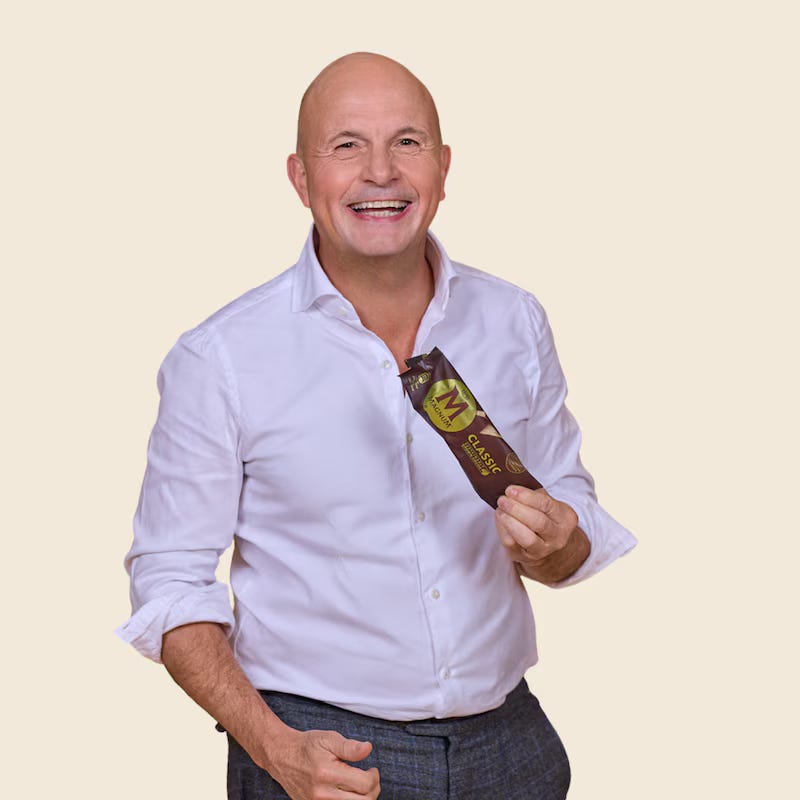
Peter ter Kulve joined Unilever’s ice cream business in 1988. That is where his career began. He ran Wall’s China and international ice cream operations, was involved in the emerging market expansion, the globalisation of Magnum and the European rollout of Ben & Jerry’s, and the North American integration. He then ran South East Asia and Australasia, corporate transformation, digital transformation and growth, and Home Care. In 2018 he founded Unilever’s Health and Wellbeing business, which assembled OLLY, Liquid I.V. and Nutrafol. He came back to ice cream in 2024 and is now chief executive.
The fit with the problem is almost uncomfortably exact: category, brands, emerging markets, transformation, digital. The gap is equally clear. He has not yet demonstrated over a decade that he is a capital allocator at an independent listed company. He is not Rodney Sacks, and it would be premature to write as though he were.
Abhijit Bhattacharya spent around thirty-eight years at Philips, as CFO of Healthcare, then Lighting, then of Royal Philips from 2015. Carve-outs, spin-offs, productivity programmes, working capital and cash conversion are the through-line of his career, which is close to a perfect description of what this company needs for the next three years. The caveat is that he was CFO of Philips through the Respironics recall and the operational problems that followed. That is not solely his responsibility, and it also does not permit anyone to call the record spotless.
Sandeep Desai and Mark O’Brien I have already covered. Both hires read as the board buying specific, unglamorous execution capability rather than star names.
Jean-François van Boxmeer chairs the board. Thirty-six years at Heineken, fifteen of them as chief executive. Consumer brands, premiumisation, emerging markets, M&A and long-horizon capital allocation. He covers, almost precisely, the one thing ter Kulve does not yet have.
Taken together this is a strong team with one honest hole in it, and the board appears to know exactly where the hole is. These guys are the Avengers of Ice Cream, rather be with them than against. There is a saying going like don’t bet against this guy or that guy, and i think this is the case here.
‘Show me the incentives…’
Compensation reveals priorities more reliably than strategy decks, and here the structure is unusually coherent with the thesis.
The 2026 annual bonus is split into four equal quarters: organic sales growth, market share gains, adjusted EBITDA margin improvement, and free cash flow. Base salaries are €1.25m for the chief executive and €875k for the finance director, with target bonus opportunities of 120% and 100% respectively, capped at twice target.
That scorecard is well built, and I do not say that often. The four metrics police each other. Growth without margin fails. Margin without market share fails. EBITDA without cash fails. It is genuinely difficult to game one at the expense of the business.
The 2026 to 2028 Performance Share Plan is weighted half to organic sales growth and half to constant adjusted earnings per share growth, at 180% of salary for the chief executive and 150% for the finance director.
Here I would have done something differently. There is no return on invested capital measure. The committee considered one and concluded that free cash flow, EBITDA margin and EPS covered the ground. For a company about to push capital back into cabinets, plants and systems after years of underinvestment, incremental ROIC is exactly the number I want management judged on, and its absence is the one genuine weakness in an otherwise excellent structure.
Then there is the Foundation Plan for Growth, which is the aggressive part.
Executives must invest their own money in the shares, up to 500% of annual salary for ter Kulve and 400% for Bhattacharya. The company then matches at up to five options for every share personally bought. Options were granted on 16 June 2026: 2,362,060 to ter Kulve and 1,330,010 to Bhattacharya, at an exercise price of €15.33, based on average closing prices over 9 to 15 June. Half vests after three years and half after four, conditional on continuing to hold the personal investment and on total shareholder return exceeding the median of a peer group of international snacking and refreshment companies. Shares acquired on exercise cannot be sold until the fifth anniversary of grant. Options lapse at the seventh. Malus and clawback apply.
The personal money is already committed. At 31 December 2025 ter Kulve held 436,665 shares, worth around 476% of his salary, of which more than ninety per cent was bought after the listing. Bhattacharya held 150,956 shares, around 235% of salary, and has continued buying through 2026.
Monster had genuine owner-operators. Magnum has professional managers whom the board is deliberately trying to convert into owner-operators. That is a weaker thing, but it is a credible attempt, and I would rather have a plan that is too generous and properly aligned than a management team paid handsomely regardless of outcome… I think you’ll think the same as I do.
It is too generous, though, and shareholders said so. The Foundation Plan resolution passed the 2026 annual meeting with 77.37% in favour: 369,793,135 votes for, 108,157,740 against. Roughly one share in five voted down a pay plan, which is a meaningful revolt by European standards, and it is not distorted by the former parent, since Unilever voted in proportion to everybody else for United States tax reasons. The company then granted 10,952,635 options under the plan on 16 June, against up to 18.5m registered on the S-8, in the order of three per cent of the current base. A five-to-one match is a large number however you frame it, and the dilution has to be watched rather than waved through.
And then, this morning, a wrinkle that I think is more revealing than it first looks…
On 18 August the company announced that it will enter into forward transactions to acquire up to 5.5 million of its own shares, worth approximately €90 million at the current price, to cover certain of its obligations arising from the long-term incentive plans. The shares are intended for the company’s employee benefit trust.
Read one way, this looks like the board answering the annual meeting.
Nobody has said so, and the announcement gives no reason at all, but shareholders objected to dilution in May and in August the company decides to buy the shares instead of printing them. That would be a defensible response, and the choice of forwards suggests somebody has noticed that the cost of settling these awards climbs with the share price, which has moved from the €13.32 at which the March performance awards were struck to something close to seventeen now.
Read another way, and this is the reading I cannot shake off, the company is about to spend ninety million euros on its own shares for the benefit of its employees. Comparable free cash flow in the first half was ninety-nine million. Net debt is €3,264m. Leverage is at the ceiling of the company’s own policy. No standalone dividend has ever been paid to anybody.
Note also the arithmetic of the number itself. Five and a half million shares against the eighteen and a half million registered on the S-8, and the wording is careful: certain of its obligations, not all of them. This is a partial answer to the dilution question, bought with cash the business has not yet demonstrated it can generate.
I am not saying it is wrong. Converting dilution into a cash cost is an honest trade and I prefer it to quietly issuing paper. I am saying that its size, set against the only cash figure in this company that means anything, deserves to be stated out loud rather than left in a Tuesday announcement.
And now the detail I keep returning to.
The chief executive’s options strike at €15.33. JPMorgan has just raised its target price to €14 from €13. Jefferies sits at €13.50, up from €13. Morgan Stanley is the most generous at €15.60. Berenberg has it at Hold. The compiled one-year target sits around €15.31.
The entire published sell-side view of this company’s fair value is, to within a few cents, the level at which management starts making money.
I do not think that is a conspiracy and I do not think it is a coincidence either.
What do we say about coincidence? The universe is rarely so lazy.
It is what happens when a large, complicated carve-out lists in December, produces one reporting cycle, and nobody has yet decided what kind of company they are looking at. The analysts are modelling a packaged food business with a low-growth category and a GLP-1 overhang. The board priced its options off a distribution network that the company is spending two euros in every five of its capital budget to extend.
Which is the last thing I want to put in front of you before the valuation, because it is the single most concrete fact in this entire piece.
Around 40% of capital expenditure in the first half of 2026 went into freezer cabinets. Not brands. Not the thirty-two factories. Not the new site in Veszprém or the research centre in India. Cold boxes, placed inside other people’s shops.
The sequence of capital allocation from here is I guess not complicated. It would go like: finish the carve-out, secure the cash, reduce the debt. Then pay shareholders. The stated payout policy is 40 to 60% of net income after adjusting items, with the first standalone dividend, relating to 2026, expected in the first half of 2027. Buybacks are a 2029 conversation at the earliest, and anyone building a thesis on them today is reading the sequence backwards.
The share purchase announced this week is not a buyback and should not be mistaken for one. It buys shares for employees rather than from shareholders. The cash leaves the business either way.
On valuation, I am going to use the reference the company itself created rather than a live screen price, (because mixing a moving quote into a structural argument produces nonsense). At around €16 per share and roughly 612m shares, the equity is worth close to €9.9bn. Add €3,264m of net debt and enterprise value lands near €13.1bn. Against the consensus the company compiled before the half-year, of roughly €8,279m of revenue, €1,318m of adjusted EBITDA and €992m of adjusted EBIT, that is around 10.0 times EBITDA and 13.3 times EBIT.
This is not deep value investing. Ten times EBITDA is not a mispricing you can point at and laugh. But it is not expensive either, for a global category leader that can grow three to five per cent organically, add forty to sixty basis points of margin a year and transform its cash profile. The opportunity here is execution, not multiple arbitrage, and anyone who tells you otherwise is selling something.
The free cash flow arithmetic is where it becomes interesting, and it is simple enough to do in your head. Against an equity value near €9.9bn, €600m of annual free cash flow is a 6.1% yield. Eight hundred million is 8.1%. Nine hundred million is 9.1%. A billion is 10.1%…
Those are not today’s yields. Today’s comparable half-year figure was €99m. That gap is the entire investment case, and in both directions. lets be honest If the company proves eight hundred million to a billion of annual cash with brands of this quality and a balance sheet that is deleveraging, it becomes hard to justify a ten billion euro equity value for very long. If it does not, the current price already assumes more than the company has delivered.
I have made the constructive case as strongly as I can, so let me be equally precise about the ways it melt under the sun and make you finger sticky.
The Turkish interim measure is a template, and that is the risk that worries me most because it attacks the thesis at its foundation rather than at its edges. If other regulators decide, as Ankara has, that the inside of the cabinet is a quasi-public space rather than a private one, the asset stops being a control point and becomes an expensive logistics obligation with no exclusivity attached. That is live, adjudicated and has a case number.
Cash conversion is the second. If free cash flow has not normalised after the TSAs end and working capital settles, the thesis is simply wrong, and 2028 is when we find out.
The technology carve-out running long or expensive, through the end of 2027, sits alongside it.
RFM Corporation, which holds the minority of the Philippine joint venture, has waived its right to force a buyout until April 2028.
There is also a quieter thing that almost nobody has mentioned. At the same annual meeting, shareholders approved a change to the reporting calendar. The financial year ending 31 December 2027 will be extended by three months to 31 March 2028, after which the year end moves permanently to April. So the period in which this company is supposed to demonstrate that its cash converts, immediately after the transitional agreements end, will be fifteen months long and comparable to nothing. I am not suggesting that is why they did it. I am saying that anyone planning to check the 2028 numbers against the 2027 numbers should know now that they will not line up.
Unilever still holds around 19.85% and intends an orderly exit over several years, which is a technical overhang rather than a business problem, but it can suppress a rerating for a long time. Cocoa, dairy and sugar inflation may outrun pricing and productivity. Türkiye contributes currency volatility, hyperinflation accounting and now a regulator. A cool summer across several major regions at once is a genuine structural risk in a way it is not for most consumer companies. Froneri and private label can apply promotional pressure indefinitely. And the Foundation Plan can dilute without the economic outperformance that was supposed to justify it…
The specific things that would break the thesis, and I want these written down where I cannot quietly forget them: organic volume growth turning durably negative in a stable category; gross savings announced while comparable EBITDA margin fails to advance over several periods without a credible explanation; free cash flow failing to normalise after 2027; net debt stuck at or above 2.5 times once separation spending ends; capital expenditure rising towards five per cent of sales with no measurable improvement in service levels, volume, margin or returns; AMEA slowing sharply or premiumisation failing in high-growth markets; Yasso and the mindful range failing to offset GLP-1 pressure in developed markets; and management optimising earnings per share and total shareholder return through financial engineering rather than cash.
One more thing, which I mention only to dismiss it. Reuters reported in May 2026 that Blackstone and CD&R had looked at the company, with tax constraints from the demerger limiting certain transactions for around two years. A financial buyer sees precisely what I have described: global brands, eight billion of revenue, a physical network, years of underinvestment and half a billion of identified productivity. Of course they looked. But I would never buy a share for a takeover, and anyone who does is buying a rumour with a two-year legal impediment attached to it. The M&A angle is a free option. It is not the thesis and it should never be allowed to become one.
Bullish, still.
I think the market is pricing a portfolio of ice cream brands with a weight loss drug problem. I think the asset is a network of three million refrigerated points of control across eighty markets, currently being extended at the rate of two euros in every five of the capital budget, in a category where the physical space to compete does not exist once the box is installed.
The transformation is real and the incentives are honest, at least, which is a rarer combination than it should be. The team fits the job with one visible gap that the chairman covers. The productivity plan is credible if you underwrite the basis points rather than the headline. AMEA is the runway and India was the tell.
But the cash has not arrived yet. Ninety-nine million euros of comparable free cash flow against a target of eight hundred million to a billion, with the transitional agreements to Unilever still running until the end of 2027, means this is a thesis about 2029 being bought at 2026 prices. That is not a criticism. It is a description of what you would be signing up for, and it is precisely why an investor is still being paid to take the risk that the transformation does not happen.
So here is what I will be watching, and it is not the weather, not the GLP-1 headlines, and not the innovation pipeline. It is the percentage of capital expenditure that goes into freezer cabinets. If it stays near forty, the company agrees with me about what it owns. If it falls, it does not.
Peter ter Kulve’s options strike at €15.33.
— Hidden Marke Gems
Comments
Nothing yet. Say the first thing.
Sign in to join the conversation.