The United States has federal AI law, and the effort to impose a regulatory framework on AI is contested and far from settling. What has emerged instead is a patchwork of state statutes that look, at first, like they solve different problems. California regulates the provenance of AI-generated content. Colorado and Texas regulate consequential AI […] The post State AI Laws Make Data Provenance a…
China’s State Council recently issued two orders that change the rules around how foreign companies can investigate their supply chains inside China, and how far they can go in enforcing Western sanctions against Chinese counterparties. State Council Order No. 834 (the Provisions on Industrial and Supply Chain Security, effective April 7, 2026) elevates Chinese regulatory […] The post Inside…
On June 8, 2026, the Department of Defense published its updated list of Chinese military companies under Section 1260H. The list names 188 entities, primary designees and their explicitly identified subsidiaries. Contracting prohibitions take effect June 30. For defense primes, that deadline is urgent. But the downstream ownership risk embedded in this list reaches far […] The post 1260h list…
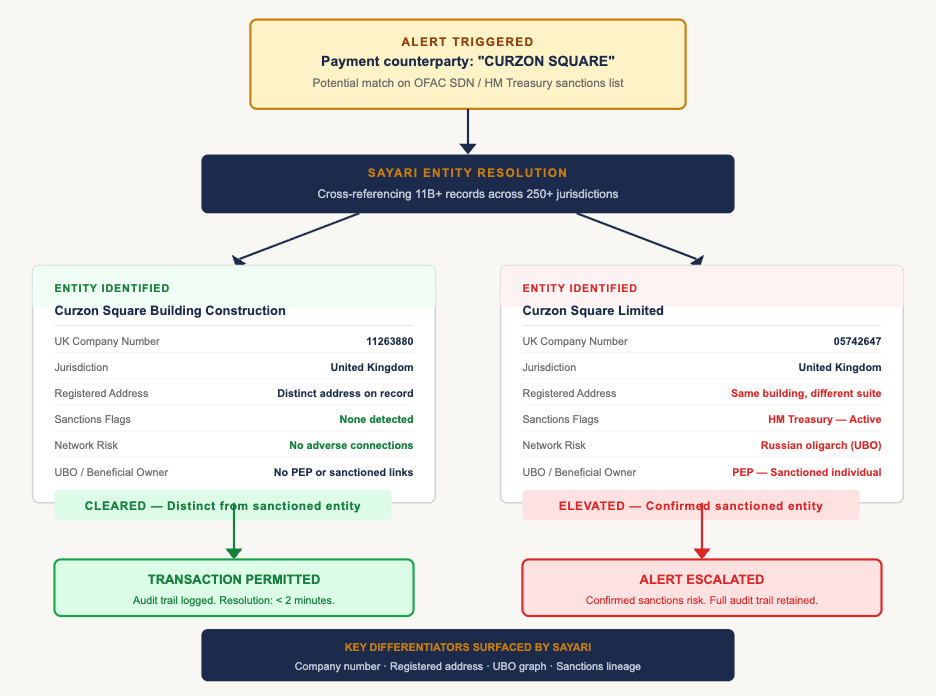
Alert adjudication is the critical success factor for financial crime compliance. Analysts must swiftly distinguish genuine risk from false positives while meeting operational and regulatory standards — yet the process across UK and European institutions is currently under question. Screening systems are at risk of producing 90–95% false positive rates, costing an estimated $206 billion globally,…
On April 15, 2026, the U.S. Department of the Treasury’s Office of Foreign Assets Control (OFAC) designated Iranian national Seyed Badroddin Naiemaei Moosavi, along with three of his front companies, for orchestrating a complex oil-for-gold money laundering scheme that generated hundreds of millions of dollars for Hezbollah and Iran’s Islamic Revolutionary Guard Corps–Qods Force (IRGC-QF). Prior…
Once mainly followed by compliance and supply chain professionals, sanctions and tariffs are now the topics of the hour. In February, the U.S. Supreme Court ruled in Learning Resources, Inc. v. Trump that the International Emergency Economic Powers Act, which the Administration used as legal basis for its tariff regime, does not authorize the President to impose […] The post Iran Sanctions and…
Most compliance programs send questionnaires to direct suppliers and assume certification equals compliance. That model has fractured under UFLPA enforcement. CBP now requires documentation of actual sourcing tracing inputs to geographic origin-a supplier’s assertion alone is indefensible if trade or customs data shows otherwise. The gap is acute. Questionnaire programs fail when tier-one…
Your compliance team screens customer names against the BIS Entity List before every shipment. But here’s what keeps you up at night: that check isn’t enough anymore. The assumption that watchlist screening protects your products from military diversion is fracturing. Watchlist screening alone no longer protects your products from military diversion. The Bureau of Industry and […] The post…
The Export Administration Regulations (EAR) assumed that listing sensitive technology, licensing transfers, and maintaining entity watchlists would stop adversaries from acquiring it. That model fails today. Sensitive technology reaches adversaries not because the EAR is weak on paper, but because its enforcement is blind: regulators identify restricted technology but cannot reliably see who…
For decades, the semiconductor industry operated on the principle of cross-border specialization: American design, Dutch and Japanese equipment manufacturing, Taiwanese and South Korean fabrication, Chinese assembly. The logic was efficient and deeply embedded in global trade. That assumption no longer holds. The CHIPS and Science Act in August 2022 authorized $52.7 billion in direct subsidies […]…