
This is Part II of a two-part series diving into The Network State Conference that happened in Amsterdam on October 30, 2023 (ICYMI: click here for Part I).
We’re picking the good apples and leaving the rest to compost at the base of our ancestral tree. We’re experimenting with the recipes we’ve inherited from generations past, like DIY kombucha during lockdowns.
Our elders offer experiential wisdom. They’ve seen a lot, done a lot, and love to talk about it. But just because grandma’s homemade recipes are perfect in their original form doesn’t mean the antiquated institutions she grew up are, too.
Like the U.S. economy, many of them are running on borrowed time.1
In this post we’ll look at some of the major institutions that are on their deathbed, and the successors that are taking their place.
The term “institution” is a big mess.2
For the sake of this article, though, we can think of institutions like manufacturing plants: comprehensive systems designed to create end products.
Education institutions pump out workers. Financial institutions productize capital. And healthcare institutions, like those in the U.S., have literally commoditized life itself. We consume these products hoping for enhancements, like what gym bros expect from creatine. But we’re starting to realize just how ineffective these products really are.
The agents of institutions—schools, banks, governments—are merely social vehicles that get us to where we want to go. What do we do when those vehicles break?
It’s not enough to repair them, we must build new ones.
At The Network State conference, we saw how we’re not just building new vehicles, we’re redesigning the entire manufacturing plant. We’re remaking the parts, replacing department heads, and re-engineering the entire assembly line from the bottom up.
Education is one system that’s undergoing incredible changes under the hood.
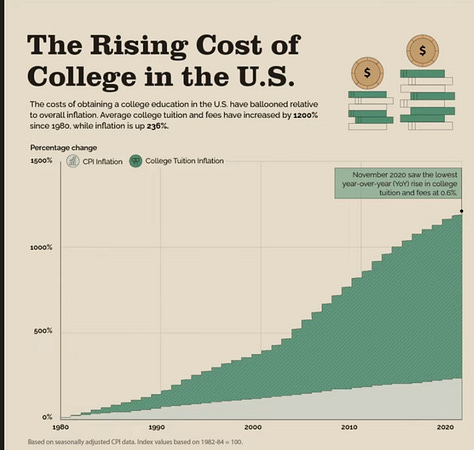
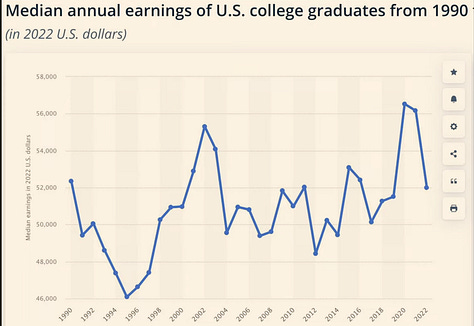
While the cost of college continues to increase year after year, earnings haven’t responded in kind. As of 2022, the U.S. student debt exceeded $1.6 trillion. One does not need a business degree to understand these indicators of poor performance.
If civilization is downstream of education, we’re sitting in an algae-infested stillwater pond.

But companies like Synthesis are working to change that.
Their schools revolve around values instead of grades. The curriculum aims at character-building and critical thinking. Like project-based learning found in countries like Finland and Denmark, Synthesis students focus on solving problems in a collaborative environment instead of testing for recall ability. And the founder, Chrisman Frank, is deploying new AI-powered tools to scale up the results:
This new approach challenges the fundamental building blocks of learning and development, while also decreasing the sensitivity to risk-taking and rule-following that’s built into our existing school system.
Instead of managers focused on high scores and A+ business ratings, this system produces innovative leaders who go on to solve the world’s toughest problems.
Y-Combinator already knows this. They were three steps ahead when they created an incubator to support young founders. The company, whose sole focus is to accelerate startups, has backed 4,500+ organizations with over 100 of those reaching a $1B valuation/market cap.3
The Thiel Fellowship iterated on that model, going so far as to start paying students to drop out.
Instead of charging kids an arm and a leg for outdated education, this invisible college actually gave kids $100k to build novel solutions, as long as they were under 19 and not enrolled in school. If unicorn status is a home run, they ended up tripling Y Combinator’s batting average, from 2% to 7%. Some of the resulting products include Ethereum, Figma, and Loom, just to name a few.
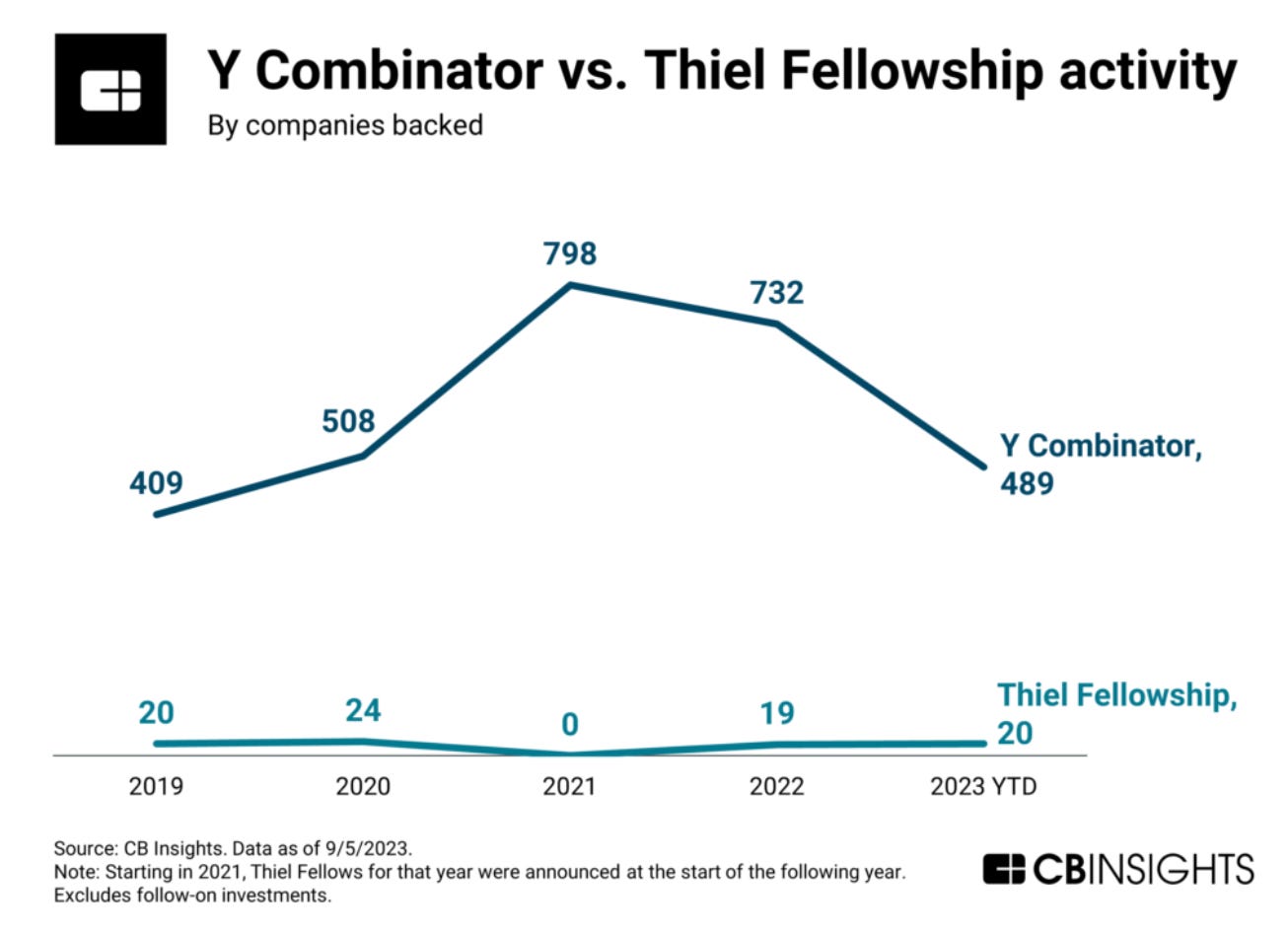
It’s hard to argue the efficacy of these alternative programs when compared to a 4-year program at a traditional university. Who knows what’ll happen when this strategy is recycled and improved over a dozen more iterations?
Michael Gibson is on a mission to find out. After he helped launch the Thiel Fellowship, he went on to start a venture fund, 1517, that aims to amplify this impact.
There may be no greater example of slow, ineffective systems than that of our government institutions. But the conference demonstrated that these, too, are rapidly changing.
Citizenship, for example, is a product of government. Traditionally, this product couldn’t be bought, it could only be granted by blood or birthright. But after COVID, governments started productizing citizenship to resuscitate their economies. Countries like Antigua, Dominica, St Lucia, and Egypt, to name a few, have all launched visa programs in recent years to attract foreign investments. In other words, governments are starting to offer “citizenship as a service.”
We’re starting to see intermediaries take this opportunity by the horns.
What Uber is to local travel SafetyWing is to international travel. They’re working on a borderless passport that supersedes the standard process for obtaining foreign visas. The Nomad Passport grants you up to 90 days in any country that’s part of their network—like Shengen but for the entire world.4
This means passports are becoming a mobility platform that levels the global playing field.
Luis Cuende of Baseflow sees this movement as the start of a “sovereignty stack.” Just like you might have a personal tech stack, we’re starting to see a suite of options that include things like citizenship, residency, companies, and cryptocurrency.
Soon, you might be a “citizen” of one country and have residency in another, while your company is based somewhere else entirely. And you’ll pay for everything using a country-agnostic currency that’s powered by the internet.
If citizenship and residency are becoming government products, then cities, states, and countries are quickly becoming the service providers.5
When you walk into an Apple store, you can only buy Apple products. That’s how governments are currently structured. They have a monopoly on sovereignty. But with the rise of The Network State, countries will be less like Apple and more like Best Buy.
This is a second-order effect of what Balaji refers to as “diplomatic recognition.” Once a community hits a critical mass of members, their weight in numbers lets them come to the big boys’ table. Their bargaining power then drives tangible changes in age-old jurisdictions.
An example of such bargaining power is the ability to change the rules of the game. Law, land use, and regulations, in general, are now being revamped based on customer demand.
When you charter a yacht, you pretty much make your own rules. You can take it out for a day or a week, go where you want, with who you want, and have a helluva good time doing it.
Charter Cities are similar.
An existing government will let you charter your own city by declaring a piece of their land a “special economic zone.” Within this zone, your city operates freely by the rules you create, amongst people that you’ve recruited. There may be a few bumpers but, for the most part, you operate independently from the country that owns the land.
Big governments are slow to change because they’re weighed down by bureaucracy. Charter Cities solve that. As Mark Lutter, founder of the Charter Cities Institute, says in his talk: they are “the rule for changing rules.”
One big advantage is low-risk experimentation. Changing rules in big countries is risky because it’s difficult to understand what the effects will be. But testing in a small-scale environment offers proof-of-concept and regulatory agility.
This is not science fiction. Cities like Praxis, a charter city in Honduras, have already been established. And others, like Neom, are being funded.
We’re headed in the direction of opt-in, open-sourced legal systems that use data-driven results to drive customer citizen satisfaction.
Once the software layer is added, you get all the benefits of technology without the error, corruption, or delays of human administration. Alexis Rivas from Cover demonstrates how this looks on a practical basis for land use and building permits:
Communities will be increasingly able to pick and choose which rules apply to them, living life on their own terms. And while the concept might not be new (eg. Singapore, Dubai), the implementation is a bit more novel: the Lean Startup for societies.
Experiment, learn, build on what works, leave what doesn’t, and then do it again.
The breadth of progress will only increase from here on out. But the speed of progress will depend on a few critical levers:
New Relationships
The Network State is an act of rebellion through innovation. We are iterating on our legacy social structures by outsmarting, outbuilding, and (eventually) outnumbering the Goliath that is the existing establishment. But we can’t go it alone. We’ll need to work with those who are open to change and find mutually beneficial solutions that “lift all boats.”New Tools
What Toyota did to cars with the assembly line, Tesla did to Toyota with the Gigafactory. For a long time, we’ve been walking around with a toolbox full of rusty hammers treating everything like a nail. By re-tooling, we can build better products, faster.New OS
A new way of living requires a new way of operating. As Garry Tan, head of Y Combinator, suggested, we need to work on replacing the ‘unelected’ parts of our system by building entirely better solutions. When we do that, we garner attention and attract others who want to build alongside us.
If the future is probabilistic, we can allocate our energy and resources to those actions and initiatives that are most likely to result in the future we want. The biggest question to answer is, what future do we actually want?
Move fast and break things.
That was Zuck’s motto when building Facebook, which went on to unravel the very fabric of our social lives and political realities. The advent of social media came with ups and downs, the aggregate benefit of which is still being debated. That is to say, just because we can move fast doesn’t mean we should.
“There’s nothing so useless as doing efficiently that which shouldn’t be done at all."
—Peter Drucker
Yes, things are changing—and fast. But change doesn’t equate to progress. Innovation is an infinite game and, if we want to keep playing, we need to pay attention to the signs. Here are a few I’ve noticed so far:
Asking Wrong and Easy Questions
We need to start asking different questions—the hard questions—or we might miss the point. Questions like, “How do we not leave others behind?”6 or “If death is optional, what will we do with ourselves?”7 We can’t solve our problems with the same thinking we used when we created them.Familiar Fears and Real Risks
Some of the same threats that exist today will also exist in the future (eg. power grid, violence). If The Network State runs online, what happens when the internet goes down? If a terror group invades Praxis, who protects its citizens? If we put Neom or Itana in the place of Taiwan or Ukraine, would it play out any differently?8Closed Minds and Narrow Paths
Concepts like effective accelerationism edge around the belief that technology will solve all our problems. That’s never been the case. And if history is trajectory, it never will be. We shouldn’t dismiss the influences of human habit, psychology, and the polarizing effects of power.
As of today, we’re like unlicensed teenagers testing new cars that haven’t passed any safety inspections. It’s not that we shouldn’t drive, we just shouldn’t be reckless.
Bedrock institutions like finance, media, and medicine, don’t simply dissolve overnight. Rather, the changes happen gradually, then suddenly, like a kidney stone that’s come to pass. Alana Newhouse sums up the pain through the lens of brokenism:
We are living in a broken world. Our institutions are failing us, our economy is rigged, and our planet is on the brink of collapse.
It feels like we’re in the eye of a perfect storm. Yet, the future is bright. As evidenced by the conference in Amsterdam, a lot of people are working hard to renovate our global home.
New recipes are being concocted. Batches are fermenting. And from what we’ve tasted so far, there are some promising prospects. But we don’t really know how the final product will turn out.
Grandma might not approve of the changes, but your kids won’t know the difference.
It’s time for The Network State.
Watch: Kathleen Tyson’s talk about Multicurrency Mercantilism, a piercing look into the global economy and how traditional finance and payments are changing right before our eyes.
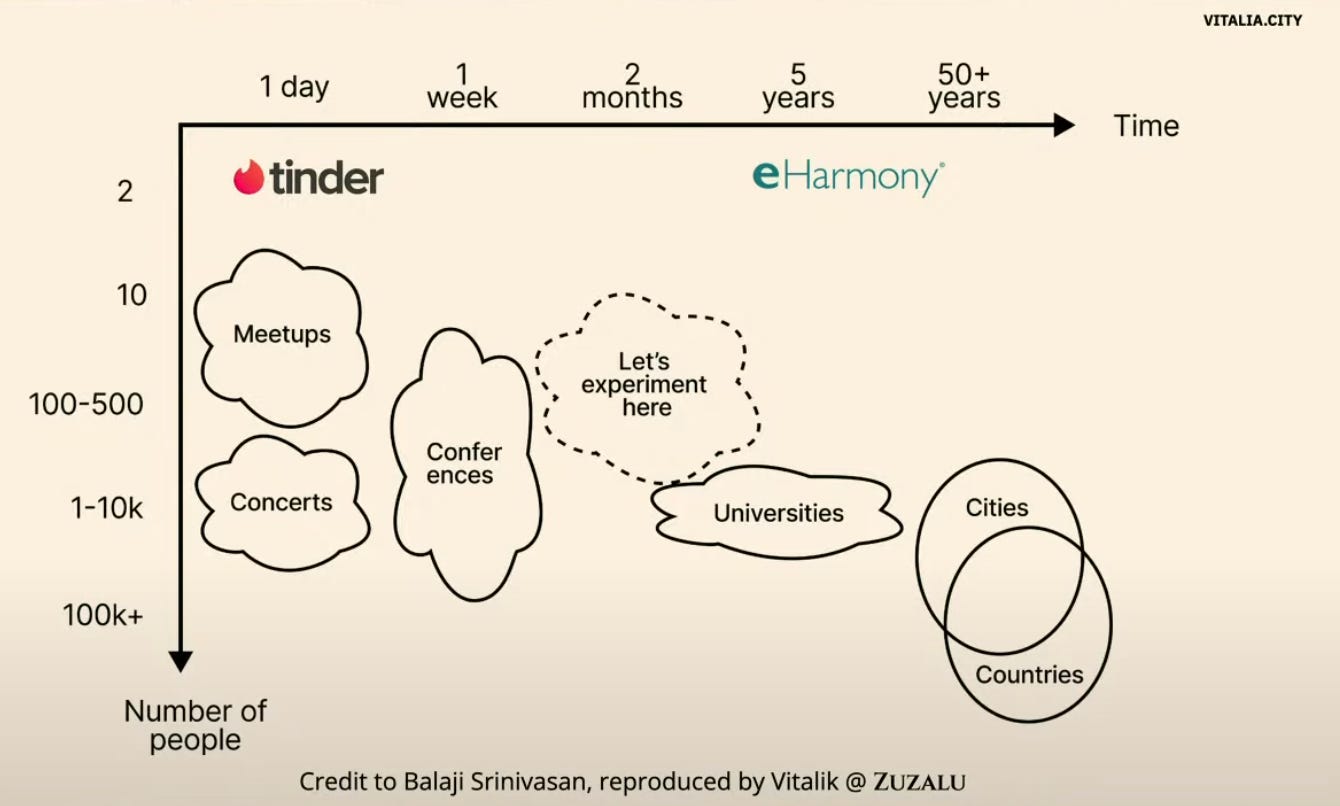
The probable conclusion that Vitalik Buterin, co-creator of Ethereum, came to as he attempted to pinpoint what institutions actually are, and the functions they serve.
Starting first with countries who have an established program for Digital Nomads (there are about 50 right now, and that number continues growing)
Codie Sanchez offers a contrarian perspective which brought a healthy balance to the conference. In her refreshing talk, she introduces the very real possibility of recreating the same problems we have today because the people who stand to benefit from The Network State, who might actually like this direction, have no way of relating to it.
The Network State is far from escaping the clutches of the military industrial complex. In his talk, Spencer Macdonald talks about security threats and how to start thinking about protection in these new societies.
Comments
Nothing yet. Say the first thing.
Sign in to join the conversation.