
It’s been a rough few weeks in the publishing industry. Some white dude got a book deal despite not having written a book because he was a viral sensation. My day job is a daily exercise in publishing executives believing everything should be done fast, cheap, and well, despite only two of those things being possible at a time. And now, apparently AI is writing books.
Let’s backtrack a couple of weeks.
I didn’t know until relatively recently that generative AI sometimes “hallucinates,” or just makes things up out of thin air, and that seems to have been what happened in a feature about summer reading published by the Chicago Sun-Times. Of the 15 books listed, 10 were completely invented books that did not actually exist. No one in the chain—the syndicate that supplied the piece, anyone at the Sun-Times—ever seems to have thought to check it. (This seems like the minimum you could do. When I write a book review for a magazine, I have to include page references so that my editor can verify that I spelled the characters’ names correctly. You’d think an editor would have at least googled these book titles to make sure they were correct and then learned the books didn’t exist. But alas.) For more on this, you can read the Sun-Times’ actually pretty solid apology explaining how it happened.
Then there was some speculation about Dani Francis, the author of the new bestseller Silver Elite. Francis is a bit of an enigma online, and a number of authors expressed frustration that the expectation is that authors always be hustling, but Silver Elite got the benefit of a big publisher push, which, the argument goes, proves publishers have more influence over book sales than authors do.
I think yes and no. Honestly, I think a big part of why Silver Elite took off (as of this writing, it’s #12 on the New York Times Hardcover Fiction Bestseller List) is that it’s of the current hot genre. I own a copy, in fact. I haven’t read it yet, but the book description is giving Fourth Wing vibes. First book in a romantasy series, violent dystopia, people with magic, elite training facility… it’s like it was designed in a lab to appeal to appeal to Rebecca Yarros fans.
And that’s kind of the problem. Because Dani Francis doesn’t have much of an online presence, people have been speculating about her identity. I legit don’t care who she is, and if she wants her privacy, she should have it. She could be a debut. She could be an established author writing under a new pen name. But some people speculated that the book could have been written by generative AI and the publisher is being cagey to hide this fact.
I find this unlikely, but it’s worth thinking about how this speculation emerged.
I have no doubt that there are hundreds of “books” written by AI in the Kindle Unlimited fever swamps. Obviously, I’m not accusing all indie/KU authors of using AI to write books; lots of good and legit books are indie published every day, and a lot of those authors condemn the use of AI. I’m just saying, grifters are churning out crap books to sell on Amazon’s platform. I’m sure this has been the case since generative AI became widely available for public use. We know this because we keep catching authors in the act, but also some tech companies have made generative AI tools available for authors specifically.
And that’s setting aside the ethics. All generative AI models were trained on stolen intellectual property. All of my books turned up in the database of books Meta used to train its AI. (Gift article.) I never gave permission for that. On top of that, the servers needed to run these AI models consume massive amounts of energy and are terrible for the environment!
So: generative AI is bad. If that was unclear.
But I’ll tell you, everyone I know who works in publishing is deeply concerned about how much generative AI is creeping into everyday operations.
I have two big clients right now that are both playing around with the use of AI in our workflows. What I’ve noticed, just observationally, is that while AI is not good at certain kinds of writing, it can automate some processes I find annoying. I think the latter is a good use of AI. For example, for one of my clients, I have to format documents in a very specific way to be uploaded to their content management system, and the AI does a reasonably good job at doing that formatting for me, which actually does save a good 10-20 minutes per document. (Which saves the company money because they pay me hourly.)
I’m trying to give the benefit of the doubt. You’ll never convinced me generative AI should be used for creative outputs, but maybe you’ve found a way to integrate ChatGPT into your writing process—I have a friend who uses it to brainstorm sometimes, and I’ve heard from others that it’s good at summarizing long documents and synthesizing data, and I can see use cases for that—but I do think it is bad for writing as a profession. I think we can draw a line between what is commonly referred to as AI that does busywork tasks, and generative AI, which does creative things, and I do condemn the use of the latter.
I love to write. It’s a stress relief valve for me, and a means of creative expression, and I’d write all the time even if I weren’t trying to trying to build a career as a published author. I honestly just don’t get the appeal of using a machine to do the thing that is the whole point to me.
I wonder if part of it is pressure on authors to publish frequently to maintain an income baseline. I want to be clear here: some authors are just very prolific and still write their own work quickly and don’t use AI. However, a lot of times, when authors are caught using AI, they say things like, “I’m very busy and don’t have the time/money to write books myself.” And I find that disheartening.
It also feels like underpants gnome thinking.
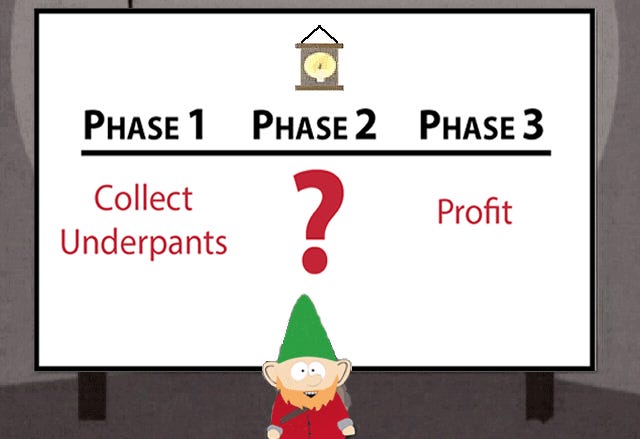
(from South Park)
Use AI to write books —> ? —> profit!
Like, if you’re not willing to put the effort into actually writing a book, do you then put effort into selling it? Are the people using AI to write novels spending a lot on ads or something? I don’t get it.
(I tend to get pushback when I make this argument, but since this is my newsletter, I’ll just say: selling a book is ridiculously hard. Getting attention above the din of the hundreds of books published every week is a challenge. If you’re just here to make a quick buck, there are easier and more lucrative ways to do it. How are the grifters making enough money from selling garbage books for it to remain a viable grift? Are they creating AI books and then spending money on ads? Are they just tossing them in KU and hoping for the best? Are the AI books not, in fact selling, but we only think they are because someone is raking in money selling tickets to his workshops about how to use AI to scam readers out of their money? I can’t figure it out. And then, if you’re a reader, what is the appeal of an AI book? I’ll get into this more below, but even if an AI can write an entertaining story, it’s basically a potato chip, right? Tasty but fleeting. An AI isn’t going to write a book you ever want to read again. I know some gen AI models have gotten better, but I can’t wrap my head around any of this.)
But the plot thickens!
Readers recently spotted AI prompts left in published books. The authors admitted to using AI for brainstorming and editing. One of the authors said, “As a full-time teacher and mom, I simply can’t afford a professional editor, and I turned to AI as a tool to help refine my writing.”
Deep sigh.
Look, if you can’t afford an editor, traditional publishing is a good option. Or you put off publication while you save money to pay one. I work full time, too. As an editor. So I also don’t love AI stepping into the breech to, you know, take the job I’ve spent my entire adult life working. Also, AI tools are not all they’re cracked up to be! (Summary of that article: AI isn’t that good at editing. But it’s worth reading the whole thing because in it, an editor tests all of the major AI editing tools and comes away thinking all of them have pretty significant setbacks.)
(I mean, if nothing else, a human editor would have spotted that AI prompt and deleted it!!!! To me, mostly this just speaks of sloppiness. Did the author not reread their own work before uploading it? That feels like the minimum she could have done?)
I get pushback about this, too. Maybe it’s just because I’ve worked in publishing for a long time, in a few different capacities, and I know the amount of work that goes into producing a good book, and I hate to see corners get cut. Editors are, on the whole, already underpaid and overworked, and every time an indie author talks online about foregoing editing because it’s too expensive, I die a little on the inside. No offense, but you’re basically saying to me, “your profession is useless, and you don’t deserve to get paid for it,” despite the fact that I’ve taken classes, undergone training, and worked at this job for more than two decades. If trad publishing (wherein the publisher pays for editing) is not a good option for you, for whatever reason, then there are reasonable workarounds—some editors might be willing to accommodate you with discounts and payment plans—but please, please do not skip the editing process.
*breathes*
But back to AI. Is it useful to the writing process? I’d argue no. One of the key points coming out of the article linked above about AI editing is that AI tends to flatten voice and make prose seem more generic, thus eliminating something that I think is essential to a good novel. Sure, gen AI can write a solid college essay, but fiction is something else entirely. If you want a straightforward story, AI is probably okay at doing that. If you want something truly imaginative, with a voice that sucks you in, I don’t think we’re there yet. All of my favorite authors have voices I click with. That’s the key thing that makes their books appealing to me, more than genre. (Seriously, if a favorite author wrote a horror novel—a genre I never read—I’d probably still pick up the book and give it a shot because I trust the author.) An AI might write an adequate book that entertains you for a few hours, but it’s not going to become your favorite author.
And yet! Now the buzz on Threads is that a novel written by AI (but edited by a human, maybe) has apparently been picked up by a trad publisher. I’m having some trouble tracking down the source for this news, but I’m gleaning it’s a romantasy. (I saw the title, but I don’t want to share it in case I’m wrong, I don’t want to give it publicity, and the title is also so common it pops up in dozens of other fantasy novels, because AI is, by definition, derivative.) I don’t know which publisher.
Which is to say, this is perhaps an example of an explicitly AI crafted book, but I’m guessing some text from gen AI engines has made its way into traditionally published books. Too many authors have admitted to using it for it not to be. And that sucks.
If the above-mentioned book exists, of which I have no proof, I hope this ends up being a failed experiment. Who asked for this? If you’re the publisher, it’s a surefire way to piss off your authors; all of the writers of my acquaintance loathe the use of generative AI for writing. (Also, see the blowback the Sun-Times got. Or that NaNoWriMo did last year after it partnered with a gen AI company.) If it’s a mediocre book, what was the point? I don’t think readers want an AI book, either, not if they value real books and quality writing.
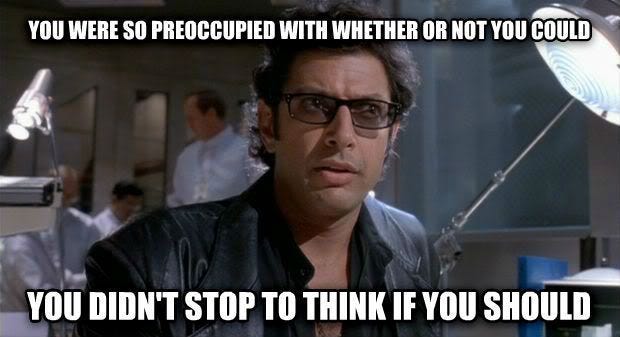
Tech CEOs are constantly bemoaning the fact that, if they can’t steal IP to train their models, they can’t afford to keep developing them. We should all be so lucky! Nobody wants AI to do this. Creative people want the busywork to be done for us so we can focus on the fun stuff, not the other way around. Generative AI is also still not profitable. I keep hoping someone will tell the tech bros in Silicon Valley that this is not technology anyone wants, but they seem convinced of their own brilliance, and their hubris has led us to the Jurassic Park place. As the great Ian Malcolm said, “You were so preoccupied with whether or not you could, you didn’t stop to think if you should.” And we all know how things turned out in Jurassic Park.
So what should we do? I think as consumers we have to put our foot down about products we know are generated by AI. Don’t buy those books. Don’t give them publicity. We should insist that authors disclose if they used AI in writing their books. (Amazon has a little box you have to check when you upload a book, but that’s an honor system sort of thing.) If publishers don’t have a problem with using AI to create books, let them put that right on the cover so consumers can make informed choices. We can also boycott generative AI where possible. I can’t avoid it at my day job (although I have brought up my concerns with my boss multiple times) but I don’t use generative AI when writing, revising, or editing my books.
Another caveat: there’s no surefire way to tell if a book was created by AI, unless it’s something obvious like a prompt being left in a book, which is confounding. Even AI checkers don’t really work that well. (There have been a few studies showing that college professors are often unable to differentiate between AI and human writing in essays they are grading.) It’s popular to say things like “if a book as x I know it’s AI,” but you don’t. It is still alarmingly common to call out an abundance of em-dashes or semicolons as AI, but as you can see, I use these all the time. (It took me three days to write this essay. I promise I did not use AI. I just really like em-dashes.)
I think authors who use AI should disclose, but we shouldn’t blindly accuse, because we can’t know for sure unless there’s obvious evidence, is my point.
But publishers need to see that AI is not profitable before they will drop it, I think. I hope.
Authors should insist on AI clauses in their contracts: no generative AI for editing, covers, or audiobooks. Get it in writing. (I did this on the contract for the book I have coming out later this year. I insisted on it. The publisher didn’t fight me.) The same contract also had a clause where I verified on a legal document that I had not used AI to write my book, and I think that’s pretty essential, too. It goes both ways! Put it all in writing!
We can continue to voice our opposition to the use of generative AI for creative work, too. Maybe Sam Altman doesn’t care, but we need to make sure publishers do.
And let’s band together as people who care about books. There’s been in-fighting on social media, mostly along indie/trad lines. Let’s fight the real enemy here. I’m close to setting up a dart board with Zuckerberg’s face on it, because after he was called out for stealing IP to train Meta’s AI, he said (paraphrasing) books have no value. Well, let’s show him and speak with our wallets.
Before you go…
A few weeks ago, I wrote a newsletter about how I want to combat publishing misinformation, which is abundant online. I gave readers the opportunity to ask me some questions about the industry for me to answer in future newsletters. I got a disappointingly low number of questions. Surely there are things you’re wondering? Seriously, ask me anything, and keep it anonymous. The form for questions is here.
No posts
Comments
Nothing yet. Say the first thing.
Sign in to join the conversation.