
This summer, I wrote a response letter to a student I was working with one-on-one, offering developmental edits on their memoir. In that letter, I asked them to consider their responses to two statements: What the book is about and What the book is. After sending it, I found myself mulling over those two statements, too—prying them open like a lid and, sure enough, unleashing a whole ass can of worms. But that’s the point, isn’t it? I wanted them—and all my students—to do the same: crack things open, lift the rock, see what’s crawling underneath. You can’t polish without getting messy first.
A few weeks later, I was on faculty at the Mendocino Coast Writers’ Conference, leading the memoir workshop. I opened my workshop by posing this question right at the top: What is the difference between what the book is about and what the book is? That question—and the discussion it sparked—guided our time together for the entire conference, shaping how we approached the sample material: chapters, passages, sometimes even a single sentence.
After the conference, one of my students came up to me and said I should write a craft essay about this. At first, I was like, ARE YOU HIGH?! My gut reaction was to bristle and question what business I had writing about craft. But then I had to teacher myself, push that feeling aside, and realize that I actually bring value to conversations about craft.
So here it is: a goddamn craft essay, Justine.
No matter what stage of the writing process you’re in—whether you haven’t started at all or are staring at your ninth draft—I think every idea, from the flicker of it to a fully formed piece and through all its subsequent iterations, benefits from being approached with curiosity.
Which brings me to the heart of this essay, the ethos I try to impart to my memoir students and my own work: Don’t go in with an answer. If you already have the answers, then why write the book? I believe the soul of a book lives in the admission, “I don’t know,” and in what comes after the however: “I don’t know, however…” What follows that however is the heart of the book.
And that, in turn, leads us to the difference between what the book is about and what the book is.
The first question—what the book is about—is often the one we answer by instinct. It’s visceral. It’s the subject matter of the book: the surface story, the narrative arc from beginning to end.
For example, my first book, Born to Be Public, is about growing up closeted in central Jersey with two Polish immigrant parents, inadvertently coming out to them via a Google search, immersing myself in New York City nightlife, finding and losing myself in equal measure, and ultimately carving out a space in writing and comedy after years of being told I was too this, too that, or just plain “no.”
That’s what I say when people ask me what my book is about. And that instinctual answer is important—it’s the anchor. But it only scratches the surface. It’s the story you can tell, not necessarily the story that lives on the page.
The next question—what the book is—asks for something deeper: the shape, the rhythm, the emotional and intellectual resonance that makes the work unmistakably yours. Where one scratches the surface, this one gets under the skin. It’s what gives your book life, what makes it bleed. It’s less about the “what happened” and more about the why it matters, the lens through which the events are filtered, the choices in structure, tone, and voice that make the work distinct.
What Born to Be Public is is a reconciliation between two parts of myself I always thought were irreconcilable. For years, I believed I had to choose: one self or the other. But in writing, I found a path from duality to totality. The book is an acceptance of identity as something frenetic, ever-changing—a self that shifts just when we think we’ve pinned it down. And my book is my way of finding power in that.
Thinking about what a book is versus what it’s about can transform how you approach revision. The former invites you to interrogate voice, pacing, structure, and nuance, to see the work as a living thing rather than a series of events. It’s the difference between telling a story and creating an experience—between recounting your life and making the reader feel it. When you focus only on what the book is about, you risk flattening the texture, compressing the emotional highs and lows into tidy plot points. We don’t like tidy; we love turmoil!!!!!
But when you ask what the book is, you start noticing not just the rhythm of your sentences or the spaces between the lines, but also the larger architecture of the work: how chapters echo each other, how scenes build or release tension, how narrative threads texture each other, and how the overall structure mirrors the emotional journey you invite your reader on. You become attuned to the patterns, the repetitions, the juxtapositions that give the book its shape and resonance, and you start to see it not as a series of events but as a carefully orchestrated experience. It’s almost like producing a song: the drums and bass lay down the rhythm, synths and melodies add dimension, harmonies elevate, and all the layers interact to create a mood that’s bigger than any single element. In a book, the chapters, scenes, and sentences work the same way, each layer shaping the whole experience.
This question also challenges you to reckon with the parts of yourself you might be tempted to ignore or smooth over: contradictions, uncertainties, moments of discomfort. The book as a living thing doesn’t require neat resolutions; it requires honesty, curiosity, and attention. It asks you to hold multiple truths at once, to follow the story wherever it wants to go. And it’s in that space—between instinct and reflection, chaos and clarity—that a book becomes more than just a memoir: it becomes your book.
Here’s the thing: writing a book is audacious. Writing I is audacious. But there’s a difference between I have something to say and there’s something I have to say.
When you decide to write I, you’re not just putting words on a page—you’re inviting readers into your mind, your body, your memories. You’re shaping yourself into a narrator readers can trust—almost like a tour guide through your own life—which means making deliberate choices about what to reveal, what to withhold, and what to let unravel in real time. That’s where the difference between what the book is about and what the book is becomes crucial: one tells us the story, the other reveals the consciousness behind it.
Writing from I demands vulnerability, but it also demands rigor. You can’t just spill on the page and call it a memoir. The work is in finding form—the shape that makes room for your chaos, your joy, your contradictions—and letting the reader feel the pulse of your thinking. The “about” is the scaffolding; the “is” is the beating heart. Both matter. But it’s the is that makes a book linger in a reader’s chest long after they’ve closed it.
Yes, your story matters. Of course it does. But I think it’s too easy—almost a cop-out—to approach the page with the blanket assumption that because it’s mine, it’s important. That attitude might be comforting, but it doesn’t do the work of making meaning for the reader. A memoir isn’t just a collection of things that happened to you; it’s an act of translation. You’re not only telling your story, you’re shaping an experience, a lens, a consciousness that readers can enter. The story matters, yes, but the craft—the choices of structure, voice, pacing, and theme—is what makes someone else care.
Share SOS (Save Our Serotonin)
Think about this for a moment: you might describe your memoir as a story of self-discovery, a quest to find your voice—and those themes are absolutely there. But at times, you may still be writing toward your voice, still metabolizing experiences as you put them on the page. And that’s okay. That’s part of the process. What I want my students to try is writing from reflection rather than solely toward it. Memoir isn’t just a collection of vivid or poignant anecdotes; it’s the narration of those moments with the wisdom—and sometimes the tenderness—of hindsight.
And, to make things even more gloriously complicated—because why are we here if not to make sense of our contradictions?—there’s also the question of when you’re ready to turn that metabolization into something on the page. The threshold between writing to process and weaving it into a tapestry for your reader to journey through is something we have to learn to trust our gut on.
When does processing become process?
I think about a conversation I had with my friend and superstar writer Rax King in our interview for Electric Literature:
"I’m always writing just to process, so the answer to that question is yes, sort of—but the writing I do to process almost never makes it to publication. Oddball pieces might, like if I happen to generate a good sentence while I’m sob-writing, but it’s mostly important to me to maintain a firewall between therapeutic writing and the stuff I share with the world."
Rax also talked about maintaining a strict firewall between writing as therapy and writing as something meant for readers. Occasionally, the therapeutic work crosses that line almost by accident—while trying to heal, she discovers things she didn’t know she knew. Some of those insights feel ready for a book; others feel like lessons she should have learned back in the anonymous LiveJournal days.
All of this comes back to trust—trusting the process, trusting your gut, and trusting that you don’t have to have all the answers before you write. The “about” of your book can guide you, but it’s the “is” that demands patience, curiosity, and a willingness to sit with the messy, contradictory, complicated parts of yourself. Writing is both excavation and alchemy: you dig into the dark corners of your experiences, shine a light on what you find, and see which pieces transform into something that might resonate with others.
And yet, the point is never to polish until perfection or to close the book on uncertainty. It’s about learning when your work is ready to live outside your own head, even if you don’t feel fully finished. It’s not about being done; it’s about being ready to let go.
…Not to be a gross self-fellating promotional nightmare, but I need to offer up collateral to fill my tank in California, so yes, I need to make money too, bitch!
Enrollment is now open for my memoir workshop this October!
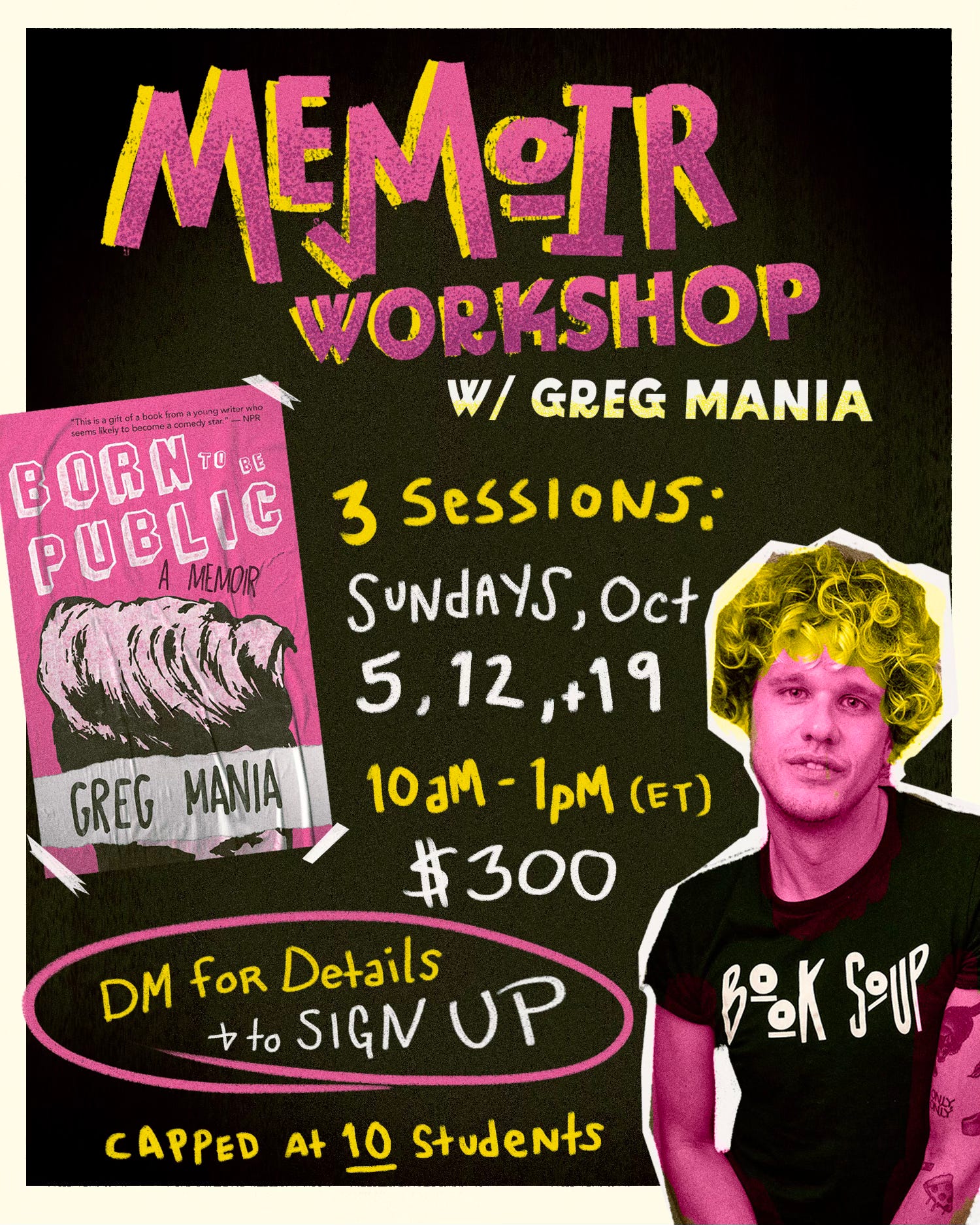
3 Sessions, 3 Hours each
Sundays, October 5, 12, & 19
10AM-1PM ET
Capped at 10 students
$300
For more details and to sign up, please use this contact form.
Let’s mine your memoir for magic, bbs.
Credits
Art by: James Jeffers
You can follow my other unhinged missives by following me on Instagram, Threads, or Bluesky. Peruse my website for more work and to get in touch!
No posts
Comments
Nothing yet. Say the first thing.
Sign in to join the conversation.