

Good Monday late morning --
We have a few updates for you today:
AUSTIN CITY COUNCIL APPROVES BALLOT LANGUAGE FOR OUTSIDE AUDIT CHARTER AMENDMENT
Late last week, the Austin City Council approved ballot language for all of the charter amendments for the Nov. 2026 ballot.
We have been given PROP I.
We will be encouraging all Austin voters to VOTE YES ON PROP I.
This is our ballot language: Proposition I: Shall the City Charter be amended to require an Independent Affordability and Efficiency Initiative on a regular basis and before any tax rate increase election and requiring the independent contractor to identify annual and multi-year savings that exceed the cost of the contractor’s service?
Our view is this ballot language is simple, fair and transparent and WILL NOT need to be challenged legally. We expected biased language, as we experience twice in 2021 on Prop B and Prop A. Thankfully, they did not play games here.
FULL NOVEMBER 2026 BALLOT SET BY AUSTIN CITY COUNCIL
From the recent Austin American-Statesman story:
Everything Austin voters need to know about the packed November 2026 ballot
By Chaya Tong
Austin American-Statesman
Five City Council seats, a $295 million bond for parks and libraries, an independent city audit proposal and notable changes to Austin’s city charter will all be on the ballot this November.
Council voted unanimously Thursday to order elections for the bond, charter amendments and City Council races.
A big bond election
Austinites will decide whether to allow the city to issue a $295 million bond for parks and libraries after the proposal won approval from a divided council on Tuesday. The bond would dedicate $260 million to park projects across the city and $35 million for library improvements.
City estimates show it would eventually cost the typical taxpayer more than $40 annually once the city issues the debt, likely around 2033.
Council approved the bond package Tuesday on an 8-3 vote with Mayor Kirk Watson and Council Members José Velásquez and Marc Duchen voting against it, citing concerns about affordability. City staff also recommended that council delay the bond until 2028 so the city can comply with its own financial policies.
Supporters, including Council Members Mike Siegel and Chito Vela, pointed to long-term benefits such as avoiding costly maintenance repairs and providing public amenities.
The bond includes infrastructure improvements at sites including Zilker Metropolitan Park, Williamson Creek Trail, Evergreen Cemetery, Onion Creek All Abilities Playground, Springwoods Park, St. Edwards Greenbelt Trail & Park, Commons Ford shoreline and Mount Bonnell.
It also would finance playscape, restroom and other upgrades at several neighborhood and district parks.
A portion of the bond also would go toward acquiring new parkland and to fund renovations or replacements at four city pools: Garrison Municipal Pool, Big Stacy Neighborhood Pool, Walnut Creek Municipal Pool and Civitan Neighborhood Pool.
The library portion of the bond would fund renovations and expansions at Hampton Branch at Oak Hill Library and Colony Park Branch Library.
Rewrite City Hall rules?
Austin voters will also decide this November whether to change the city’s charter on issues including clarification on the role of the Independent Citizens Redistricting Commission, rules around ordinances and council meeting times and whether to give council the power to hire and fire the city attorney. An independent citizen-led petition requiring regular audits of city spending will also appear on the ballot.
Charter amendments, approved July 30, include:
Deleting language requiring the council to meet at least once each week
Deleting language requiring the council to adopt its rules by ordinance
Clarifying the term “election” and requiring campaign contribution and expenditure limits to be adjusted annually by Jan. 1, rather than during budget adoption
Requiring initiative elections and petitioned charter elections to be held on the next available November election date in an even-numbered year that provides enough time to comply with state law
Giving the council the power to hire and fire the city attorney
Making non-substantive corrections to typographical errors, punctuation and sentence structure, and removing language that is moot or unenforceable because it has been superseded by state law or the courts
The council also approved an amendment last week clarifying that the Independent Citizens Redistricting Commission operates independent of council control.
Council Member Ryan Alter also successfully amended the proposal to correct a drafting error in the charter and allow college students to serve on the redistricting commission after hearing from a University of Texas at Austin student during public comment last Tuesday.
A contentious proposal to raise the number of petition signatures needed to recall a council member to 15% of registered voters in a council district failed last week.
Watson successfully amended the motion to lower the percentage back to its original 10% with minor wording changes. Still, the motion failed 7-4 with only Watson and Council Members Velásquez, Duchen and Paige Ellis voting in favor.
Council Member Natasha Harper-Madison was the only council member on the dais who publicly supported the full 15% increase, citing concerns about racial attacks.
“I don’t want future-facing Black political power to be at risk because we have low voter turnout, and the people who would find nefarious purposes use this tool to recall a Black council member for no other reason, except that they are a Black council members concerns me,” Harper-Madison said at the July 30 meeting.
Council election incoming
Five of the 10 council seats are up for election in Districts 1, 3, 5, 8 and 9.
Incumbents Velásquez, Alter, Ellis and Zo Qadri are seeking reelection. District 1 will elect a new council member because Harper-Madison is term-limited after her second and final term. (AAS)
CITY VENDOR PAID TWICE?
Save Austin Now ally and former Austin City Council Member Mackenzie Kelly posted an interesting item in her Substack this morning.
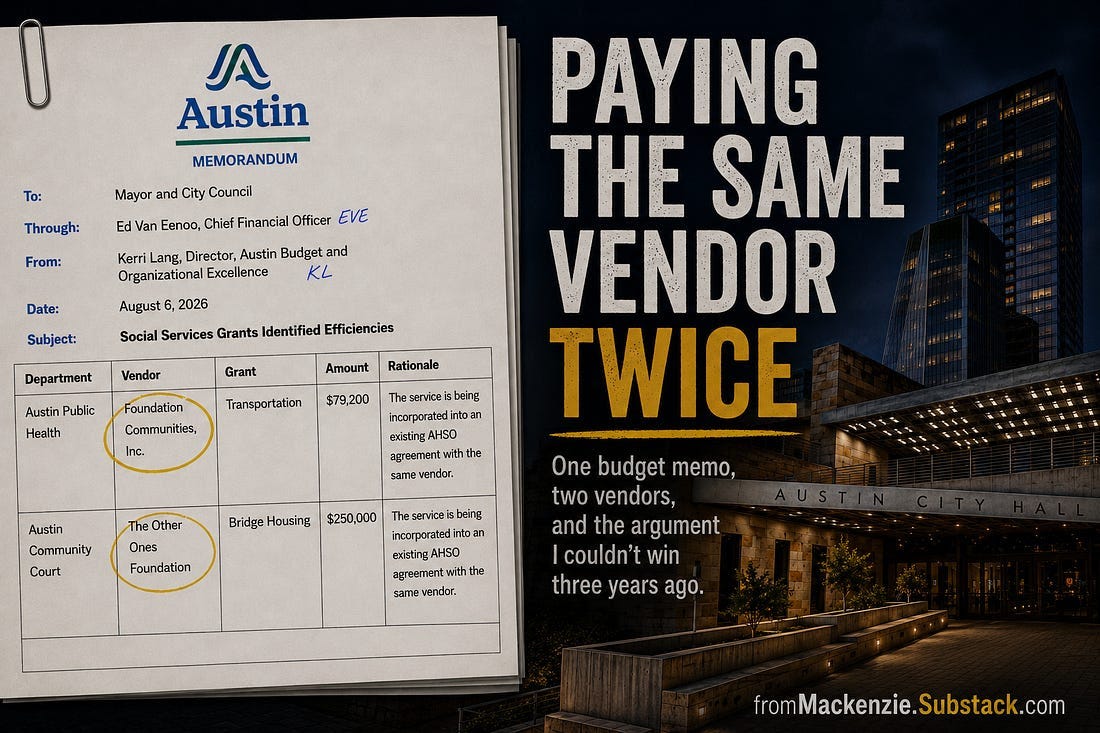
Some of you may remember the memo I wrote back in August 2023: I asked the City Manager for a comprehensive review and audit of homeless services and spending within our city. I didn’t have the votes to make it policy, so I sent it as a memo instead, which meant it went on the public record but didn’t obligate anyone to act on it. As best I can tell, nobody did.
Friday of last week, a routine budget memo landed that I think proves my point better than I could have three years ago.
$845,831 eliminated. $329,200 of it is the part that matters.
On August 6, Kerri Lang, the city’s Director of Budget and Organizational Excellence, sent Council a memo identifying nine social services grants being sunset, consolidated, or folded into other programs. Cutting them eliminates $845,831 in funding, and the memo states plainly that doing so “will not impact existing service levels.”
I want to be precise about what that $845,831 actually is, because it’s not one thing. Most of it is unused contingency money, programs already scheduled to wind down, and a few things city staff had already decided were lower priority. None of that is “savings” in the sense of the city recovering money it shouldn’t have spent. It’s mostly money that was never going to be spent the way it was budgeted, or that staff had already decided to stop funding for other reasons.
There’s also a fourth category worth flagging on its own, because it’s not really a cut at all. $150,000 for the Sunrise Community Church’s Mobile Outreach and Housing Navigation Program isn’t being eliminated. It’s being moved off recurring city funding and onto one-time HOPE Fund money tied to the new South Austin Housing Navigation Center. That’s not a redundancy and it’s not unused money. It’s a funding swap, and swapping a recurring source for a one-time source on an active homelessness outreach program is worth watching, not filing away as “no impact.” One-time money runs out. If nobody replaces it next year, that’s a real service actually at risk, just delayed a budget cycle.
Two line items are different, and they’re the ones that caught my attention, because of how they’re worded:
Transportation, Foundation Communities, Inc., $79,200: being folded into an existing agreement with the same vendor
Bridge Housing, The Other Ones Foundation, $250,000: being folded into an existing agreement with the same vendor
That’s $329,200 where the city was running two separate funding streams to the same vendor for related work, and someone eventually noticed. That’s the real finding here. Not a priority call, not unused contingency money. The city had been paying for overlap it didn’t need to pay for, and caught it.
Why $329,200 matters more than $845,831
I want to be honest about scale here. $329,200 is a rounding error in a multi-billion dollar city budget. Nobody should read this and think the city just found its big fiscal problem.
But that’s exactly why I think it matters. This wasn’t found by a comprehensive audit. It was found by routine budget staff doing routine budget work, across a handful of departments’ grant portfolios, nine grants total. If routine review at that scale turns up a real, documented case of double-paying the same vendor, the obvious question is what a genuine, systemic, department-by-department audit would find if it went looking on purpose instead of stumbling into it.
That’s the exact case I was trying to make in 2023. I didn’t have $329,200 in hand back then. I had a hunch, built on watching individual contracts and individual votes up close, that nobody had really gone looking. I still think that hunch has held up.
The fight happening right now over exactly this
Here’s where it gets timely. Austin voters are going to decide this November whether the city has to do this kind of scrutiny as a matter of law, not just when a budget staffer happens to catch something.
In February 2026, Council unanimously passed its own ordinance setting up a recurring systemic audit of city departments, directing the City Auditor’s Office to bring in outside experts to look at management, contracting, and cost-saving opportunities, with the first audit required to launch within a year. Separately, the PAC Save Austin Now spent six months gathering more than 20,000 signatures to force a charter amendment onto the ballot requiring the same basic idea, recurring external audits of city spending, utilities, and vendors, every five years, written permanently into the city charter instead of sitting in an ordinance Council could later undo. Council voted July 30 to add that petitioned amendment to the November ballot alongside its own slate of charter proposals.
The city’s position is that the ordinance already covers this. Save Austin Now’s position is that a charter amendment can’t quietly get repealed by a future Council the way an ordinance can. I’m not going to pretend that’s a small distinction. It’s the entire argument. An ordinance is only as durable as the Council that keeps it. A charter amendment belongs to voters.
I don’t think this week’s memo settles that argument. But I do think it’s a small, real, dollar-denominated example of the thing both sides claim to want: someone actually checking whether the money is doing what it’s supposed to. The disagreement is about who should be required to keep checking, and how hard it should be to stop.
And yet, Council still spends freely
Here’s the part that I think is worth sitting with, and it’s the part that keeps this from being a simple “see, audits work” story. The same city that just found $329,200 in documented vendor overlap also, in the same stretch of weeks, put a $295 million parks and libraries bond on the ballot and built a tax rate increase into this year’s budget projected to bring in 3.5 percent more revenue. Finding real overlap in one grant portfolio and asking taxpayers for hundreds of millions more in the same season are not contradictory acts, exactly. But they don’t sit easily next to each other either.
Someone once told me the definition of insanity is doing the same thing over and over and expecting a different result. I’d argue Austin has that backwards. The city keeps finding the same kind of overlap and waste, memo after memo, year after year, and keeps expecting the next ask for more money to land differently anyway.
Here’s the part I actually want to give credit for: the instinct to look for savings is real, and when it shows up, it works. Kerri Lang’s team found $329,200 of documented overlap in this one memo. That’s not nothing, and it’s not the only example. Council passed its own resolution in August 2024 explicitly aimed at “identifying and eliminating redundant technologies and overlapping solutions” in city cybersecurity systems. This year’s budget cites $5.8 million in savings from consolidating overlapping IT applications and centralizing technology that had been duplicated across departments. And the $845,831 memo itself is only a slice of a larger effort: budget staff separately recommended eliminating 24 social service contracts and reducing 53 more, cutting $5.35 million total, after Council asked staff in a July 22 work session to review contracts individually instead of applying an across-the-board cut.
So the instinct is there, and it clearly produces real findings when someone actually applies it. My complaint isn’t that the instinct is missing. It’s that it seems to only fully show up either quietly, in memos nobody outside City Hall was going to read, or loudly, after an internal audit becomes headline news and enough people are outraged that Council has no choice but to act on it. And even in a budget cycle that found all of the above, the city still landed on a $6.6 billion budget with a property tax increase and a net 225 new positions. What I haven’t seen much of is that same instinct showing up on its own, before a scandal forces it, at the same scale and with the same seriousness the city brings to asking for more money. A city that is serious about efficiency looks for it as a matter of routine, not just after the memo leaks or the audit makes the news.
That’s the same standard I’ve been applying to the parks bond, and it’s the same one I’d apply here: show me the overlap gets found because someone was actually looking, not by accident on the way to the next ask.
Until Next Time, Mackenzie
ACTION ALERT: Release the List of Nonprofits That Failed City Audit!
More than 370 Austinites joined Save Austin Now in demanding the release of the list of nonprofits that failed the city audit when we sent out the action alert last week. We need more!
As local media reported recently, an internal city audit found that of 25 local nonprofits who were fully paid their taxpayer-funded contracts with the City of Austin, 19 did not deliver the services that were required.
For some inexplicable reason, the City Council has refused to release the list of nonprofits.
If you have emailed the council, THANK YOU!
If you haven’t yet, we are asking all Austinites to join us in demanding the City Council release the list.
ACTION ALERT: You can easily email the Mayor, the entire City Council, the City Manager and the City Auditor by clicking this link. Please make the email your own before you send it. This will take you less than 30 seconds.
Our press release is pasted below.
- - -
For Immediate Release
June 30, 2026
Save Austin Now Calls on Austin City Council to Release List of Nonprofits Who Failed Internal Audit
City Audit Found 19 of 25 Reviewed Nonprofits Failed to Deliver on Contract Requirements
AUSTIN, TX — Nonpartisan grassroots organization Save Austin Now PAC today is calling on the Austin City Council to release the list of nonprofits that failed a recent internal audit. City leaders have said they will not release the list, which only deepens distrust between taxpayers and City Hall.
As KXAN reported last week:
The auditor’s office looked at a sample of 25 family and social service contracts amounting to roughly $30 million (for context, the city spent roughly $100 million with 95 of those nonprofits during FY 2025).
They found of those contracts, 19 of the contracted nonprofits did not meet one or more performance expectations.
“For nonprofits that did not meet one or more performance expectations, there were significant deviations between what the City was expected to receive and what the nonprofit provided,” the report said. It continued: “For more than half of the performance expectations we reviewed, what was provided was more than 40% below the expected amount. As a result, the City is paying for services that were not fully delivered, and vulnerable residents may not get the services they are supposed to receive.”
However, city leaders are refusing to release the list of nonprofits who failed the audit.
“City Hall needs to stop looking at city spending as a private matter and recognize these are taxpayer dollars paid by hard working Austinites,” said Save Austin Now co-chair Matt Mackowiak. “The overwhelming defeat of Prop Q last November undeniably showed that trust is broken between taxpayers and City Hall. You do not rebuild trust by hiding failure. Austin taxpayers have a right to know which city nonprofits failed this narrow and limited internal audit. Unlike this effort, or any future city-run audit ordinance, our Outside Audit Charter Amendment will fully release all findings and backup material. We are calling on City Council to release the list immediately, and we are asking all Austin taxpayers to join us in making this reasonable demand.”
“Austin social service nonprofits are more dependent by far on City tax funding than nonprofits in other large Texas cities,” said Bill Aleshire, a local attorney and former Travis County Judge who drafted the Save Austin Now’s Outside Audit Charter Amendment language. “There is a city law barring vendors from lobbying Council Members but the Council has exempted social service agencies from that law. These conditions plus secrecy in the audits of these contracts make this a Petri dish for corruption and waste of tax dollars. This situation was explained to the Council in a 2019 Audit and Council has done nothing to fix it.”
Austinites who wish to contact the Mayor and City Council to join this effort can easily do so here.
More information about Save Austin Now PAC can be found at SaveAustinNow.com.
# # #
86 DAYS TO GO UNTIL ELECTION DAY!!!
FINANCIAL SUPPORT NEEDED: PLEASE DONATE TO OUR EFFORTS
We absolutely need your financial support.
The campaign to pass the Outside Audit Charter Amendment (Prop I) begins immediately!
Ways to Give:
ONLINE: You can securely contribute online here.
BY CHECK: You can make a check to “Save Austin Now PAC” and mail it to:
807 Brazos Street
Suite 306
Austin, TX 78701
VENMO: @saveaustinnow
WIRE: If you wish to send a wire, please email Matt.
As we have said before, WE HAVE ONLY BEGUN TO FIGHT!
THANK YOU.
-Save Austin Now PAC
Pol. ad. paid for by Save Austin Now PAC. Leland Bickers, Treasurer. SaveAustinNowPAC.com
Save Austin Now substack is a reader-supported publication. To receive new posts and support our work, consider becoming a free or paid subscriber.
No posts
Comments
Nothing yet. Say the first thing.
Sign in to join the conversation.