

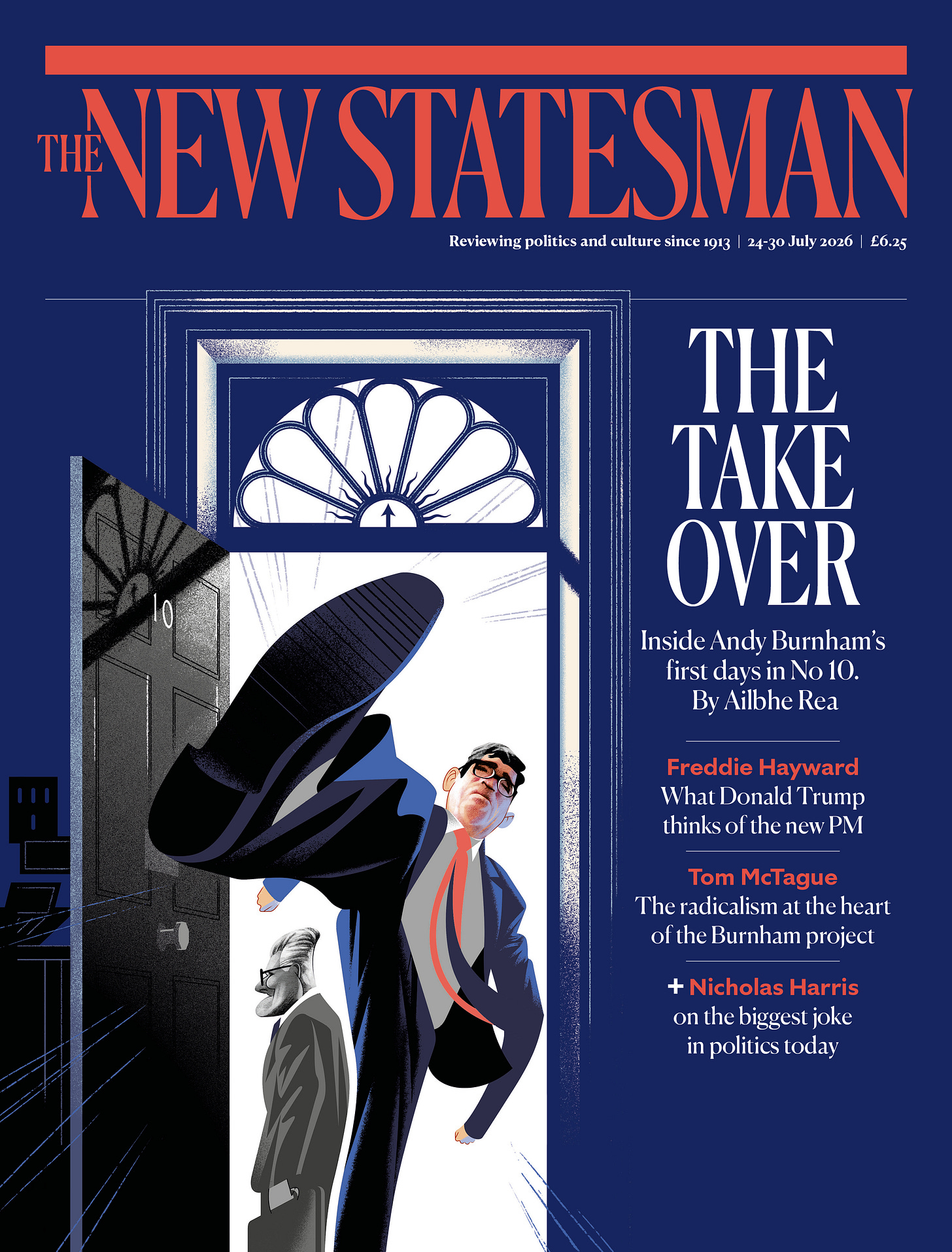
Good morning. Our political editor Ailbhe Rea has written this week’s cover story. In his first days in No 10, Andy Burnham showed his determination to do politics differently. You can read the piece here. If you’re not subscribed, you can have two months for £2 here
When Andy Burnham shared a video of his newly appointed cabinet on his Instagram at the end of his first day in office, he accompanied it with the rock anthem “How You Like Me Now?” by the Heavy. If “how’d you like me now” is the question, the answer is that some of Burnham’s Labour colleagues like him rather less than they did when they still thought they were in with a chance of staying in government. At the Grafton pub in Kentish Town on the evening of 20 July, Starmer, Reeves and their former colleagues drank late into the evening, “a mixture of furious and sad” at Starmer’s treatment and the sheer, unexpected extent of the clear-out of perceived Starmer loyalists. Sacked cabinet members arrived one by one, to applause, with resentments towards Burnham and his team building as the night wore on and word of new appointments trickled through.
Burnham’s team, for their part, were delighted both by their cabinet appointments and that they had managed to keep them so tightly held, while much of the lobby incorrectly guessed that Mahmood was to enter No 11. Haigh – the right-hand woman who, along with Burnham’s chief of staff, James Purnell, oversaw the appointments planning with the incoming premier – received the most important job: Chancellor of the Duchy of Lancaster and First Secretary of State, the de facto deputy position formerly held by George Osborne, Peter Mandelson and John Prescott. In her new role, running a beefed-up Office of the Prime Minister, there is little Haigh won’t be across, driving Burnham’s agenda from the centre, while also overseeing the redistribution of power around the country.
After initially favouring Miliband for the role of Chancellor, in the end Burnham delivered the great surprise of the day by appointing Healey, chosen because he has “the same outlook” as Burnham, one No 10 insider says. He is being described as a “split the difference” candidate between Mahmood and Miliband, sharing Burnham’s radical priorities but with the serious, “safe pair of hands” demeanour of a former defence secretary.
Burnham’s team felt there were enough Starmer allies in the mix – Yvette Cooper and Emma Reynolds, for example – to ensure Labour unity. Burnham’s No 10 team, too, retains many Starmer advisers, alongside well-liked newcomers including Alison Phillips, the former Mirror editor, and Hayden Munro, Jacinda Ardern’s former campaign director. Yet Burnham’s cabinet appointments, favouring a wide range of people from across the Labour ideological spectrum, but mostly united by their shared efforts to get rid of Starmer, have been perceived as nothing short of a declaration of war. “They started a factional war on day one,” a newly fired senior adviser says, describing it as “absolutely nuts”.

To enjoy our latest analysis of politics, news and events, in addition to world-class literary and cultural reviews, click here to subscribe to the New Statesman. You'll enjoy all of the New Statesman's online content, ad-free podcasts and invitations to NS events.
Comments
Nothing yet. Say the first thing.
Sign in to join the conversation.