
0:00
-10:18
My project for ONIRA, titled The Book of Light, began when Sarah invited me to be part of this year’s exhibition. Through that invitation, and through the opportunity to connect with the other participating artists, I found myself thinking deeply about what ONIRA is really about.
It’s about activation. It’s about portals.
Portals have fascinated me for a long time. Portals of the mind. Portals of the body. Portals into unseen spaces. I began asking myself how I could contribute in a way that wasn’t about being in the forefront, but instead about supporting the other artists and creating something in unison, in community.
Around that same time, I found myself being pulled more and more toward light language. Some of you may have noticed that my work has shifted toward drawing, rhythmic mark-making, and what I experience as channeled visual language. I knew I wanted that energy to become part of this project, even though, at that point, I had no idea what form it would ultimately take.
I began collecting all the different pieces of what was currently capturing my interest, the things I felt deeply moved by.
I also started thinking about something practical. I’m based in Los Angeles, my studio is in Los Angeles, and the exhibition was going to take place in Portugal. There was the very real question of transportation.
That led me to think about scriptures and how, many centuries ago, people carried spiritual knowledge from place to place. What did it look like to travel with these sacred objects?
Both of my parents are lay Buddhist monks, and I grew up in a Buddhist church. I remembered that when Buddhist monks traveled from village to village, they carried their scriptures in accordion-folded books. For those of you who love books as much as I do, an accordion book is a hardbound book made from one continuous folded page.
Even today, when my parents pray, they read from a kyōten, which is a sutra book containing Buddhist teachings. Remembering that tradition opened up something for me.
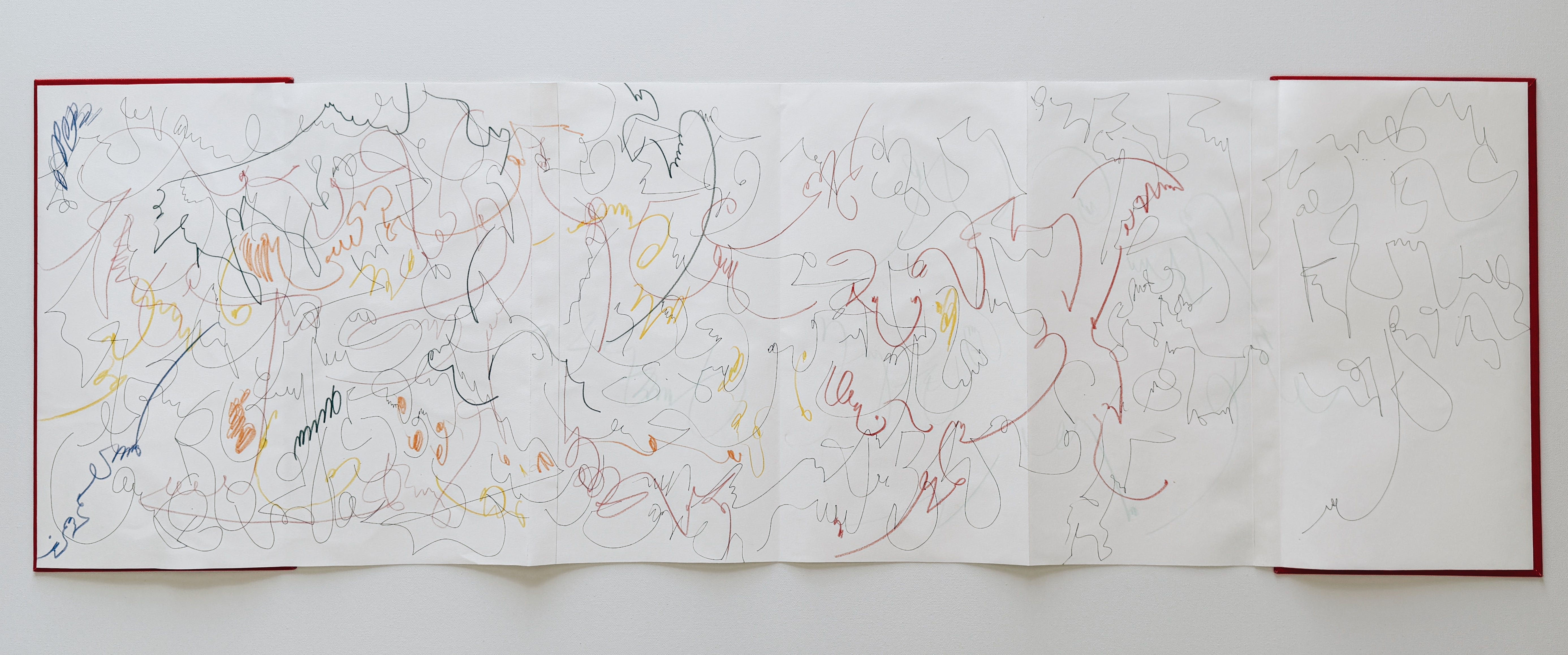
I began exploring the idea of creating a piece in the form of a book. It felt like a natural continuation of everything that had been coming together.
It was also a nod to spiritual writings. I knew I would be downloading information into the project I was creating, so the idea of working in a book format felt deeply aligned.
I also loved the idea that it could be transported easily and held in someone’s hands. There was something about that intimacy that felt important to me. Rather than viewing it from a distance, I wanted people to have a personal relationship with it.
I love painting, and painting is still the primary way I express what I’m sensing. But for this particular project, I wanted the experience to be more interactive. I wanted people to feel a personal connection with the work, and to encounter it in different ways.
Around that same time, my love for books kept speaking to me. I thought, what if I created a large-format accordion book?
People could experience it one page at a time, just as they would any other book. But if they opened it completely, it would transform into one continuous painting.
That reminded me of historical Japanese scrolls, which were displayed in homes, particularly among the nobility. I loved that it could exist in both forms. It could be experienced as a book, or it could become a painting.
So I began crafting a large-format, hardbound accordion book.
As I was creating the pages, I remembered something else.
The Buddhist Lotus Sutra that my parents recite when they pray is printed on both sides. One side contains the Buddhist teachings translated into Japanese from Sanskrit. The other side contains Dharani, which remains largely in its original Sanskrit.
Dharani has a very rhythmic quality when it’s recited. Growing up, I would hear that cadence during special moments. Toke, toke, toke, toke, toke… It has a rhythm that has stayed with me all these years.
But even then, I had always been able to see, with an inner knowing of what I was sensing.
I remember going with my parents to prayer services held in people’s homes. Sometimes someone was ill. Sometimes they were going through a particularly difficult time. The elder women of the church would recite the Dharani over the person who was in need.
I distinctly remember the feeling of those recitations. It felt as though they were cutting through a heaviness, through darkness, clearing away stagnant energy.
I always knew there was something deeply powerful about it.
As I was creating the book, I found myself thinking about that feeling. By this point, I already knew it was going to be a book.
I wanted one side to be something: magic, meditation, flowing.
The other side would be pure light language, where I am drawing lines, rhythms, and anything that comes through.
So for this book, as you can see in some of the photographs and videos I’ve shared, one side became a watercolor painting.
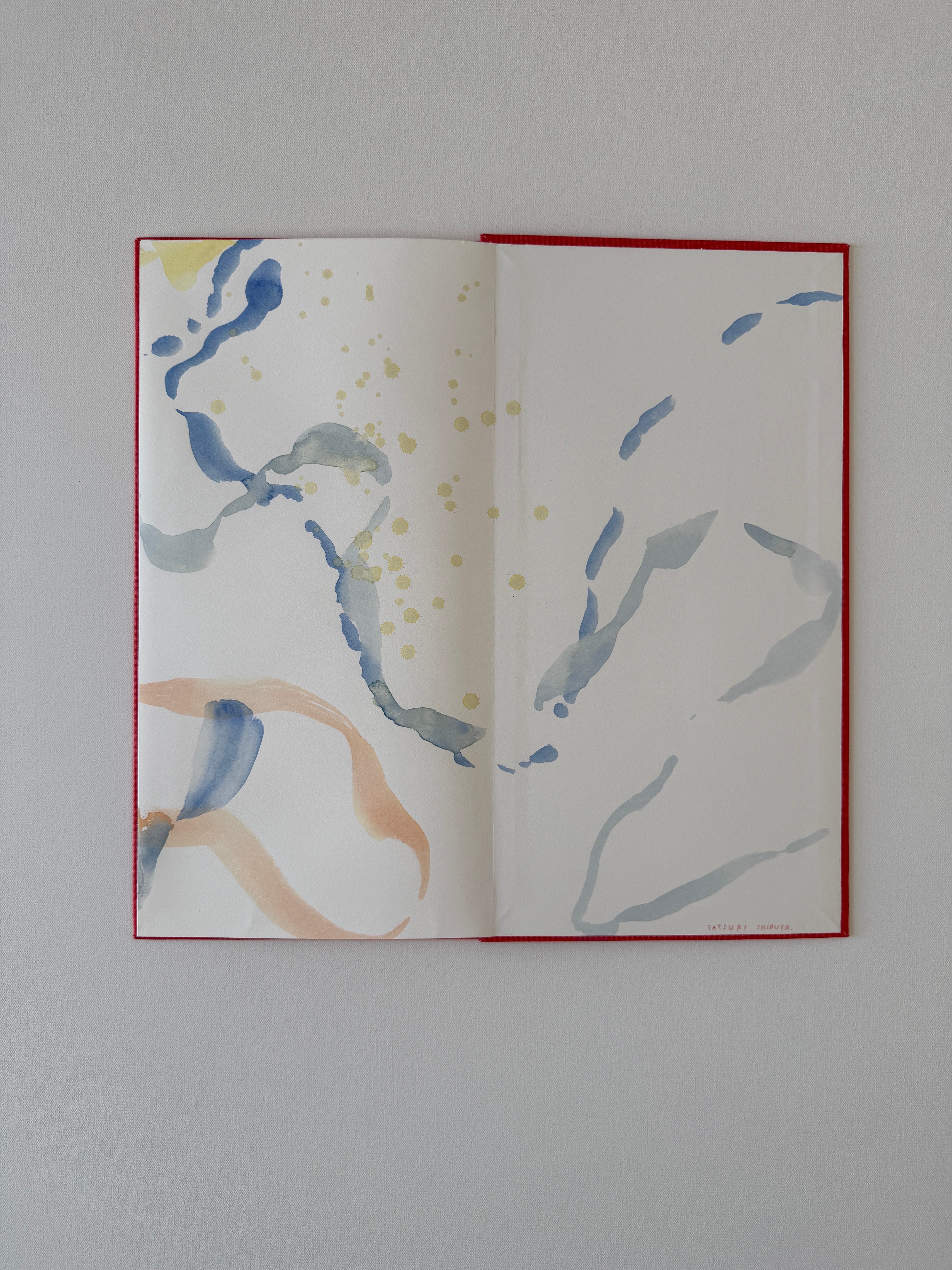
Watercolor is where my art practice began. Although I’ve naturally expanded into other mediums over the years, watercolor has always remained an anchor for me.
Watercolor has a way of capturing the beautiful quiet that unfolds when delicate communication is needed.
Through the process of creating The Book of Light, I found myself returning to my roots, creating one side of the book as a watercolor painting, reflecting the spiritual foundations of my artistic practice.
For those reading the book, they can experience its meditative side, almost like taking a quiet breath.
Or they can display that side fully opened as a scroll and experience it as a painting.
I love the idea of the book existing in various forms, depending on who is interacting with it.
Turning the book over reveals the light language.
That side can also be approached meditatively. For some, it may invite subconscious activation. For others, it may become a way of clearing space, whether within a home or within themselves.
Like the watercolor side, it can be experienced page by page as a book, or fully opened as a scroll.
I wanted the book to feel multidimensional, intimate, and interactive. If it ever finds its way into someone’s collection, I hope it becomes something they return to over time, discovering new relationships with it throughout their own journey.
If you have the opportunity to experience The Book of Light in person, I’d love to hear what it was like to encounter the work within the exhibition space.
Alongside the book, I also created a twenty-minute soundscape that will accompany the work throughout the presentation. The recording includes channeled sounds, sound healing, and channeled messages.
My vision for The Book of Light was for the book and soundscape to be experienced simultaneously, creating an interactive, multidimensional, and multi-sensory experience. It is an invitation into a consciousness-opening and awakening experience.
The Book of Light is available through ONIRA for those interested in collecting the piece.
Comments
Nothing yet. Say the first thing.
Sign in to join the conversation.