
This is satirical commentary drawing on today’s front pages and additional reporting. Where claims are disputed, attributed or under investigation, they remain so here and are not treated as findings.
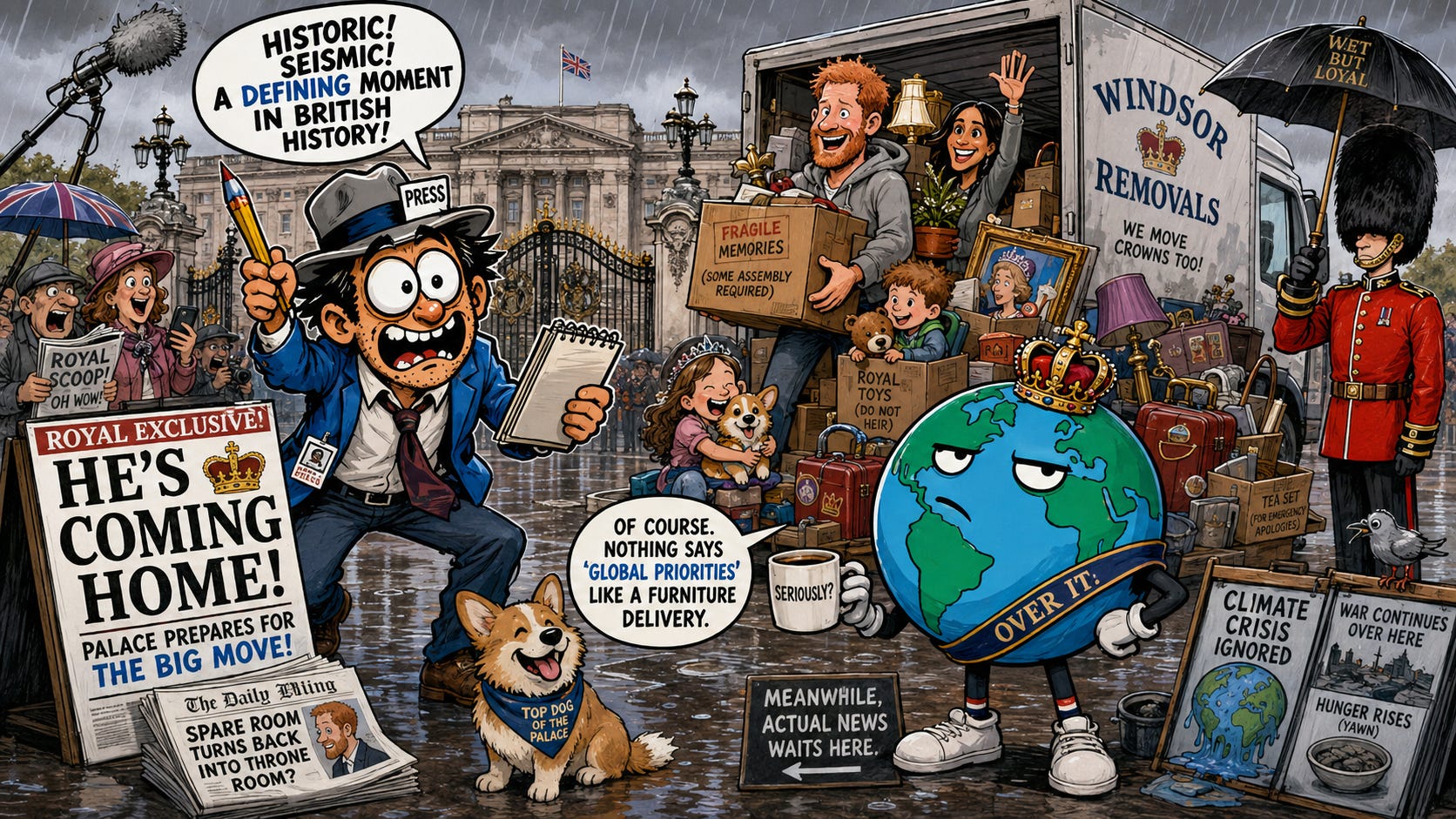
Good morning Leg’ends,
It’s Thursday and it has rained, which after the last few weeks feels less like weather and more like somebody at the water company accidentally delivering the product.
Proper rain as well. Enough to darken the garden and remind the lawn that green remains available if conditions improve. I stood looking at it this morning with the sort of gratitude normally reserved for discovering twenty quid in an old coat, which probably tells you where Britain is environmentally.
Then I looked at the papers and thought, oh, fuck.
What an absolute mess.
There is quite a lot happening beyond Fleet Street’s royal paddling pool this morning. The international situation has the structural integrity of a folding chair at a village fête, while cancer researchers may have produced something genuinely important for people with melanoma. The Guardian is carrying a long-delayed Israeli military acknowledgement concerning the death of five-year-old Hind Rajab, and the Financial Times has the sort of geopolitical and financial material that makes you instinctively check whether the household insurance covers history.
A substantial part of Fleet Street has surveyed all this and concluded that Thursday urgently requires Harry’s removal arrangements.
The Telegraph and Sun are knee-deep in royal return theatre. The Mail and Express have turned Home Office guidance into a civilisational alarm. The i has the cancer-vaccine research, while the Daily Star has found a dehydrated bat in a toilet and may therefore be the only publication on the rack displaying a sensible understanding of the scale of its own story.
There are also betting vouchers bobbing around the front pages with the serene confidence of deckchairs on the Titanic.
My first considered professional reaction was still: what the fuck are we supposed to do with this?
Still, hey ho. This is what we do.
And this morning we have looked away from the splashes quite a bit, because some of the most interesting things are sitting underneath the words printed large enough to frighten livestock.
So, without any further ceremony, let’s see what they are trying to install into our brains this Thursday morning.
The Mirror and Metro carry something that needs to be removed entirely from the comedy machinery.
Three members of the same family died at Shoreham-by-Sea after getting into difficulty in the water on Tuesday, while a younger daughter remains critically ill.
A family went to the seaside and several of them did not come home.
There is no clever line that improves that. Somewhere this morning, relatives are waking into the kind of day that divides life into before and afterwards.
The jokes can stay outside.
Metro places the deaths within a wider summer in which unusually hot weather has brought more people towards open water. That wider safety question matters, but the family comes first. They are not evidence furniture for somebody else’s argument.
Then you lift your eyes a few inches across the same newspaper rack and Fleet Street is sounding the ceremonial trumpets because Harry has apparently located Britain.
HARRY’S COMING HOME, announces the Telegraph.
The Sun has HARRY & MEG COMING HOME and has cleared pages 2 through 7 for the occasion, which is an astonishing amount of forestry for a family relocation. Britain has conducted inquiries into actual national disasters with less preliminary paperwork.
The underlying story is considerably smaller than the acreage suggests. Harry and Meghan are planning to spend an extended period living in Britain. Their children are expected to start school here in September, and the family intend to live in a private residence rather than return as working royals. They are expected to retain their homes abroad.
In ordinary English, a wealthy family is moving for a while.
Fleet Street has fed that into the royal sausage machine and produced the return of Richard the Lionheart with an Ocado account.
There is something particularly magnificent about Harry’s coming home because English football has spent about sixty years making the same promise with substantially poorer logistics.
Harry left in 2020.
He appears to have completed the return journey before football.
At this point the FA should probably ask who handled the removals.
The Telegraph gives the move the emotional architecture of a dynastic restoration, with Harry’s improving relationship with the King providing enough mortar for several extra storeys. The relationship with William inevitably appears as well because apparently a royal family member cannot purchase so much as a kettle without Fleet Street dispatching somebody to take the emotional temperature of every surviving relative.
Families fall out. Sometimes they repair things. If that is happening here, good luck to them.
What we actually know does not require anybody to crawl through a hedge carrying a novelty stethoscope.
The King is reported to welcome the opportunity to see more of Harry and his family. The Sussexes are reported to remain non-working royals. Beyond that, private family feeling can remain private until somebody with actual knowledge puts it on the record.
There is enough absurdity in the observable spectacle.
By page seven, Harry has not so much moved house as been restored to the realm under terms apparently negotiated between Buckingham Palace and Pickfords.
And as if the Times knew we needed a visual aid for the wider monarchy argument, there is Queen Camilla at York Races beneath the caption Long to rain over us.
It is a perfectly pleasant photograph.
It is also a magnificent demonstration of what happens to an ordinary activity when you apply royal stationery.
For most people, getting dressed up and going to the races is called a day out. You might have a bet and spend too much on a drink before returning home convinced your horse had been denied victory by forces normally investigated at The Hague.
Put a royal car outside and the same afternoon acquires the administrative gravity of a North Sea shift.
Now, there are genuine constitutional responsibilities around monarchy, and royal patronage can bring useful attention to charities. Nobody needs to pretend the institution consists entirely of people being driven between marquees.
But from the outside, some of the visible diary does look remarkably like the leisure pages after somebody has stapled a crest to them.
Imagine explaining to a care worker finishing a night shift that attending York Races in formal clothes forms part of another person’s exhausting programme of public engagements.
You would want sturdy footwear for the retreat.
The photograph does useful monarchy work without saying very much at all. Camilla is visible, the umbrella is functioning and the Crown remains open for business.
That is the extraordinary advantage of royal imagery. A senior royal can enter a grandstand and several centuries of symbolism follow behind carrying the bags.
Then Harry moves house and six pages start breeding.
Further along the rack, the Mail and Express have found an altogether uglier source of morning adrenaline.
The Mail leads on Home Office guidance for asylum seekers explaining British law around rape and violence against women. The Express translates the material into DON’T RAPE OR BEAT UP WOMEN WHEN IN BRITAIN, which is the sort of headline that does not arrive at the breakfast table so much as execute a controlled entry through the patio doors.
Sexual violence is serious. Women who are attacked are not scenery for an immigration argument, and offenders should face the law regardless of where they were born.
The Home Office has produced guidance explaining consent and expected behaviour to people seeking asylum.
Fine.
Governments issue guidance about conduct which is already prohibited all the time. Every workplace in Britain contains at least one laminated notice explaining something which a functioning adult might reasonably have been expected to work out before reaching the photocopier.
The interesting leap comes when the existence of the guidance itself is treated as evidence about the character of the people receiving it.
The Express quotes shadow safeguarding minister Alicia Kearns describing the campaign as an admission of the “danger” immigrants can pose.
But a leaflet cannot establish that proposition.
It establishes that the Home Office printed a leaflet.
The Express has effectively taken a government document and promoted it into a diagnostic instrument for an entire population. By the same logic, the fire-safety poster above the office kettle is evidence management suspects Brenda from payroll of arson.
We looked beyond the front page here because the implied argument deserves more than somebody on the opposite side simply shouting back.
The latest ONS data we examined for England and Wales cover rape or assault by penetration, including attempts. In that dataset, the great majority of victims knew the perpetrator. Only 16.3 per cent reported a stranger.
That statistic does not tell us whether offending patterns differ according to immigration status. It does not answer that question, so I am not going to strap it to the roof of the argument and pretend otherwise.
What it does remind us is that sexual violence was not invented at passport control.
Most victims in those figures knew the person responsible.
Which creates a fairly awkward test for the front-page logic. If issuing basic consent guidance to a group amounts to an admission that the group itself represents a danger, send the same guidance to every British bloke turning eighteen and see what happens.
WELCOME TO ADULTHOOD. WOMEN MAY SAY NO. RAPE REMAINS ILLEGAL EVEN IF YOU WERE BORN IN WOLVERHAMPTON.
I somehow doubt the next Express would arrive screaming GOVERNMENT ADMITS MEN FROM WOLVERHAMPTON MAY REQUIRE SUPERVISION.
Nuance would return so quickly it would leave skid marks.
Tell asylum seekers the law. Of course.
But a government booklet is not a national-character blood test.
And while the Mail and Express are doing all this, look at the commercial furniture around the outrage.
The Express has a huge front-page warning about rape and violence with a William Hill promotion perched above it offering a free £2 shop bet for York. The page is essentially announcing a threat to British civilisation while somebody from racing leans through the hatch to ask whether you fancy the 3.20.
Nobody needs to have designed that collision as satire.
That is what makes it work.
The moral emergency occupies the large type and the betting voucher quietly carries on with capitalism.
Elsewhere, the Times has the harder asylum story, which is about where people are actually going to live.
Home Secretary Shabana Mahmood says asylum accommodation should be spread more fairly around the country, including into wealthier areas, rather than repeatedly concentrating pressure in the same kinds of communities.
Now we have reached policy.
People need somewhere to live and local capacity is not imaginary. If governments repeatedly use places already struggling with housing pressure because those are the areas where accommodation can most easily be obtained, resentment does not require a Russian bot farm. The state can manufacture quite a lot of it domestically by repeatedly sending demand to the same postcode and forgetting to send capacity.
Mahmood says no one type of community should bear the brunt.
Fair enough.
But that proposition becomes considerably more interesting once it reaches affluent Britain.
Suddenly the national asylum debate is standing outside an estate agent in Surrey wearing sensible shoes.
That is where policy leaves the studio and develops a postcode.
A minister can describe a fair national distribution in a sentence. Somewhere further down the machine, a council has to locate actual accommodation while its housing team is already staring at a waiting list with geological properties.
That is the real argument.
Not whether the Home Office owns a printer.
Whether the country can distribute responsibility fairly and make the services around it work.
The i, meanwhile, has put something on its front page that could genuinely change lives if the evidence continues to hold.
A personalised mRNA vaccine for people with high-risk melanoma has produced promising results in a large phase 3 trial. More than 1,000 patients took part after surgery, and the companies developing the treatment say it improved recurrence-free survival and reduced the risk of the cancer spreading.
If the detailed results stand up, that is extraordinary.
The treatment is designed using information from an individual patient’s tumour and is given alongside Keytruda, an immunotherapy drug already used in cancer treatment. The aim is to train the immune system to recognise that particular cancer more effectively.
The i keeps an important qualification visible. The results still need peer review, and the detailed findings have not yet been fully published.
Good.
Evidence does not become less exciting because somebody lets peer review into the room wearing comfortable shoes.
Cancer patients have had enough miracle language sprayed at them over the decades. What matters is whether the evidence survives proper examination and whether the treatment eventually gets through regulators into hospitals.
For years, personalised cancer vaccines have sounded like medicine permanently living inside the phrase “one day”.
This one has reached a final-stage trial.
That is not the finish line, but for once you can see the building from here.
On GCSE results day, the Guardian has another story about what happens when an institutional system collides with the person inside it.
Research from UCL suggests England’s mandatory English and maths resit system can damage the wellbeing of young people who do not achieve grade 4.
There is an obvious public interest in making sure people leave education able to handle literacy and numeracy. The problem comes when the answer to somebody failing an exam is to return them to the same emotional crime scene carrying a fresh pencil.
The Times reports that Education Secretary Lucy Powell wants to move away from what she calls the “conveyor belt” of compulsory resits and towards stepping-stone qualifications.
For once, the political language has arrived with the joke already fitted.
A teenager fails the exam. The conveyor belt carries the paper back round and the institution seems genuinely surprised when the young person does not experience this as a rejuvenating annual tradition.
Anyone who remembers exam halls can probably summon the atmosphere without assistance. That particular institutional silence. The desk. The sensation that your entire future has been temporarily subcontracted to a booklet placed face-down at precisely 9am.
For some pupils, another attempt works.
For somebody else, repeatedly returning them to the same test can teach a very different lesson: education remembers exactly where you failed and would like you to come back next year so it can point.
If the purpose is competence, finding another road towards competence is not abandoning standards.
It is accepting that repeatedly driving into the same bollard has stopped qualifying as navigation.
The Guardian’s main story takes us into Downing Street, where Sue Gray’s description of the early Starmer operation sounds less like the centre of government and more like an office where somebody has discovered the communal fridge is briefing journalists.
Gray, Starmer’s former chief of staff, has described the working environment as “unbearable” for her. She said she reached the point where she felt somebody might be recording what she said because discussions were appearing in media briefings.
That does not establish that anybody recorded her.
It establishes how she says the place felt.
And for the centre of government, that is already fairly extraordinary.
Gray says she raised her concerns with Starmer and was disappointed more was not done. Westminster has always leaked, obviously. Trying to stop political aides briefing newspapers altogether would be like trying to make Blackpool Tower less noticeable by putting a tea towel over it.
But No 10 still needs somewhere inside the building where people can speak freely.
Government needs a room in which somebody can say, ‘That is a terrible idea,’ before the terrible idea acquires a minister, a logo and £600 million.
If the chief of staff enters a meeting wondering whether tomorrow morning’s newspaper is already hidden under the table, candour begins behaving differently.
No 10 cannot function like the residents’ WhatsApp group after somebody has moved the recycling bins.
The joke stops being Westminster gossip once the culture affects decisions. Internal dysfunction eventually leaves the building disguised as government policy, at which point the taxpayer gets to meet it properly.
The Guardian also carries something far heavier.
Reuters reports that Israel’s military has now acknowledged that its troops killed five-year-old Hind Rajab and members of her family in Gaza in January 2024. The military has opened a criminal investigation. Its internal review found that troops fired on the family’s car and later shelled the ambulance sent to rescue her.
For more than two years, the military position had been that its forces were not there.
Hind had spent hours on the telephone asking for help.
She was five years old.
There is no useful joke to put beside that.
More than two and a half years have passed between her death and this acknowledgement. That delay is not an abstract administrative interval. It is longer than much of the life she had already lived.
The criminal investigation now has to establish what can properly be established. Individual criminal responsibility should not be invented before that process has done its work.
But the surrounding history has not frozen while the investigation catches up.
OCHA reported, citing Gaza’s Ministry of Health, that by early August more than 1,250 Palestinians had been reported killed since the October 2025 ceasefire announcement. The precise civilian and combatant breakdown remains disputed, so that figure should not be made to answer a question it cannot securely answer.
What it tells us is serious enough.
The word ceasefire has not meant an absence of lethal force.
Hind’s case therefore does not arrive as an old file finally being corrected after the violence ended.
It arrives while people are still dying.
For more than two years, the military position was that its forces were not there. The current record says troops fired on the car, and a criminal investigation has now been opened.
That is not closure.
It is the point where an old answer has finally had to make room for a different record.
The Financial Times then widens the geography of Thursday’s anxiety.
It reports that Iran has identified possible targets in Europe if the conflict escalates further, according to people close to the regime. The reported possibilities concern US-linked military infrastructure and other strategic assets.
That attribution matters. This is reported contingency planning, not an announced order to attack Europe.
It remains deeply uncomfortable.
We looked beyond the front page and the wider reporting describes a situation in which planners are taking the possibility of further escalation seriously.
Once European locations begin appearing inside military contingency work, the reassuring phrase ‘over there’ develops a few cracks.
Modern conflict does not even need to arrive with tanks on your street before ordinary life notices. A communications system fails or energy costs jump and somebody whose principal strategic objective was getting the kids out of the door discovers Tehran has entered the breakfast routine.
And sitting on the same FT front page is something which sounds wonderfully boring until you translate it into normal human language.
The US Treasury says it will at least double the size of certain buyback operations for long-dated government debt from $2 billion to at least $4 billion per operation.
This does not mean Washington has found four billion dollars behind the Treasury sofa and begun paying America off.
Buybacks can improve liquidity and change the composition of debt in the market. The United States still owes the money.
The interesting part is why Washington wants to increase them now.
We dug into the bond-market movement behind the announcement. Long-term government bonds have been under pressure, with the 30-year Treasury yield reaching around 5.34 per cent before easing after news of the larger buybacks.
Translated into pub English, people lending America money for decades are asking for more in return.
US federal debt has passed $40 trillion.
That does not mean the United States is going to collapse next Thursday and leave the keys under Canada’s flowerpot.
But the long end of the bond market has started clearing its throat.
Even the largest economy on Earth eventually encounters the financial equivalent of an email from British Gas beginning: We’ve reviewed your monthly payment.
The additional buybacks are tiny beside the scale of the Treasury market. They do not solve the underlying fiscal problem. The signal is what makes them interesting.
Washington has seen the behaviour of long-term borrowing costs and would quite like the market to stop making that face.
Politics spends years speaking in slogans. Bond markets send decimals.
And energy costs linked to the conflict with Iran create another source of uncertainty. The latest inflation figure does not itself establish another surge, but expensive energy has an irritating habit of visiting almost every other price wearing muddy shoes.
So the FT manages to place widening military risk beside an unusual Treasury-market intervention.
Across the rack, Harry has found a school.
There is absolutely no evidence that the Sussexes have returned because somebody showed them the 30-year yield curve over breakfast.
But HARRY FLEES AMERICA AFTER OPENING BOND APP would at least begin to justify page six.
The FT also provides an Edinburgh Fringe special, which after all of that feels like the teacher unexpectedly cancelling double maths.
We did a bit of digging into the Fringe because its origin story is almost suspiciously perfect.
The Edinburgh International Festival began in 1947 as a major post-war cultural gathering. Eight theatre companies arrived in the city without invitations to the official programme.
Rather than accept the hint, they performed anyway.
The following year, Scottish journalist Robert Kemp described these unofficial performances as happening ‘round the fringe’ of the main festival, and the name stuck.
For years, there was no central organisation deciding who deserved artistic permission. People found venues and put things on. Eventually the Festival Fringe Society emerged to handle the practical machinery while preserving the open-access principle.
That refusal to wait politely outside created one of the largest arts festivals in the world.
Today there are more than 4,000 shows.
Somewhere in Edinburgh this morning there is probably a future television star performing to fourteen people above a pub. Next door, someone may be explaining capitalism using a sock and a desk lamp while a reviewer from Croydon writes ‘surprisingly moving’ into a notebook.
That is the Fringe.
The original principle is still the part I love most.
You did not invite us?
Fine. Shift your chair.
There is something healthy about culture occasionally entering through the side door because the official reception desk has become too impressed with itself.
Back at the Telegraph, a smaller teaser offers one of Thursday’s purest management fantasies:
I FIRED MY ENTIRE HR TEAM AND ALL MY PROBLEMS VANISHED.
That sentence is capable of making a certain kind of executive slowly stand beside his ergonomic desk as though someone has started playing Land of Hope and Glory.
We looked behind it.
The remark comes from Ryan Breslow, founder and chief executive of US fintech company Bolt. Breslow has argued that the company’s previous HR operation was creating problems he believed were unnecessary during a period when Bolt needed to operate more like a company in crisis.
The fuller picture is much less magical.
Bolt had suffered a huge fall in valuation before Breslow returned as chief executive and the business went through severe restructuring, including substantial job cuts.
The people function did not disappear altogether.
The fuller reporting says Bolt later brought in a smaller People Operations team handling things such as required training and employee support.
So the glorious management parable I FIRED HR AND ALL MY PROBLEMS VANISHED becomes slightly less biblical once you discover Human Resources was not cast into the sea.
Part of the work came back wearing a different lanyard.
There is still a perfectly legitimate argument underneath about bureaucracy inside a struggling business. Breslow has acknowledged that a more conventional HR model can contain useful expertise in a larger, stable company.
The funny part is the mythology wrapped around it.
Apparently bureaucracy becomes significantly less offensive once somebody changes the badge and lets it wear trainers.
That is how management folklore gets made. A company goes through painful restructuring and, by the time the story reaches the front-page teaser, the chief executive has personally defeated Human Resources in single combat and discovered productivity underneath the photocopier.
Reality remains annoyingly committed to paperwork.
Fortunately, the Daily Star has found something requiring almost no policy analysis whatsoever.
A bat ended up in a toilet.
The Star calls this DRACULOO.
And, frankly, fair enough.
We still went looking behind the headline because once a newspaper tells you that a large British bat has entered a lavatory during a heatwave, professional standards demand closure.
The bat was a serotine and appears to have become badly dehydrated. According to the wildlife account we looked at, he flew through an open bathroom window in search of water and landed in the toilet, where he could not get himself back out.
The woman who found him initially thought there was something else in the bowl.
Then it opened its wings.
There are moments when the human brain briefly displays NOT RESPONDING.
He was eventually rescued and taken into specialist care, where they named him Louis after the loo because sometimes reality arrives carrying its own headline.
Louis was underweight and in poor condition. After being cared for and developing what appears to have been an enthusiastic professional relationship with mealworms, he recovered sufficiently to pass a test flight and was released back into the garden at dusk.
So the Star’s description of him ‘chilling out’ in the lavvy is slightly unfair.
Louis was not chilling.
He had been shipwrecked in porcelain.
I remain surprised that BATSHIT CRAZY did not make it through the headline meeting, but perhaps even the Star has compliance.
The important thing is that Louis survived.
After the rest of Thursday’s front pages, a dehydrated bat going into rehabilitation, eating well and flying home feels almost indecently optimistic.
And the Star understands the dimensions of what it has.
There is a bat in a toilet.
It has called the story DRACULOO.
Nobody has asked what Louis’s return means for Prince William.
There are no anonymous sources close to the cistern describing relations as ‘frosty’.
The bat has not been given six pages.
The Daily Star may therefore be the only paper this morning whose sense of scale has passed its MOT.
Which is really what this whole rack is about.
Scale.
Harry and Meghan moving back is news. Nobody needs to pretend otherwise.
The question is what happens when news is inflated until it fills the corridor and everything else has to shuffle sideways carrying its coat.
A front page is not a machine for measuring the moral importance of the world. It is an editorial arrangement of attention.
And sometimes the arrangement reveals itself beautifully.
On the Express, a headline about rape and violence sits underneath a cheerful William Hill promotion. On the FT, military danger and debt-market stress eventually give way to an advert offering fractional ownership of luxury holiday homes.
This is not necessarily hypocrisy.
It is the commercial anatomy of the newspaper standing there without its trousers.
Terrible things happen. Attention arrives. Somebody has already sold the rectangle beside it.
The page can tell you civilisation faces a threat while simultaneously asking whether you fancy two quid on York.
That may be the most brutally accurate picture of modern information available this morning.
The cancer-vaccine research could eventually matter enormously to patients. The acknowledgement in Hind Rajab’s case matters now. A bond market can look boring right up until its numbers begin finding their way into government budgets and household bills.
Meanwhile, Harry’s removal van receives heraldic accompaniment.
That is not an argument for refusing to read newspapers.
Quite the opposite.
Read them.
Then keep going after they have told you where to look.
The biggest type on the page is not the voice of God.
Quite often it is just somebody near the font menu with a deadline.
Well, Leg’ends, that is your Thursday morning, as crap as it is.
If you did not check out the Universal Credit piece yesterday, please do have a read when you get a chance. If you are on Universal Credit yourself, or you know somebody relying on another supposedly helpful part of the safety net, pass it on if you think there is anything in there that might help.
They may know all of it already. Fine. If one useful thing reaches somebody who did not know it, then the piece has done its job.
Useful information sitting unread on a website is basically a first-aid kit being used as a paperweight.
From this end, I spent most of yesterday backing up my systems, which turned out to be spectacularly good timing because I then decided to improve something.
I had another part of the setup I wanted to re-engineer so it would be more stable. More exacting is probably the better word. I wanted it to behave more precisely and stop occasionally developing its own interpretation of what I had asked it to do.
Several hours later, I had made a complete fucking hash of it.
There is a peculiar confidence involved in taking something that works, opening the bonnet because you are convinced you can improve it, and eventually finding yourself staring at the remains with the expression of a man who has assembled an IKEA wardrobe into a canoe.
Thankfully, I had the backup.
Thank God for that.
There are few experiences more capable of producing immediate religious belief than destroying several hours of your own cleverness and discovering yesterday-you left an emergency exit.
So nothing important has been lost. The original is safe and I can return to the scene later when I have stopped taking the machine’s behaviour personally.
Miss T is coming round later, which will be nice.
That is Miss T, M-I-S-S-T, because I know how this place works and I am not having somebody decide by teatime that I have acquired a covert government handler.
Kat has already spent part of the morning running around like a lunatic. She wanted to be chased and made this very clear by sprinting away, meowing at me and then stopping to check whether I was taking my responsibilities seriously.
So we played for a bit.
Her management style is uncomplicated. If the employee fails to follow, shout until performance improves.
I have seen consultancy firms charge four figures for less.
Other than that, thank you to everybody who shares these pieces, restacks them or subscribes and keeps this strange contraption moving.
And yes, feel free to send this one to your uncle who thinks Britain is being invaded.
I cannot promise an ideological rebuild before lunch, but if Louis the toilet bat gets a laugh out of him then diplomatic relations have technically begun.
Enjoy your Thursday as best you can, Leg’ends.
We’ll speak soon.
Stay dry, stay loud, and stay deeply, gloriously allergic to bullshit.
Want to know how this was written? Click here
SPN is free to read, but not free to produce. If this helps you make sense of the circus, support the chaos.
💸 Go paid if you can.
☕ Buy me a coffee if you fancy a one-off thank you.
If money’s tight, share, like, restack, or comment. The paying Leg’Ends have you covered.
We’re at 806 Leg’Ends. Help us reach 1,000.
194 more readers gets us to 1,000. Send this to one friend who has ever trusted a patch of blue sky and ended up sheltering under a Co-op awning with rain running down the back of their neck.

The Web
The Monarchy’s Emotional Rebrand
·
October 9, 2025

It arrived like the soft ping of a meditation app, a royal essay on human connection in a distracted world. The Princess of Wales had something deeply personal to share, and the country, reliably obedient to the promise of royal candour, leaned forward.
Thanks for reading Satirical Planet News! This post is public so feel free to share it.
Comments
Nothing yet. Say the first thing.
Sign in to join the conversation.