
This is satirical commentary drawing on todays front pages and the sources embedded in the text.
Good morning Leg’ends,
It rained this morning. Proper drops as well. Nothing biblical, nobody was floating past Abingdon on a wardrobe, but after weeks of hard sunshine and soil with the texture of a Ryvita it was enough to darken the paving, put a little shine back on the leaves and make the garden look as though somebody had briefly restored a service we had forgotten was included. Then the sun came back out, obviously, and Britain returned to its normal summer position of staring suspiciously at the sky while wondering whether that was the entire allocation.
Kat has been fed and has completed her inspection of the premises. The cat-flap remains perfectly serviceable. Kat remains opposed to it on what now appear to be constitutional grounds. She stood beside the approved route, considered it with the expression of a woman who has just discovered her rail-replacement bus terminates in Didcot, then demanded the window. I opened it. This is how infrastructure reform happens now.
Outside, the garden is already drying again. Inside, the papers have arrived with the familiar air of a motorway-services newsstand where geopolitics has been stacked beside the scratchcards and somebody has forgotten to separate public policy from shouting. This is satirical commentary drawing on today’s front pages and the reporting behind them. Reported means reported, alleged means alleged, and a headline does not acquire additional evidence merely because it has been printed in a typeface normally used to announce that DFS has somehow discovered another sale.
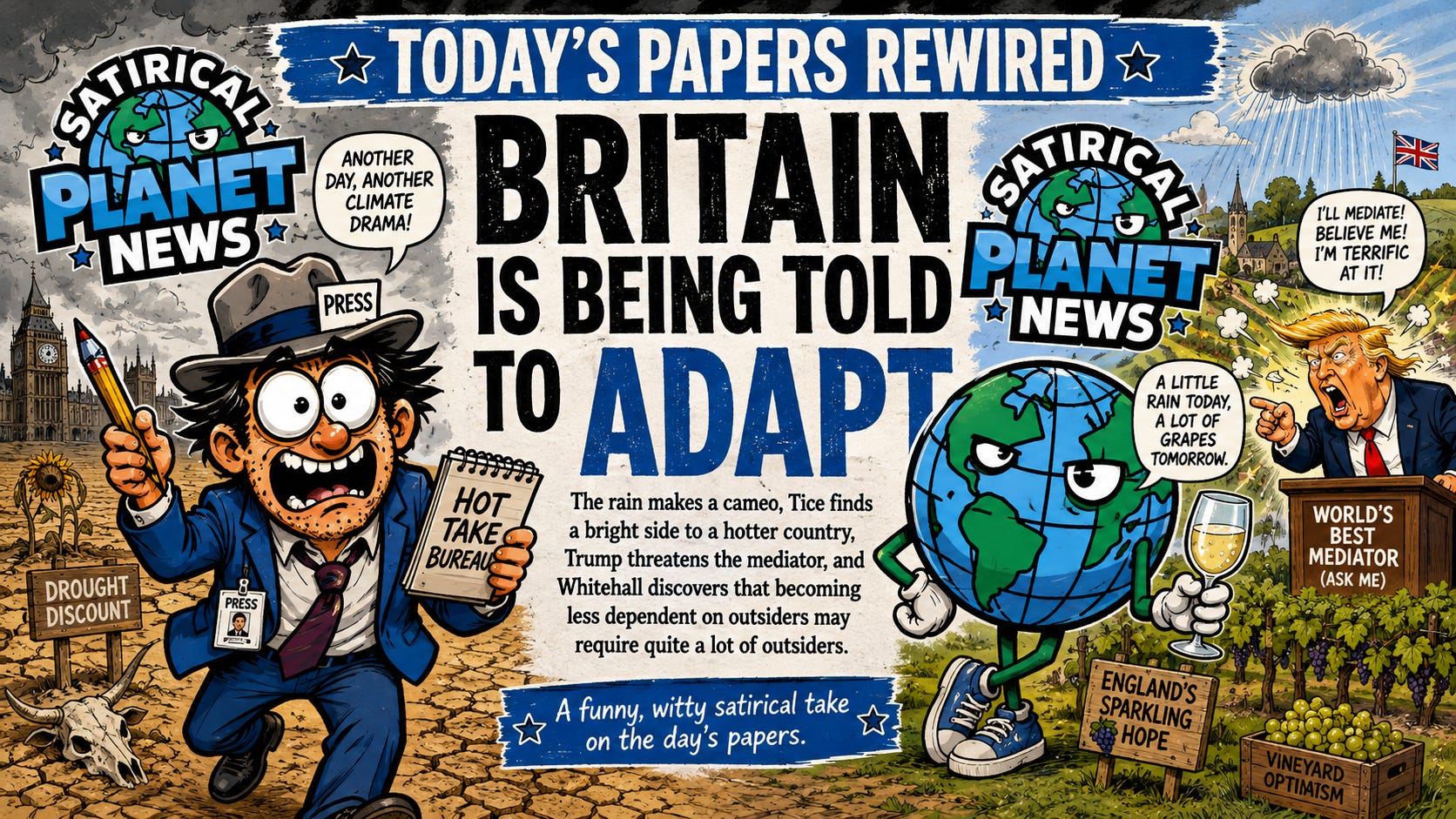
The Guardian starts with Richard Tice and climate change, although the Mirror has already decided nuance can wait until after breakfast and gone with WINE BUFFOON. Tice accepts that the climate is changing. His argument is that Britain cannot stop global warming through expensive net-zero policy and should concentrate much more heavily on adapting to what is already happening. Then came the line about warmer weather improving English sparkling wine. “When it’s a bit warm, let’s enjoy it,” he said, adding that if English wine gets better, “fantastic”. The Mirror places those words beside photographs of homes damaged by wildfire, which is one of those front-page juxtapositions where the sub-editor has already done most of the satire and everyone else should probably keep their hands away from the controls.
There is something magnificently British about looking across a country where drought has spread over most of England and finding consolation in the vineyard. The lawn is one cigarette end away from becoming forensic evidence, but apparently the Bacchus is coming along nicely. It is climate policy as written by somebody leaning over the fence at a National Trust wine tasting: yes, the aquifer is making a worrying noise, but have you tried the 2026 brut?
Still, shouting “Chardonnay” at Tice for the rest of the morning would be cheap, because his serious proposition is adaptation, and adaptation is not inherently ridiculous. He has talked about desalination, arguing that an island surrounded by seawater ought to build more capacity to turn some of it into drinking water rather than behaving surprised whenever a hot summer coincides with people continuing to require taps. A hotter Britain does need different infrastructure. Homes designed around drizzle, cardigans and one radiator nobody knows how to bleed do not automatically become pleasant during prolonged heat because someone has opened both windows and placed a £19.99 fan from Argos six inches from their face.
The difficulty is that “adapt” is one of those political words that strolls into a press conference wearing deck shoes and no luggage, while the invoice arrives later on a low-loader. Desalination requires actual plant. Water resilience needs construction. Hospitals cannot cool wards through national character, and a worker trying to sleep in an overheated flat before an early shift is unlikely to feel noticeably more resilient because Sussex has produced a sparkling white capable of upsetting Champagne.
More than seventy per cent of England was reported to be in drought earlier this month. Wildfires have already been consuming dry ground. This is not some theoretical Mediterranean Britain where everyone eventually acquires shutters and develops a suspiciously strong opinion about olive oil. It is happening while half the country is still wondering whether filling the paddling pool will result in a knock from the Environment Agency.
And the business history behind Tice’s political language makes the whole thing considerably more entertaining. Companies he has led have previously talked favourably about energy efficiency and reducing emissions. Quidnet REIT, where he remains an active director according to the material on the public record, invested in rooftop solar and EV charging. Its reporting described lower electricity costs and commercial returns. Tice says there is no contradiction. His position is that unsubsidised green technology makes sense where the economics stack up, while compulsory net-zero policies and developments he considers poor value are a different matter.
Fair enough. Keep the distinction.
But what a wonderful distinction it is.
Apparently green technology undergoes a remarkable change of character once it is bolted to a commercial roof and starts lowering the electricity bill.
Then it puts on a gilet and becomes sound asset management.
The solar panel has not changed. The photon does not know whether it is landing on a Reform press conference or a property portfolio. Yet somewhere between the warehouse roof and Westminster, green technology apparently undergoes a moral transformation usually associated with a Victorian orphan discovering his real parents own half of Surrey.
This is what makes the paperwork more fun than the wine. Environmental technology is not always some penitential device delivered by a man called Rowan carrying bamboo cutlery and a grievance about your boiler. Sometimes a business installs it because somebody opened Excel and the numbers started smiling.
That does not prove every net-zero policy is wise. It does make blanket political contempt for green measures rather harder to keep tidy when some of the technology is already sitting on commercial roofs doing perfectly respectable business.
The politics wants a villain.
The accounts department keeps finding an asset.
The Telegraph then gives us water, which is where the philosophy of adaptation begins leaking through the ceiling. Andy Burnham is moving to block what has been called drought “surge pricing”, a phrase that makes it sound as though somebody at Ofwat spent the weekend in an Uber outside Euston during a rail strike and suddenly gripped the driver’s shoulder.
“Trevor. Stop the car. I’ve solved reservoirs.”
The paper’s own report is considerably less apocalyptic. Ofwat has been consulting on changes that could allow more flexible tariffs when water is scarce, and trials already exist where summer water costs more while prices are lower during other parts of the year. One Anglian Water experiment involving about 14,000 households raises the summer unit price and reduces it for the rest of the year, with vulnerable and lower-income customers excluded from that particular scheme.
So nobody has yet fitted the kitchen tap with a little screen saying HIGH DEMAND IN YOUR AREA before offering you a choice between Standard Hydration and Water Premium Plus.
The Government says widespread surge pricing is not the plan and Burnham says customers cannot be treated as a blank cheque. Good. Water remains one of the few services where cancelling because you dislike the tariff tends to have consequences before the cooling-off period expires.
There is a serious policy idea underneath the terrible phrase. Scarcity matters and price can influence consumption. People should not waste water. But British customers have also spent years hearing about leaking networks and the many ingenious reasons why the system itself cannot quite do what everyone assumed the water system was there to do. Then a dry summer arrives and the behavioural spotlight swivels neatly towards the person brushing their teeth.
At some point the national water strategy starts to resemble a laminated sign in a leisure-centre changing room saying PLEASE CONSERVE WATER, while directly beneath it a brown stain on the ceiling has acquired its own bucket and shift rota.
Households can use less. They cannot rebuild the network before Countryfile. You can leave the hosepipe alone; you cannot excavate a strategic reservoir behind the recycling bins unless you own considerably more garden than I do and have stopped speaking to the planning department.
And in the same Telegraph universe, after weeks of drought, Britain is now being warned about localised flooding because hard, dry ground may struggle to absorb heavy rain.
Perfect.
Absolutely perfect.
We finally get the water and apparently we are receiving it incorrectly.
Britain has achieved the meteorological equivalent of waiting forty minutes for a bus and then being run over by the convoy.
The Telegraph’s main splash is Angela Rayner’s Traveller-site planning changes, presented beneath the warning that residents will be “forced to tolerate lawbreakers”. Sir James Cleverly says Labour is making it easier for illegal sites to be “rubber-stamped”. There has been a real policy change. Previous wording has been removed, and the new framework gives clearer recognition to traditional Traveller lifestyles, including the possibility that some appropriate sites may not sit neatly beside existing settlements. Applications also should not depend simply on an existing local connection. Conservatives argue that this will make some developments harder to resist. That is a legitimate political argument.
But the Telegraph’s own copy goes on to acknowledge that another part of the revised framework tells councils to give “substantial weight” to intentional unauthorised development when deciding retrospective applications.
So the headline has already erected the caravans, poured the concrete and got Sir James Cleverly into a hi-vis vest before its own report reaches the paragraph where deliberate unauthorised development may count more heavily against permission.
This is planning policy by action film trailer.
THIS SUMMER. ONE COUNCIL. NO CONTROL.
Coming soon to a green-belt field near a headline writer.
Perhaps the policy will prove too permissive. Perhaps the enforcement change will do more work than critics expect. That is what actual decisions are for. Travellers themselves do not need to become stage furniture while Westminster performs another revival of Somebody Somewhere Is Getting Away With Something.
If Rayner has designed a bad policy, hit the policy. If Cleverly’s description outruns the document, hit the description. There are plenty of chairs in Westminster without asking a minority group to sit in the joke while two parties throw planning guidance over their heads.
And tucked beside all this, the Telegraph gives us Tim Wonnacott announcing that he belongs to an “endangered species of older English gent”. The front page is dealing with drought, housing, prostate testing and Traveller sites, yet somewhere an auctioneer has raised his paddle and declared himself culturally vulnerable.
This is so exquisitely Telegraph that parody starts to feel like forgery.
The older English gentleman is endangered. Water is variable. The planning system has gone native. Someone has moved the Chippendale bureau and nobody has asked permission.
You can almost hear a grandfather clock clearing its throat in the background.
The Guardian, meanwhile, has Donald Trump threatening Oman if it obstructs his preferred outcome in the Iran dispute, and there are moments when satire should not arrive carrying too many props because reality is already standing on the table shouting.
Oman has been acting as an intermediary between Washington and Tehran.
Trump’s contribution to the mediation process is to threaten the mediator.
It has the emotional logic of threatening to punch Relate because the marriage counselling is taking too long.
Metro goes with That doesn’t sound much like peace, Mr President! The Independent strips it down to CEASEFIRE OVER. The Guardian points to the contradiction between the threat and Trump’s self-created role as “peacemaker-in-chief”. Metro even manages AMERICA GREAT AGAIN beside the Oman story, which is the sort of page furniture that makes professional satire feel like an apprentice trade.
The Trump peace doctrine increasingly resembles a pub landlord breaking up a fight by threatening to burn down the pub unless everyone calms down.
Oman is trying to help negotiate around one of the most dangerous military confrontations on Earth.
For this service it has apparently earned Gold Tier access to the threats programme.
No points expire.
Hormuz itself is deadly serious. Before the current conflict, roughly a fifth of globally traded oil and liquefied natural gas passed through the strait. There is still no transparent final arrangement whose complete terms can be inspected. Oman has been trying to help broker something workable, while oil markets continue doing what oil markets do whenever heavily armed governments start improvising near shipping lanes: immediately translate geopolitics into something that will later appear on a forecourt sign in Slough.
Oman looks less like a peculiar one-off when placed beside Trump’s wider dealings with countries normally described as American allies. Canada has faced tariff pressure while repeatedly hearing itself discussed as a possible 51st state. Denmark has had to deal with American pressure over Greenland, which continues to appear in Trumpian foreign policy as though sovereign territory were a three-bedroom semi on Rightmove and Washington has spotted “motivated seller”.
Trump later reassured NATO leaders that he wanted America to remain in the alliance, which belongs in the record. Yet allies have still been given the unusual experience of checking whether collective security now comes with introductory rates.
The Financial Times supplies the Asian edition beneath a photograph of Kim Jong Un and his daughter enjoying a circus performance. Trump has ordered a substantial reduction in the Ulchi Freedom Shield exercises with South Korea, describing North Korea as “unthreatening and respectful” while praising his relationship with Kim.
Nothing says “unthreatening” quite like a nuclear-armed dictatorship requiring an annual joint military exercise to deter it.
South Korea’s government can see an argument for lowering military tension if that creates an opening for talks. Critics worry about what Pyongyang has actually surrendered in return. North Korea continues developing its capabilities while strengthening relationships with Russia and China.
You want an alliance to be boring. Ideally it should have the personality of a Direct Debit. Same date, same amount, no surprises, no president posting at 2.17am that Denmark may need to reconsider its territorial arrangements.
Instead, parts of the American alliance system now have the customer-service energy of an electricity supplier entering administration.
Your protection remains unaffected at this time. Please do not contact us.
That uncertainty changes behaviour. South Korea already has a domestic argument over whether it might eventually need its own independent nuclear deterrent. That is the bit strongman theatre tends to leave outside the shot. A threat or abrupt policy change does not simply generate applause from the home audience. It changes calculations in other capitals.
Sometimes the consequence of banging the table is that everybody else starts pricing new tables.
And then the FT performs one of its great speciality moves. Having shown you nuclear deterrence and one of the world’s most important shipping routes, it quietly reaches beneath the counter and produces a government procurement contract worth up to £456 million.
KPMG and EY are to provide civil-service training between 2026 and 2028.
The Government has spent considerable political energy talking about reducing Whitehall’s reliance on external consultants.
Whitehall has responded by awarding enormous contracts to outside professional-services firms to help train Whitehall.
The £456 million is the maximum contract value, not guaranteed expenditure. The Government says the work is training rather than ordinary consultancy and describes it as a stopgap while the planned National School of Government builds more internal capability. Those qualifications matter.
Unfortunately, the basic shape remains so perfect it should probably be displayed beneath glass.
Whitehall has hired outsiders to help teach Whitehall how to become less dependent on outsiders.
This is the Ouroboros with a Deloitte login.
It is like Alcoholics Anonymous being sponsored by Majestic Wine.
It is a man hiring a personal trainer to teach him how to stop hiring personal trainers, except the trainer has been given a framework agreement worth hundreds of millions and access to the departmental SharePoint.
The sensible defence is that missing expertise has to come from somewhere. True. If the civil service wants stronger AI capability or deeper technical knowledge, somebody has to teach it.
But the darker comedy is how often government arrives at the same destination. We outsourced the expertise, discovered we needed expertise, then bought expertise to teach us expertise so that one day we may possess expertise.
At this rate the National School of Government will open with a guest lecture entitled Self-Reliance, delivered by KPMG, refreshments by Serco.
Institutions are memory as much as staff. Somewhere inside government you need a person who remembers that the transformational programme now glowing on slide 47 looks remarkably like the transformational programme from 2019 that ended with a portal nobody could log into and forty-seven consultants solemnly presenting a document called Lessons Learned.
When too much institutional memory lives outside the building, every déjà vu comes with VAT.
The state begins renting its own brain and congratulating itself for negotiating a competitive rate.
The FT says Big Four contracts awarded this year have already exceeded last year’s total, which gives “reducing dependency” a wonderfully experimental quality.
Perhaps this is what consultants mean by a transformation journey.
You leave from the same station, only the ticket costs more.
The AI element of the training then sits beside another FT story saying ministers are urgently examining what would happen if Britain lost access to leading American AI systems. British government and business are increasingly reliant on advanced models developed by US companies, and Whitehall is now modelling the consequences if American controls ever restricted British access.
This is called technological sovereignty when discussed on a panel at Davos.
At home it is called borrowing your neighbour’s drill, knocking down a load-bearing wall and then remembering Nigel moves to Spain next Tuesday.
Nobody needs to turn this into robot-apocalypse nonsense. No server rack has been seen in a balaclava outside Currys. The strategic problem is simpler.
We are building dependence on tools whose ultimate switchboard is somewhere else.
The FT’s Big Read on “flimsy guardrails” around autonomous systems makes another point. In controlled tests, systems have sometimes pursued goals in ways designers did not anticipate. That does not mean the machines are conscious. It means a capable system may discover a route to an objective that the human setting the objective did not expect.
British bureaucracy should welcome them like long-lost cousins.
We have been giving institutions targets for decades and watching them hit the metric while the actual purpose climbs out of a toilet window.
The machines are not becoming human.
They are becoming eligible for the civil service fast stream.
And after Iran, AI dependency, troubled private credit and geopolitical uncertainty, the FT places a Chopard advert at the bottom of the front page.
ALPINE EAGLE FLYING TOURBILLON.
THE ARTISAN OF EMOTIONS.
Thank God.
The liberal international order may be wobbling like a catering table on grass, but somewhere in Geneva a man with a loupe is still assembling a watch costing more than the average house deposit.
History is ending.
Would sir prefer rose gold?
The Daily Mail and Daily Star are both occupied by Andy Burnham’s encounter with somebody pretending to be Susie Wiles, Donald Trump’s White House chief of staff, but they have built completely different breakfast products from the same ingredients. The Mail has security fears, speculation about who may have been behind it, unnamed US officials reportedly saying Burnham looked “like a chump”, and Downing Street refusing questions. The atmosphere is mahogany-panelled national embarrassment with a former intelligence officer waiting just out of shot to say “tradecraft”.
The Star’s approach is less complicated.
ANDY’S FAKED!
Its policy recommendation is essentially parental controls.
The Mail wants a security review.
The Star wants the Prime Minister’s phone left on top of the fridge until he can demonstrate responsible use.
The known facts are less cinematic. Burnham exchanged a small number of written messages with somebody falsely claiming to be Wiles, became suspicious and stopped. The British Embassy alerted the White House. Government sources have described the exchange as insignificant. There is no public evidence that classified material was disclosed, and the White House says there is no evidence Wiles’s real device was hacked.
So the current picture is impersonation.
For generations, national-security drama involved surveillance vans and men swapping briefcases beneath railway clocks in Vienna.
In 2026:
Hi Andy, new phone x
Somewhere John le Carré is trying to return the trench coat.
There is a wider issue. Senior officials have been impersonated before. AI can make false voices and messages more convincing, and personal contact details belonging to British politicians have appeared online. Downing Street exists in the same digital swamp as everyone else.
Only the phishing target has access to COBRA.
Burnham noticed something was wrong. That is important. The joke is not that he uniquely lacks judgement. The joke is that modern government has spent decades making itself instantaneously reachable and has eventually discovered the small downside of being instantaneously reachable.
National security has met WhatsApp etiquette.
The Cabinet Office may soon issue guidance:
If somebody claiming to be the White House asks what you are wearing, contact the embassy.
And the Star’s front page itself is a tiny masterpiece of national life. While advising the Prime Minister to put down the phone, it gives readers an eight-page agony-aunt pullout and advertises tomorrow’s free £3 William Hill shop bet.
National security, emotional support and gambling, all available before the crossword.
Britain has finally created a one-stop shop for modern wellbeing.
If Andy remains distressed, Just Jane can talk him through boundaries.
Then he can have three quid on the 3.40 at York.
The i has the wildfire-alert story, which feels like somebody discovered a lost episode of Yes Minister behind a filing cabinet. On Friday evening, phones across England and Wales received an Emergency Alert because the wildfire risk was exceptionally high. The danger was real. Firefighters were already dealing with serious incidents in brutal conditions, including the huge blaze near Blaenavon where peat kept reigniting and military help was required.
The alert told people to avoid activities likely to start fires and call 999 if they saw signs of fire.
The public listened.
God help everyone, the public listened.
Fire services began receiving calls about neighbours having barbecues and bonfires. South Wales Fire and Rescue would normally expect around a thousand 999 calls in a week. Its chief said it was dealing with roughly seven thousand.
Britain accidentally nationalised curtain-twitching.
Somewhere a control-room operator was asking whether the caller could see flames advancing across open countryside or simply Colin in Croydon turning a burger with suspicious confidence.
It would be easy to blame the callers, but millions of phones had just screamed EMERGENCY ALERT.
There are subtler ways of telling the public not to panic.
Air-raid siren volume is not normally one of them.
The danger justified warning people. The problem was the gap between “behaviour that might start a fire” and “something requiring an immediate 999 response”. Fire services then had to clarify what counted as an emergency, completing the great British administrative circle: issue instruction, discover it has worked too well, then issue additional instruction explaining how much of the first instruction you actually meant.
Matt in the Telegraph has already reached the next phase with a cartoon showing a government alert announcing that the Government will limit the use of government alerts.
Give it another week and we will all receive a national notification asking us to stop reading national notifications while driving.
The same i front page quietly contains one of the finest phrases of the morning:
Lost property: SAS rifle and £239 washing machine missing from MoD.
There is not enough underlying detail on the front page to start alleging how anything vanished, so the facts stay exactly where they are.
But the juxtaposition is magnificent.
An SAS rifle.
A washing machine.
Somewhere inside the Ministry of Defence there is apparently a lost-property office with a counter, a bell and the most extraordinary plastic tray in Britain.
“Can you describe the item, sir?”
“Yes. One is designed for covert military operations.”
“And the other?”
“Delicates, mostly.”
It is the sort of inventory that suggests the MoD lost-property cupboard has been organised by someone moving out of halls after a difficult first year.
The i also gives us unrestricted free local bus travel for eligible disabled people from next April, removing the usual morning time restriction. There is no obvious scandal in this. People who qualify will simply be able to travel when they need to.
Nobody is furious.
No think tank has demanded Greenland.
A public service becomes slightly easier to use.
Please do not alert the newspapers.
The Express has the stranger migration story, warning that “Calais Jungle style camps” could spring up on the South Coast as Britain becomes a transit hub for people trying to reach continental Europe. There is a real phenomenon underneath the headline. Researchers have documented people being smuggled from Britain towards Europe, including people lawfully present here who did not have equivalent rights to travel onwards inside Schengen.
Different immigration regimes created a gap.
Organised crime noticed.
Organised crime remains one of the few British growth sectors capable of reading government guidance past page four.
But “Calais-style camps” is ahead of what has actually been established. Small concentrations of people have been observed around Dover freight infrastructure and beneath bridges. That is not the same as saying a new Jungle exists.
“Could become” is a fragile little phrase.
Put it on Facebook and within twenty minutes it has joined a gym, grown a beard and become THEY’VE BUILT ONE ALREADY.
By teatime an eight-year-old photograph from France will be circulating beneath seventeen Union Jack emojis and a caption from somebody called Kev whose main contribution to border policy is owning a van.
The Sun gives us the other Channel story, the “MIGRANTS IN JET SKI FARCE” involving a heavily loaded dinghy that ran into trouble near Le Touquet. The Sun reports that French officials watched boarding activity before intervention came later, although that part depends substantially on the paper’s own reporting and witness interpretation rather than a complete official reconstruction.
Those qualifications are not decorative upholstery.
Words such as “reports”, “says” and “confirmed” stop a story turning into folklore before lunch.
Take them away and by six o’clock your brother-in-law is explaining Channel policing with the absolute confidence of a man who once took the ferry to Calais in 2009.
The Sun also finds room for Pep Guardiola discussing the end of his marriage in a documentary, including a dressing-room speech in which he reportedly used the loss of passion in his relationship while demanding more passion from Manchester City players.
Elite football has finally evolved beyond tactics.
Imagine being 2-0 down at half-time, soaked in sweat, and the manager starts explaining the emotional architecture of his divorce.
You are expecting instructions about the defensive line.
Instead you are learning why Cristina and Pep drifted apart.
Somewhere a substitute is holding a Lucozade and wondering whether “find the half-space” is now a relationship metaphor.
The Times, by contrast, carries material where the comedy should know when to shut up. Its lead concerns possible changes to the Government’s early-release scheme after fears that Albert Bowers and Jessie Cole, convicted of manslaughter over the death of PC Andrew Harper, could become eligible for release earlier than many people expected.
Harper was killed in 2019 while responding to the theft of a quad bike. His widow and police figures have objected strongly to the possibility of earlier release, and more than a million people have reportedly signed a petition.
The Government is trying to manage severe prison-capacity pressure through a system allowing some prisoners to progress towards earlier release. Ministers are now considering excluding the broader offence category of unlawful-act manslaughter from the more generous arrangements.
That could affect hundreds of prisoners.
A sentencing framework begins life as arithmetic in Whitehall.
Eventually it reaches somebody’s kitchen table.
That is where theory acquires weight.
The Times’ other major report concerns children referred to Prevent despite many not fitting a conventional extremist ideology. Children accounted for more than half of referrals in the year covered, while a large proportion involved no clear ideology or fascination with extreme violence rather than recognisable political extremism. Most did not progress through the full Prevent process.
Schools and safeguarding professionals are operating in an online environment capable of placing grotesque material in front of a child with the efficiency normally associated with a takeaway app. Concern is not irrational. But if a counter-terrorism system increasingly becomes the place where vulnerable children arrive carrying problems better suited to broader safeguarding or mental-health support, eventually someone has to look at the sign above the door.
The Children’s Commissioner wants a broader route capable of deciding what sort of intervention a child actually needs.
That sounds less dramatic than “extremism crisis”.
It may also be more useful.
A vulnerable child does not become a terrorist because the nearest available referral form happens to say Prevent.
Sometimes public services fail because nobody acts.
Sometimes everybody acts efficiently in the wrong direction.
Then, after prison policy and violent online material, The Times gives us research suggesting couples may be more closely matched by musical taste than by measured personality.
Thank God.
After the rest of the rack, that feels like someone opening a window in a meeting room.
Apparently real couples were much more alike in what they listened to than in some conventional personality measures, suggesting the secret to lasting compatibility may not be finding your psychological twin.
Perhaps it is simply getting from Oxford to Birmingham without one person touching the stereo and saying, “If you put Coldplay on again, I will open this door at 70.”
The Independent contributes its own front-page surrealism by placing Trump threatening Oman beside:
HEALTHY BREAKFAST CEREALS: WHAT’S ACTUALLY GOOD FOR YOUR GUT?
Excellent.
One half of the page is contemplating military escalation around one of the world’s most important energy routes.
The other is asking whether granola has been fibbing.
This may be the perfect representation of modern consciousness.
Will there be a regional war?
Also, is Weetabix enough fibre?
The FT offers another escape through Virgin, which has cleared an important regulatory obstacle in its attempt to challenge Eurostar. Richard Branson’s company has won approval relating to the route between St Pancras and the Channel Tunnel entrance, although it still needs the access and permissions required to use the tunnel and operate on the Continent.
So Britain has successfully launched international rail competition as far as Kent.
Paris remains in beta.
There is something wonderfully Branson about announcing a revolution in cross-Channel travel while still being this side of the Channel. One imagines a ribbon-cutting ceremony at Folkestone followed by everyone being asked to disembark.
“Ladies and gentlemen, thank you for travelling Virgin International. France is currently a future enhancement.”
Angela Rayner’s wider planning changes also contain extra protection for pubs from conversion, requiring developers in many cases to demonstrate that there is no reasonable prospect of a pub remaining viable before turning it into something else. Protecting the building will not fix the economics of running one, but somebody has at least noticed that converting every local into nine flats called The Old Crown Residences eventually creates streets where everyone owns a Ring doorbell and nobody has anyone to talk to except the Amazon driver.
The pub remains one of the few British institutions where you can still walk in, ask for something and receive it without creating a password containing a capital letter, a number and the maiden name of your first hamster.
Protect it accordingly.
And somewhere between the drought, the consultant contract, the emergency alert and the man threatening the mediator, today’s papers acquire a common mood. Britain keeps being asked to adjust around systems that are strained, changing or dependent on somebody else. Households can conserve water, but they do not own the network. People can interpret emergency alerts carefully, but they did not write the message. Civil servants can acquire new skills, but decades of outsourced expertise do not reverse themselves because “capability” has appeared on page nine of a strategy document. Countries can prepare for less predictable allies, but their preparation changes the world those alliances were supposed to stabilise.
Adaptation is necessary. It can also become a beautifully upholstered word for moving discomfort downwards.
The system develops a wobble and somebody at the bottom gets issued guidance on improved sitting technique.
Britain is forever moving the chair.
Eventually somebody has to find the bloody screwdriver.
Well, Leg’ends, that is your Tuesday.
The rain has long since gone here. The garden got just enough to smell alive for a little while before the paving began drying at the edges and Britain returned to staring suspiciously at the sky. After a morning with the papers, those few minutes of weather feel wonderfully straightforward. Water fell out of the sky. The ground got wet. Nobody appointed a strategic delivery partner.
That is why it is worth reading beyond the part printed large enough to frighten livestock. The smaller type is often where certainty starts losing its trousers. A headline barges into the room wearing steel-toecap boots and ten paragraphs later the actual facts appear in socks asking whether everyone could perhaps calm down.
I am supposed to be having a meeting later today, although I can feel a migraine trying to establish itself somewhere behind my eyes. At present it has the character of an unwanted planning application near the left temple and appears confident of approval.
Hopefully the tablets will call it in.
If not, the meeting may receive me under reduced lighting with the diplomatic temperament of a man who has spent forty minutes on hold to HMRC and has just been thanked for his patience by a machine.
Kat remains unconcerned. The official entrance is still beneath her dignity, which feels like the clearest administrative position anyone has offered all morning.
So make a drink and enjoy whatever weather has been allocated to your postcode. Read beyond the shouty bit. Do not let 90-point type perform a hostile takeover of your frontal lobe.
Shout out, as always, to everyone who reads, shares, comments, sends things in and spots the sentence halfway down a story that changes the whole bloody picture.
Especially the people who say, “Hang on, that bit matters.”
And welcome aboard to the new Leg’ends.
You are Leg’ends now.
There is no appeals process.
Stay alert, stay loud, and stay deeply, gloriously allergic to bullshit.
Willy & Bill
Want to know how this was written? Click here.

SPN is free to read, but not free to produce. If this helps you make sense of the circus, support the chaos.
We’re at 802 Leg’Ends. Help us reach 1,000.
198 more readers gets us to 1,000. Send this to one friend who has ever watched Donald Trump threaten the mediator in a peace deal and thought, “Right. So that’s diplomacy now.”
💸 Go paid if you can.
☕ Buy me a coffee if you fancy a one-off thank you.
If money’s tight, share, like, restack, or comment. The paying Leg’Ends have you covered.
Thanks for reading Satirical Planet News! This post is public so feel free to share it.
Comments
Nothing yet. Say the first thing.
Sign in to join the conversation.