
Satirical commentary. Reported claims remain reported claims; an arrest is not a conviction.
Good afternoon Leg’ends,
I was about to say good morning, but by the time this reaches you the morning will probably have packed its bags and buggered off somewhere without leaving a forwarding address.
I have made an executive decision that, every now and then, I am going to have a lie-in. Revolutionary stuff, I know. It means Today’s Papers might occasionally arrive a little later than usual, perhaps even in the afternoon, depending on how much enthusiasm my body has for joining Britain before breakfast. I have conducted the necessary impact assessment and concluded that the nation will probably survive an extra couple of hours without me staring suspiciously at the Daily Star.
It is sunny but cloudy here this morning, which feels about right. The weather has looked at Britain, considered making a firm commitment and decided to keep its options open. Kat has been fed and is now giving me some love because the breakfast transaction has cleared successfully. I have already had two rollies and am well into tea batch number two, so the basic infrastructure is functioning.
Grab yourself a cuppa as well, because we have been through the front pages and, after careful consideration, I believe the technical term remains clusterfuck.
Not because everything on them is false. That would almost make the job easier. Most of today’s stories have something real underneath them. The trouble begins while that fact is travelling towards the splash, because uncertainty has a habit of becoming much more confident once somebody has found a large typeface for it. By the time a cautious proposition reaches the front page, it can sound as though the paperwork has been signed and Britain has already been instructed to report for duty.
The most important sentence is often not the one in enormous letters. It is farther down, quietly clearing its throat after the front page has already decided what emotion you should be having.
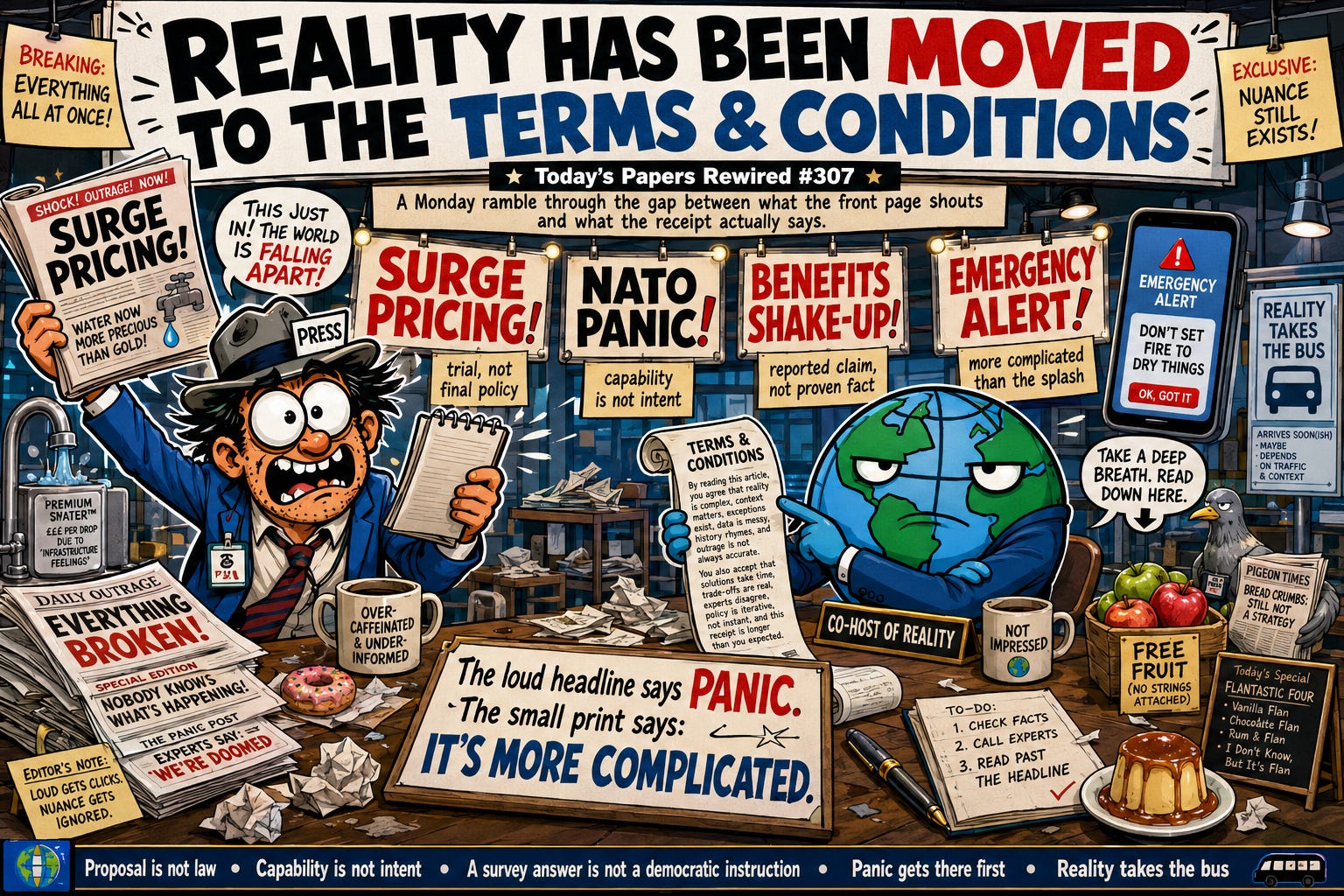
Reality, apparently, has been moved to the terms and conditions.
So let’s have a wander through it and see what they’re trying to install into our brains today.
We can start with water because apparently yesterday was only the trailer. Metro has SURGE PRICING FOR BILLS with Water cheek!, while the Daily Star has independently arrived at Water bloody cheek!, which is what happens when two newspapers discover the same pun and there is no regulator available to decide who gets custody. The Star also tells us FATCATS WILL CHARGE US EVEN MORE IN DROUGHTS, and says PM BURNHAM ALLOWS THE BIG DRIPS TO ‘SURGE PRICE’.
There is a real policy story underneath all that wet fury. Ofwat has been overseeing experiments with alternative charging systems, including seasonal tariffs where water can cost more during warmer periods and less at other times of year. The argument behind the trials is straightforward enough: if water becomes scarcer, changing the price may encourage people to use less.
You are completely entitled to think that sounds arse-about-face for an essential utility. A regulated monopoly supplying something required for human life developing the commercial instincts of a motorway service station is, at the very least, worth discussing. There is plenty to argue about before anybody needs to make the current position sound more final than it is.
Metro says the Government backs firms’ bid to make you pay more in drought. The Star tells us Burnham allows the big drips to surge price. Read quickly and it sounds as though Downing Street has simply moved August into the premium package.
Except the underlying position is considerably more fiddly. The material we checked points to a regulated trial process with affordability protections and limits around overall revenue. The Government’s public position is that any charging reform should leave bills fairer and more affordable overall, while the final regulatory decisions sit with Ofwat rather than somebody in Whitehall simply opening the drought till and yelling, ‘Go on then, lads.’
The summer number doing most of the emotional work is genuine. In Anglian Water’s trial, the rate could rise from about £2.69 per cubic metre to £4.39 during the warmer period, which is a sizeable jump. Outside that period, though, the same trial cut the price to £1.78. Oddly enough, £1.78 has not been given the same enormous typeface. It is somewhere inside the paper like the quiet cousin at a wedding, wondering why £4.39 got the top table simply because it knocked over a chair.
Ofwat’s assessment, according to the research we looked at, also suggested that many people on the trials were expected to pay the same or less overall. That does not settle whether this is good policy. Water is not an optional consumer purchase you can postpone until the January sales. You cannot inspect the August hydration market, decide conditions are unfavourable and defer having kidneys until autumn.
If scarcity becomes part of the charging system, the obvious concern is what happens to households whose needs cannot simply shrink because the tariff has noticed it is hot. The industry’s wider performance matters as well. A new pricing model does not make longstanding questions about investment disappear, nor does it wash away public anger about pollution.
Feargal Sharkey is quoted attacking the companies’ record and arguing that customers are being asked to pay for industry failure. That is his criticism, and it should remain his criticism rather than silently becoming an established finding because it happens to be a very punchy quote.
The policy itself is strange enough without our help. Britain may genuinely be experimenting with the economics of the peak-time shower. Nothing says public utility quite like your kitchen tap discovering Bank Holiday pricing. You wander downstairs for a glass of water and the smart meter flashes HIGH DEMAND IN YOUR AREA, gently suggesting that perhaps your bladder could wait until after nine.
I know. I am trying to behave here, Leg’ends, but once a monopoly utility starts flirting with seasonal pricing, the kitchen sink practically writes the paragraph itself. No water company has actually announced bladder rationing, obviously. I am merely giving capitalism ideas for free, which is probably unwise.
The same drought reaches into The Times, where car washes and private swimming pools could face restrictions under existing non-essential-use powers if conditions worsen. Official figures we looked at put about 71 per cent of England’s land area in drought by 13 August, with more than 27 million people facing restrictions. Several reservoirs were also recorded at exceptionally low levels.
The paper says officials have been working through a ‘reasonable worst-case scenario’ involving wider restrictions on business use. We have not independently reproduced the specific Whitehall discussions described by The Times from a published government document, so that part stays exactly where it belongs: reported by The Times.
The situation itself needs very little theatrical assistance. It is dry enough that the argument has moved well beyond somebody being cross because the hosepipe is unavailable. Somewhere in Britain, a man with a private swimming pool is discovering that the phrase ‘non-essential use’ has finally acquired his postcode.
That carries us back into the emergency-alert argument from the weekend. On Friday, millions of phones received a warning about wildfire danger. Some of Sunday’s coverage treated the message as though the Government had interrupted Magna Carta with a push notification about sausages, and now The Telegraph has found an older Cabinet Office report warning that an emergency system can lose impact if it is used too often.
That is useful context. A system which interrupts millions of people needs to preserve its authority. If the national warning noise starts going off for every wobble, people will eventually hear it with the same urgency they reserve for ‘your parcel is eight stops away’.
Current government guidance also explicitly includes wildfires among the life-threatening events for which the emergency-alert system can be used. That removes one of the dafter arguments immediately. Wildfire was not smuggled into the system by a bored minister on Friday afternoon.
The real issue is proportionality. If an alert reaches large numbers of people who feel nowhere near the danger, the Government needs to be able to explain why that reach was justified, because trust in an emergency-warning system is part of the system itself.
Chris Philp describes Friday’s use as an ‘abuse of the system for the purpose of political posturing’. Richard Tice reaches for ‘nanny state’. Those are political judgements rather than findings contained in the guidance, and I still cannot quite get over Britain spending years developing a national emergency-warning system only to reach the great constitutional debate of 2026: should people have been told not to put fire on extremely dry things?
Maybe the Government should explain the threshold more clearly, and perhaps the alert could have been targeted better. That is enough of an argument without pretending wildfire sits outside the purpose of the system. Nobody confiscated Dave’s barbecue tongs or nationalised the sausages.
The Independent has taken the same fire and drought atmosphere and gone full apocalypse spreadsheet.
Our burning world.
Its front page is covered in enormous statistics. The underlying climate story is serious. Europe has endured brutal heat and major wildfires, while Britain has faced severe fire pressure of its own. Nobody sensible needs the reality enlarged before caring about it.
Which is precisely why the numbers need to behave themselves.
The Independent puts 370 million acres on the front page as the amount consumed by fire this year. Yet the underlying article, according to the research we looked at, also contains another worldwide estimate of approximately 150 million acres. That is not two people squabbling about the final decimal place. It is a fairly impressive amount of planet to have misplaced behind the sofa.
There may be a legitimate explanation involving different source definitions or time windows. Fine. Tell the reader. What you cannot sensibly do is present 370 million acres as a beautifully clean global number while another dramatically smaller global estimate sits inside the same article wondering whether it has turned up to the wrong meeting.
And I am trying here, Leg’ends. I really am. But when the same article appears to contain two very different answers to the question ‘how much planet has burned?’, somebody has to put the infographic down for a minute and check which number has brought identification.
The 1.5 million annual deaths figure also needs care because the underlying research appears to concern mortality linked to landscape-fire air pollution, which is broader than wildfire smoke alone and can include agricultural burning.
You can almost imagine the statistics arriving separately, each carrying its own paperwork, before somebody sits them around the same kitchen table and announces that they are related.
They may not be.
This is what annoys me about statistical maximalism. The climate emergency is frightening enough without inviting every remotely combustible number onto the front page and implying they all belong naturally together. Accuracy does not make a crisis less urgent. It stops somebody who desperately wants to dismiss the crisis from being handed a loose thread and spending the next six months pretending the thread disproves the jumper.
The Times has found a different way of stretching a narrower proposition.
Half of disability claimants would swap cash for help.
That sounds enormous. You can almost hear Westminster swivel towards the headline and ask, ‘Half, you say?’
Well, sort of.
The Good Growth Foundation surveyed 1,000 people receiving disability-related benefits. According to The Times, 49 per cent said they would hypothetically give up at least £20 a week in return for specified support. Twenty pounds a week comes to a little over £1,000 a year, which is where the headline gets its number.
The arithmetic is not the interesting bit. The meaning is.
There is a large difference between somebody saying, ‘Yes, I might give up twenty quid if the support presented in return is genuinely useful to me,’ and that person saying, ‘Please replace my disability payment with services.’
Westminster appears to have rediscovered barter.
Insert twenty pounds and wait for functioning public service.
And you know what makes this one itch? The hypothetical works because the support is presented as the thing the claimant receives in return. Of course a person might surrender money if the thing offered back genuinely improves their life. I would probably exchange twenty quid for a dentist who answered the bloody phone. That does not mean I have developed a philosophical objection to cash.
If somebody is struggling to get therapy and you present reliable therapy as the alternative, some people will naturally think that is worth something. That tells us the service has value. It does not tell us cash support is unnecessary, and it certainly does not demonstrate that half of disabled claimants want money replaced with government-provided alternatives.
Stephen Timms has reportedly said the Government is not moving away from providing money to disabled people for the additional costs they face. The review is considering whether other forms of support might help in some circumstances.
Then that is the real conversation.
The crucial word is support.
If the state wants somebody to give up part of their cash because another service will supposedly carry the need, that service has to exist in the real world rather than in a ministerial sentence. An appointment that turns up months later is not the same thing as the support imagined in a survey, and equipment that spends half a year touring procurement is not much use to the person who needs it now.
Otherwise the transaction is not money for help. It is money for the possibility of help, which is a completely different product and conveniently not the one put to the person answering the question.
PIP itself is meant to contribute towards the additional costs of disability and can be claimed by people who work. That matters because disability-benefit conversations have a nasty habit of sliding towards the assumption that the payment itself is stopping somebody taking a job. For some people, the payment may be part of what keeps daily life manageable enough for work to remain possible.
Alan Milburn’s call for a much larger role for supported internships for young people with special educational needs and disabilities sits beside that rather neatly. The Guardian says employment rates after supported internships can be as high as 70 per cent. That little ‘can be’ matters. The government evaluation identified in the research apparently found movement into paid employment closer to 48 per cent, which is still meaningful in a group that can face painfully poor employment prospects. Seventy per cent simply looks better in the window.
What matters more is Milburn’s refusal to begin with the idea that young people are simply not trying hard enough. He asks whether useful opportunity exists.
Someone can be perfectly capable of working and still find that the route into a suitable job has been made unnecessarily difficult. Sometimes the barrier is practical rather than moral, which is much less satisfying to put on a political leaflet because practical problems usually require competent administration rather than a lecture about attitude.
If supported internships are producing worthwhile employment, expand the parts that work and keep measuring them honestly. Do not turn the most flattering percentage into scripture, but do not ignore an effective intervention merely because helping someone costs money before any wider saving appears.
That distinction has been sitting with me since yesterday’s Reform welfare material. One kind of politics begins with the person and asks what would make life more workable. Another can begin with a giant savings figure and then go looking for human beings who will fit underneath it.
You feel the difference before anybody gets near the calculator.
A disabled person is not an inefficiency waiting to be discovered by someone with access to a Treasury spreadsheet. Support can make work possible for some people, while for others work may not be realistic at all. The policy still has to land in an actual life rather than inside a neat column.
Professor Alan Smithers supplies another front-page proposition trying to run slightly ahead of what has actually been established. He says boys and girls may have inherent differences which contribute to the way they perform in different GCSE subjects.
The attainment differences themselves are real. Smithers asks whether inherent differences could form part of the explanation.
That is a hypothesis, and hypotheses are allowed.
What makes the story irresistible is Smithers raising the possibility while warning that cancel culture is in ‘overdrive’. Cancel culture has apparently become so severe that controversial opinions are now being forced onto the front page of The Times.
A dreadful underground existence. You say the unsayable and somebody puts it above the fold.
I mean, where can a controversial opinion even go these days apart from a national newspaper or the broadcasting circuit? Practically samizdat.
The word protecting the headline is may, because the results do not establish the cause. Other explanations exist, from schooling to development, and the point of research is to work out which ones survive contact with the evidence.
The paper has chosen the interpretation most likely to make somebody stop halfway through the toast.
Fair enough.
Just do not mistake the most combustible hypothesis for the settled explanation.
The Telegraph gives us Russia’s secret bases threaten Nato.
This is a serious investigation. The Telegraph says its investigation, using satellite imagery and leaked material, identified new or adapted launch infrastructure which could support longer-range Russian drones, potentially putting Nato territory such as Warsaw within reach.
That matters. Russia is already using large-scale drone attacks against Ukraine, and Nato planners obviously care about an expansion in range.
Then the Telegraph’s own front-page copy supplies the sentence that changes how the splash should be heard: there is no suggestion Russia is planning such an attack.
What the investigation appears to demonstrate is capability, and capability is strategically significant. If a hostile state develops a weapon system that can reach farther into allied territory, defence planners are not supposed to shrug merely because nobody has issued a launch order that morning.
But capability is not evidence of current intent.
The headline has already packed Warsaw an emergency bag by the time the article mentions that nobody is alleging the trip has actually been booked.
That distinction matters even more because Ukraine is not living inside a hypothetical conflict. People are already dying there. The Guardian and FT both report a very large Ukrainian drone operation into Russia while Russian strikes on Ukraine continued, and the enormous drone figures being quoted by Moscow need to stay attached to the Russian defence ministry because they are claims from a party to the war rather than independent totals.
There is no useful joke in making the war itself more theatrical. The humour belongs on the distance between what a weapon can do and what the headline encourages a reader to imagine is about to happen.
The Telegraph also reports that Andy Burnham is ‘minded to approve’ the Jackdaw gas project.
That is not the same as approval, and the paper itself says no formal decision has been made. Rosebank remains less certain, according to the reporting, while the formal process still has to run its course.
Then comes the detail that almost writes its own satire: Labour figures are reportedly concerned about how approving major fossil-fuel projects would look in the middle of a heatwave.
If that sourcing is right, the political optics around British climate policy have apparently become weather dependent.
The gas field does not become less carbon-intensive once Manchester gets drizzle.
I can see the meeting now. ‘Secretary of State, emissions remain the same, but good news, there is a low-pressure system coming in over Stoke on Thursday.’
If the Government thinks Jackdaw should go ahead, explain the energy-security case and defend the climate consequences honestly. Timing the politics around whether the public is visibly sweating is not environmental policy.
That is wardrobe.
The FT describes the looming decisions more soberly as a test of Burnham’s North Sea approach, which is probably closer to the grown-up version.
Jamie Dimon has meanwhile been warning Chancellor John Healey about higher taxes on banks. The FT is clear that this is lobbying and says Dimon argued that a heavier tax burden can encourage financial activity to move elsewhere.
He may have a substantive economic argument. Capital is mobile, and large companies do consider tax regimes when deciding where to put money or staff. Governments would be daft to pretend otherwise.
There remains something magnificently unsurprising about the chief executive of an enormous bank discovering that the ideal tax arrangement contains fewer taxes on enormous banks.
It is one of the enduring miracles of economics that the person paying the tax so often turns out to be the leading local expert on why the tax is dreadful.
Thank Christ Jamie was available, really. Imagine the Chancellor being forced to consider the optimal tax burden on JPMorgan without first asking JPMorgan how JPMorgan feels about being taxed.
The FT says the conversation was ‘very cordial’, which I believe. Capital does not need to throw a chair when everyone in the room already knows it has a passport.
What I like about the reporting is that it does not inflate the exchange into an ultimatum. Dimon’s comments about tax were part of a wider conversation, and the paper specifically stops short of saying JPMorgan threatened to pull its London investment.
That is what a useful qualifier looks like when nobody has locked it in the basement.
Just below that sits the Thames Barrier, which the FT says may need replacing earlier than expected as weather pressures increase, with an indicative future cost of around £20bn being discussed.
That is not an approved £20bn bill. It is a planning estimate around something London may eventually need, and the story is interesting because the Thames Barrier is what infrastructure looks like when it succeeds.
Most people barely think about it. It sits across the river doing the work, preventing large parts of central London from discovering waterfront living in a very sudden way. Then the assumptions it was designed around begin to shift and everybody remembers that civilisation depends on expensive engineering continuing to function long after the opening ceremony has vanished from memory.
Britain loves opening things, but maintenance has terrible PR. The river does not care.
HMP Millsike provides another version of the same lesson. Britain’s newest ‘super-prison’ reportedly cost around £400m and has hundreds of cells currently unavailable because it does not have enough staff to operate at full capacity.
The political juxtaposition with early release is obvious. There are empty cells, so why are prisoners being released?
Except an empty cell inside a prison that does not have enough officers to use it is not functioning capacity.
It is an expensive room.
The staffing problem is not irritating small print spoiling the argument. The staffing problem is the argument. Politics loves the physical asset because a minister can stand in front of it and look usefully industrious. The workforce required to make the building function is far less photogenic.
Hospitals run into the same problem. Adding another bed to a ward does not magically create care if nobody is available to look after the person lying in it. You have mostly increased the room’s mattress density.
And this is the point where I start wondering whether Britain secretly believes public services are Sims houses. Put the object in the room, rotate it until it turns green, job done. Unfortunately the little people inside require wages and training.
A £400m prison has no setting marked RUN WITHOUT HUMANS.
Apparently somebody forgot to order one.
The Mail has a serious safeguarding story involving a convicted sex offender who reportedly used numerous aliases. Its front page calls the ability to change identity a legal ‘loophole’.
There is a genuine weakness underneath the language, but the position is not that Britain somehow forgot to put any rules here. Registered sex offenders already have notification duties around new names and aliases. Tighter advance-notification rules have also been legislated for, although the relevant provision has not yet been brought into force.
That distinction matters because ‘shockingly, legally’ nudges the reader towards believing the area was essentially unregulated.
It was not.
The real criticism is that the existing system can depend heavily on the offender complying with notification requirements, which creates an obvious safeguarding problem if someone is trying to avoid scrutiny.
You can summarise the old architecture in painfully British terms: if you become somebody else, do remember to pop down and tell us.
Not ideal.
Strengthen it.
But the subject is serious enough without inventing a legal vacuum around it.
The same restraint applies when we reach Jason Arday.
The Telegraph reports Lord Woolley calling for an investigation into what he describes as the ‘media onslaught’ against Arday before his death. Arday had resigned from his Cambridge role amid plagiarism allegations, which he disputed, while there had also been reports of racist abuse directed towards him.
He died aged 41, and police have reportedly described the death as unexpected but not suspicious.
We do not know that media coverage caused his death, so we do not say it. We also do not write around the edge of that claim in the hope that the reader makes the dangerous leap for us.
Lord Woolley is entitled to describe the coverage as he sees it. His language remains his.
There are legitimate institutional questions around how the appointment was handled and how the later controversy developed. Those can be examined when the evidence is available, but there is also a human fact underneath the story. Someone has died and people who loved him are grieving.
Sometimes the line has no useful job, so you leave it alone.
Thankfully, Amy Hunt has spent the weekend doing something beautifully straightforward.
She became the first athlete in European Championships history to win four gold medals at a single edition after Britain took the mixed 4x100m relay in a European record.
That is a remarkably restful front-page fact. No caveat is going to crawl out of page seven and reduce it to 3.6 pending approval.
The Express gives us FOUR-MIDABLE, which is terrible enough to be correct.
Release the pun department. They have earned supervised exercise.
Arsenal have also contributed to Monday’s brief outbreak of straightforward reality by beating Manchester City 3-0 in the Community Shield. The Sun says they thrashed City, and I am prepared to approve ‘thrashed’. Three-nil has supplied adequate supporting evidence.
Football is back, which means Britain once again has somewhere to store emotional energy that might otherwise end up beneath a council Facebook post about recycling collections.
Give it until the first refereeing catastrophe and somebody will demand an emergency alert.
Metro also has the actors playing the Beatles recreating the Abbey Road crossing.
Lovely.
Sometimes a newspaper is allowed to tell us that actors walked across a road without suggesting Nato needs to raise readiness.
I support this constitutional settlement.
The peaceful interlude lasts about twelve seconds because the i Paper has already moved your private pension age.
Private pension age set to rise to 58 sooner than expected.
The legally settled change is from 55 to 57 in April 2028. There is also a longstanding policy intention for the normal minimum pension age to sit roughly ten years below State Pension age, which makes 58 an obvious future possibility once State Pension age reaches 68.
But the research we looked at says the move to 58 is not currently an automatic legal change. Further legislation would be required.
Suddenly the word set becomes rather interesting.
Political journalism loves it because ‘set’ can sound wonderfully definite while doing a surprising amount of work. Sometimes something is set because Parliament has passed the law and the date is waiting patiently in the calendar. Elsewhere it appears to mean that ministers are expected to do something which has not yet happened.
Britain’s private pension age has therefore managed to reach 58 on a front page before making the same journey through the statute book.
Retirement has beaten the legislation there.
At this rate I may simply announce that I am ‘set’ to retire at 41 and see whether anyone has to honour it.
This is not just pedantry over one word. People make decisions about work and savings based on when they believe their own money becomes accessible.
If 58 is likely, report it as likely. If ministers are considering moving faster, tell us that.
Do not give a possible future change the confidence of an enacted one merely because the headline has somewhere else to be.
The same paper has Angela Rayner pushing much harder for development near well-connected stations, including on some green-belt land. This is a real policy move. The Government wants a strong presumption in favour of suitable housing around places with frequent public transport.
I confess I enjoy the great conceptual breakthrough underneath it.
Apparently people find it useful to live near trains.
After decades of British planning arguments, somebody has drawn a house next to a railway station and realised that the people inside the house might use the railway station.
Stunning.
Alert Stockholm.
The i says councils will ‘have to approve’ qualifying developments, but the underlying position appears more conditional. The ‘default yes’ still operates inside planning criteria, while local infrastructure remains part of the policy framework.
That distinction will matter when actual proposals land in front of actual councils.
Britain desperately needs more homes. It also needs the things around those homes to exist in the same universe.
Building flats near a station can make enormous sense. Building 600 of them with inadequate local services and calling the development ‘The Junction Quarter’ because somebody has planted an ornamental tree is not quite the same achievement.
Some local objections will be perfectly legitimate. Others will amount to: ‘Yes, the country needs housing, but unfortunately this field is visible from Gerald’s conservatory.’
British planning has always contained a bit of both.
The real test is what gets built and whether ordinary people can afford to live there.
The FT’s housebuilder story is useful because it stops the housing debate pretending there is one enormous lever somewhere in Whitehall. RBC Capital Markets forecasts adjusted operating profits at major listed housebuilders falling by around 12 per cent this year.
That is a forecast rather than a completed annual result, and the market is being squeezed by high costs while demand remains weak.
So even if planning permission becomes easier, the economics of actually building and selling homes still matters.
Planning reform can be important without solving everything. Housing is bloody complicated, which is why politics keeps searching for one villain large enough to fit on a leaflet.
The Guardian has chosen a more famous landlord for its own housing story. King Charles and Prince William could face costs of up to £10m bringing rental properties on their estates towards future energy-efficiency standards.
The policy direction is real. Private rented homes are being pushed towards the equivalent of EPC C by 2030, subject to the final rules and exemptions. The Guardian has analysed the royal estates and estimated what compliance might cost.
The important words are could and up to.
This is not a £10m bill currently sitting beside the royal marmalade.
It is an estimate.
The rule applies far beyond the monarchy, obviously, and ‘very large landlord may have to comply with rule applying to landlords’ does not have quite the same front-page magic.
Still, I rather enjoy the constitutional spectacle. After centuries of solemnity, monarchy has finally encountered an opponent which does not bow.
Somewhere in an estate office, EPC C has entered the room without asking permission.
The Crown meets the cavity wall.
Britain continues.
The Express has something genuinely hopeful on its front. The Alzheimer’s Society says we are entering a ‘golden era’ for dementia research.
There has been significant progress around diagnostics and treatment research, with things that seemed distant only a decade ago becoming possible.
Actual good news.
The phrase ‘golden era’ is the charity’s assessment rather than a scientific state that can be measured, but there is no reason to sneer at justified optimism.
The harder issue is whether the health system can turn those advances into something patients actually experience. The Express itself points towards delays in diagnosis and access to trials.
That is where the familiar British difficulty arrives.
Science can sprint while the NHS is still looking for its shoes.
A person with memory problems does not experience a research breakthrough as a press release. They experience whether the appointment arrives, while their family experiences the waiting around it.
If the diagnostic tools improve but people cannot reach them quickly enough, the breakthrough has not completed the journey.
So yes, celebrate the research. Then make sure the golden era does not begin with a letter saying somebody will be in touch next spring.
By this point the same problem is starting to appear underneath otherwise unrelated stories. A thing can exist on paper while the surrounding system decides whether it ever reaches a human being.
The prison can have physical cells and still lack usable capacity because there are not enough staff. A disability survey can offer somebody useful support in return for cash, but the political promise only means something once that support exists outside the hypothetical.
That is where institutional language keeps meeting ordinary life.
It is also where the front pages become most interesting.
What we found this morning is not a rack filled with outright fabrication. It is subtler than that. A real component gets selected and allowed to carry more emotional weight than the surrounding qualification.
Metro gives the expensive summer water rate the megaphone while the cheaper off-season price waits indoors. The Telegraph leads with strategic capability while its own caveat arrives after the reader has already absorbed the threat.
Nobody has to forge a document.
Arrangement does plenty.
That is what a front page does, after all. It ranks reality.
The useful question is not whether some editor secretly intended to manipulate anybody. We do not know what is going on inside somebody else’s head, and we do not need to.
The public page is enough.
What conclusion does the layout encourage before the qualification appears?
That is something we can actually examine.
The ownership material we checked is useful for the same reason because it stops us replacing one simplistic explanation with another. Reach publishes both the Star and the Express, yet their front pages this morning could hardly be doing more different jobs. The same broader point holds elsewhere across the newspaper market.
Ownership matters, obviously, but it does not save us the work of reading the individual paper in front of us.
The Telegraph also shows that attribution can fit perfectly well on a front page. BBC harassed my family, Trump claims tells you immediately that ‘harassment’ is Trump’s side’s characterisation of the BBC’s legal attempts to obtain testimony from members of his family.
Look at that.
Attribution on a front page and nobody required oxygen.
We have the technology.
Which is why I have become rather fond of the poor qualifying sentence this morning. It is the hardest-working employee in British journalism and nobody has even given it a proper chair.
It arrives late carrying the awkward bit. By the time the Telegraph says there is no suggestion Russia plans the specific Nato attack under discussion, the headline has already packed Warsaw an emergency bag.
That is the habit worth learning to spot, not because the next paragraph always reverses the splash, but because it tells us which proposition the evidence actually supports before we decide how angry we are.
Headlines travel differently from articles. They get repeated on television and then land in the group chat, where any surviving uncertainty starts losing luggage. By tomorrow it becomes something ‘everyone knows’.
That matters because the wording determines what problem people think exists before the political argument has even begun.
Take the disability story. If the public hears half of disability claimants want cash benefits replaced with services, one sort of argument follows.
If what the survey actually shows is that 49 per cent of one sample would consider giving up £20 per week for specified support, the next question becomes much more practical.
Fine.
Show us the support.
Does it exist when the person actually needs it, rather than merely existing as an idea in a policy discussion?
And there you are, back in the world outside the headline.
Yesterday’s Reform welfare material sits beside this in my head.
Reform’s £50bn savings claim sounds beautifully solid.
Lives are not.
If politicians want to redesign disability support around services, the service has to exist before anyone starts celebrating the saving. A portal describing what may eventually be available does not carry somebody’s daily needs.
Therapy which begins eight months after somebody loses money is not an exchange. An employment programme somebody cannot physically reach does not become supportive because the brochure says ‘personalised’.
The gap is where families end up doing the work.
That is why the Guardian internship story still matters even after we take the shine off its most flattering number. When practical support helps somebody move into paid employment, there is something worth learning from.
Begin with what helps somebody participate, then see what wider benefit follows.
Starting with a savings target and hunting for somebody from whom it can be extracted turns the whole moral direction backwards.
That does not mean every benefit system is perfectly designed. Of course it does not. Disabled people themselves can tell you how maddening and inefficient the existing machinery can be.
Reform it.
But reform should mean the thing functions better for the person using it, not merely that the expenditure total looks prettier when somebody takes it into a television studio.
The person at home does not experience ‘welfare spending’.
They experience whether life works.
That is where the grand language eventually has to land.
The same principle applies to the water tariff. If the new charging model is supposed to improve resilience, the useful test is what happens to actual households once the trial becomes policy.
Likewise, a £400m prison is only useful to the extent that enough staff exist to operate it.
The front page can move on tomorrow.
The system cannot.
That is a bad habit governments and newspapers occasionally share. Announcement becomes achievement because the announcement is the visible bit.
Then ordinary people are left living in the distance between the promise and the service.
Perhaps that is why the water story keeps pulling me back.
It is such an ordinary object.
Turn the tap and water comes out.
Then a serious drought arrives and suddenly the kitchen sink has acquired an entire political economy.
The front page starts arguing about who is to blame while the household still wants a glass of water.
That is where all the rhetoric eventually has to land.
And I do not want water companies escaping legitimate scrutiny simply because the Star has overcooked the splash. Nor should a questionable headline automatically turn seasonal pricing into brilliant policy.
We are allowed to hold two thoughts at the same time.
I realise this may be devastating news for social media.
The tariff trials may be more complicated than BURNHAM ALLOWS BIG DRIPS TO CHARGE MORE, while the wider industry can still deserve hard scrutiny.
One fact does not cancel the other.
This is the irritating part of media literacy. There is no team scarf.
Sometimes a newspaper you normally dislike has found an important document. Sometimes a campaigner whose broad argument you sympathise with has made a claim which still needs testing.
Reality does not give loyalty points.
I checked.
Shite system.
Thankfully, the papers also contain free fruit.
The Star and Mirror are both offering it, because apparently Britain’s strategic reserve for national anxiety remains the easy peeler. I approve. There is something deeply comforting about being told the planet is burning and then discovering that if you turn to page 22 you might be entitled to a Granny Smith.
Perhaps that is resilience.
Not the government kind involving a consultancy document.
Actual resilience.
You have read enough horror.
Have an apple.
Nigella Lawson is joining Bake Off as well, and the Mirror calls the new line-up the Flantastic Four.
I have subjected this to the full SPN evidential process and can confirm it is a baking pun.
Proceed.
These lighter bits matter more than we sometimes admit, not because Bake Off or football cancels politics, but because human attention cannot remain permanently at emergency volume.
I am about to eat yesterday’s roasted vegetables, rice and feta for what is technically breakfast despite lunchtime having filed a formal complaint, and frankly that feels like a more sensible use of my nervous system for the next half-hour.
Life continues between headlines.
That is not disengagement.
Sometimes it is maintenance.
Which brings us, in a slightly stupid circle, back to the emergency-alert argument.
If everything screams, eventually screaming loses information.
Newspapers have the same problem as governments here. The signal needs some sense of scale, particularly when the subject is genuinely serious.
There are actual emergencies in these papers, and the people living through them deserve precision rather than volume for its own sake.
If there is one thing worth keeping in your head from this whole bloody lot, it is this:
Proposal is not law. Capability is not intent. A survey answer is not a democratic instruction.
The rest is messier because reality is messier.
Reading beyond the splash may confirm the outrage or make the story considerably more complicated. Either outcome is useful, because the front page gets first crack at your reaction but it does not get the final say.
That, I think, is the actual job here. The point is not to shout that every newspaper is lying. It is to leave enough space between the splash and your conclusion for the receipt to get through the door.
Panic usually gets there first.
Reality takes the bus.
So, Leg’ends, that is your Monday.
Before I disappear, a belated happy birthday to Nessie. I know I said it privately, but now I have performed the essential administrative procedure and said it publicly too, so I hope you had a bloody lovely birthday.
We did very little yesterday, which was exactly what was required. I should have taken some photographs of the food because my better half made this gorgeous dish with roasted vegetables. You roast the veg, add water and rice, put a block of feta in the middle and stick the whole thing back in the oven until everything starts behaving like it was always meant to live together.
It was bloody delicious, and crucially there is some left, so what will technically be my breakfast, despite lunchtime now standing in the doorway checking its watch, will be a bowl of that when I have finished here.
This is one of the underrated benefits of adulthood. Breakfast eventually becomes whatever you can locate when your personal administrative systems finally boot up.
Other than that, yesterday was mostly a day of doing bugger all. We relaxed, let the house settle and tried not to become too heavily involved in the national nervous breakdown.
I hope you all got something from yesterday’s Reform piece, although ‘enjoyed’ is probably the wrong word given that we were talking about Robert Jenrick and the politics around people who need support.
The thing that matters there is the public politics, and after sitting with that politics my considered technical assessment remains: what an absolute cunt.
Anyway, we have a couple more Reform pieces coming later today because apparently peace was never part of the editorial calendar.
I have also sent another Freedom of Information request to Nottinghamshire Council concerning sponsorship for flags. This is the second time I have sent it because I have not received a response to the first, so I will be following that up through the usual email trail and the deeply erotic administrative thrill of asking a public body whether it might eventually fancy answering the question.
When there is something solid to report, I will bring it back to you.
For now, try and enjoy your Monday. Have a brew if you can and occasionally look away from the national malfunction. It will still be malfunctioning when you look back. Britain remains extremely dependable in that department.
And, as always, massive thanks to everybody who keeps this strange little corner alive. We genuinely would not have much of an operation without you lot on the other side of it.
So thank you, Leg’ends.
Enjoy the rest of your Monday, and we’ll catch up with you soon.
Stay warm, stay loud, and stay deeply, gloriously allergic to bullshit.
Willy & Bill
Want to know how this was written? Click here

SPN is free to read, but not free to produce. If this helps you make sense of the circus, support the chaos.
We’re at 802 Leg’Ends. Help us reach 1,000.
198 more readers gets us to 1,000. Send this to one friend who has ever read a screaming headline, felt their blood pressure rise, then discovered the actual story was hiding three paragraphs down with a qualifier and a cardigan.
💸 Go paid if you can.
☕ Buy me a coffee if you fancy a one-off thank you.
If money’s tight, share, like, restack, or comment. The paying Leg’Ends have you covered.
Power & Politics
The Reform Franchise Has No Returns Desk
·
Jul 6
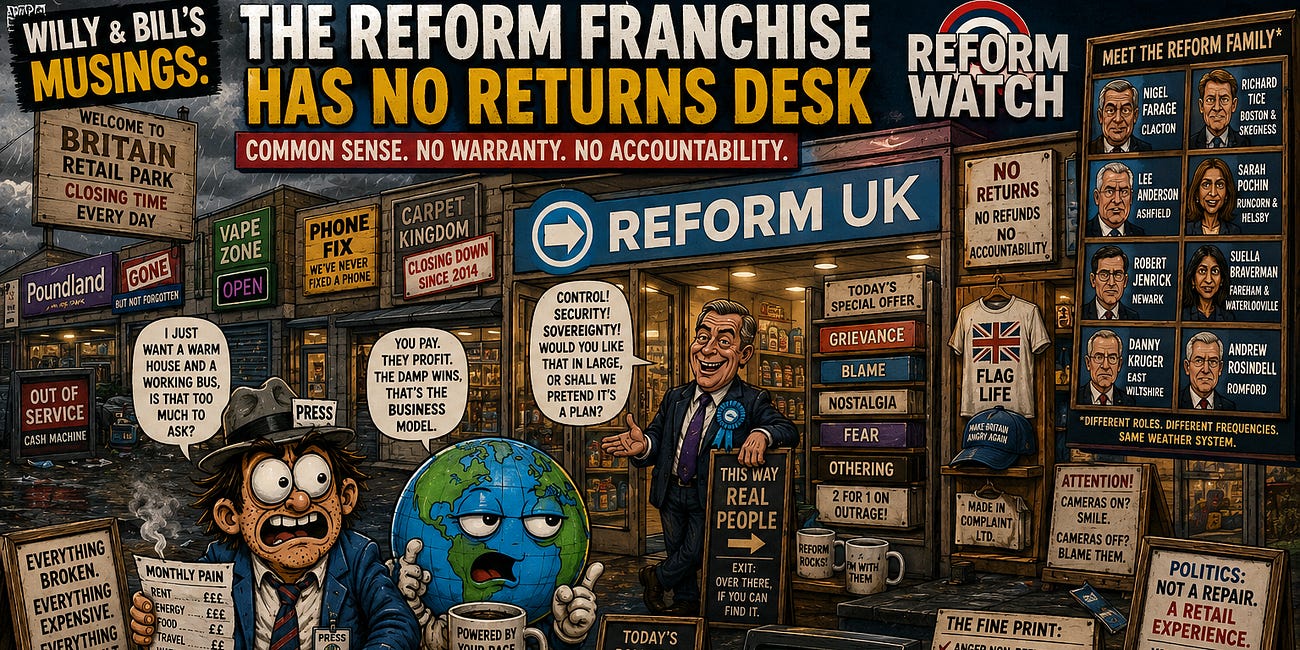
Satirical note: the retail park, grievance shop, tannoy, mystery shopper and broken kettle are comic scenery. This piece is satirical commentary based on a local SPN archive search and public political positioning. The archive figures are attention markers, not allegations of wrongdoing, affiliation, coordination, or secret planning. The joke is aimed a…
Comments
Nothing yet. Say the first thing.
Sign in to join the conversation.