
People ask: what does a positive future look like after the singularity? I try to resist mental capture by extreme ideas of the future, so my default response is to say “the singularity won’t happen”. But let’s say it happens. We hit the recursive self-improvement loop. Cancer gets cured, mosquitos are eradicated, our poodles are uploaded, there’s a techno-plague or two. Some of us live, and then what? What if the computers take over all the computer tasks, such that the world of bits simply falls from the sphere of human interest, and we return to the world of atoms? What if we all devote ourselves to what is and physical and small, to projects that don’t have to scale, once the hyperscalers create the gigavortex? What if we live lives of devotion to what is in front of us?
I recently ate at Cafe Kestrel, which was recommended to me as a “stupidly wonderful” meal and which brought home the power of devotional action.
Two minutes after arriving, I was not convinced. The bathtub-sized dining room was filled with two large parties, making it loud enough that I couldn’t hear my friend Marisa, a foot away from me. We moved to another table. Still too loud. I explained to the server that we were leaving. She said, “oh, want to try the patio out back?”
She led us to a darkened backyard. We were seated at a metal table with metal chairs. It had rained, so everything was damp. We were seated at wet dark tables in some random backyard in Red Hook and we had damp butts. “Your friend who recommended this place,” Marisa asked, “does she hate you?” The bread came, and it was pretty good. 25m in, we got drinks. They were drinks. What is happening? Our server was nonchalant to the point where it was unclear whether she’d worked in a restaurant before. 35m in, she returned. “Here’s some popcorn,” she said, dropping a small plate of salted popcorn on the table and disappearing again. Normal popcorn.
I don’t remember the last time I’ve laughed for three solid minutes. Tears were streaming down our faces. It felt like we had entirely left civilization. It felt like that moment in a psychedelic trip where you ask, “is reality supposed to be like this?” The average restaurant in NYC is, at this point, stupidly optimized, backed by wealthy investors, coated in impeccable branding. Meanwhile, this place was jankier than most pre-adolescent lemonade stands. We wondered whether the whole restaurant was a prank, or if possibly we were about to be murdered. “How funny would it be if the food was amazing?” I said.
And then the first dish showed up, a fried halloumi with bitter spices and honey, fried so you could hear it shatter against your teeth. Sometimes you see a person walking down the street, and you just know they grew up doing ballet. The halloumi was like that: a casual display of studied technique and taste. And also, somehow, a reference to the frozen mozzarella sticks I’d eaten as a lonely youth.
Then the next dish: an asparagus terrine. An arrangement of achingly fresh peas and asparagus, perversely encased in gelatinous animal fat. It felt both healthful and carnal, natural and fussy, and I’d never had a vegetable dish like it. At that point, we were stunned. Another server showed up. “Who are you?” I asked. “What is this place?” She turned out to be the general manager, and a total delight. “Things got off to a rough start,” I told her, “but these are weird and amazing.” “That’s what I like to hear,” she said.
The mains arrived. A burger that, I swear to God, was maybe the best I’ve had on earth. Mountainous, perfectly pink in the middle, swimming in an exceptional sauce. Then a macaroni and cheese that made Marisa remark: “how is it floral?” A fucked up riff on chicken piccata, with date and carrot, thickly seared on the outside but tender all the way through. We were filled with speculation. At some point during the mains, I was like, this place has to be a husband and wife duo. Something about it felt like an artwork by sexually satisfied people with nothing to prove. Marisa started wondering if they had their own supply chain, because “the food tastes too good for New York.”
Everything had an irreducible sense of absurdity to it—we were eating particular whims, rendered flawlessly by chef Dennis Spina.
The general manager showed up to refill our drinks. “Are we still weird and amazing?” she asked, which we took as an opportunity to question her. Marisa was right, I was half-right: they do have their own supply chain, and the restaurant was opened by formerly married people.
“So the service is a bit… informal,” I said. I couldn’t help myself. “Yeah,” she nodded, “We keep it casual. We just figure the food speaks for itself.” We realized that, as we’d been eating, they’d set up the whole back patio for us. We found ourselves surrounded by candles and tablecloths, even though we were the only diners. So while our welcome wasn’t ass-kissy, we were cared for. “We love you?” I said to the GM, at one point.
I’ll eat at Cafe Kestrel again many times if I get the chance. It’s a tier of cooking I would describe as, “I’ve had food as good as this, but not better.” Still, I’m a little sad that I’ll never again experience going in a 90-minute swerve from “I’m about to leave” to “this is unforgettable.”
You will get a sudden plate of popcorn. Your wine will be served in a clunky chalice. The burger will come with a pickled pepper under the bun, leaving a soggy dent in the soft bread, for some fucking reason. You will experience food by people who have religious attention to their particular vision, with zero regard for ironing out the wrinkles.
I left wanting to look at my life afresh. Have I made unnecessary concessions, filing off my rough edges in order to accommodate the boring? Cafe Kestrel has not. And it was my utopia that night. I’d recommend going, but I have no guarantees if you do. It just doesn’t give off uniformity vibes. You might wait seven hours. They might announce that the restaurant is now for dogs. If they did that to me, I’d forgive them and wish them every happiness. I’ve never eaten at a restaurant that renewed my sense of innocence.
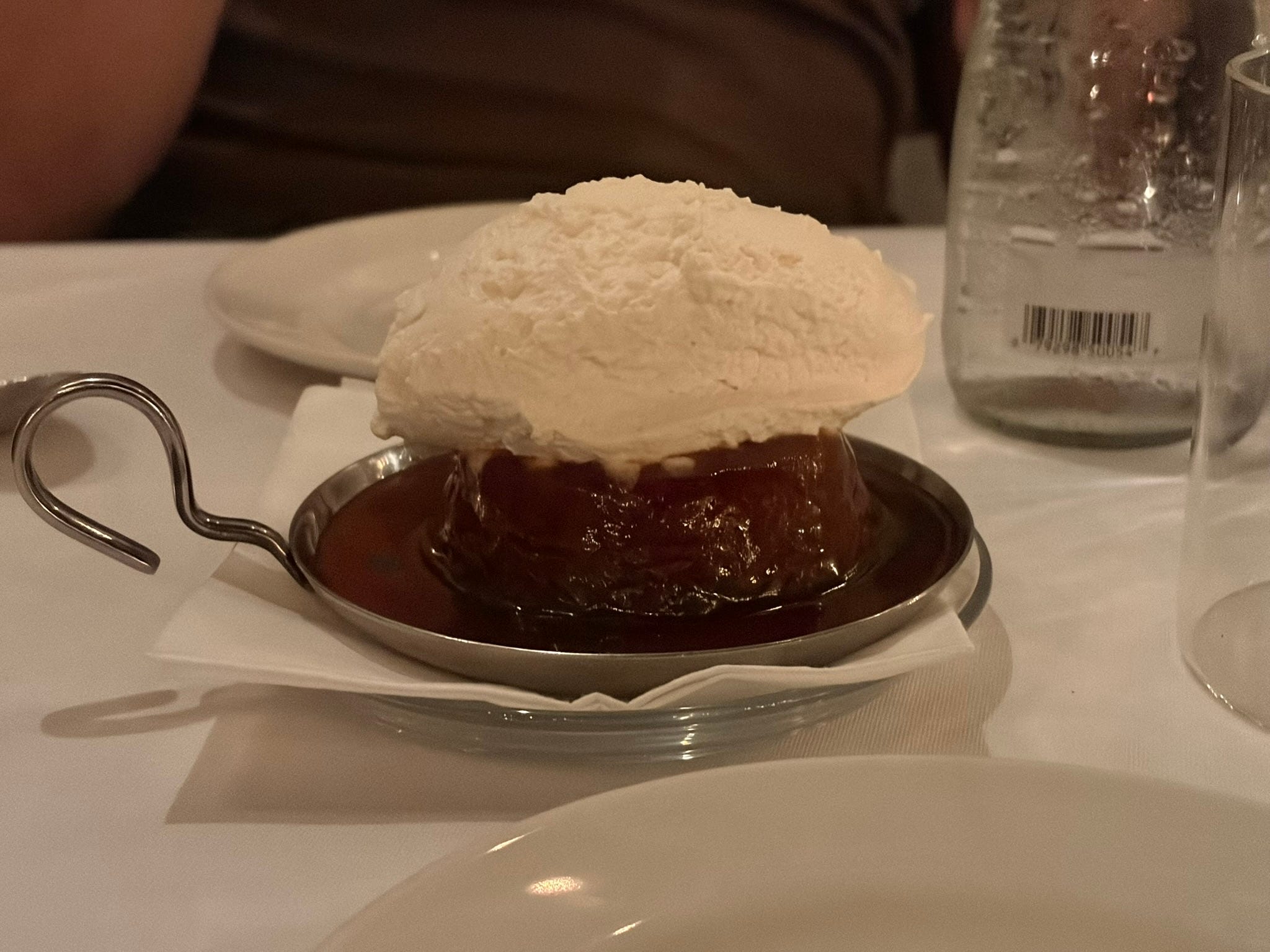
Here’s a photo of the final dish, an apricot cake. “The cream to cake ratio…” I said. “…is perfect,” Marisa said, reading my mind.
No posts
Comments
Nothing yet. Say the first thing.
Sign in to join the conversation.